
The stereotype about community programs “not caring about research” is outdated—and often flat-out wrong.
Let me tell you what really happens behind those closed-door rank meetings: more and more community programs quietly light up when they see research-heavy applicants, even if their websites say “research not required” and their residents swear “no one here cares about publications.”
They care. Many of them a lot. They just do not advertise it.
You’re about to see why.
The Myth: “Community = Zero Research”
Every year, I hear the same line from applicants: “I’m not competitive for university programs, so I’ll just apply to community programs; they don’t care about research.”
You’re basing your entire strategy on a half-truth.
Here’s what people miss. There are actually three rough “tiers” of community programs when it comes to research:
| Program Type | Research Culture | Hidden Preference for Research-Heavy Applicants |
|---|---|---|
| Pure community, no affiliation | Minimal | Low to Moderate |
| Community with university affiliation | Growing/Moderate | High |
| Community aiming for academic status | Aggressive/Expanding | Very High |
What you think of as “community” is often a hybrid: community-based programs that are trying to look more academic, win better fellowship placements, or position themselves for future expansion. That shift changes who they want to recruit.
I’ve sat in rank list meetings where a PD at a “sleepy” community internal medicine program said, about a candidate with several publications: “We need more applicants like this if we want to get our residents into cards and GI.”
Translation: research output = currency for fellowship outcomes, which = better recruitment next cycle, which = program prestige. That equation has penetrated way deeper into community settings than most students realize.
The Real Drivers: Why Your Research Suddenly Matters
1. Fellowship Outcomes: The Quiet Arms Race
Community PDs will never say this on a website, but they are absolutely keeping informal score: “Where do our residents match for fellowship compared with the hospital across town?”
Better fellowship lists = more competitive applicants = more leverage with hospital leadership.
And what do competitive fellowships want? Applicants who look academic. Which usually means:
- Some form of research or QI
- Abstracts, posters, or at least a manuscript in motion
- Evidence that you can generate or interpret data, not just follow orders
So when a community PD sees an applicant who already behaves like a future fellowship applicant—multiple posters, maybe a PubMed entry or two—they know this person will likely:
- Push for projects during residency
- Show up at regional or national conferences
- Make the fellowship match list look stronger
I remember a PD at a community IM program (suburban Midwest, 12 residents per year) bluntly saying in our selection committee meeting: “Our residents keep getting blocked from cards at [Big University]. We start interviewing only workhorse clinicians, we’ll never get them there. This guy already has two abstracts and a cardiology mentor. He’s a multiplier.”
They ranked him near the top. Not because they love research philosophically. Because he was a tool to move their fellowship match data.
2. The Hospital Needs Grants—And They Need You
Here’s something almost no applicant appreciates: hospitals, even community ones, get measured by more than RVUs and patient volume. They’re also increasingly pushed to show:
- QI initiatives
- Outcomes data
- Participation in registries or industry-sponsored trials
- Magnet status or similar “excellence” credentials
Who runs those projects? Not the CMO. Not the chief of staff. It’s usually a handful of attendings and whatever residents are willing to grind through data.
So if you walk in with a track record of research, the leadership sees someone who can be plugged directly into:
- An ongoing registry study (“You’ve done REDCap before? Great—come here.”)
- A hospital-wide sepsis or readmission initiative
- The “Research/Scholarship” bullet point on their next ACGME site visit slide deck
You might think your single-author case report in some low-tier journal is nothing. The hospital doesn’t. To them it’s:
- A line item in the “scholarly output” spreadsheet
- Evidence they can present when negotiating with a potential university affiliate
- Another way to justify funding a “research coordinator” or “resident research time”
I’ve seen CMOs lean over to PDs and say during expansion talks: “Can you show me the residents you’ve had with publications?” They’re not reading your paper. They’re counting.
The Hidden Agenda: ACGME, Accreditation, and “Scholarly Activity”
This is the piece students rarely understand because they never see it: ACGME site visits and annual reviews.
On paper, the ACGME language sounds mild: “Residents should participate in scholarly activity.” But programs know very well that zeros across the board in the “publications / presentations / QI projects” section raise red flags.
So community programs do the math. If they want to avoid pain during reviews, they need residents who will produce something. Not everyone. Just enough to point to.
Who looks likely to generate those poster abstracts and QI projects with minimal babysitting? Not the person whose ERAS has zero research, zero QI, zero indication they’ve ever written anything longer than a SOAP note.
The PDs will not say, “We only rank research-heavy applicants.” They won’t. Because:
- They still need solid workhorses
- They don’t want to scare off IMG/DO applicants
- Many of their attendings don’t personally care about research and would rebel if they thought the culture was changing
So what they do instead is this: quietly bump up research-heavy applicants in the rank list.
On the whiteboard, they’ll say: “We want good people, not CVs.” Then, later, someone will say, “Between these two similar candidates, who’s more likely to help with our QI requirements?” And the one with posters mysteriously slides higher.
What Research Signals to Community PDs (It’s Not What You Think)
You think your research says: “I love science.” They’re reading something different.
Here’s what research-heavy applicants signal to community faculty:
You can finish things.
Abstracts and manuscripts are painful. They involve emails, revisions, deadlines. If you finished one, you probably don’t vanish when things get annoying.You can handle bureaucracy.
IRB. Data agreements. Conference submissions. That’s the same muscle you’ll use navigating hospital policies, QI projects, and bothersome administrators.You write better than the average intern.
A resident who can write a decent introduction section can usually also write an acceptable H&P and discharge summary. Less clean-up for attendings.You might be promotable.
Programs love residents who can become chief, stay on as junior faculty, or help justify a new fellowship. Research and scholarship grease that path.
I once heard an APD at a community transitional year program say it out loud: “Applicants who’ve done research usually don’t implode when I ask them to run a small QI project. The ones without any scholarly work? Half never start. The other half vanish halfway through.”
That’s why your “throwaway” medical school projects still carry weight.
Why They Don’t Admit Any of This Publicly
You’re probably wondering: if this is all true, why do so many community programs literally write “research not required” on their websites?
Because they’re playing a double game.
On one hand, they want:
- Reliable, service-oriented residents
- People who won’t complain when the census spikes
- A steady pipeline of mid-tier applicants who will actually say yes
On the other hand, they know they need:
- A subset of residents who raise their academic profile
- Residents who will help with publications, posters, and fellowship outcomes
If they advertise “we value research heavily,” they’ll:
- Scare away decent applicants who have little to no research
- Create resentment among their own staff (“We’re becoming like a university now?”)
- Fail to match, especially if they’re IMG-heavy or smaller markets
So they do what a lot of institutions do: maintain a public narrative (“We’re a clinically focused community program; research is optional”) and a private preference (“Between two equal applicants, we want the one with evidence of scholarship”).
And no, they will not put that in an email to you. But you can hear it in how they talk among themselves.
Who Really Benefits: The Overlooked Research-Heavy Applicant
Here’s where it gets interesting for you.
There’s a whole category of applicant that doesn’t realize they have leverage in the community space:
- You’re not competitive for the top university programs (maybe Step 1 pass on the second attempt, or average Step 2, or a rocky semester in pre-clinicals).
- But you have serious research or at least visible scholarly work: multiple posters, one or two publications, maybe in a niche field.
You tell yourself, “The big-name places won’t touch me; my scores aren’t there. And the small programs don’t care about my research, so I’m kind of nowhere.”
Wrong. You’re exactly the type of applicant some of these community programs quietly covet.
I’ve seen files like this:
- Step 1: pass, Step 2: 226
- Two cardiology posters, one first-author case report
- IMGs or DOs with 3–4 abstracts from a home-country or home-institution research group
And in a mid-tier community program that’s trying to build up its fellowship pipeline, these applicants aren’t “borderline.” They’re moved near the top.
Why? Because they offer something the 260-step-score but zero-research applicants don’t: they look like the future success stories the program can publicize.
The PD doesn’t need 10 of you per class. They need 2–3. Enough to carry the banner.
So if that’s you, stop underselling yourself. In the right community environment, you’re not an afterthought. You’re a strategic hire.
How to Recognize Community Programs That Secretly Want Research People
You can’t always trust websites. You can, however, read between the lines.
Here’s how I spot community programs that quietly favor research-heavy applicants:
They brag about fellowships on the website.
If there’s a long “Recent Fellowship Matches” section listing GI, cards, heme/onc, they care about academic metrics more than they’re admitting.They mention “scholarly activity” with specifics.
Not vague fluff. Things like: “Our residents presented 15 abstracts at [regional/national] conferences last year.”They have a “Research Director,” “Scholarly Activity Director,” or similar title.
Community programs don’t invent those roles unless they’re trying to look more academic to someone.They’re affiliated with a university department.
“Community-based, university-affiliated” is code for: we’re still service-heavy, but we’re under pressure from the mothership to produce data and graduates who win fellowships.Their faculty bios show ongoing projects or publications.
Even a handful of attendings with recent papers or QI projects means there’s a culture to plug into.
Here’s the pattern condensed:
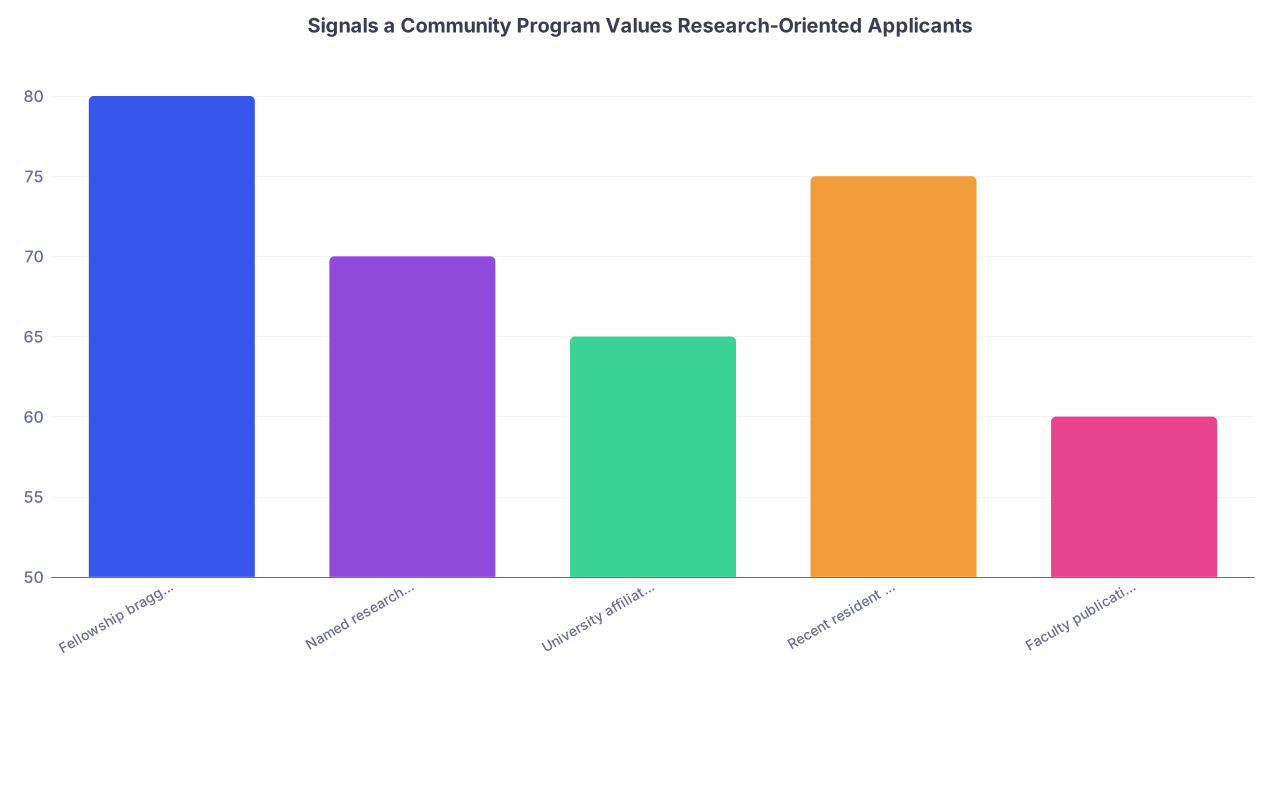
| Category | Value |
|---|---|
| Fellowship bragging | 80 |
| Named research director | 70 |
| University affiliation | 65 |
| Recent resident abstracts | 75 |
| Faculty publications | 60 |
If a program hits 3 or more of those, your research background is a real asset there—no matter what they say out loud.
How to Use Your Research Story Strategically in Applications
Now, here’s where most research-heavy applicants blow it. They mention their projects once in ERAS, paste an abstract into the experience section, and never weaponize it.
The insider move is different: you frame your research not as “look how academic I am,” but as “here’s how I will help your program win.”
This is how you thread that needle in a community setting.
In Your Personal Statement (Yes, It Matters Here)
For a community program that’s trying to grow its scholarly output, you don’t write, “I want to be a physician-scientist at a major academic center” and then apply to a 6-resident community internal medicine program with no fellowships. That just makes you look like you misapplied.
You say things like:
“I’ve found that working on QI and outcomes projects makes me a better clinician, and I’m excited to continue that kind of work in residency, especially projects that directly improve patient care on the wards.”
“In medical school I helped design a small retrospective study on COPD readmissions; I’d like to work on similar data-driven projects that matter to a community hospital population.”
Notice the key shift: you tie your research muscle to their world—readmissions, length of stay, sepsis bundles, not basic-science bench work that has nothing to do with their hospital.
In Interviews
When community PDs ask, “Tell me about your research,” what they are really asking is: “Are you a prima donna academic who’s going to hate our workload, or can your skills actually help us?”
You answer the hidden question. Example:
“I enjoyed my research because it forced me to think in a system-level way—how protocols, documentation, and small changes can alter outcomes. I don’t need protected lab time, but I’d really like to work on at least one QI or outcomes project that aligns with the hospital’s priorities. That’s the kind of research that directly complements busy clinical work.”
You just told them:
- You’re not expecting a cushy academic lifestyle
- You’re willing to integrate projects into service
- You’re thinking in terms of their metrics, not your ego
That lands very differently in a community conference room.
One More Truth: Research Heavy ≠ Safe From Red Flags
Let me balance this with a reality that applicants sometimes ignore.
Research will not erase:
- Unprofessionalism
- Bad interviews
- Toxic letters
- Multiple failures without honest reflection
I’ve seen PDs say, “Impressive CV. But something feels off,” and drop a research-beast applicant way down the list. Community programs still need residents who show up, work hard, and don’t burn the place down.
What research can do in many community settings is:
- Get you the interview when your scores are average
- Anchor you higher on the rank list when you interview reasonably well
- Make the PD go to bat for you in the room: “I really want this one; they’ll help us with our scholarly activity and fellowships”
But it doesn’t give you immunity. It gives you leverage. There’s a difference.

| Step | Description |
|---|---|
| Step 1 | Application Received |
| Step 2 | Evaluate as Pure Clinician |
| Step 3 | Flag as Potential Academic Asset |
| Step 4 | Neutral Impact |
| Step 5 | Higher Interest & Priority |
| Step 6 | Interview Invite & Targeted Questions |
| Step 7 | Any Research or QI? |
| Step 8 | Program Values Fellowship/Scholarly Growth? |

Quick Reality Check: Is Your Research “Enough” for This to Matter?
Applicants obsess over whether their research is “good enough” to count. From a community program’s perspective, the bar is lower than you think.
Here’s roughly how they see it:
| Research Profile | Community PD Reaction |
|---|---|
| 0 research, 0 QI | Neutral to slightly negative |
| 1 QI project, no posters | Mild positive |
| 1–2 posters, no publications | Clear positive |
| 1+ publication (any impact factor) | Strong positive |
| Multiple pubs + clear academic career goals | Very strong positive, with “flight risk” |
Even a single decent poster or a substantive QI project moves you above the pure zero column.
If you’ve got more than that, stop acting like it only matters at Harvard and Hopkins. The right community program will value it more than you think.

FAQs
1. If a community program says “research not required,” should I still highlight mine?
Yes. You should absolutely highlight it—but frame it correctly. Emphasize how your research experience makes you better at QI, data-driven care, and improving systems in a busy hospital, not how you’re dreaming of an R01 at an Ivy. You’re showing them you’re a useful tool, not a misfit academic.
2. Will community programs think I’m not serious about clinical work if I have heavy research?
Some will worry—if you present yourself poorly. That’s on you. Make it explicit in your statement and interviews that you enjoy clinical work, that you understand community programs are service-heavy, and that you see scholarship as a complement, not a substitute, for taking care of patients. Spell it out. Do not make them guess.
3. I have no publications but several QI and small retrospective projects. Does that still help?
Yes. For many community programs, QI projects are actually more attractive than obscure bench work. If you can talk concretely about how you reduced readmissions, improved documentation, or changed a local process, that hits exactly the metrics their hospital leadership cares about. Package that experience well and it absolutely moves the needle.
The bottom line:
- Many community programs quietly prefer research-heavy applicants because they’re chasing better fellowships, safer ACGME reviews, and institutional prestige.
- Your research becomes a weapon when you frame it as fuel for their goals—QI, outcomes, and fellowship success—not just your ego.
- Stop assuming “community = no research.” In the right program, your posters and papers are exactly why they move your name up that rank list.