The mythology around research and chief/fellowship selection is wildly overstated—and also dangerously understated. Both. At the same time.
Let me spell out what really happens behind closed doors when program directors and division chiefs decide who becomes chief resident and who gets the best fellowship spots.
They are not counting PubMed IDs. They are reading between the lines of your “research story” to answer a very different question:
“Can I trust this person with my program’s reputation?”
That’s the real game. Research is just one of the clearest, most objective ways they think they can answer it.
How chiefs are actually chosen: what’s said vs what’s done
Most programs will tell you the party line about chief selection: “We look for leadership, teaching, professionalism, and teamwork.” All true. But that’s not all.
Behind the scenes, the conversation sounds more like:
- “Who can we put in front of applicants and not worry?”
- “Who will answer emails, finish schedules, and not melt down under pressure?”
- “Who already acts like junior faculty?”
Research sneaks into this equation in ways that are not always explicit.
At an upper-mid-tier academic IM program, I’ve seen the chief selection meeting. They had four short-listed PGY-2s. On the whiteboard: their names, informal “grades” for clinical work, teaching, professionalism, and yes—academic productivity.
Here’s the truth:
- Nobody became chief because they had 10 publications.
- But borderline candidates absolutely lost ground because they had zero meaningful scholarly work in an academic program that prides itself on scholarship.
One associate program director said it flatly: “If we’re trying to sell ourselves as an academic place, I can’t have a chief with no research or QI. It looks bad to fellowship PDs.”
That’s the key. Chiefs are marketing material. To med students. To incoming residents. To fellowship PDs. Your “CV story”—with research as a cornerstone—signals whether you fit the program’s brand.
When research matters a lot for chief
Research becomes a real differentiator in a few situations:
Academic programs that sell themselves on scholarship
Think places like BIDMC, Michigan, Emory, UCSF-affiliated community sites. They don’t need you to be an R01 machine, but they expect their chiefs to present at regional/national meetings, publish a few case reports, maybe a QI paper.
If you’re up against someone equally strong clinically and your research record is “poster at local hospital day” vs their “first-author ACP or ATS abstract,” you’re at a disadvantage.When leadership potential is similar across candidates
On paper: everyone is “outstanding clinician, loved by juniors, strong evaluations.” The tie-breakers become things like:- Who’s done a project from idea → IRB → data → poster?
- Who showed initiative by starting something instead of just joining the mandatory residency QI project?
That completion arc is exactly what PDs want in a chief when they hand you complex tasks like redoing the schedule system or launching a new rotation.
Programs hungry for visibility
Mid-tier programs trying to punch above their weight rely on chiefs to produce visible work: posters, workshops, MedEd projects. If you already have a track record of getting abstracts accepted, they’ll trust you to do it as chief.
Now the flip side.
When research is almost irrelevant for chief
I’ve seen chiefs chosen with literally zero PubMed entries in:
- Strong community IM programs
- EM programs that care far more about service and shift coverage
- Some surgical and community-based specialties where chiefs are basically schedule managers and morale officers
In these places:
- The PD will pick the resident who never complains, picks up extra shifts, and keeps the wheels from falling off.
- A single paper won’t save you if nurses and co-residents don’t like working with you.
Bottom line on chiefs:
Research rarely crowns you chief. But in academic environments, a complete lack of scholarly work can quietly take you out of serious contention.
Research and fellowship: what PDs actually look at
Now let’s talk about the thing you actually care about: fellowship.
Most residents wildly misjudge this. They either think:
- “If I don’t have 10 papers, I’ll never match cardiology at a good place.”
or - “Research is overrated, it’s all about letters.”
Both are wrong in specific ways.
Here’s how fellowship PDs privately think about research, specialty by specialty.
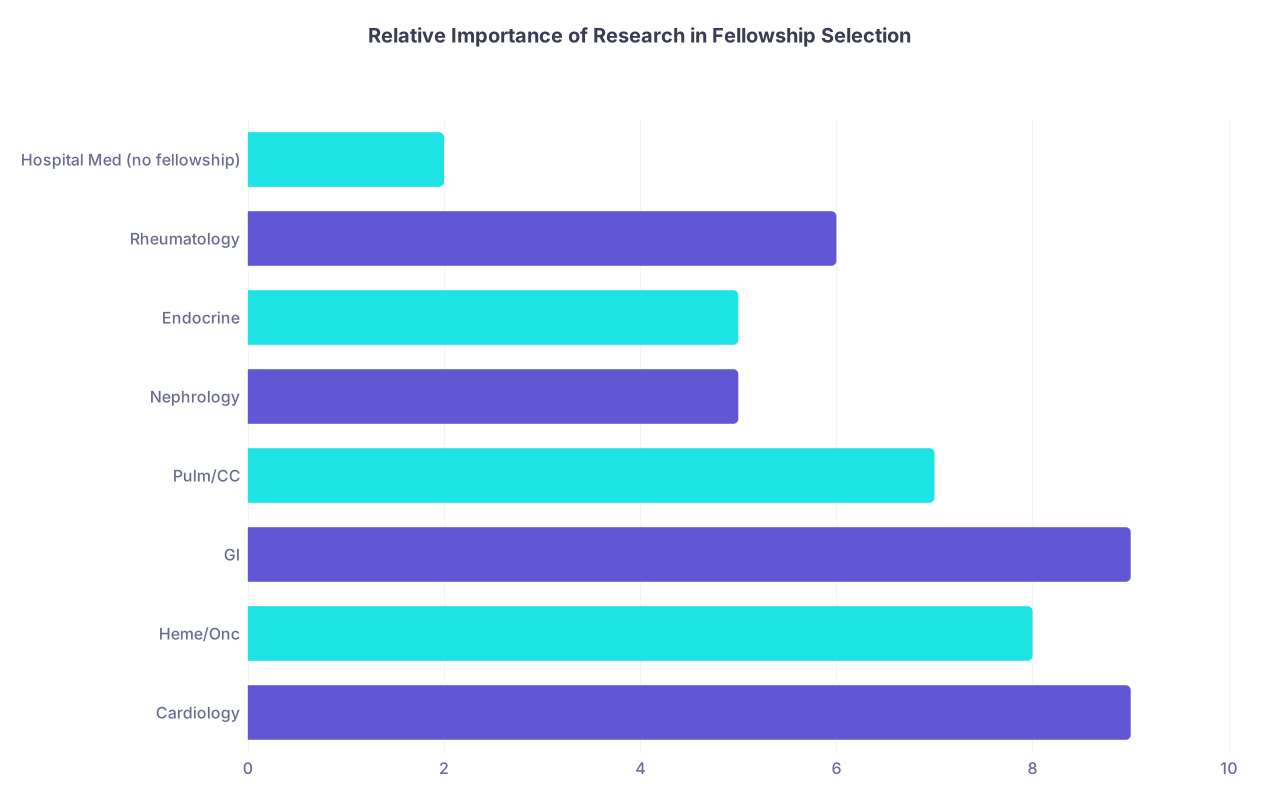
| Category | Value |
|---|---|
| Cardiology | 9 |
| Heme/Onc | 8 |
| GI | 9 |
| Pulm/CC | 7 |
| Nephrology | 5 |
| Endocrine | 5 |
| Rheumatology | 6 |
| Hospital Med (no fellowship) | 2 |
The hidden calculation: “Is this person serious about my field?”
Fellowship PDs are not just asking “Can this person publish?” They’re asking:
- “Is this person genuinely committed to my specialty or just escape-hatching from general IM?”
- “If I bring them here, will they enhance our program’s academic footprint?”
Research is the easiest, clearest evidence of both.
I’ve sat in on fellowship rank meetings where the language is brutally simple:
- “He says he wants cards but has zero cardiovascular anything. Not serious.”
- “She has two ICU QI projects and a critical care abstract – she knows what she’s getting into.”
- “This guy came from a non-academic program but still managed two oncology case reports. Hustled. I like that.”
Notice the pattern: it’s not just about volume. It’s about aligned work that shows you’ve put skin in the game for that field.
How much research you really need by specialty
Let me simplify what most PDs won’t say out loud. This is not perfect, but it’s closer to reality than anything you’ll hear on Reddit.
| Fellowship | Research Needed To Be Competitive (Academic Programs) |
|---|---|
| Cardiology | 2–4 projects, at least 1–2 in cards, abstracts strongly preferred |
| GI | 2–4 projects, GI-focused, regional/national posters very helpful |
| Heme/Onc | 2–3 projects, oncology/hematology related, at least 1 publication/abstract |
| Pulm/CC | 1–3 projects, ICU/respiratory/QI acceptable, some scholarly output |
| Endocrine | 1–2 relevant projects or strong QI, publications nice but not mandatory |
| Rheumatology | 1–2 rheum/immunology/autoimmune-focused projects, case reports common |
| Nephrology | 0–2 projects; research helps but is not usually decisive |
Notice:
- For cards/GI/heme-onc, you’re playing a different game. “No research” is a major handicap at academic places.
- For rheum/endocrine, you can absolutely match with lighter research if other pieces (letters, narrative of interest) are very strong.
- For nephrology and many community-based fellowships, research is a plus, not a gatekeeper.
Where research replaces scores and rank—and where it doesn’t
At competitive sites, research is often the thing that rescues an “average numbers” candidate. I’ve heard versions of this conversation many times:
- “Her Step 2 is 238, but she has three GI abstracts, one DDW poster, and a GI attending writing ‘top 5% I’ve ever worked with.’ She’s in.”
- “He’s got a 260, but literally no cardiology anything and lukewarm letters. There’s no evidence he actually wants this.”
So:
- High scores + no research can still match, but usually at less research-heavy places or community fellowships.
- Modest scores + strong, focused research can push you into much more competitive programs.
The worst profile in the eyes of a serious academic PD?
High scores, zero scholarship, generic “I like procedures” personal statement. Feels hollow. Replaceable. Risky.
The unwritten rules: what selection committees actually infer from your research
Research is not just “output.” It’s character evidence.
Here’s what attendings and PDs quietly infer from a solid research record:
Follow-through.
Anyone can say “I’m interested in research.” Fewer can get through IRB delays, data problems, co-author flakiness, and still push it to a poster or paper. When they see completed projects, they see someone who doesn’t quit when things get boring.Ability to work in a team with faculty.
Every chief and every fellow is effectively junior faculty-in-training. If you’ve navigated working closely with a PI, statistician, or QI director and did not burn the bridge, that’s worth gold. Letters will reflect this even if they don’t use the word “research” once.Academic orientation.
Even if your program is “clinical-heavy,” serious fellowships want people who at least speak the language of academics. One pilot QI paper + one case report tells them you won’t drown when they expect you to do a scholarly project in fellowship.Risk profile.
No projects at all, especially in a research-rich environment, raises a subtle red flag: Did no one want to work with you? Were you lazy? Disorganized? Checked out?
Nobody will put this in writing on your eval, but it’s in the room when they’re comparing you to someone with a similar clinical profile and three posters.
When a weak research record is forgiven
There are exceptions. They’re not random.
You can “get away with” minimal research if:
- Your program has almost no research infrastructure and everyone knows it. PDs calibrate expectations between, say, MGH and a small community program with no IRB office.
- You have monster letters that scream “top 1–3 residents in 10 years,” especially from known faculty in the field.
- You clearly used your non-research time for something equally compelling: major teaching work, curriculum development, advocacy with real outcomes.
But notice the pattern: you’re not just sitting on an empty CV. You’re replacing lack of research with tangible, provable excellence elsewhere.
How research shapes your trajectory, not just the next step
Here’s the part most residents completely miss.
Research doesn’t just get you chief or fellowship. It changes the options on the table during and after those roles.
Think like an insider for a second:
- A PD is picking a chief they might later want to hire as junior faculty.
- A fellowship PD is picking a fellow who might later be their colleague bringing in trials, grants, speaking gigs, or at minimum, quality scholarship that makes their division look good.
If you show up with:
- Multiple well-run projects
- Evidence you can present, write, respond to reviewer comments
- A “lane” (e.g., heart failure, medical education, ICU QI)
You’re the type of person they can imagine:
- Running the residency’s research curriculum as chief.
- Leading multicenter registries or QI collaboratives as a fellow.
- Getting hired on as faculty with built-in academic productivity.
The opposite is just as important.
If you show up as “hardworking, clinically strong, no scholarship,” here’s what happens more often than you think:
- You get steered toward more service-heavy roles.
- You don’t get invited into interesting collaborative projects.
- Your long-term options in academic medicine narrow, sometimes before you realize doors have closed.
So yes, research is about getting the spot. But it’s also about how you’re perceived once you’re there.
The smart way to use research during residency
Let me be very clear: killing yourself for 10 low-impact case reports is dumb. PDs see through volume games. What matters is focus, completion, and story.
Here’s how residents who “get it” structure their research during residency.
PGY-1: Positioning and low-hanging fruit
You’re not publishing NEJM as an intern. Nor should you be trying.
Your goals:
- Get attached to one attending in your target field who’s known to be productive or at least finishes projects.
- Join one project that’s already moving: data collection for an ongoing study, an almost-ready case report, or the residency’s QI project that someone actually cares about.
- Aim for one completed product by the end of PGY-1: local poster, accepted abstract, or submitted paper.
Not glamorous. But it plants your flag.
PGY-2: Build a coherent narrative
This is the crucial year for fellowship and chief positioning.
You should:
- Have at least one project with your name clearly visible (first or second author on a poster or paper).
- Start at least one new project that you can clearly brand as yours: a QI intervention on your ICU, a small retrospective cards project, a MedEd initiative.
- Get your attending mentors to see you as “the [field] resident” and not just “another PGY-2.”
By the end of PGY-2, applying to competitive fellowships, you want:
- 2–3 tangible scholarly products (submitted, accepted, or presented).
- At least one of them clearly related to your intended field.
That’s usually enough to not be “the research black hole” on your application.
PGY-3: Finish instead of thrash
PGY-3 is when people get sloppy. They panic and try to start five new things late.
Bad move.
If you’re aiming for chief or a late fellowship, your main job is to:
- Push earlier projects to publication or presentation.
- Get your name on anything you helped with as it matures.
- Lock down strong, detailed letters that talk about your persistence and ownership in scholarly work.
If you do it right, by graduation, your CV reads like a coherent arc, not a stack of unrelated fluff.
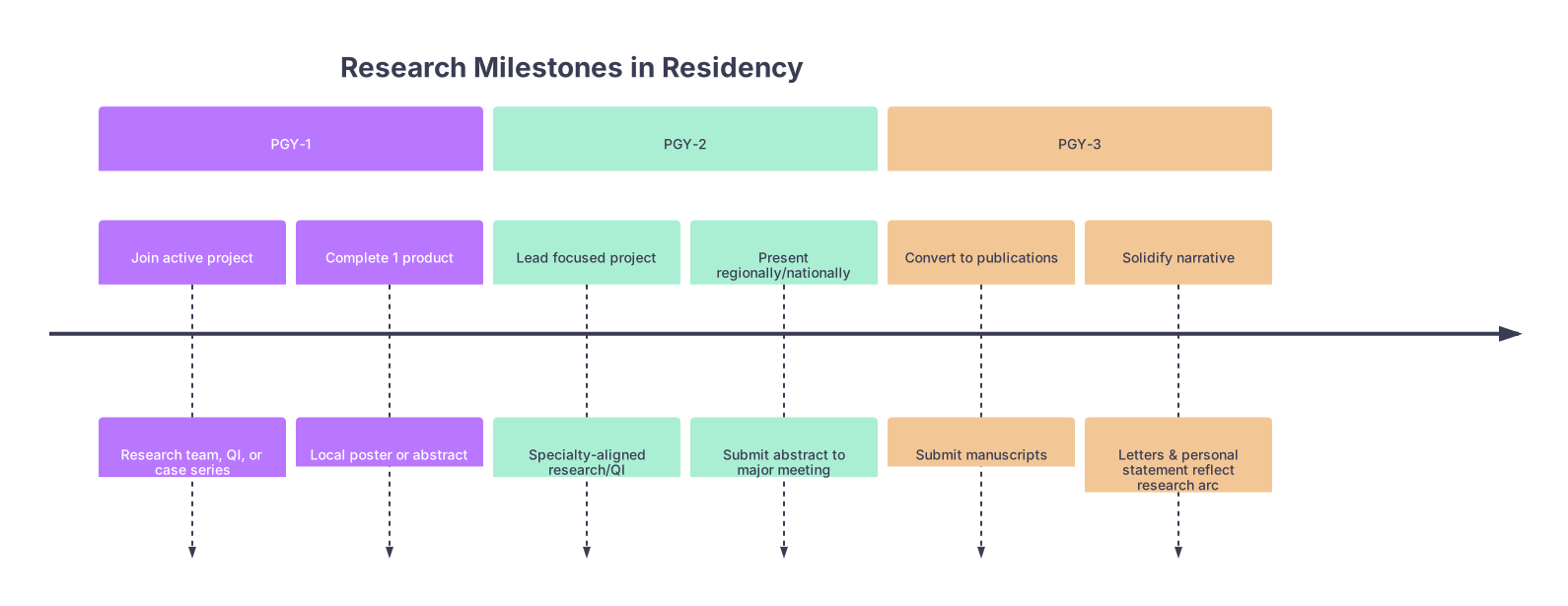
| Period | Event |
|---|---|
| PGY-1 - Join active project | Research team, QI, or case series |
| PGY-1 - Complete 1 product | Local poster or abstract |
| PGY-2 - Lead focused project | Specialty-aligned research/QI |
| PGY-2 - Present regionally/nationally | Submit abstract to major meeting |
| PGY-3 - Convert to publications | Submit manuscripts |
| PGY-3 - Solidify narrative | Letters & personal statement reflect research arc |
Specific scenarios: how research tips the scales
Let me give you a few real-world composites I’ve watched play out.
Scenario 1: Chief selection in an academic IM program
Two PGY-2s under consideration.
- Resident A: Fantastic evaluations, beloved by interns, one QI poster as PGY-1, now co-leading a resident sepsis project that’s getting serious traction.
- Resident B: Same clinical caliber, also well-liked, no research/QI beyond mandatory residency project that never left the PowerPoint stage.
Committee quote:
“We tell applicants we’re serious about QI and scholarship. Resident A embodies that. Resident B is great, but doesn’t really represent that side of us.”
Result: A becomes chief. B doesn’t. Research was not the only factor—but it was the visible difference that aligned with the program’s self-image.
Scenario 2: Cards fellowship, mid-tier academic program
Two candidates:
- Candidate 1: DO from a solid community IM program, 3 cardiology-related case reports, 1 regional ACC poster, strong LOR from the cardiology chief there.
- Candidate 2: MD from well-known academic IM program, Step 2 255, honors in cards rotation, zero cardiology research, generic personal statement.
Behind closed doors:
“Candidate 1 actually did the work to show he lives in this world. Candidate 2 just looks like the standard high-achiever dabbling in whatever is prestigious.”
The DO with hustle and a few targeted projects outranks the “brand name” MD with nothing aligned.
Scenario 3: Rheumatology at a strong academic center
Candidate with:
- One rheum case report, one QI project on outpatient follow-up, both presented at local/regional meetings.
- Otherwise average scores, but a rheum faculty letter calling her “top 5% in curiosity and follow-through.”
Committee reaction:
“She’s not hyper-productive, but she clearly cares and can finish what she starts. We can build on this.”
They don’t need a grant-writer. They need a fellow who’ll complete the required scholarly project and maybe grow into more.
What this means for you—practical translation
Strip away the noise and it comes down to this:
- If you’re in an academic residency and want a competitive fellowship or chief spot, you cannot be the resident with zero scholarship. One to three focused, completed projects beats ten half-finished “ideas.”
- If you’re in a community-heavy residency with limited infrastructure, you’ll get bonus points for anything that crosses the finish line, especially if you hustled to make it happen.
- If you want options in academic medicine long term, you need a research arc that makes sense, not just a few random posters.
Think less about “number of pubs.” Think more about:
“Would my research story convince a skeptical fellowship PD that I’m serious, reliable, and aligned with their field?”
If the answer’s no, you still have time to fix it—if you stop doing what most residents do, which is wait until PGY-3 and then start flailing.
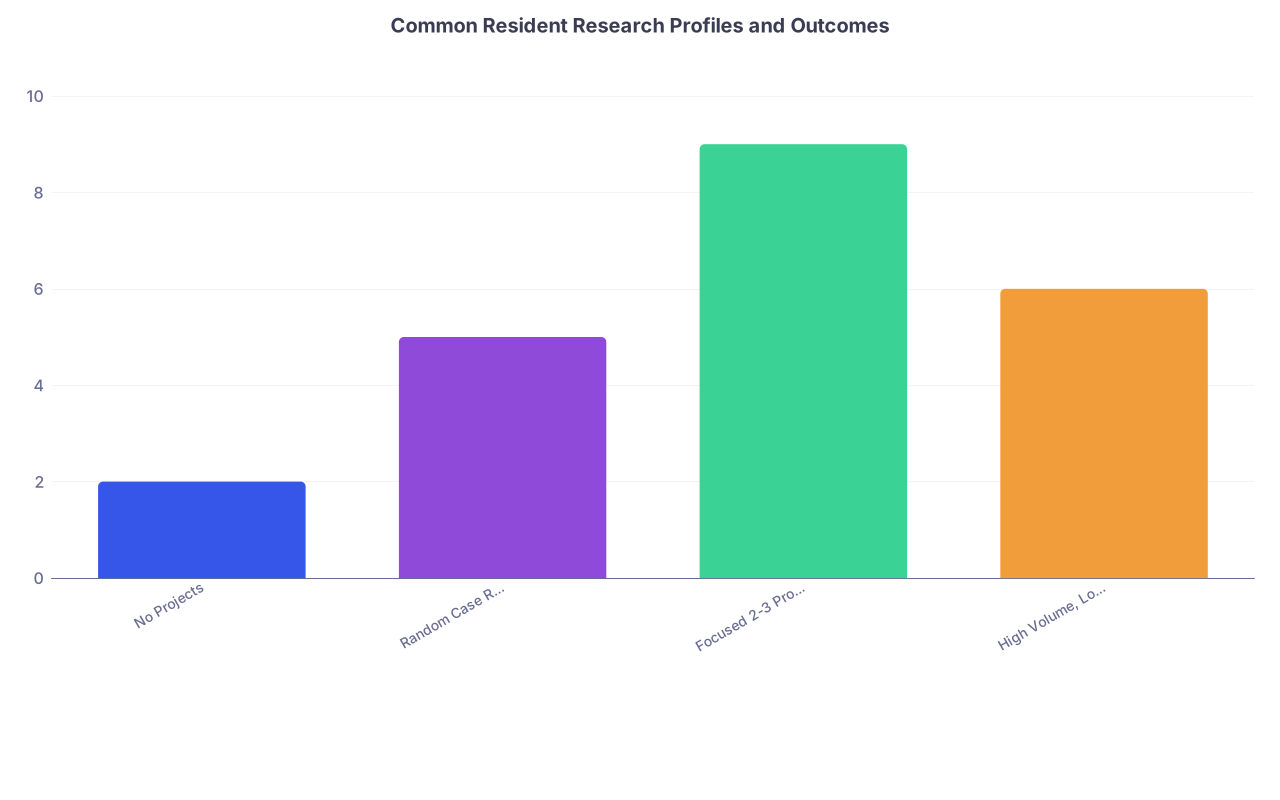
| Category | Value |
|---|---|
| No Projects | 2 |
| Random Case Reports | 5 |
| Focused 2-3 Projects | 9 |
| High Volume, Low Impact | 6 |
(Think of those values as “how much confidence an insider PD feels when they see that profile,” on a 1–10 scale.)
You want to live in the “Focused 2–3 Projects” zone. That’s where chiefs and strong fellowship matches usually come from.
You now know the part nobody explains openly: research isn’t just decoration. It’s character evidence, brand alignment, and a long-term positioning tool.
Use it that way, and your chief and fellowship chances stop feeling like a coin flip and start looking like a deliberate, built outcome.
What comes after that—how to actually turn these roles into an academic or hybrid career you control—that’s the next conversation.