
The worst research on your CV is not “no research.” It is rushed, low‑quality research slapped together right before ERAS — and it can quietly damage your application.
I have watched applicants with “8 pubs” get grilled in interviews and sink, while quieter candidates with 1 solid, real project walked out with pre‑Match offers. The difference was not the number of lines on their CV. It was whether what they listed was credible, coherent, and defensible.
If you are thinking, “I need some quick research to look competitive,” you are standing on a landmine. Let’s go through the mistakes that actually hurt your Match odds and how to avoid them.
The Dangerous Myth: “Any Research Is Better Than No Research”
This is the lie that gets people in trouble.
Students panic when they see charts like this from specialty advising talks:
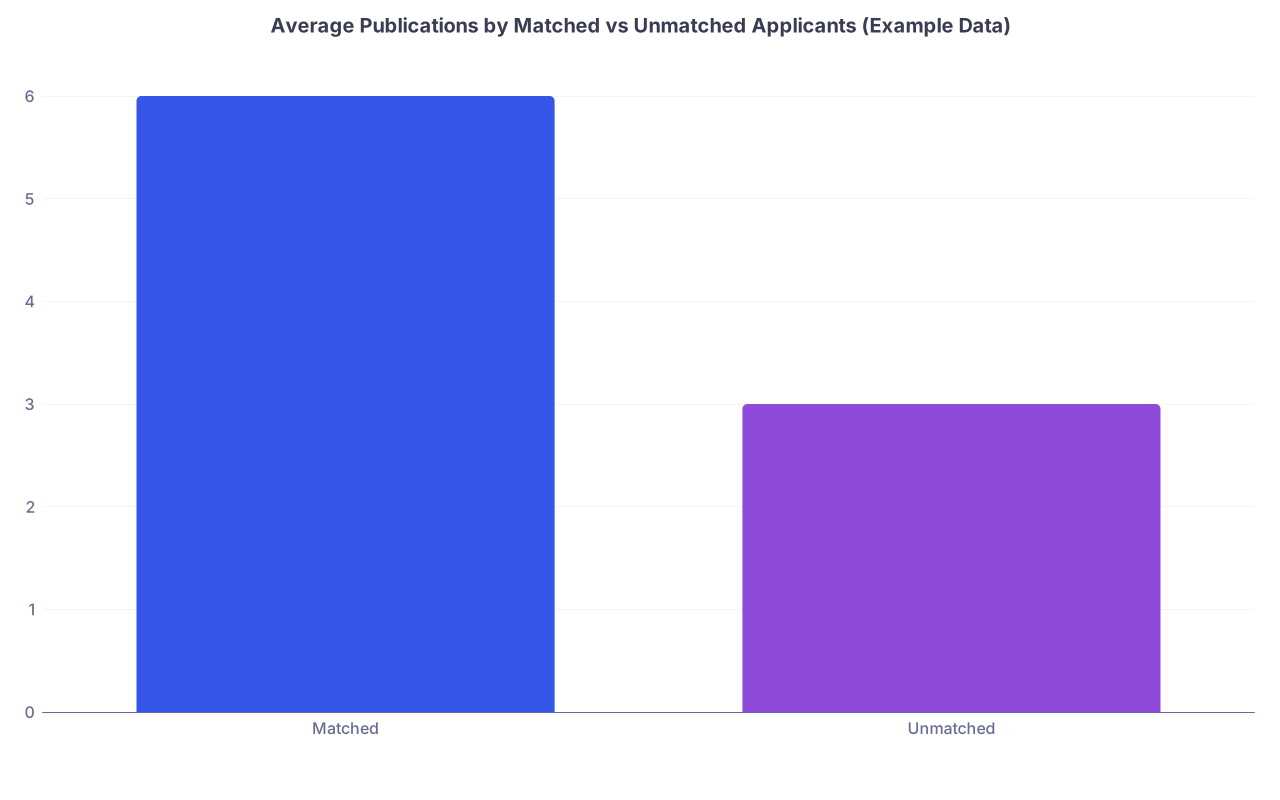
| Category | Value |
|---|---|
| Matched | 6 |
| Unmatched | 3 |
Then the mental shortcut kicks in: “Matched = more pubs. So I just need... more pubs.” That logic is seductive. And wrong.
Selection committees do not reward:
- Incoherent, low‑impact abstracts scattered across random conferences
- “Publications” where your own role is unclear or nonexistent
- Projects so rushed that you cannot explain the methods without contradicting the paper
I have seen program directors literally say in debrief: “Their research does not pass the sniff test.” That applicant is done, regardless of the number in their “total publications” box.
“Any research” is not better than no research when:
- It exposes dishonesty or exaggeration.
- It shows poor judgment (e.g., predatory journals, fake “peer review”).
- It makes you look disorganized or superficial when you try to talk about it.
If you cannot safely answer questions about a project in a 10‑minute grilling by a subspecialist, it is not helping you. It is a liability.
Mistake #1: Rushing a Project Months Before ERAS
The classic pattern goes like this:
January–April of application year:
You realize your CV is thin on research compared to classmates gunning for the same specialty. You panic. You email 20 faculty with some version of:
“I’m very interested in your research and was wondering if you have any ongoing projects I could help with and hopefully publish before applications…”
You get a bite. Maybe a case series, a chart review, or a rushed retrospective study.
You tell yourself: “We can crank this out in a few months. Get at least an abstract. Maybe a submission.”
Here is what actually happens most of the time:
- The IRB takes longer than you expected.
- The data is messy or incomplete.
- The faculty is busy and slow to respond.
- You do not really understand the stats, so the analysis gets patched together.
- You submit to a bottom‑tier or predatory journal “because it’s fast.”
By September, you have something “accepted” or “submitted” that looks like research but falls apart under scrutiny.
Why this hurts you
Rushed projects produce:
- Sloppy methodology you cannot explain clearly
- Weak or inconsistent results that do not make sense
- Low‑credibility venues on your CV that scream “desperate”
Interviewers are very good at spotting a project that was born and buried in the same application year. When they dig in and you stumble, they do not just downgrade the project. They downgrade you.
Here is the part people underestimate: you are basically advertising how you think under pressure. Rushed, corner‑cutting research right before ERAS says two unflattering things:
- You delay planning until you are under the gun.
- Under pressure, you compromise on quality.
That is the opposite of what programs want in a resident.
Mistake #2: Over‑Inflating Your Role (And Getting Caught)
This one is brutal because it is so avoidable.
You join a project late. The main work is already done. You help clean up some data, format references, edit a few paragraphs. Then you or your mentor list you as middle author. Fine.
Where the trouble starts: how you describe it.
I have heard students say in interviews:
- “I designed the study” when they joined after the protocol was written.
- “I did the analysis” when they clicked ‘run’ on a pre‑written SPSS script.
- “I wrote the manuscript” when they edited 10% of the Discussion.
Program directors are not naive. They see “Third author, multicenter RCT, JAMA” from a med student and think: “Interesting. Let’s see what they actually did.”
Then you sit down and they ask:
- “Walk me through how you developed your hypothesis.”
- “Why did you choose that primary outcome?”
- “How did you handle missing data?”
If you cannot answer without exposing that you were essentially a peripheral helper, you look dishonest. Not just inexperienced. Dishonest.
Once an interviewer suspects you are inflating your contribution, they start questioning everything: your personal statement, your “leadership roles,” even your letters.
This is how a seemingly minor exaggeration tanks an otherwise solid application.
Safe rule:
If you cannot:
- Explain the project from idea → design → data → analysis → limitations
- Describe exactly what you personally did in each step
- Defend those choices under pushback
Then do not present yourself as the driving force. Be precise: “I contributed to data collection and helped with early drafts of the results section.”
Honesty paired with a clear understanding of the project is far more impressive than inflated heroics you cannot back up.
Mistake #3: Padding with Predatory or Dubious Journals
Let me be blunt. Listing publications in obviously predatory journals is one of the fastest ways to make serious programs lose interest.
You know the type of outlet I am talking about:
- Journal name sounds grandiose but you have never heard of it
- Accepts your paper in 5 days after “peer review”
- Article processing charges are prominently advertised
- Website looks like a template with endless “special issues”
These journals are not respected. Many program directors know them by name. Some keep internal lists. When they see them on your ERAS, they do not think “Wow, proactive.” They think “This person either does not understand academic standards or is trying to game the system.”

You also get hit with a double penalty:
- The work itself is usually rushed and weak.
- The venue signals poor judgment and low standards.
If your name appears in one decent, field‑appropriate, slow‑to‑publish journal, that is infinitely better than three sketchy “International Journal of Multidisciplinary Advanced Clinical and Surgical Innovations” type entries.
Quick comparison
| Signal Type | Strong, Helpful Signal | Weak or Harmful Signal |
|---|---|---|
| Venue | Recognized specialty journal, mainstream conferences | Unknown / predatory online journals |
| Timeline | Reasonable lag: project → submission → acceptance | Hyper‑fast “peer review” and acceptance |
| Description | Clear, specific role and methods understanding | Vague role, cannot explain statistics |
| Consistency | Work fits your stated interests and specialty | Random topics with no clear theme |
| Depth | Fewer, more substantive projects | Many superficial, low‑impact items |
If you are not sure whether a journal is predatory, assume you will be asked about it by someone who knows more than you do. If that thought makes your stomach drop, do not submit there.
Mistake #4: Listing “In Preparation” / “Submitted” Junk
Everyone is tempted here.
You finish a hasty project in August or September. You submit it somewhere, anywhere, so you can write “submitted” on ERAS. Or worse: you only have a half‑drafted Word file and you list it as “in preparation” to thicken the research section.
You think: “Everyone does it. They know not all of these will get published.”
True. They also know exactly what an “in preparation” graveyard looks like.
Red flags:
- Long lists of “in preparation” manuscripts with no prior track record of completed work
- “Submitted to NEJM” when the project is obviously not NEJM material
- Multiple “under review” items all started the same year you are applying
In interviews, faculty can and will ask:
- “What is the current status of this ‘in preparation’ paper?”
- “Where exactly did you submit this ‘under review’ manuscript?”
- “What feedback did you receive from reviewers?”
You need real answers.
If your “in preparation” piece is little more than a half‑formed idea and an incomplete spreadsheet, you will not survive this line of questioning.
Better approach: List fewer items. Only include “in preparation” when:
- There is a complete draft manuscript
- You could send it to someone that day without major embarrassment
- You can summarize the full paper and your role clearly
Otherwise, you are offering them an easy way to expose your padding.
Mistake #5: Doing Research You Cannot Explain
This is where last‑minute, low‑quality work really destroys people.
You show up interview day in dermatology, radiology, ortho, EM — any moderately competitive field. Faculty flip through your application. They see 5–10 research items. They choose one and say:
“Let’s talk about this project. Explain it to me like I’m a smart intern but not in your field.”
That is a kindness. A lifeline. They are not trying to fail you.
If you then:
- Recite the title but cannot explain the central question in simple terms
- Fumble over the study design (was it retrospective? cross‑sectional? RCT?)
- Mangle basic stats you claimed to perform (“uh, we did a t‑test for the multivariable model… I think”)
- Cannot articulate the main limitations or what you would do differently
You have just shown them that either:
- You did not actually participate in the way your CV suggests, or
- You rush through work without really understanding it
Neither is compatible with being a competent resident.
This is why “low‑quality” is more dangerous than “no research.” With no research, programs may question your interest in academics, depending on the specialty. With misleading, shallow research that you cannot explain, they question your honesty, work ethic, and maturity.
That is a different category of problem.
Smarter Moves: What To Do Instead Of Rushing Bad Research
Let me be clear: some of you are already late. You are MS3 in spring, or early MS4, realizing you are behind. Fine. The solution is not to panic‑produce garbage.
Here is how to avoid blowing yourself up.
1. Prioritize depth over decoration
If you only have time for one project, make it:
- Clearly related to your intended specialty or a plausible interest
- Methodologically simple enough that you can fully own it (case report, small series, well‑defined chart review)
- Something you can walk through confidently from start to finish
One well‑done case report you can defend is more valuable than three incoherent “database studies” that you do not understand.
2. Be brutally honest on your CV
Your role should match reality:
- “Assisted with data collection and literature review” is perfectly respectable.
- “Co‑first author, led study design and analysis” is not, if you did not.
If a project is early or incomplete, you can still discuss it in your personal statement or interviews as “ongoing scholarly interests,” without inflating its status.
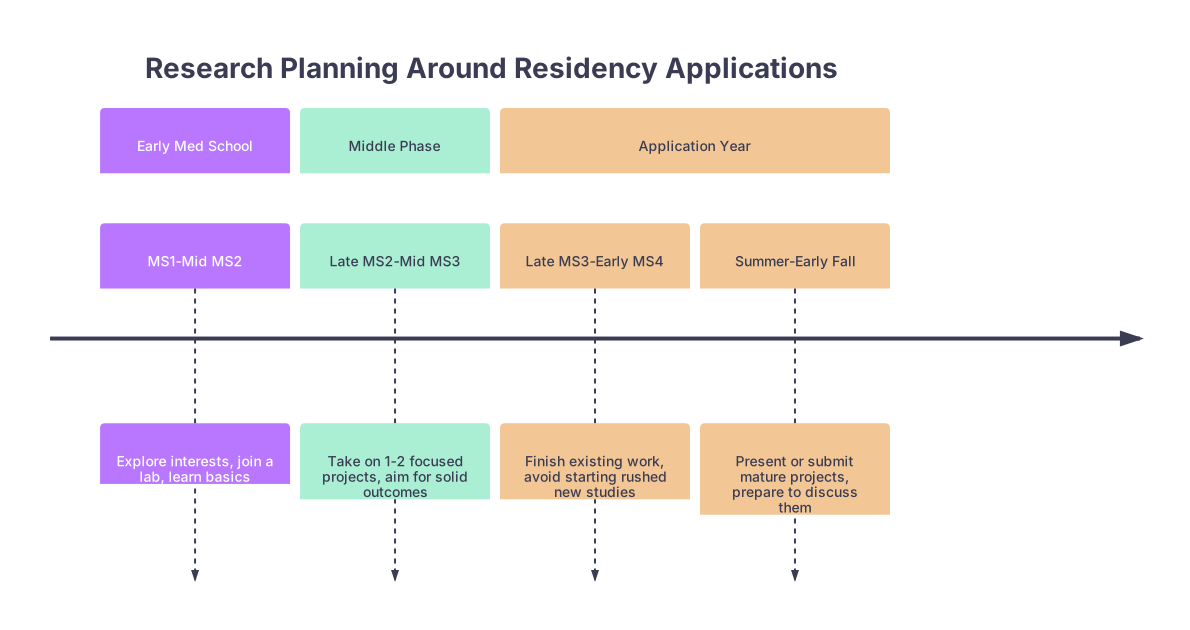
| Period | Event |
|---|---|
| Early Med School - MS1-Mid MS2 | Explore interests, join a lab, learn basics |
| Middle Phase - Late MS2-Mid MS3 | Take on 1-2 focused projects, aim for solid outcomes |
| Application Year - Late MS3-Early MS4 | Finish existing work, avoid starting rushed new studies |
| Application Year - Summer-Early Fall | Present or submit mature projects, prepare to discuss them |
3. Use late‑stage opportunities wisely
If you are already close to ERAS, safer options include:
- Joining an existing project where your role is clearly defined and limited (e.g., data abstraction) and not over‑selling it on your CV.
- Doing a straightforward, teachable‑moment type project (e.g., QI with clear before/after outcome) that you can thoroughly explain.
- Focusing on turning previous incomplete work into one solid presentation or poster instead of chasing “publications” at all costs.
And if you really have nothing?
You focus on the rest of your application: grades, letters, personal statement, away rotations, interview skills. A clean, honest, research‑light application is far less damaging than a padded, suspicious one.
How Programs Actually Read Your Research Section
You need to understand how your research gets processed on the other side.
Most faculty reviewers skim first:
- Volume: “One project vs ten. Fine.”
- Pattern: “Do these topics make sense for this person?”
- Venue: “Are these real outlets or nonsense?”
On interview day, they drill down on:
- A project that matches their own interests
- The most impressive‑looking item by venue or design
- Any big claim (“multicenter RCT,” “systematic review,” “machine learning model,” etc.)
They use your answers to gauge:
- Intellectual honesty
- Depth of understanding
- Curiosity and teachability
- How you handle being pressed on details
Last‑minute, low‑quality research exposes you at exactly this pressure point. It hands them a weak structure and invites them to push on it.
When it collapses, they do not blame the project. They blame your judgment in presenting it.
Red Flags You Should Treat As Stop Signs
If any of these are true about a potential project, treat it as a warning, not an opportunity:
- The primary attraction is “fast publication” or “we can probably get this accepted by September.”
- The mentor suggests a journal you have never heard of and cannot justify beyond “they accept quickly.”
- You cannot, in plain language, describe the central question and how the design will answer it.
- You are being added as an author late with no clear role except “helping out.”
- You already know you will not have time to learn the methods properly.
Walk away or scale back. Your future self on interview day will thank you.
FAQs
1. Is it ever OK to have no research when applying to residency?
Yes. For many specialties (family medicine, psychiatry, some internal medicine programs) a strong clinical record, good letters, and clear commitment can outweigh a thin research section. No research is far safer than padding your application with work you cannot explain or low‑credibility publications. If you lack research, own it and emphasize other strengths instead of scrambling into bad projects.
2. Should I leave off weak or rushed projects that still technically “count” as research?
If a project is so weak that you cannot confidently explain the question, design, your role, and the main limitations to a skeptical faculty member, it is safer to omit it or describe it more modestly (e.g., as “participation in data collection” rather than a full “publication”). Every line you add invites scrutiny. Only include what you can defend comfortably.
3. What if I already have a predatory or low‑quality publication on my CV?
Do not panic, but do not double down. Leave it on if it is truly your only work and you can explain the project well. Be prepared, if asked, to focus on what you learned from the process rather than the prestige of the journal. Going forward, avoid similar venues and prioritize higher‑quality, slower, and more transparent projects. A single questionable paper is survivable; a pattern is not.
Two things to remember:
- Rushed, low‑quality research can hurt you more than no research at all by exposing dishonesty, poor judgment, or shallow understanding.
- You are better off with fewer, cleaner, fully defensible projects than a cluttered CV of flimsy work you cannot explain.