
Most program directors can spot token research in under 15 seconds. And they do not respect it.
Let me be blunt: the little retrospective chart review you slapped together for two weeks, added eight authors to, and never submitted anywhere? The thing you’re planning to defend with, “It was a great learning experience”? They’ve seen that exact script a hundred times this season alone.
You think of it as “I need something in the research section.”
They think of it as “This applicant treats research like a checkbox. Pass.”
I’m going to walk you through how program directors, selection committees, and research-heavy attendings actually read your “research” section, what instantly screams “token,” and what still works even if you started late and don’t have a first-author NEJM paper.
Let’s pull back the curtain.
How Research Really Gets Read on Application Review
On committees, research is not read like an academic CV. It’s read like a character test.
Faculty are skimming fast. Here’s roughly what happens on a real review screen:
- Click “Experiences”
- Eyes jump to “Research”–titled entries
- Scan: project title → your role → duration → outcome (poster, paper, nothing)
- Two-second mental sort:
- Serious
- Light but real
- Pure fluff/token
If you’re at a mid-tier community IM program, research might be a minor plus.
If you’re at UCSF medicine, MGH radiology, or any top 50 academic program, research is a sorting tool.
They’re asking themselves:
- Does this person actually know how scholarship works?
- Are they the type who follows through or the type who bails when it’s not convenient?
- Are they going to help our program publish, or are they dead weight?
Nobody says that out loud in the brochure. But those are the thoughts in the room.
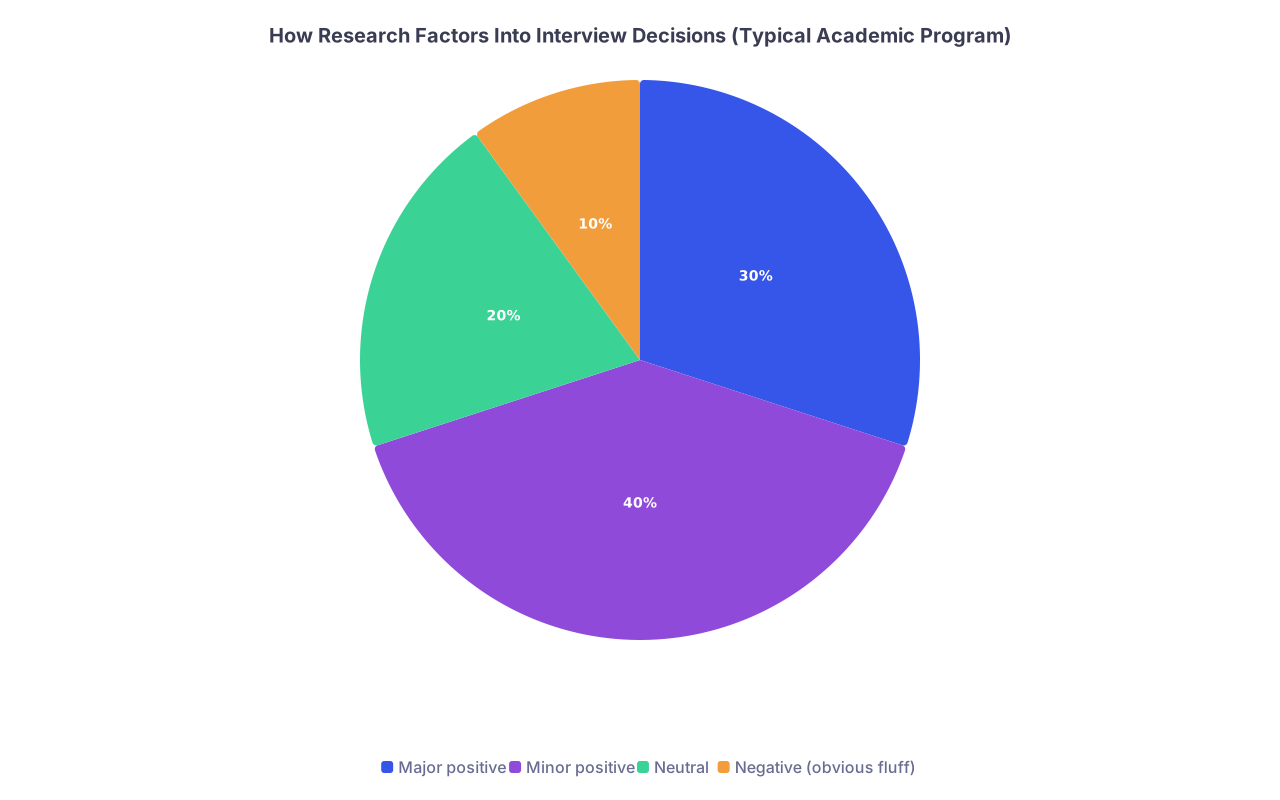
| Category | Value |
|---|---|
| Major positive | 30 |
| Minor positive | 40 |
| Neutral | 20 |
| Negative (obvious fluff) | 10 |
That bottom 10%—the “negative” slice—is students hurt by exactly what you’re asking about: token projects.
What Program Directors Call “Token” Research (Behind Closed Doors)
A “token” research project isn’t defined by topic or journal. It’s defined by pattern. I’ve sat in meetings where PDs and faculty say this out loud:
“This reads like they needed something on their CV.”
“This is classic ERAS fluff.”
“They ‘participated’ in three things and nothing ever finished.”
You want to know the red flags? Here they are.
1. The Generic, Overcrowded Chart Review
This is the archetype. You’ll see entries like:
“Retrospective chart review of outcomes in patients with [common condition] at [institution]. Assisted with data collection.”
Translation to faculty: someone added you to a giant group project, you clicked through Epic for a while, then disappeared. You learned nothing, contributed little, and the project may never see daylight.
By the way, “data collection” only is the lowest-credibility role. Everyone knows it’s the easiest thing to hand to a medical student who showed up late to the party.
2. One-Month “Research” Blocks With No Output
If your timeline says:
- 08/2023–09/2023: “Research elective with Dr. X. Assisted with project Y.”
- No poster, no abstract, no local presentation, no “in preparation” manuscript with details…
Most PDs assume that block was a vacation with a nicer name.
Shorter than 3–4 months continuous involvement with no tangible product? It reads as “I tried to pad my CV and then stopped when it got hard.”
3. Laundry List of Micro-Projects
This one is everywhere:
- “Helped design survey for resident wellness project”
- “Collected data on clinic no-show rates”
- “Assisted with IRB submission for quality improvement initiative”
On their own, these can be real contributions. But when they appear as three separate “research experiences” each spanning 1–2 months without any abstract/presentation, the story writes itself:
This person walked through other people’s projects, touched nothing deeply, and bailed before impact.
Committees look for depth. Serial dabbling is a red flag.
4. The Vague “Manuscript in Preparation” With No Details
Everyone on the committee knows the game: “in preparation” often means “we talked about maybe writing something someday if we have time.”
The smart programs have a sub-rule:
If it says “in preparation” with no journal target, no stage (data analysis vs drafting vs submitted), and no clear senior author? It might as well not exist.
I’ve seen PDs scroll right past those lines like they’re invisible.
5. Projects That Magically Start and End Around ERAS Season
This is where timestamps betray you.
- Started: 06/2025
- ERAS submitted: 09/2025
- “Ongoing, manuscript in preparation.”
To faculty, that’s not commitment. That’s panic.
They’ve all seen the student who realizes in May of M3, “Oh, I need research to apply to derm,” then runs around asking to be “put on a project.” You do not want to look like that person.
How Programs Actually Categorize Your Research
Let me give you the internal taxonomy committees use. Because it exists, even if nobody wrote it down.
| Category | How It’s Perceived |
|---|---|
| High-impact, first-author | Strong signal of excellence |
| Mid-level, clear contribution | Solid plus, reliable follow-through |
| Low-yield but honest | Neutral to minor plus |
| Token/fluff, obviously padded | Neutral to negative |
| None, but consistent story | Neutral (varies by specialty/program) |
The key point: fake-looking research is often worse than none.
A PD at a big-name IM program once said in committee, about an applicant with nothing scholarly:
“At least they didn’t pretend. I’d take this over three BS posters.”
And he meant it.
How “Token” Research Hurts You During Interviews
The real damage shows up on interview day. Because that’s when you have to talk about this stuff.
Two common scenarios.
Scenario 1: The Shallow Project You Can’t Explain
Faculty question:
“Tell me about your research on COPD readmissions. What was your hypothesis?”
Applicant:
“Uh, we were looking at which factors… um… affected readmissions, like social factors and… uh… I helped with the data collection…”
Follow-up: “How did you decide on your statistical model?”
Blank stare.
In that moment, the silent judgment is brutal:
“CV padding. This person never knew what that project was about.”
That’s when token research shifts from “harmless filler” to an active negative.
Scenario 2: They Ask Why Nothing Ever Finished
Faculty:
“I see you’ve been involved in three different projects. Did any of them lead to publications or presentations?”
If all you have is:
- “We’re still working on the manuscript.”
- “It’s in preparation.”
- “Covid delayed things.”
You can feel the room cool.
They’re not mad you do not have a Nature Medicine paper. They’re annoyed you touched three things and never saw one through to a visible endpoint. That screams poor follow-through.
What Program Directors Actually Respect (Even If It’s Modest)
Here’s the part students don’t believe until they see it from the inside: faculty care far more about trajectory and ownership than the impact factor of the journal.
I’ve seen a modest, well-owned project beat a fancier token entry over and over again.
They like:
- One or two projects you can explain in detail, start to finish
- Anything that made it to the outside world: poster, abstract, local talk, grand rounds
- Clear, credible roles: “did the analysis,” “wrote the draft,” “presented as first author”
Let’s break the “good enough” buckets down.
1. The Honest, Single Modest Project
Example:
- “Prospective QI project on reducing ED length of stay for chest pain patients at our county hospital. I helped design the intervention and collected data. We presented a poster at our regional ACP meeting; manuscript currently drafted and being revised with my mentor.”
If you can talk through:
- Why the problem mattered
- What you actually did week to week
- What changed (even small)
- What you learned about process, statistics, or teamwork
You look prepared for residency scholarship. You look like someone they’d trust with a residency QI requirement.
2. The Long-Term “Workhorse” Role
Imagine two applicants:
- A: 2-month “research elective,” generic data collection, no output.
- B: 18-month slow-burn project, helped with database building, maintained a REDCap registry, co-authored a poster at a regional meeting.
Applicant B wins every time, even if the topic is boring and the journal is unknown.
Programs love residents who keep grinding quietly on long projects. The ones who can be handed a database and asked for “clean data by Friday” and will deliver.
3. Non-Publication Outcomes That Still Count
Not everything needs PubMed to be legitimate. Faculty respect:
- Institutional QI presentations
- Morbidity and mortality conference presentations where you led a segment
- Local research day posters
- Short “Research in progress” talks at your school
If the work had an audience and you had to stand there and answer questions, it counts a lot more than fake “in preparation” manuscripts.
Fixing Your Application If You Already Have Token-Looking Research
You might be reading this with a sinking feeling. “Well, I already did the 6-week chart review with ‘data collection’ and nothing came out of it. Am I just dead?”
No. But you cannot pretend it’s something it is not.
Here’s how the savvier students salvage this.
1. Cut the Obvious Padding
If you have five “research” entries but only one has any real legs (presentation, actual understanding, real time involved), you don’t need to advertise all five.
Too many tiny, hollow-sounding projects scream insecurity.
Three decent experiences > six flimsy ones. It looks more mature.
2. Rewrite Your Role to Reflect Real Work, Not Titles
Bad:
“Research assistant. Assisted with data collection and analysis.”
Better, if true and specific:
“Reviewed 200 charts for baseline characteristics, developed Excel data dictionary with my mentor, and helped pilot-test the data collection form before IRB submission.”
Faculty know truth when they see it. That kind of detail sounds like someone who showed up.
3. Be Brutally Honest in Your Interview Answers
If cornered on a weak project, don’t pretend you were founding the field.
Example answer that actually plays well:
“That was my first exposure to research, and honestly I was mostly doing chart review and learning how messy real data is. I realized I didn’t understand the statistics well enough at that point, which is why my later project on sepsis outcomes was more meaningful—I took ownership of the analysis and worked closely with our biostatistician.”
Now you’ve reframed the token-looking thing as an early step in a learning curve, instead of a failed attempt to look impressive.
If You’re Early: How To Avoid Token Research Altogether
If you’re not deep into M4 yet, you still have time to choose better.
Here’s what seasoned mentors quietly tell their own students, not in the official workshops.
Choose People, Not Projects
A boring topic with a mentor who publishes and responds to email beats a glamorous topic with a checked-out PI every single time.
PDs know the labs and the attendings. When they see “worked with Dr. X on Y,” they often know whether that lab ever finishes anything. I’ve heard, word-for-word:
“Oh, they worked with [Name]? That group actually gets things done.”
Aim for One Anchor Project, Not Seven Cameos
One serious project where you:
- Sat in on planning meetings
- Helped design something (protocol, survey, database)
- Stuck with it for a year or more
- Got to a poster or abstract
…is better currency than a dozen “assistance with…”
Depth beats breadth in this realm. Every time.
Build Towards a Concrete Deliverable
Ask mentors, explicitly:
“If I join this project now, what’s the realistic timeline to a poster or abstract by [month/year]?”
If they shrug or say “hard to know,” be cautious. You don’t have infinite time in med school.
How Different Specialties View Token Research
Token research doesn’t hurt you equally everywhere. Some specialties care a lot more.
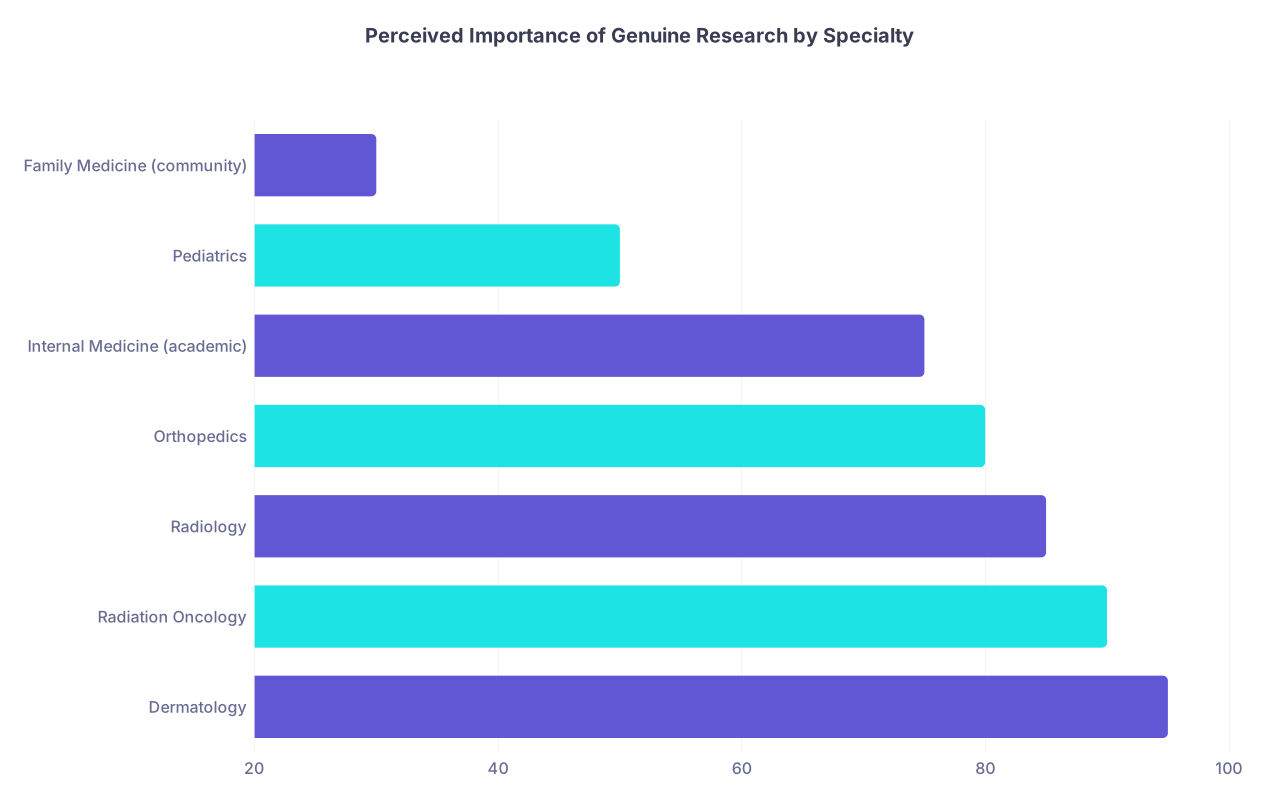
| Category | Value |
|---|---|
| Dermatology | 95 |
| Radiation Oncology | 90 |
| Radiology | 85 |
| Orthopedics | 80 |
| Internal Medicine (academic) | 75 |
| Pediatrics | 50 |
| Family Medicine (community) | 30 |
Here’s the unfiltered breakdown.
Highly Competitive, Research-Heavy (Derm, Rad Onc, ENT, Plastics)
They live in PubMed. Their residents publish. Their faculty are on editorial boards.
Token research here isn’t just unimpressive; it’s almost insulting. It tells them you either didn’t understand how this game works or you thought they wouldn’t notice.
If you’re applying to these fields without at least one substantial, clearly-owned project, your narrative needs to be flawless elsewhere to compensate.
Academic IM, Radiology, Neuro, EM in Big University Centers
They like to see a pattern: at least one project done decently, or a strong QI effort. They’re not all demanding RCTs, but they want proof you can survive scholarly expectations.
Token entries often backfire—especially if your personal statement goes on about loving “evidence-based medicine” and “investigating clinical questions” but your CV is three “data collection” projects that died on the vine.
Community-Focused and Less Research-Intensive Programs
Family med, community peds, many community IM programs: they won’t kill you for weak research. They honestly don’t care that much.
But here’s what still matters: authenticity. If your research section looks bloated and fake, it raises a character question:
“If they’re padding here, what else are they going to gloss over?”
That’s the part applicants underestimate. It’s not about PubMed—it’s about trust.
A Simple Mental Rule: Would You Be Proud to Present This at Noon Conference?
Here’s a sanity filter I give students:
Imagine your PD saying:
“Tomorrow’s noon conference is open—can you present your project on X?”
If your honest reaction is panic because:
- You don’t really understand the question the project was asking
- You barely remember the methods
- You wouldn’t be able to answer basic questions from residents about what you did
Then it’s token. At least in the eyes of a real academic clinician.
If instead you could:
- Sketch the study design on a whiteboard
- Explain your actual role without lying
- Take a few questions and handle them competently
Then that project is defensible, even if it’s a small local poster in a mediocre venue.
Programs care about that line. Can this person talk about their own CV like a grown professional? Or do they crumble as soon as you scratch the surface?