The truth is blunt: one truly strong research LOR can move you up (or onto) a rank list in a way your Step scores never will.
Program directors will not say this on panels. They talk about “holistic review” and “fit.” In the closed-door ranking meetings, what actually cuts through the noise is a specific kind of letter: a respected researcher or division chief staking their reputation on you.
Let me walk you through how that really plays out.
What Program Directors Actually Do With LORs
Publicly, everyone pretends letters are all the same. Privately, we sort them into three piles in about 30 seconds.
I’ve sat in those rooms. Seen PDs flip through ERAS packets, skim a line or two, then put an applicant in a different mental bucket based on a single name or a single sentence in a research letter.
Here’s the behind-the-scenes reality:
- Many letters are generic, polite, and useless.
- A smaller subset are clearly strong but formulaic.
- Then there’s the unicorn: a research LOR from someone we know and trust, who is clearly going out on a limb for you. That’s the one that changes where you sit on the rank list.
And the key? It’s almost never about the project details. It’s about what that letter says about how you function in a serious academic environment.
We aren’t asking: “Did they pipette well?”
We’re asking: “If I hire this person as a resident, will they be a force multiplier for our program, or a problem I need to manage?”
A strong research LOR answers that question in bold font.
Why Research LORs Hit Different
Clinical letters are everywhere. “Excellent student.” “Hard working.” “Pleasure to work with.” You’ve seen the templates; so have we.
A research letter, when done right, cuts on a different axis.
- It speaks to persistence over months, not a 4-week block.
- It shows how you operate with minimal structure, not a fixed rotation schedule.
- It shows whether you create value out of nothing but a vague hypothesis and a messy dataset.
That is exactly what residency feels like to us: chaos, partial supervision, incomplete instructions, constant uncertainty. Research mentors see you in that environment before we do.
The hierarchy in an academic PD’s head goes something like this:
| LOR Type | Typical Impact on Rank Position |
|---|---|
| Generic clinical attending | Minimal |
| Strong clerkship director | Mild–moderate |
| Home program PD chair letter | Moderate |
| Known, respected research mentor | Moderate–high |
| Nationally prominent PI in field | High |
That last two rows are where the magic happens. A single research LOR from someone we trust can bump a borderline candidate above people with better Step 2 scores.
Not because we worship research. Because we trust the judgment of that letter writer in predicting who will thrive in our environment.
How One Research LOR Actually Moves You on the Rank List
Let me give you a typical ranking committee scenario. This is almost a direct transcript from a real meeting.
We’re sitting around a conference table. Spreadsheet on the screen. Color codes for Step 2, interview scores, “concerns.” We’re in the middle third of the list—where things are fluid and people can move up or down 20+ spots based on discussion.
Applicant A: Step 2 253, mid-tier med school, decent interview. Letters fine but unremarkable.
Applicant B: Step 2 244, slightly weaker school, good interview. One letter from a well-known researcher in our field at a different institution.
The PD says:
“Look at this letter from Dr. X. I know him. He doesn’t write like this for just anyone.”
They read a line out loud:
“In my 15 years mentoring students, I can say without hesitation that [Applicant] is in the top 1–2 I have ever worked with in terms of independence, resilience, and ability to move projects forward without hand-holding.”
Now the numbers matter a lot less.
The conversation shifts to:
“If Dr. X says they’re that good, they’re going to be an asset. They’ll help with our trials, our QI projects, maybe bring in abstracts. They can probably handle autonomy from day one.”
Most of the room has never met you. But we all know Dr. X. We know his standards. He just made the decision for us.
Applicant B moves up. Applicant A stays put.
Multiply that by 10–15 micro-decisions across a rank list, and you see how one heavy-hitting research LOR reshapes your match probability at multiple programs.
The Hidden Currency: Writer Reputation and Language
Here’s the part students almost never understand: the value of a research LOR is not additive, it’s multiplicative.
A “good” letter from an unknown community researcher does not equal “good” from a national PI whose trials we all read.
Programs mentally apply two silent multipliers:
- Who wrote it
- How far they went
And we’re reading the subtext as much as the text.
1. Who wrote it
There’s a quiet mental map in every competitive academic program. Names we know. Institutions we trust. People whose letters we’ve seen before and learned to calibrate.
You don’t see that map. We live in it.
Some examples from the back of the room commentary:
- “That’s the ICU research director at [top-10 place]. She’s not effusive. If she’s saying this, it’s real.”
- “I’ve read ten of his letters over the years. Everyone is ‘excellent,’ no one is ‘top 1–2.’ This kid is different.”
- “This is the fifth applicant this year with a letter from that lab. All sound the same. Discount a bit.”
A letter from a moderately known but trustworthy person we’ve experienced as honest is worth more than a flowery, over-the-top letter from someone who writes like that for everybody.
2. How far they went
We’re not impressed by “excellent student” or “among the best.” Those are useless phrases.
The phrases that move you:
- “Top 1–2 students I’ve mentored in the last X years”
- “I would unreservedly rank this student at the very top of any list for your program”
- “I recruited them to stay here, and would be genuinely disappointed if they went elsewhere”
- “I trust them with high-stakes work that I usually reserve for fellows”
Those are risk-bearing statements. The writer is tying their reputation to you. That’s the currency.
When we see those lines from somebody we know? You jump.
What a Rank-Changing Research LOR Actually Looks Like
Let me demystify it. The letter that really changes things isn’t three pages of your methodology. No one cares if you used STATA or R.
What matters is this pattern:
- The writer clearly knows you well and for a long enough period (6+ months is ideal).
- They have seen you in difficulty: failed experiments, messy data, IRB delays, rejected abstracts.
- They describe specific behaviors under those conditions.
Here’s the kind of paragraph that gets read out loud in meetings:
“When our data analyst left mid-project, [Applicant] independently learned how to manage and clean a 20,000-line dataset, meeting every weekly deadline. At one point we discovered a major data integrity issue the week before abstract submission. Instead of panicking, [Applicant] stayed late for three consecutive nights, fixed the problem, revised all the tables, and we still submitted on time. I would trust them with similarly high-stakes, time-sensitive work as a resident.”
That tells us more about your predictive performance as a resident than ten canned clinical comments.
We’re silently mapping what you did in that lab to: “What happens when night float explodes and they have 18 cross-cover patients and no senior in-house?”
If your letter convinces us you don’t crumble, you rise on the list.
How This Differs by Specialty and Program Type
Not all programs weigh research LORs the same. But almost all academic-affiliated programs care more than they admit.
Here’s the rough landscape:
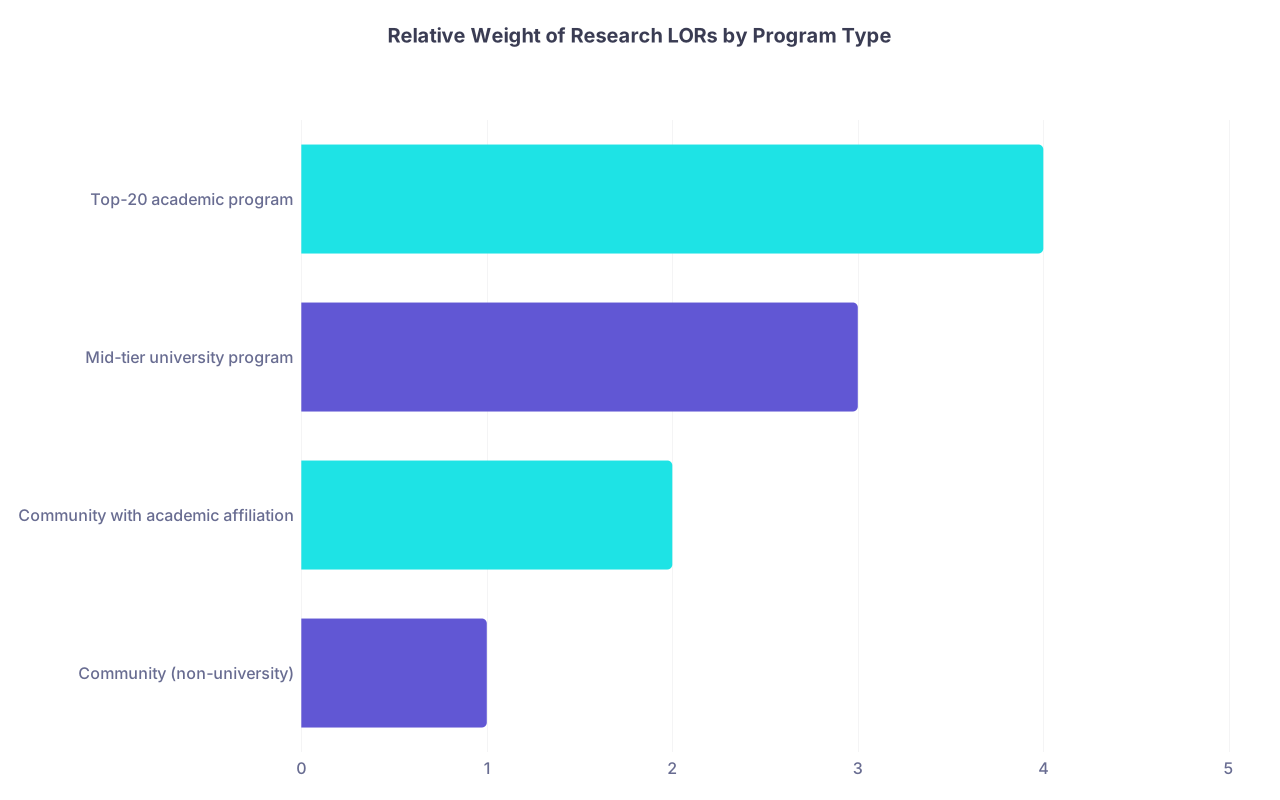
| Category | Value |
|---|---|
| Community (non-university) | 1 |
| Community with academic affiliation | 2 |
| Mid-tier university program | 3 |
| Top-20 academic program | 4 |
1 = low relative weight, 4 = very high relative weight.
- Pure community programs: they care more about “will this person work hard and not be a problem?” A research LOR can still help if it emphasizes work ethic and reliability, but the name power matters less.
- Hybrid/community-affiliated: a strong research LOR from someone in their orbit (same region, same specialty) can be surprisingly influential.
- University programs: this is where a major research LOR can swing borderline applicants heavily.
- Top-20 academic: in some of these places, one famous PI going hard for you is essentially a golden ticket to at least a high rank.
Do not misunderstand: you still need to clear basic thresholds—no disasters, reasonable Step 2, no massive professionalism red flags. A god-tier LOR won’t save catastrophic metrics. But it will absolutely rescue a slightly below-median applicant and move them into “we want this person” territory.
How to Actually Earn One of These Letters (Not Just Ask for It)
Most students approach this backwards. They think: “I need a big-name letter.” So they try to join a big-name lab six months before ERAS and hope for the best.
That’s how you get a polite, useless letter from a busy PI who barely knows you.
The sequence that works looks more like this:
Step 1: Choose the right environment, not just the biggest name
You want someone who:
- Actually works with their trainees
- Has a track record of writing real, detailed letters
- Is connected to your target specialty’s world
Ask residents quietly: “Whose letter actually moves the needle around here?” They will tell you. They know who the PD respects.
A mid-tier name who knows you deeply beats a Nobel-adjacent lab head who’s never seen you work.
Step 2: Commit for real time
Three months in a lab = “they were fine, did what was asked.”
Nine to twelve months (even part-time) = “I saw how they handle setbacks, ambiguity, and long arcs of work.”
The letters that change rank position almost always come from mentors who’ve seen you across at least one full project cycle or major pivot.
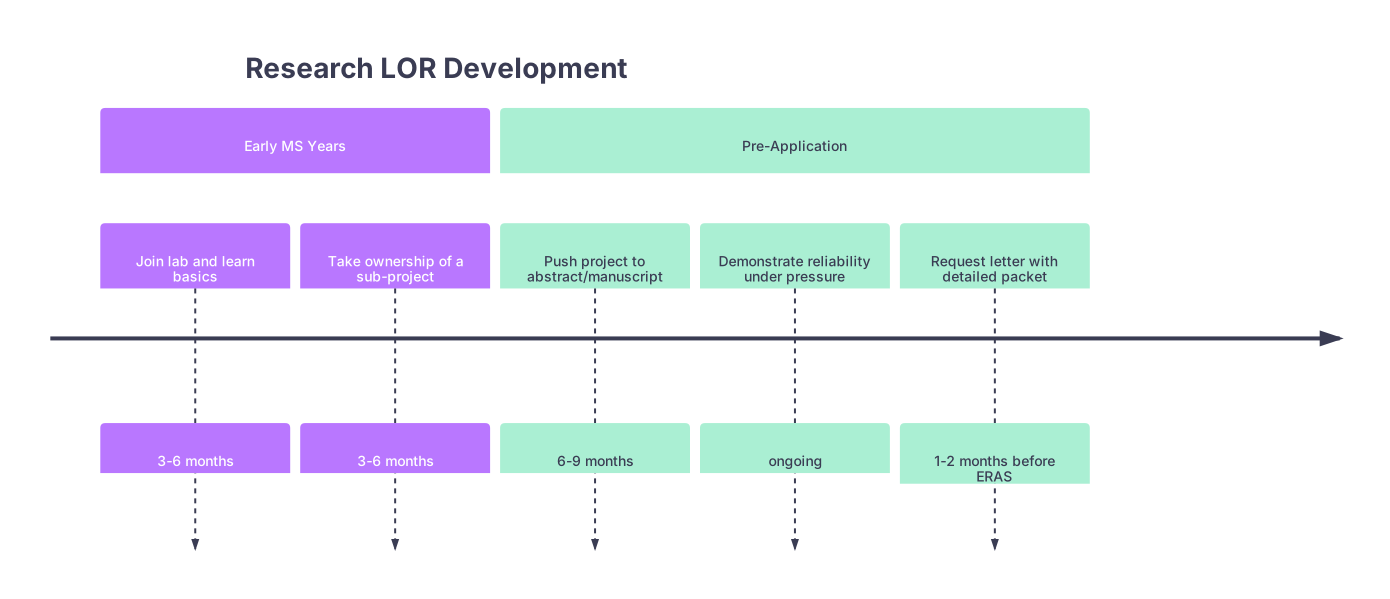
| Period | Event |
|---|---|
| Early MS Years - Join lab and learn basics | 3-6 months |
| Early MS Years - Take ownership of a sub-project | 3-6 months |
| Pre-Application - Push project to abstract/manuscript | 6-9 months |
| Pre-Application - Demonstrate reliability under pressure | ongoing |
| Pre-Application - Request letter with detailed packet | 1-2 months before ERAS |
Step 3: Make their life easier to advocate for you
The strongest letters come from mentors who:
- Remember specific events
- Can reference concrete outcomes
- Feel personally invested in your trajectory
You help them by:
- Owning a piece of the project, not just being “extra hands”
- Taking unglamorous work without whining (data cleaning, IRB, revisions)
- Communicating clearly when things go wrong, not disappearing
Then, when the time comes, you do not just email, “Can you write me a strong letter?” You send:
- Your CV
- A one-page bullet summary of what you actually did on each project
- Specific anecdotes they might mention (yes, this works; no, it’s not arrogant if done humbly)
- Your target specialty and why you’re a fit
Good mentors are busy. When you give them this scaffolding, they repay you with a much stronger, more specific letter.
How PDs Use a Research LOR To Break Ties
Here’s something very few applicants appreciate: by the time we get to final rank order, we’re not arguing over the top 10. We’re fighting over the middle 50.
Scores and CVs start to blur. Everybody has some research, some leadership, some “interest” in our specialty. We need tiebreakers.
A memorable research LOR becomes a tool:
- “We need someone who’ll push scholarly output this year; this candidate has that letter from Dr. Y saying they drove a multicenter project.”
- “We’re thin on people who can help residents with QI and data stuff; this one clearly can translate research skills into real work.”
- “We’ve had great experiences with students from Dr. Z’s lab. I trust their judgment.”
So instead of looking at raw numbers again, we look at that letter and say: “Who is more likely to make our program better?” That person moves up.
You don’t want to be “acceptable.” You want to have a story in the room. A strong research LOR gives you that story.
Warning: The Overhyped, Empty Research Letter
Not all research letters are helpful. Some are actually harmful.
Common red flags PDs notice quickly:
- The letter is obviously ghostwritten by you and rubber-stamped by the PI. The voice doesn’t match their usual tone; it reads like an overpolished personal statement. We’ve seen their letters before. The inconsistency is obvious. That letter gets discounted fast.
- The writer lists your tasks but never comments on your character, resilience, or independence. That’s a “they showed up” letter. Fine. Not game-changing.
- Over-the-top praise with no specifics. “One of the best ever,” followed by nothing concrete. We assume inflation or lack of real contact.
- The mentor writes a lukewarm or vague endorsement. Something like, “I expect [Applicant] will be a solid contributor as a resident.” That wording is not accidental. It’s code for “fine, but I’m not sticking my neck out.”
PDs are reading for signal strength and credibility. Empty fireworks don’t move your rank; they just waste space.
How This Plays Out on Match Day (Whether You See It or Not)
You only see one outcome: matched vs not matched, where you ended up. You don’t see the quiet reshuffling that happened at 10 pm the night before rank lists locked.
I’ve watched this exact sequence:
A borderline candidate at a big-name academic program. Interview was decent, not mind-blowing. Some faculty wrote “solid, quiet.” Step 2 good but not stellar. Program initially ranked them in the lower half.
During the second-pass review, someone says:
“Wait, look at their letter from [name]. Didn’t he just chair the guidelines committee we all use?”
We reread it. Find this line:
“I will be very frank: if you are looking for someone who will show up, do the minimum, and coast, that is not [Applicant]. They push, they ask uncomfortable questions, they hold themselves to an unusually high bar. I would trust them as a junior colleague in any academic department.”
That applicant got bumped 20+ spots. They matched there. They will never know how close they were to being somewhere else.
That’s what a real research LOR does.
Three Strategic Moves If You’re Late to the Game
If you’re already in the “residency applications this year” phase and feeling behind, you still have a few plays.
- Identify your strongest research mentor, even if not famous. Think: who actually knows you best, has seen you over time, and would genuinely advocate for you? That credibility matters.
- Have a direct, adult conversation. “I’m applying to X. I value your judgment. Do you feel you know me well enough to write a strong, detailed letter commenting on my work ethic, independence, and how I function under stress?” If they hesitate, do not push. A lukewarm letter hurts more than it helps.
- Prime them with specifics. Send a concise reminder list of concrete things you did that show growth, persistence, and impact. You’re not scripting them; you’re jogging their memory.
Sometimes one carefully chosen, deeply authentic research LOR is better than three generic letters from “bigger” names.
Key Takeaways
- A single, credible, strongly worded research LOR from a respected mentor can move you dramatically up (or onto) a rank list, especially at academic programs.
- The power is in the combination of writer reputation, time spent with you, and specific, risk-bearing language about your independence, resilience, and reliability.
- You do not need the biggest name in the country. You need the mentor who knows you well enough to stake their reputation on you—and programs can tell the difference instantly.