
Only 27% of residency applicants can accurately explain their own research methodology when pushed beyond the first follow‑up question.
That statistic comes straight from what I have seen sitting in on research-heavy academic interviews: applicants who did months or years of research, reduced to vague buzzwords under mild pressure. Not because they are not smart. Because they never practiced talking about the methods with precision.
You want to stand out on interview day? Stop memorizing your abstract and start owning your methods.
Let me break this down specifically.
Step 1: Know exactly what you did – not what was written in the paper
The problem starts here: most applicants know how to summarize their project but not their process.
You say: “We did a retrospective cohort study looking at outcomes in patients with…”
The interviewer hears: “Scripted line from ERAS that tells me nothing about whether you actually worked.”
You need a clear, concise mental template of your study that you can say from memory, with zero slides in front of you:
- Study design
- Population / sample
- Data source
- Main exposure / intervention
- Main outcome(s)
- Basic analysis plan
That is your skeleton.
Let us run a concrete example and make it brutally specific.
You did a retrospective chart review on patients with heart failure readmissions.
Your one‑sentence methods spine should sound like:
“We performed a single‑center retrospective cohort study of adult patients admitted with decompensated heart failure from 2017–2021, using the hospital EMR to extract demographic, clinical, and readmission data, and then used multivariable logistic regression to identify factors associated with 30‑day readmission.”
That one line already signals you actually know what you did. Now you can expand under questioning.
Checklist: core facts you must be able to say without hesitation
If I pause you mid‑sentence, you should still know all of these:
- Design: retrospective vs prospective, cohort vs case–control vs cross‑sectional vs RCT vs qualitative, etc.
- Setting: single center vs multi‑center, academic vs community, country/region.
- Population: inclusion criteria, major exclusion criteria, final N.
- Time frame: data collection period or follow‑up length.
- Data source: chart review, registry, survey, administrative database, biobank, etc.
- Primary outcome: exactly what you were trying to measure (not five outcomes; the main one).
- Main analysis: descriptive only, t‑tests, chi‑square, regression, Kaplan–Meier, thematic coding… whatever actually happened.
If you cannot state all of that cleanly in 30–45 seconds, you are underprepared for a research‑heavy interview day.
Step 2: Translate design jargon into clean, confident English
Most applicants either drown in jargon or avoid it entirely. Both look bad.
You want a mix: correct terms, followed by a plain‑language explanation that shows you actually understand.
Say it like this:
“This was a retrospective cohort study – we looked back at existing charts over a fixed period and followed a group of patients forward in time from their index admission to see who was readmitted within 30 days.”
“We used a case–control design – we identified patients who had the event (cases) and matched them to patients who did not (controls), then looked back to compare prior exposures.”
“This was a cross‑sectional survey – essentially a snapshot at a single time point, not following participants over time.”
The interviewer is not just checking if you can recite the label. They are checking if you understand why that design was chosen and what it actually implies.
Be ready for the “why this design?” question
You will hear some version of:
- “Why did you choose a retrospective design instead of prospective?”
- “Why not a randomized trial?”
- “Why did you go with a survey instead of interviews?”
Your answer should have structure, not flailing:
Feasibility constraints
“We were limited by time and resources; a prospective study would have taken years, so we used existing data.”Ethical or practical reality
“Randomizing patients to receive or not receive the intervention would have been unethical, so we used an observational design and adjusted for confounders.”Strength of design relative to the question
“Because we were primarily interested in prevalence at a single time point, a cross‑sectional approach made more sense than a cohort.”
If your explanation is some vague “this is what the PI suggested,” you immediately look peripheral to the work.
Step 3: Own your specific role without inflating it
Program directors and research faculty are allergic to the “I did everything” answer. They know you did not.
You must be able to say, in simple language, what you actually did with your hands and brain.
Break your role down into:
- Conceptual work: helped refine the research question, literature review, protocol drafting.
- Data work: chart review, survey administration, data cleaning, coding, database building.
- Analytic work: ran analyses, wrote code, produced figures, interpreted results.
- Writing / presentation: wrote sections of the manuscript, built posters, presented at meetings.
Example of a strong answer:
“My primary role was data extraction and cleaning. I developed the REDCap data dictionary with my mentor, performed manual chart abstraction for around 220 patients, and then did the initial cleaning in R – handling missing values, checking for outliers, and merging in ICD‑10 codes from an administrative dataset. After that, I worked closely with our biostatistician, running the regression models under her supervision and generating the adjusted odds ratios and confidence intervals for the primary outcome.”
That answer does three things:
- Shows you know the workflow.
- Names concrete tasks and tools.
- Credits the team and does not overclaim.
Weak answer that I hear all the time:
“I helped with data collection and analysis and wrote some of the manuscript.”
That tells me essentially nothing.
Step 4: Be technically specific about your methods – at your level
You are not defending a PhD thesis, but you should be technically literate about what you did.
You do not need to derive logistic regression on a whiteboard. You do need to say something more meaningful than “we used some stats.”
Here is how to calibrate it.
Quantitative / clinical research examples
You should be able to say:
- The unit of analysis: patient‑level, encounter‑level, provider‑level, etc.
- How you handled key variables: how you defined exposure and outcome, how you operationalized them.
- Basic statistical methods: which tests and why, at a superficial but correct level.
For instance:
“We defined 30‑day readmission as any non‑elective inpatient admission within 30 days of discharge, at our hospital or an affiliated site. Our primary exposure was discharge to home versus a facility, plus we adjusted for age, sex, comorbidity score, and insurance type. We used multivariable logistic regression because the outcome was binary, and we were interested in the adjusted association between discharge disposition and readmission, not just raw percentages.”
If you did more advanced work, name it correctly but still explain plainly:
“We used Cox proportional hazards models because we had time‑to‑event data, and we wanted to account for different follow‑up times across patients. The event was incident venous thromboembolism; patients without events were censored at 1 year or last follow‑up.”
Basic science / bench research examples
Same idea. Talk methods like you actually used them.
- Cell lines or organisms: which, why chosen.
- Assays and techniques: Western blot, qPCR, flow cytometry, patch clamp, etc.
- Controls and replicates: biological vs technical replicates, negative/positive controls.
- How you quantified and analyzed: densitometry, fold change, normalization, basic stats.
Example:
“I worked with a human hepatocyte cell line (HepG2). I treated cells with varying doses of drug X for 24 hours, then measured gene expression changes using qPCR. GAPDH was used as the housekeeping gene for normalization. Each condition was run in triplicate wells, and we repeated the entire experiment on 3 separate days. We calculated relative expression using the ΔΔCt method and compared groups using ANOVA with Tukey’s post‑hoc test.”
That sort of detail tells any PhD in the room you actually did the work. And that you understood it.
Step 5: Anticipate and rehearse the 6 most common methods questions
Interviewers are incredibly predictable. The questions change words but not structure.
If you rehearse answers to these, you will sound composed and not rattled.

1. “What was your study design, and why did you choose it?”
Template:
- Name the design in 1–2 words.
- One plain‑English line describing what that means.
- One or two reasons why it fit the question or constraints.
Example:
“This was a retrospective cohort study. We identified patients from past records and followed them forward from their first admission to look at 30‑day readmissions. We chose this design because we could use existing EMR data to get a large sample quickly, and a prospective study would have required years of enrollment.”
2. “How did you define your primary outcome?”
Template:
- Exact definition, including threshold or timeframe.
- How you measured or ascertained it.
- Any key edge decisions you made.
Example:
“Our primary outcome was severe hypoglycemia, defined as a blood glucose <54 mg/dL requiring assistance from another person. We identified events via EMR glucose values plus nursing documentation of hypoglycemia treatment, and we manually verified ambiguous cases.”
3. “What were the main limitations of your methods?”
If you say “small sample size” and stop, you look like you read a generic limitations section once and called it a day.
Better:
Name specific limitations that directly flow from your method.
- Selection bias (single center, referral population).
- Measurement bias (retrospective data, missing key variables).
- Confounding (non‑randomized, unmeasured variables).
- Generalizability (unique setting or population).
- Design limitations (cross‑sectional cannot infer temporality).
Example:
“Because this was a single‑center retrospective study, we were limited by what was already in the chart. We had no reliable data on medication adherence after discharge, which is a likely confounder. Also, our hospital is a tertiary referral center, so our heart failure population probably has more severe disease than the average community hospital, which limits generalizability.”
That is the kind of answer that makes attendings nod.
4. “What did you actually do day‑to‑day on this project?”
This is where applicants either shine or die.
You should describe 2–4 concrete activities, not vague “helped with.”
Example:
“My main tasks were designing the REDCap form with my mentor, piloting it on 20 charts to refine variable definitions, then abstracting data for about 200 charts. I also wrote the initial R scripts for cleaning the dataset – recoding categorical variables, identifying implausible values, and creating the derived comorbidity index. Once the data were clean, I met weekly with our biostatistician to run and interpret the regression models.”
5. “If you could redesign this study, what would you change about the methods?”
This is a higher‑order question. It tests whether you have thought beyond your initial project.
Good options:
- Upgrade design: retrospective → prospective; single center → multi‑center; cross‑sectional → cohort.
- Improve measurement: collect more granular variables, validated questionnaires, direct measurements.
- Strengthen analysis: pre‑specified analysis plan, better handling of missing data, prespecified subgroups.
Example:
“In an ideal world, I would convert this into a prospective cohort with standardized assessment of social determinants at discharge. Right now, we are limited to what is casually documented. I would use a validated social risk screener and collect data at baseline and 30 days. That would let us more rigorously model how post‑discharge social support affects readmission.”
6. “What was the most challenging part of the methods, and how did you handle it?”
This is really a professionalism / resilience question disguised as methods.
Pick something real: inter‑rater reliability issues, missing data, poor survey response, complicated code, protocol deviations.
Example:
“The biggest challenge was inter‑rater variability in chart abstraction. After the first 50 charts, we realized our definitions of ‘infection‑related admission’ were not aligned. We did a formal inter‑rater reliability check on 30 charts, found the kappa was only 0.62, and then revised our definitions with more specific criteria. After training and a second check, we improved to 0.84 before abstracting the rest.”
You just showed you understand rigor, identified a problem, and fixed it. That is what they want to hear.
Step 6: Talk statistics without embarrassing yourself
Let me be blunt: nothing sinks an otherwise strong research conversation faster than statistical bluffing.
You do not need to be a statistician. You do need to be honest and precise about what you know.
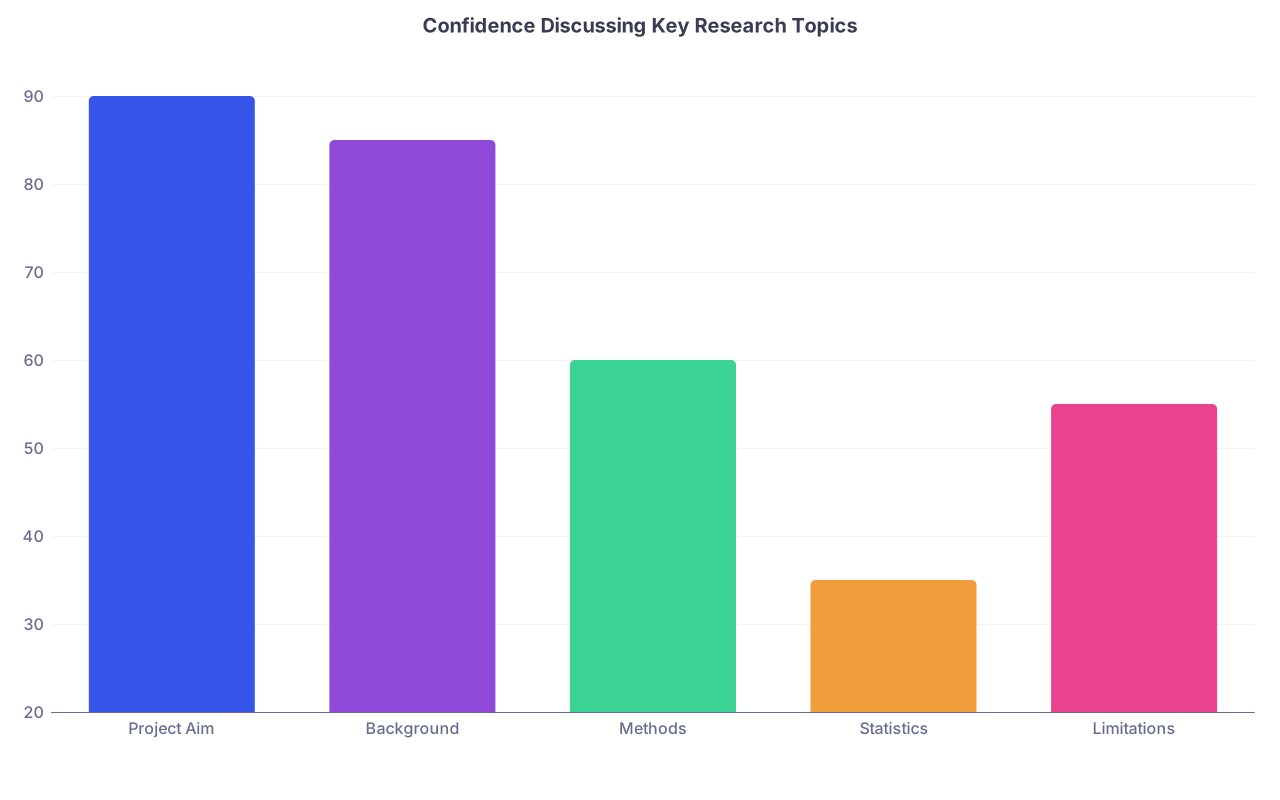
| Category | Value |
|---|---|
| Project Aim | 90 |
| Background | 85 |
| Methods | 60 |
| Statistics | 35 |
| Limitations | 55 |
What you should be able to do
For the analyses you used:
- Name the test(s) or models correctly.
- Explain, in one or two simple sentences, what they do.
- Say why they were appropriate for your data structure.
- Interpret your key result in plain language.
Example:
“We used logistic regression because our outcome – 30‑day readmission – was binary. The model estimates the odds of readmission associated with each predictor, adjusting for the others. Our main finding was that discharge to a skilled nursing facility was associated with about 1.8‑fold higher odds of readmission, even after adjusting for age, comorbidities, and prior utilization.”
Do not say “risk” if you mean “odds” when talking to people who care. They notice.
How to handle questions above your head
At some programs, you will get the attending who lives to ask detailed stats questions. Fine.
Your strategy:
- Be direct about what you know and what you delegated.
- Anchor back to your biostatistician or mentor when appropriate.
- Still show conceptual understanding.
Example:
“I set up the dataset and ran the models in R under the guidance of our biostatistician. I am comfortable explaining why we chose logistic regression and how to interpret the odds ratios, but I would defer to her on the finer mathematical assumptions if you want to go deep into those.”
That answer is much stronger than guessing or hand‑waving.
Step 7: Build and rehearse a structured 60–90 second “methods story”
You will often get some version of: “Tell me about your research.” Most applicants spend 75 seconds on background and results, and throw in “we used a retrospective design” like it is an afterthought.
Flip that.
Aim for roughly:
- 15–20 seconds: question and design.
- 30–40 seconds: methods and your role.
- 20–30 seconds: key result and implication.

| Step | Description |
|---|---|
| Step 1 | Research Question |
| Step 2 | Study Design |
| Step 3 | Population & Data Source |
| Step 4 | Your Specific Role |
| Step 5 | Key Methods Detail |
| Step 6 | Main Result |
| Step 7 | Limitations & Next Step |
Here is what that might sound like, stripped of fluff:
“Our main question was which factors are associated with 30‑day readmission in patients hospitalized with decompensated heart failure. We designed a single‑center retrospective cohort study, identifying all adult heart failure admissions from 2017 to 2021 using ICD‑10 codes, then confirming diagnoses through chart review.
We extracted demographic, clinical, and utilization data from the EMR into REDCap. I built the data dictionary with my mentor, performed manual chart abstraction for about 220 of the 600 patients, and wrote the initial R scripts for data cleaning and derivation of the comorbidity index. With our biostatistician, I then ran multivariable logistic regression models, with 30‑day readmission as the binary outcome.
We found that discharge to a skilled nursing facility, prior year hospitalizations, and higher comorbidity burden were independently associated with higher odds of readmission, even after adjustment. The retrospective design and single center limit generalizability, but the methods are robust enough that our hospital is now piloting a targeted transitions‑of‑care program for those high‑risk groups.”
That is the level you want.
Step 8: Practice with actual interrogation, not friendly nodding
Reading your methods section silently or mumbling it to your mirror is not enough. You need someone to interrupt you, press you, and ask “why?” five times in a row.

Find:
- A mentor who has published extensively.
- A resident who has done a couple of serious projects.
- A biostatistician or PhD if you have access.
Give them permission to be aggressive.
Have them ask:
- “How did you handle missing data?”
- “Did you check any model assumptions?”
- “How did you define your exposure variable?”
- “What was your sample size calculation?” (if prospective)
- “How did you control for confounding?”
- “Why did you choose that particular assay / technique?”
You will not have perfect answers to everything, and that is fine. The rehearsal is to train:
- Staying calm under rapid‑fire.
- Saying “I do not know that level of detail; our biostatistician made that decision” in a mature, composed way.
- Not contradicting yourself between answers.
Step 9: Adjust depth based on the program and the interviewer
You do not need to give a thesis defense to a community program that mostly cares about your clinical interest. You also cannot give a fluffy 2‑sentence overview to a research‑heavy academic faculty member.
The trick is reading the room.
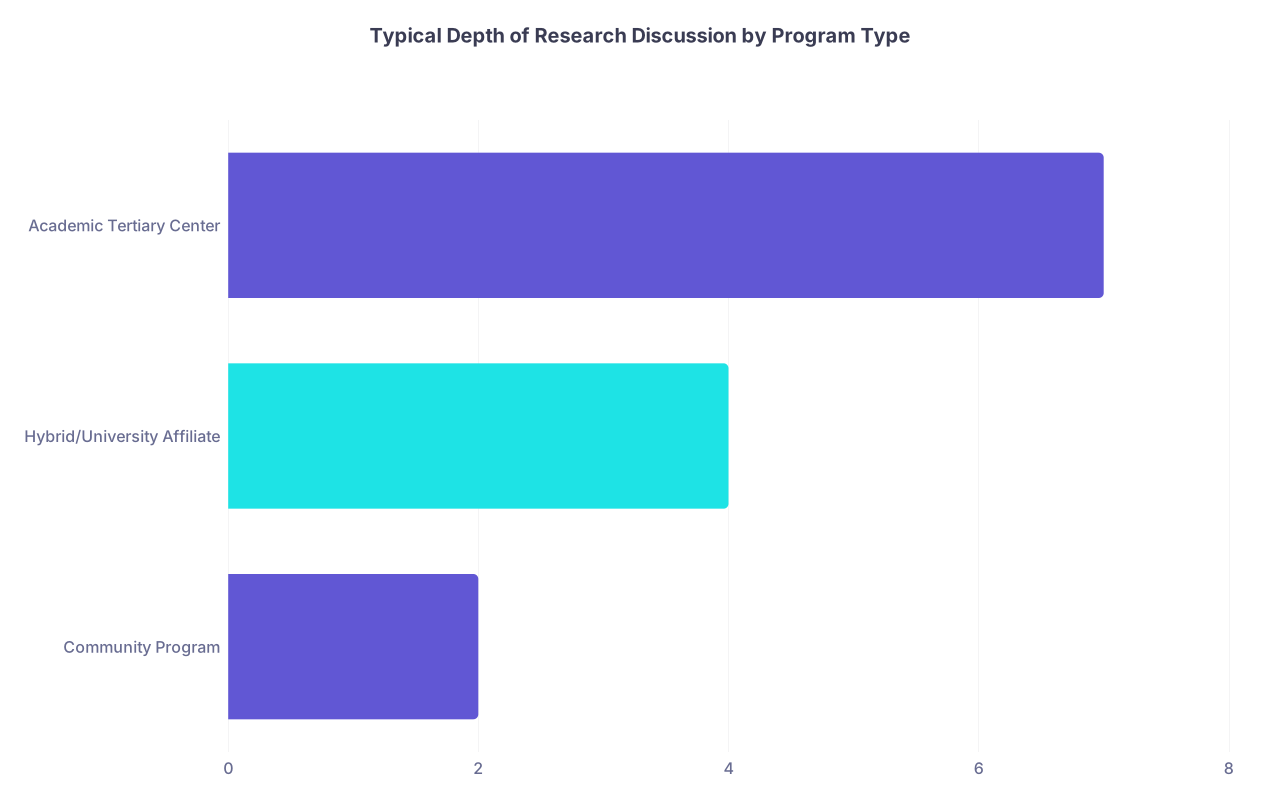
| Category | Value |
|---|---|
| Community Program | 2 |
| Hybrid/University Affiliate | 4 |
| Academic Tertiary Center | 7 |
Think of depth as a scale from 1–10:
- 2–3: one sentence on design and your role.
- 4–6: short but concrete discussion of design, key methods, your tasks, major limitation.
- 7–9: detailed dive into methods choices, limitations, and potential improvements; some stats.
At an academic IM program like UCSF or Hopkins, if an interviewer says, “I do cardiovascular outcomes research too – tell me about your project,” assume a level 7. They are inviting you to talk methods.
At a community program where the PD is clearly more interested in your work ethic and fit, you might keep it at a level 3–4 unless they dig deeper.
You can even ask, briefly:
“I can give you a quick overview, or if you are interested in the methods side, I am happy to focus there. What would be most useful?”
That is a confident, adult move.
Step 10: Have one “methods lesson” you took away from the project
Good interviewers love this question, even if they do not phrase it this way:
“What did you actually learn about doing research from this project?”
Make your answer methods‑focused, not just “I learned persistence.”
Examples:
“I learned how much front‑end work goes into defining variables precisely. We spent weeks just agreeing on what counted as an ‘infection‑related admission,’ and that saved us a ton of pain later.”
“I saw firsthand how easy it is to overinterpret subgroup analyses. Our initial model suggested a strong effect in one subgroup, but it disappeared when we adjusted the model specification. That made me more skeptical reading similar claims in the literature.”
“I realized how critical pilot testing is. Our first survey had a terrible response rate and confusing items. After cognitive interviews with 10 residents and revising several questions, response rates improved dramatically.”
Those answers show growth in research thinking, not just “I got a poster.”
A quick comparison: weak vs strong answers
To make this brutally clear, compare these side by side.
| Aspect | Weak Answer | Strong Answer |
|---|---|---|
| Design | “It was a study on heart failure readmissions.” | “Single-center retrospective cohort of adult HF admissions from 2017–2021.” |
| Role | “I helped with data and wrote some of the paper.” | “Designed REDCap form, abstracted 220 charts, wrote R scripts for cleaning and models.” |
| Stats | “We used some statistical tests and got significance.” | “Multivariable logistic regression; 30-day readmission as binary outcome.” |
| Limitations | “Small sample size and single center.” | “Retrospective EMR data with no adherence info; tertiary referral population.” |
| Takeaway | “I learned that research is hard but rewarding.” | “I learned how upfront variable definition and inter-rater checks prevent bad data.” |
You know which column you want to live in.
Final calibration: what is “too much” detail?
Yes, you can overwhelm people. A 3‑minute monologue on your imputation strategy is unnecessary for 95% of interviewers.
Signs you are going too deep:
- Interviewer glances at the clock or keeps nodding without follow‑up.
- They try to redirect to another topic.
- They ask very broad questions (“So, what do you like to do outside medicine?”) right after your answer.
So you bracket your detail. Offer a headline and invite follow‑up.
Example:
“We handled missing data with multiple imputation using chained equations, under the assumption that data were missing at random. That allowed us to include all 600 patients in the multivariable model rather than dropping about 15% with incomplete covariates. I can talk more about how we implemented that if you’re interested, but the main point is that it reduced bias from listwise deletion.”
If they care, they will ask. If not, you already showed you know what you are doing without burying them.
Three things to remember on interview day
You are not being tested on perfection. You are being tested on whether you truly understand what you did and can talk about it like a junior colleague, not a parrot of your abstract.
Specific beats impressive. “I abstracted 200 charts and wrote the cleaning scripts” is stronger than “I contributed significantly to the analysis.”
Confidence comes from rehearsal with pushback. If you have survived a mentor or stats person grilling your methods for 30 minutes, a residency interviewer’s questions will feel very manageable.
Talk about your research methods like you actually did the work. Because you did. Now you just need to sound like it.