
Program directors do not weigh all publications equally—and pretending they do is how strong applicants end up looking mediocre on paper.
If you are treating “5 publications” as inherently impressive without asking what kind of authorship, you are already behind your competition. Let me break this down the way PDs and serious academic faculty actually think about it.
How PDs Really Look at Your Publication List
Most applicants imagine a PD opening ERAS, seeing “Publications: 7,” and being instantly impressed. That is not how it works.
Here is what actually happens on the other side of the screen.
A PD or faculty screener will:
- Glance at the total number of peer‑reviewed works.
- Immediately scan for first‑author and last‑author positions.
- Clock the type of work (original research vs review vs case report vs “other”) and the journal tier.
- See whether your research narrative matches your stated career interests.
- Make a subconscious judgment in about 10–20 seconds: “Serious academic potential” vs “standard applicant” vs “CV padding.”
Notice what is missing: nobody says, “Ah, 6 middle‑author retrospective chart reviews in low‑impact journals—this must be the next physician‑scientist.”
Authorship position is one of the fastest heuristics PDs use to judge depth of involvement and actual intellectual contribution.
The basic hierarchy PDs use
Very roughly, for most specialties:
- First‑author original research (especially in a decent journal): heavy weight
- Co‑first author (shared first): similar to first, assuming credible
- First‑author review or meta‑analysis: moderate to heavy, depending on journal and rigor
- Middle‑author on substantive projects (R01‑level studies, multicenter trials): moderate if your role is believable and you can explain it
- Middle‑author on small, low‑impact or obviously student‑assembled projects: light
- Last‑author as a student: often ignored or treated with skepticism unless there is a clear explanation (dual degree, prior career, etc.)
None of this means middle‑author work is “useless.” It means PDs interpret it differently—and you need to understand that interpretation to use it to your advantage.
What First‑Author Actually Signals (And When It Matters)
First‑author is a signal. It says: “This person led the project intellectually and operationally.”
That does not mean you pipetted every sample or did every chart review yourself. It does mean, in the ideal world:
- You were involved in forming the research question.
- You helped design the study or data collection strategy.
- You drove the draft writing and responded to reviewers.
- You kept the project moving when everyone else got busy.
PDs know this is not always reality. They also know which environments abuse the first‑author label and which maintain standards.
So when a PD sees multiple first‑author papers, what do they infer?
For highly competitive, research‑heavy specialties
Think derm, plastics, ENT, neurosurgery, rad onc, certain IM subspecialty tracks (physician‑scientist, PSTP).
Two or more first‑author works—especially original research or good systematic reviews—in decent journals can make you jump tiers.
You move from:
- “Applicant with research” to
- “Applicant who can actually conceive and drive a project.”
That is not a small shift. For physician‑scientist or research‑track positions, it is basically the minimum bar for serious consideration at top programs.
For moderately competitive specialties
Think internal medicine, EM, peds, OB/GYN, anesthesiology at solid academic centers.
Here, even one credible first‑author publication, especially if tied to your stated interest (e.g., first‑author HFpEF outcomes paper for someone aiming at cardiology), can separate you from the crowd of people with “a few poster abstracts.”
The PD’s mental note is less “this is a future R01 PI” and more “this person can finish things.”
For community or less research‑heavy programs
Here the calculus changes. Authorship still matters, but the bar is lower and the returns are more limited.
One or two first‑author projects show:
- You can own responsibility.
- You have a basic grasp of research workflow.
- You will not completely fall apart when the program asks residents to contribute a QI project.
But nobody at a purely community FM program is doing impact‑factor math in their head.
When first‑author does not impress as much as you think
There are scenarios where “first‑author” gets mentally discounted.
These show up over and over again:
Obvious CV stuffing in low‑quality venues
A flood of first‑author “papers” in predatory or obscure journals with sloppy titles and no coherent thread looks worse than 1–2 strong pieces. PDs and academic faculty know the difference between Chest and “Annals of Clinical & Analytical Medicine and Allied Sciences” (you get the idea).Endless micro‑case reports
Eight first‑author single‑patient case reports in irrelevant journals suggest you learned how to hit ‘submit’, not how to ask a meaningful question.No narrative coherence
First‑author in cardiology, then ophthalmology, then dermatology, then orthopedic trauma, without any story, screams: “I chased whatever would let me be first‑author.” You can fix this a bit in your personal statement and interviews, but if the scatter looks random, serious research programs will notice.Inability to explain your own paper
This is fatal. If you claim first‑author and then cannot walk a faculty interviewer through the study aim, methods, limitations, and next steps at a basic level, you have just told them that your name means nothing. I have seen PDs completely disengage from an applicant after that.
Middle‑Author: Underrated When Used Correctly
Middle‑author gets treated like “filler” by many students. That is a mistake.
Middle‑author can be useless noise—or it can be a quiet but powerful signal that you played a real role on serious projects.
The difference is context and explanation.
What middle‑author usually signals to PDs
Baseline assumption:
- You contributed in a limited but meaningful way to a broader project you did not lead.
That contribution could be data collection, specialized analysis, patient recruitment, imaging reads, survey administration, or something similar.
By itself, a few middle‑author lines do not tell a compelling story. But they add crucial texture when combined with:
- A well‑articulated research narrative.
- A mentor’s letter that spells out your role.
- One or two projects where you had more visible leadership (first‑author, abstract presenter, etc.).
When middle‑author is genuinely impressive
Here is where middle‑author authorship jumps categories in PDs’ minds.
High‑impact or field‑defining work
Middle‑author on a NEJM, Lancet, JAMA, or a top‑tier specialty‑specific trial is not the same as first‑author in an obscure journal. Serious faculty know this.Large multicenter or registry‑based studies
Many major specialties (cardiology, critical care, oncology, surgery) run multicenter trials or registries where students/residents contribute real work but do not lead. Being a middle‑author on those can show you were plugged into a serious research ecosystem.Technical or methodologic expertise
Maybe you did all the image processing for a radiology study, or wrote the R code for propensity matching, or handled a key lab technique. Even as a middle‑author, if you can explain that work clearly, a PD or subspecialist interviewer will perk up.Repeated collaboration with the same group
Multiple middle‑author publications with the same PI or team, over time, say: “I am someone this lab trusted and kept.” That continuity matters more than one flashy first‑author case report with strangers.
When middle‑author essentially adds no value
Harsh but honest:
- One‑off middle‑author on a tiny retrospective review where six students were added to the author list.
- A stack of middle‑author “accepted abstracts” that never led to manuscripts.
- “Authorship” on obvious gift‑authorship papers where you cannot articulate your contribution.
PDs have seen entire classes of students “added” to authorship lists by overgenerous PIs. They now ask more targeted questions.
Side‑by‑Side: How PDs Weigh Different Authorship Profiles
To make this concrete, compare a few common CV patterns.
| Profile Type | PD Reaction (Academic Program) |
|---|---|
| 1 strong first‑author original paper + 2 middle‑author in same field | Serious engagement, clear research potential |
| 0 first‑author, 5 middle‑author, including 1 top‑tier journal trial | Respectable, especially if explained well |
| 4 first‑author case reports in low‑quality journals, all different fields | Mild skepticism; CV padding suspicion |
| 1 first‑author review in decent journal + 3 local abstracts | Solid for non‑research‑track spots |
| 8 total works, mixture of abstracts/posters, all middle‑author, no manuscripts | “Busy but unfinished”; moderate interest |
Notice something: PDs are not just counting lines. They are integrating authorship type, journal quality, project type, and thematic coherence.
Specialty‑Specific Nuances: Who Cares the Most?
Different specialties treat authorship signals differently. Some brutally so.
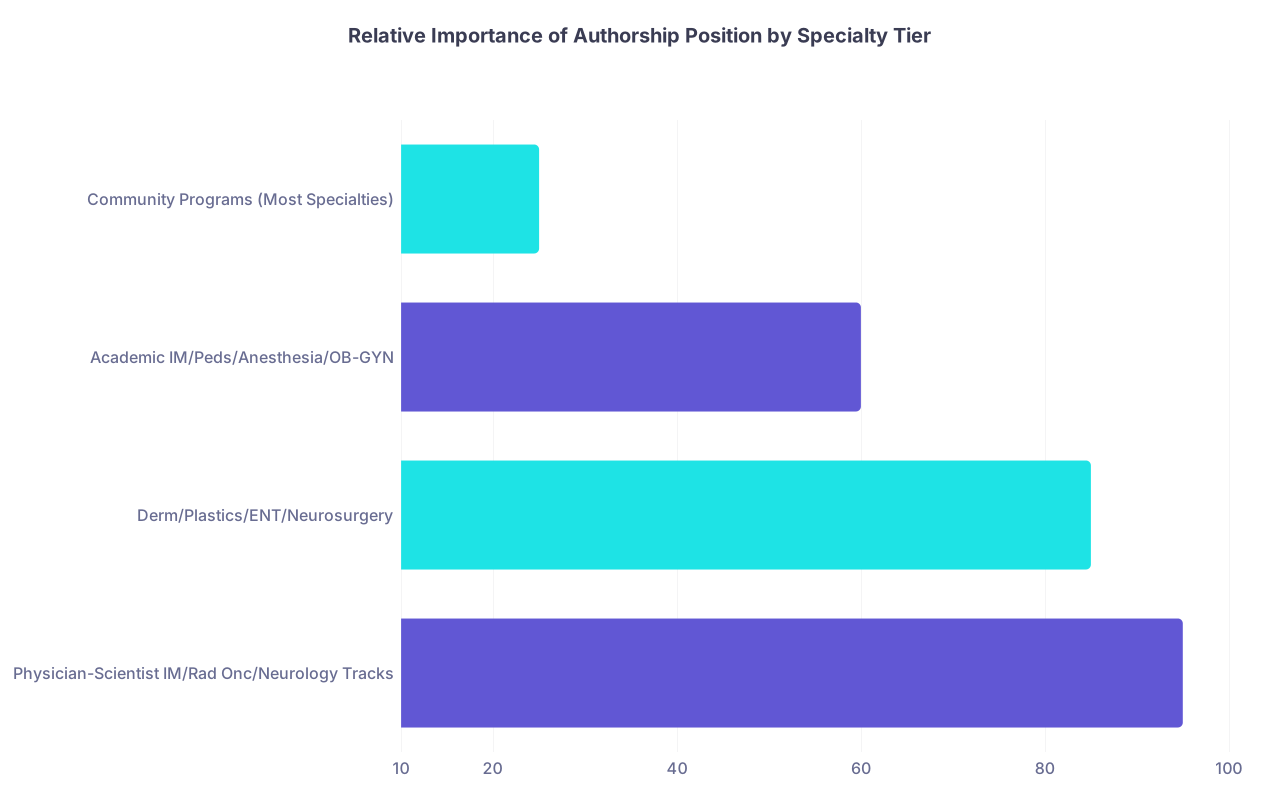
| Category | Value |
|---|---|
| Physician-Scientist IM/Rad Onc/Neurology Tracks | 95 |
| Derm/Plastics/ENT/Neurosurgery | 85 |
| Academic IM/Peds/Anesthesia/OB-GYN | 60 |
| Community Programs (Most Specialties) | 25 |
Hyper‑research‑heavy trajectories
- Dermatology at top programs
- Integrated plastics
- ENT at research‑heavy institutions
- Neurosurgery
- Radiation oncology
- PSTP / R38 / physician‑scientist tracks in IM, neurology, pediatrics
These groups care a lot about:
- Multiple first‑author works
- Evidence of hypothesis‑driven, not just descriptive, research
- Letters from research mentors documenting your role
- Some glimpse of independent thinking (even if primitive)
For these, a strong first‑author track record can literally shift you from “maybe” to “must interview.”
Middle‑author here is additive, not core. A few strong middle‑author roles help, but they rarely carry you alone.
Solid academic programs in more general specialties
Examples:
- Academic internal medicine programs (e.g., university‑affiliated IM)
- Pediatrics at children’s hospitals with robust research arms
- OB/GYN at university centers
- Anesthesia at academic centers
- EM at research‑oriented sites
These want to see:
- That you can participate in and complete projects.
- Ideally, at least one first‑author or project where your leadership is clear.
- A coherent story aligning your research with your career interests.
Here, a mix of 1–2 first‑author plus several middle‑author papers is very respectable.
Community and non‑academic programs
They care much less about the fine grain of authorship. As long as your research section does not look fabricated or bizarre, they will mostly focus on:
- Board scores / clinical grades
- Fit, professionalism, letters
- Basic evidence you can finish tasks (a QI project, maybe a small paper)
For these PDs, first‑author vs middle‑author is noise unless they are personally research‑oriented.
How PDs Integrate Authorship with Other Research Signals
PDs rarely look at authorship position in isolation. They triangulate it with three other things:
- Letters of recommendation.
- How you talk about your work.
- The overall structure of your CV.
1. Letters: the reality check
A strong mentor letter can dramatically upgrade how your authorship is perceived.
If a letter says:
“She was the intellectual driver of two projects, both of which she first‑authored, and she wrote the initial drafts, ran the analyses herself under my supervision, and is continuing this line of work into residency,”
then your first‑author lines just became gold.
But if your letter is generic, boilerplate, and does not reference your “multiple first‑author publications” at all, the faculty reader will quietly wonder how real your leadership was.
Similarly, a letter that spells out a substantial middle‑author role can rescue what might otherwise look minor:
“Although he was middle‑author, he built the REDCap database, managed all data cleaning, and created the analysis pipeline in R, which our group still uses.”
Now that middle‑author line reads very differently to an informed PD.
2. How you present your research in interviews
You will be asked one of the following, nearly verbatim:
- “Tell me about your research.”
- “Pick one of your papers and walk me through it.”
- “What was your role in this project?” (often pointing at a specific citation)
If your answer sounds like:
“I collected some data and helped with the draft,”
over and over, then your authorship positions are not saving you.
If instead you can say, with precision:
“I was first‑author on a retrospective cohort study of X in Y population. I helped design the inclusion criteria, built the data extraction form, and led the analysis, which was primarily logistic regression. We found that after adjusting for A, B, and C, the effect of D disappeared, so our conclusion shifted significantly between the initial abstract and final paper.”
Now the PD knows your first‑author status is honest. And if you say something similar for a middle‑author role but clearly define your niche contribution, that middle‑author line gains weight.
3. Overall CV structure
PDs and faculty look for patterns:
- Consistent work with 1–2 mentor groups vs random scatter of tiny projects.
- A build‑up from middle‑author early to first‑author later (this is ideal narrative arc).
- Evidence of increasing responsibility over time.
Someone who starts as a middle‑author on a group’s project in M1, then becomes first‑author on a follow‑up study in M3, is much more impressive than someone with four disconnected first‑author case reports assembled in a single pre‑match panic year.
Strategic Takeaways: How To Build and Sell Your Authorship Profile
Let’s shift from theory to what you should actually do.
1. Early on: accept middle‑author roles—tactically
If you are M1/M2 or early in research, middle‑author is normal and appropriate.
Your goal in that phase:
- Attach yourself to serious mentors, not just whoever promises first‑author.
- Learn how real projects work (IRB, data collection, stats, revisions).
- Build trust by doing unglamorous work well.
If you do this right, you will often be invited into more central roles later. That is how most genuinely strong first‑author papers by students happen.
2. By mid‑training: aim for at least one clear first‑author project
For most academic‑leaning applicants, the sweet spot by ERAS time is:
- At least one project where you can legitimately say: “I drove this,” and your authorship reflects that.
This does not have to be a Phase III trial. It can be:
- A solid retrospective study.
- A rigorous systematic review / meta‑analysis.
- A meaningful QI project with good pre‑post data and thoughtful design.
What matters is that your contribution is real, defensible, and articulable.
3. Prioritize project quality and narrative over raw count
Common trap: chasing any first‑author line you can get, even on flimsy or irrelevant work.
A more sophisticated approach:
- Two or three substantial projects (mixed authorship positions) in a coherent domain > ten random low‑impact items.
- Being the “go‑to” student for one lab or PI > superficial involvement with six different groups.
PDs and faculty in your target specialty will immediately see the difference.
4. Use your personal statement and experiences section to frame authorship
You can do some narrative repair or enhancement here.
For instance:
- In your “Most meaningful experience,” walk through that first‑author project step by step.
- For an important middle‑author paper, emphasize what you specifically contributed (“I built the database and handled data cleaning for 800 patients, which required…”).
- Link your research trajectory to your career goals (“These projects sparked my interest in X fellowship, where I hope to continue similar work in Y area.”)
This framing helps PDs interpret your CV the way you want, instead of making their own guesses.
Edge Cases and Misconceptions About Authorship
There are a few recurring confusions I see with students.
Co‑first authorship
If the article explicitly marks you and another person as “co‑first authors,” most PDs and faculty will treat that as essentially equivalent to first‑author—if you can articulate your leadership.
You should be ready with a clean explanation:
“We led different arms—she led the clinical data abstraction, I led the statistical analysis and primary drafting. We were both essential, so the PI designated us co‑first.”
That is fine. Just do not pretend you were the sole driver if you were not.
Last‑author as a student
Sometimes MD/PhD or prior‑career researchers end up as senior/last author. Faculty will notice and may ask.
If it is real, explain it:
“This was based on work from my prior PhD, where I was running my own group. I supervised two junior students, hence the senior author position.”
If it is gift authorship or your PI’s weird internal policy, be cautious. Over‑inflating this will backfire with people who know authorship norms.
“But my PI put my name in the middle even though I did a lot”
It happens. Some mentors spread authorship more equitably, others reserve first‑author for more senior trainees.
In that situation, your best tools are:
- A detailed letter from that mentor articulating your role.
- Your own clear description in ERAS and in interviews.
Experienced faculty know not every lab plays by the same authorship rules. They will listen to your description if it is precise and plausible.
A Quick Reality Check: How Much Does This Actually Move the Needle?
Research and authorship position are not the only levers. They sit alongside:
- Scores (USMLE / COMLEX or pass/fail school context)
- Clerkship performance
- Clinical letters of recommendation
- Interview performance
- Fit with program culture
For hyper‑competitive, research‑heavy paths, authorship can be decisive. For others, it is more of a bonus category.
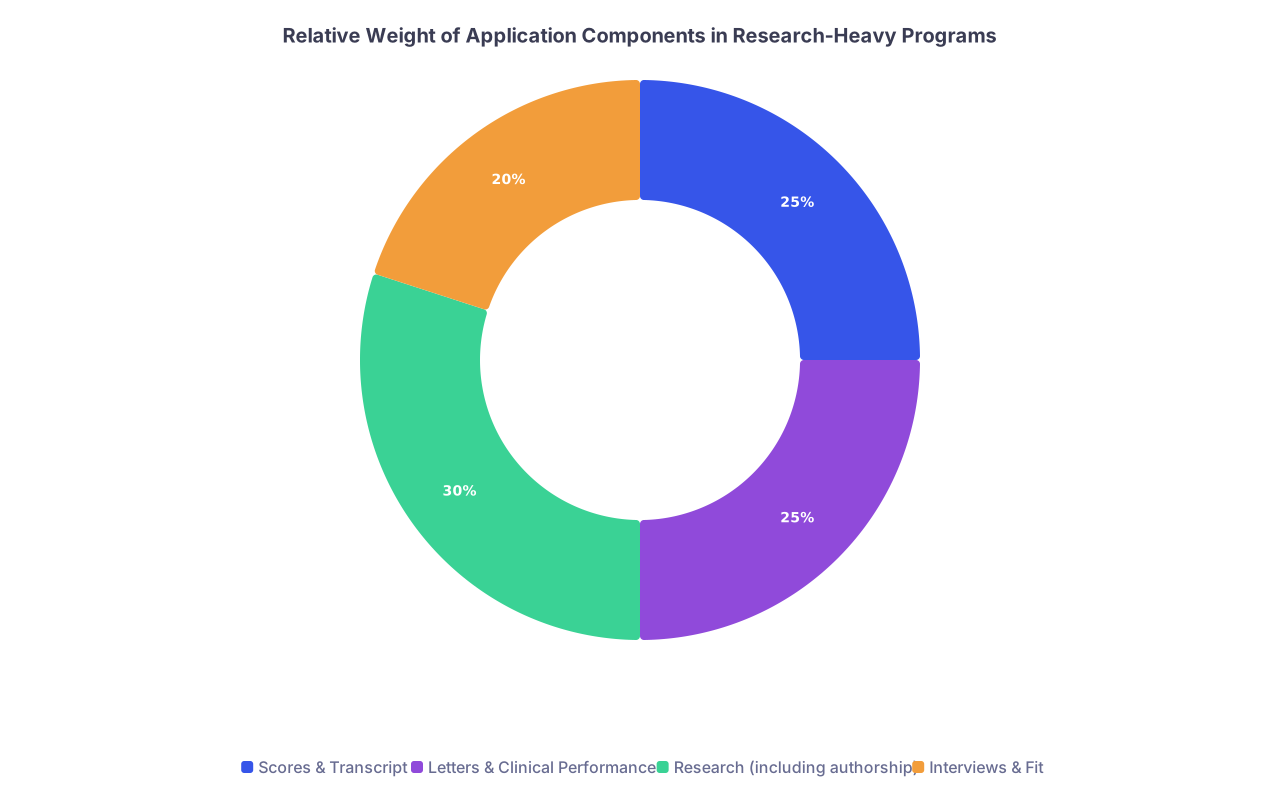
| Category | Value |
|---|---|
| Scores & Transcript | 25 |
| Letters & Clinical Performance | 25 |
| Research (including authorship) | 30 |
| Interviews & Fit | 20 |
Even where research is crucial, PDs are not doing a rigid point system:
- First‑author ≠ automatic interview.
- Middle‑author ≠ meaningless.
They are asking one core question:
“Does this applicant show the habits and trajectory of someone who will contribute meaningfully to our program’s academic mission?”
Authorship position is just one very visible part of that answer.
How To Talk About Your Authorship Without Sounding Defensive or Arrogant
Last piece, because I have watched applicants sabotage themselves here.
Avoid these two extremes:
- Minimizing: “Oh, it was just a middle‑author thing, not that important.”
- Inflating: “I basically did everything on this NEJM paper” (you probably did not).
Instead, use clean, factual language.
Something like:
“On this first‑author project, I led X, Y, and Z. My mentor guided the analysis and helped shape the final framing, but I wrote the initial drafts and responded to reviewers.”
or
“On this middle‑author paper, my primary role was building and managing the dataset for 500 patients and running the descriptive statistics. I was not involved in the final modeling, but I learned a lot from the biostatistician about how they approached it.”
Faculty know the difference between honest, grounded descriptions and embellished stories. They respect the former, even if your authorship line is not in the perfect spot.
Visualizing a Strong Research Trajectory
Let me sketch how a believable, impressive authorship progression might look over time.
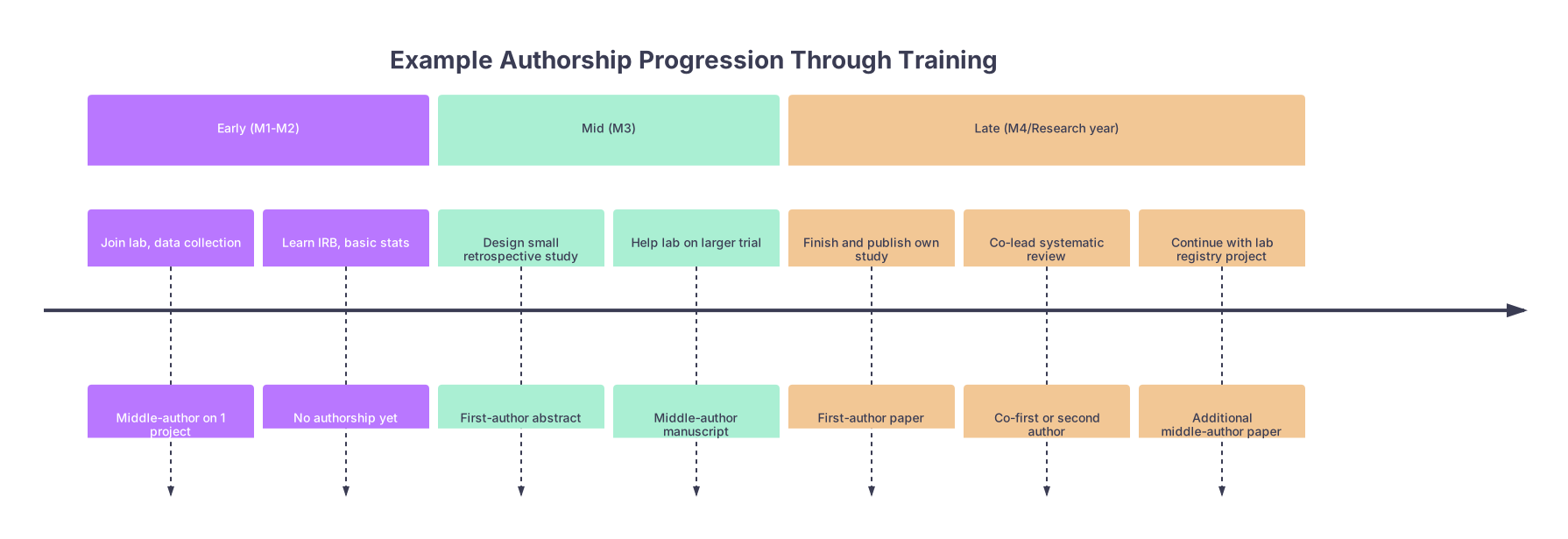
| Period | Event |
|---|---|
| Early (M1-M2) - Join lab, data collection | Middle-author on 1 project |
| Early (M1-M2) - Learn IRB, basic stats | No authorship yet |
| Mid (M3) - Design small retrospective study | First-author abstract |
| Mid (M3) - Help lab on larger trial | Middle-author manuscript |
| Late (M4/Research year) - Finish and publish own study | First-author paper |
| Late (M4/Research year) - Co-lead systematic review | Co-first or second author |
| Late (M4/Research year) - Continue with lab registry project | Additional middle-author paper |
That is the kind of arc that makes PDs think: “This person gets it.”
Key Points to Walk Away With
- First‑author is a strong signal of leadership and depth of involvement, but only when the project is substantive and you can defend your role; flimsy first‑author work in low‑quality venues impresses no one.
- Middle‑author publications are not filler if they are on serious projects, in good journals, or part of a coherent long‑term collaboration—and if you can clearly explain what you actually did.
- PDs integrate authorship position with journal quality, project type, letters, and your narrative; your job is to build at least one genuinely led project and then present your entire research portfolio in a way that makes your trajectory and contributions unmistakably clear.