
The way program directors interpret multi‑institutional projects is brutally simple: they care far less about how many logos are on the paper and far more about what you actually did and how clean your story is.
Let me break that down specifically.
What PDs Actually See When They Look at Your Research
Most applicants overestimate how forensically PDs will examine their research. They imagine someone pulling the PDF, reading the methods, parsing the authorship order.
Reality: on ERAS, PDs see a short title, your role, the type of project, and a journal or meeting name. They might glance for 3–5 seconds, maybe 10 if something catches their eye.
Here is how a typical PD mentally parses a research line item:
- Is this clinically or methodologically relevant to my field?
- Is this real and completed (pub/accepted/major presentation) or hand‑wavy “in progress”?
- Is the applicant’s role meaningful or fluff?
- Does this show they can finish work in a complex setting?
Multi‑institutional projects can help or hurt each of these, depending on execution.
| PD Question | Red Flag Example | Strong Signal Example |
|---|---|---|
| Relevance to specialty | Multi-center psych study for ortho applicant | Multi-center trauma registry for EM applicant |
| Completion status | “Data collection ongoing” only | “Accepted, Journal of Neurosurgery, 2025” |
| Role clarity | “Collaborator” on 30-site project | “Site PI; coordinated data collection at my site” |
| Evidence of follow-through | 5 multi-site projects, zero publications | 2 projects, 1 publication, 1 national presentation |
The “multi‑institutional” label is not automatically a plus. It is a multiplier of whatever story you are already telling. Strong work looks stronger in a multi‑center context. Fluff looks even flimsier.
The Real Pros of Multi‑Institutional Projects
When done properly, multi‑institutional work gives you a few very concrete advantages over single‑center projects.
1. Scale and Credibility
PDs know that genuine multi‑center projects are harder to coordinate, require infrastructure, and typically involve more senior mentorship. That signals maturity.
Strong examples:
- A 12‑center trauma registry study with 8,000+ patients in Annals of Surgery.
- A multi‑institutional survey on resident burnout across 20 programs presented at ACGME or APDIM.
- A collaborative QI initiative across three hospitals on sepsis bundle adherence with system‑level changes.
When a PD sees that plus a clear role, they infer:
- You can work in complex teams.
- You have seen how “grown‑up” research operates (IRBs, REDCap, data dictionaries, author committees).
- Your work is not just a pet project from one attending’s lab.
But the key is “genuine” multi‑center. Not “we sent a 10‑question survey to 4 friends at other schools.”
2. Networking and Letters
Multi‑institutional projects give you something more valuable than lines on a CV: people.
Common high‑yield scenarios I have seen:
- The lead PI at another institution writes you a strong, content‑rich letter because you rescued the data cleaning.
- A co‑author from another program flags your name to their PD: “This student was actually indispensable on our project.”
- You get invited to present at another institution’s conference or departmental meeting, and that turns into an away rotation or interview advantage.
In competitive fields (derm, ortho, plastics, ENT, neurosurgery), this “network lift” is often more important than the paper itself.
3. Systems Thinking and Logistics Experience
PDs in 2025 care about people who understand systems, not just p‑values.
Real multi‑institutional work forces you to:
- Deal with multiple IRBs and slightly different interpretations of “minimal risk.”
- Create standardized protocols that work in very different clinical environments.
- Handle messy, non‑uniform data and asynchronous timelines.
When you articulate that experience in an interview—how you harmonized variable definitions across 10 sites, or created training materials for data abstractors—you sound like someone who will do well in QI committees, multicenter trials, and national collaboratives during residency.
That matters more than your exact odds ratio.
4. Higher Impact and Visibility Potential
Not always, but often:
- Multi‑center studies are more publishable in mid‑to‑upper tier journals.
- Abstracts are more likely to be accepted at big national meetings, especially if the sponsor organization runs the collaborative.
- The project “headline” can be more impressive on a CV: “COVID‑19 Outcomes in 50,000 Patients Across 30 US Hospitals.”
That headline draws the PD’s eye on a crowded ERAS page.
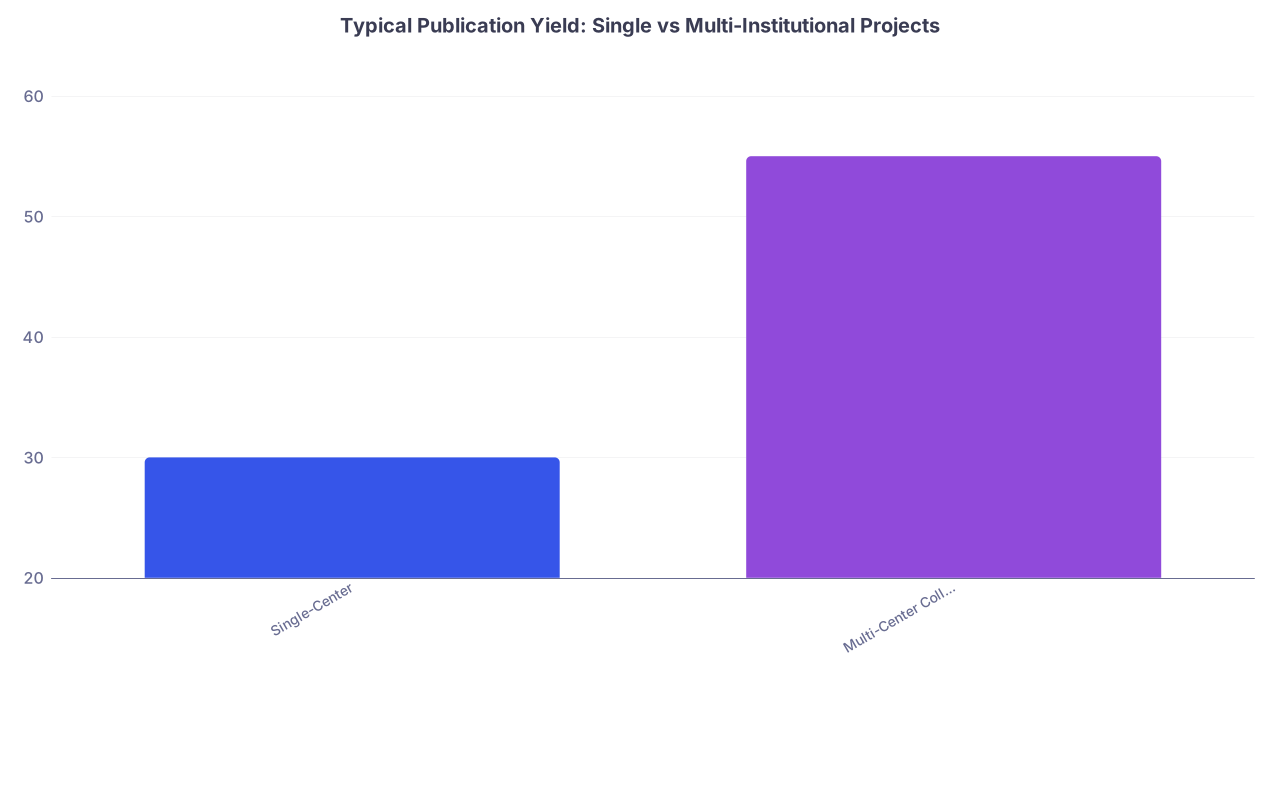
| Category | Value |
|---|---|
| Single-Center | 30 |
| Multi-Center Collaborative | 55 |
(The numbers above are illustrative, but they reflect the pattern I see: multi‑center work tends to have higher completion and dissemination when it is part of a structured collaborative.)
The Cons Nobody Tells Students About
Now the less glamorous half. Multi‑institutional projects are also where students get used and discarded the most.
1. Role Dilution and “Spreadsheet Fodder”
The most common problem: 40+ names on an author list, and your role is “helped with data collection.” Translation in PD brain: You filled out a REDCap form for a few afternoons.
If the only concrete thing you can say is:
- “I collected data from my institution,”
- “I helped distribute the survey,” or
- “I attended Zoom meetings,”
then the multi‑center part does not rescue you.
I have seen applicants list ten multi‑site “publications” from a big national collaborative, each with 80 co‑authors, and they could not explain the methods of a single study. That is worse than having fewer, more substantive entries.
PDs pick up on that in about 30 seconds of questioning.
2. Glacial Timelines and Zero Closure
Multi‑institutional = slow.
You may recognize this pattern:
- Month 1–3: Feasibility discussions, endless “we should…” emails.
- Month 4–8: IRBs, data agreements, protocol revisions.
- Month 9–18: Data dribbles in; 3 sites are always late.
- Month 18–24: Analysis, drafting, authorship disputes.
- Month 24–36: Journal ping‑pong.
You, as a medical student applying this cycle, sit in Month 11 with “multi‑institutional retrospective cohort study” stuck at “data collection ongoing.”
On paper, that project is barely better than nothing. It shows initiative but not completion. PDs heavily discount long lists of “in preparation” and “in progress” without at least one or two completed products.
3. Authorship Politics and Getting Cut
This part is ugly but real.
In big collaboratives, authorship rules can and do change mid‑process:
- A new faculty leader decides that only site PIs and statisticians go on the main paper; students get relegated to “supplementary collaborators list.”
- A site PI leaves; new leadership changes contribution thresholds.
- Your mentor overpromises authorship slots that never materialize.
You end up with: “I worked on a multi‑center project for 18 months, but my name is not on the paper.”
You can still mention the research experience in ERAS, but without your name on a poster or publication, it is a weak line. PDs have seen hundreds of applicants burned by this.
4. The “Honorary Author” Smell
There is a line between large‑scale collaborative science and author inflation. PDs with academic backgrounds are familiar with both.
Warning signs that make PDs suspicious:
- You have 15 multi‑institutional pubs and 0 first‑ or second‑author anything.
- All your publications are from one national collaborative series, each with >70 authors.
- You cannot explain the design, primary outcome, or main findings of any paper with your name on it.
That looks like opportunistic box‑checking, not genuine scholarly development.
When PDs smell honorary authorship, trust erodes fast. They start wondering what else on your application is padded.
How PDs in Different Specialties Tend to View Multi‑Institutional Work
Not all PDs weigh this the same way. The culture of the specialty matters.
| Specialty Group | Typical PD Attitude |
|---|---|
| Physician-scientist heavy (IM subs, Neuro, Heme/Onc, Cards) | Likes multi‑center trials/registries if methods solid |
| Procedural competitive (Ortho, ENT, Plastics, Urology) | Likes multi‑center work, but still wants first‑author |
| Lifestyle competitive (Derm, Rad Onc) | Impressed by high‑impact collaboratives with clear role |
| Primary care (FM, Peds) | Neutral; values QI and outcomes more than pure scale |
| EM, Anesthesia | Positive if EM/anesthesia specific; likes registry/QI |
Broadly:
- Internal medicine subspecialties and neurology PDs are often most research‑attuned. They care about methodology and whether you can discuss the study intelligently.
- Surgical specialties like ortho or ENT respect large national registries and collaboratives but still look for at least some first‑ or second‑author work to prove ownership.
- EM and anesthesia PDs like pragmatic registries, FOAMed collaboratives, and big QI/safety projects—especially if implemented across systems.
- Family medicine and general pediatrics: multi‑center is a mild plus, not a prerequisite. They care more that you helped change practice or address disparities than that you had 20 sites.
So the same project can be a “huge strength” in one context and “nice but not decisive” in another.
How to Present Multi‑Institutional Projects on ERAS
This is where many applicants blow it. They list vague, generic roles and let PDs assume the worst.
You need to do the opposite: make your specific contribution obvious in about two lines.
1. Use Role Language That Means Something
“Collaborator” is meaningless. “Co‑investigator” is often vague. Instead, describe the function you actually performed.
Better language:
- “Site principal student investigator; coordinated IRB submission and trained data abstractors.”
- “Led data cleaning and created analytic dataset in REDCap.”
- “First author; developed protocol, performed primary analysis, and drafted manuscript.”
Each of those signals responsibility.
2. Be Honest About Status but Highlight Concrete Products
Do not pretend your IRB‑approved idea is a publication. But do not undersell either.
If you have partial outputs, specify them:
- Abstract accepted to a national meeting.
- Regional presentation with an award.
- Preprint uploaded, in submission.
Example:
“Multi‑institutional cohort study of 12 EDs examining timing of vasopressor initiation in septic shock. Site lead for my institution; coordinated local data collection (n=180) and assisted with data dictionary. Abstract accepted, SAEM 2025 (oral). Manuscript in revision.”
That reads far stronger than “Data collection ongoing” with no other details.
3. Avoid Inflating “Participation” into Ownership
PDs know how multi‑center collaboratives operate. Overclaiming will backfire.
Bad:
“Designed multi‑center study evaluating…” (When you joined after the protocol was finalized.)
Better:
“Participated in multi‑center study evaluating…; at my site, implemented standardized data collection protocol and validated 200 chart abstractions.”
Grounded, specific, believable.
4. Tie the Project to Skills, Not Just Results
In your experiences section and personal statement, occasionally connect the project to a skill:
- “Learned to harmonize variable definitions across sites with different EHR systems.”
- “Navigated three IRBs (home institution plus two affiliates) and created unified consent language.”
- “Coordinated monthly Zooms across 10 time zones; used shared dashboards to track enrollment.”
That sounds like future chief resident material, not just another student filling cells.
How PDs Probe Multi‑Institutional Work in Interviews
If a PD is research‑minded and sees a big collaborative project on your CV, you should expect targeted questions. They are not trying to grill your statistics; they are trying to see if you truly owned something.
Common real‑world questions I have heard PDs ask:
- “Tell me about your role on this multi‑center study.”
- “How did the different sites coordinate data collection?”
- “What was the primary endpoint, and why was it chosen?”
- “What was one challenge the group encountered, and how did you personally contribute to solving it?”
- “If you could redesign the study, what would you change?”
If your answers sound like:
- “I am not sure; I mostly helped at my site,” or
- “I do not remember the primary outcome, but it was something about mortality,”
you lose ground very quickly.
Good answers mention:
- Specific steps you took (e.g., building data dictionaries, standardizing chart abstraction).
- Concrete numbers (sites, patients, response rate).
- Trade‑offs (e.g., why you chose a composite endpoint, or how you handled missing data across centers).
That tells the PD: This person did real work and can think critically.
Choosing Between Single‑Center vs Multi‑Institutional (Strategically)
You do not have infinite time. You need to decide where to invest: a single‑center project where you might be first author vs a multi‑center project where you are 1 of 50.
Here is a brutally honest way to think about it.
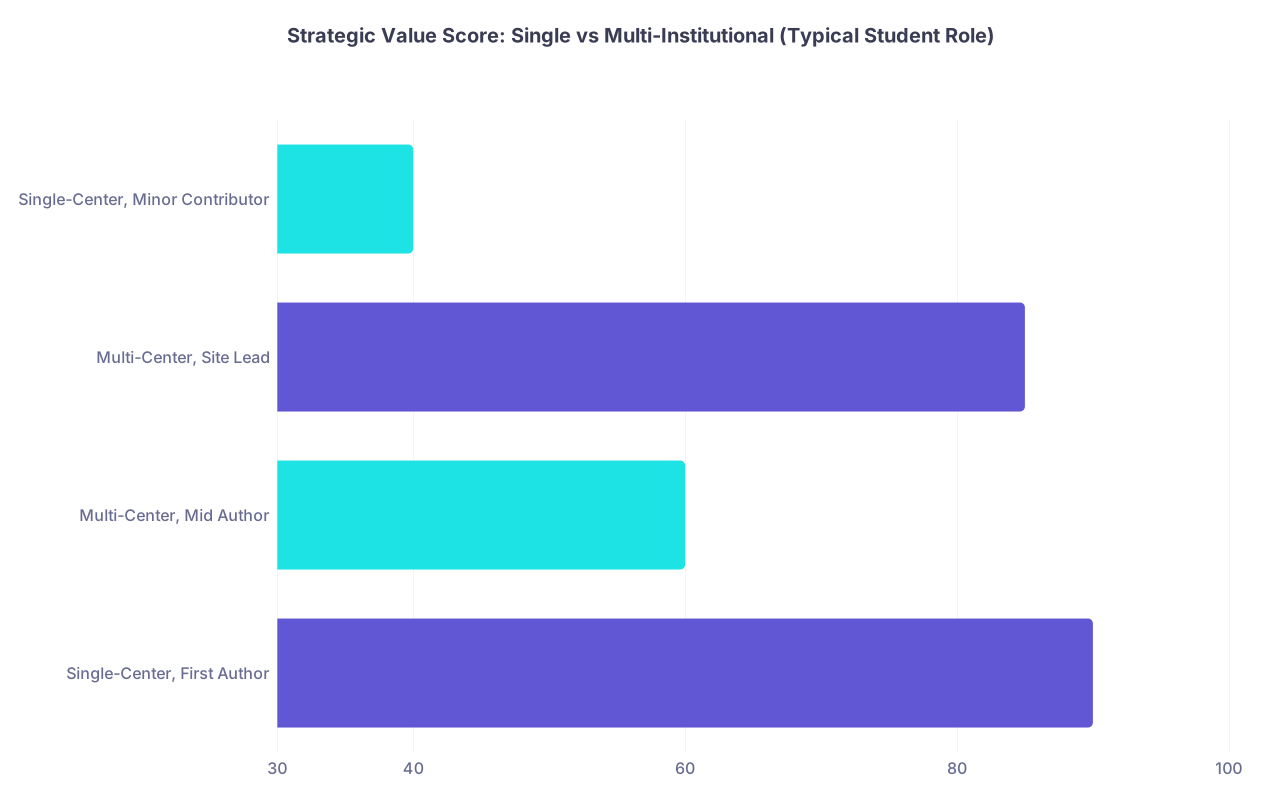
| Category | Value |
|---|---|
| Single-Center, First Author | 90 |
| Multi-Center, Mid Author | 60 |
| Multi-Center, Site Lead | 85 |
| Single-Center, Minor Contributor | 40 |
If you can reasonably secure:
- First‑author status on a meaningful single‑center project with a high chance of completion before ERAS → that is almost always worth prioritizing.
- A genuine “site lead” role on a multi‑center project with clear timelines and realistic publication plans → that is also high value.
Low‑yield scenarios you should be cautious about:
- Being one of dozens of data abstractors on multiple huge projects with no clear authorship or timeline.
- Jumping into a multi‑center idea that is still a concept with no IRB, no realistic sponsor, and a PI known for never finishing anything.
Better to have:
- 1–2 strong, completed projects (single‑center or multi‑center),
- plus maybe 1–2 ongoing, clearly described works,
than 10 vague “in progress” multi‑institutional efforts with nothing to show.
How PDs Rank: The Hidden Hierarchy of Evidence
They will not write this down, but most PDs have an internal hierarchy in their head when they scan research.
Something like:
- First‑author or second‑author publications (clinical, outcomes, or basic science) in legit journals.
- Major national presentations, especially oral or plenary.
- Substantive roles in large multi‑center trials/registries with at least one resulting paper.
- QI or education projects that changed actual practice, even if local.
- Laundry lists of minor authorships, multi‑center or not, without clear role.
Multi‑institutional does not automatically move you up the hierarchy. It just modifies how much credit you get in #3 and #5.
If your only research is minor contributor on a multi‑center project, that is not fatal—many specialties do not expect more—but you should not kid yourself that this “makes you a research powerhouse.”
The applicants who stand out use multi‑institutional work to demonstrate:
- Ownership of a piece of a complex process.
- The ability to bring something to completion.
- Maturity in how they talk about limitations and logistics.
Concrete Moves If You Are Already in a Multi‑Institutional Project
Let’s be practical. You may already be on one of these behemoths. How do you improve its value on your application?
Ask for a clearly defined, non‑trivial role.
- “Could I take the lead on drafting the methods section?”
- “Could I serve as the site lead for our institution and coordinate data abstraction?”
Attach yourself to one specific manuscript or abstract.
- Large collaboratives often spin off multiple papers. Try to be first/second author on at least one smaller, focused paper or abstract, even if the main mega‑paper remains out of reach.
Push for intermediate outputs.
- Offer to submit a preliminary abstract to a regional meeting based on your site’s data.
- This lets you list a completed product even if the final paper lags.
Document your contributions meticulously.
- Keep a one‑page log: dates, tasks, meetings led, data points abstracted. When you write ERAS descriptions or prep for interviews, you will have real material to draw from.
Be realistic about sunk cost.
- If 12–18 months have passed with no IRB approval or actual data, you may need to shift energy to a more nimble single‑center project that can finish before you apply.
Final Takeaways
Three points to remember:
- Multi‑institutional projects amplify whatever is already true about your research: real ownership looks stronger, superficial participation looks weaker.
- PDs care less about the number of institutions and more about whether you can clearly articulate your specific role, the study’s design, and how the work led to concrete outputs.
- If you can secure either a first‑author single‑center paper or a genuine leadership role (site lead, analytic lead, or key manuscript author) in a multi‑center project, you are in excellent shape; anything less must be presented carefully and honestly to add real value.