
The default advice about “just do any research” for residency applications is lazy and wrong.
For time‑limited students, the choice between cranking out a case report or pushing for a case series can be the difference between having something mildly useful on ERAS and having a line that actually moves the needle.
Let me be blunt: not all low‑budget, low‑resource clinical projects are created equal. Case reports and case series sit in that gray zone students love—“doable without a lab, IRB might be easier, quick-ish publication.” But if you do not understand how program directors, academic faculty, and PubMed indexing treat these differently, you will waste time.
So let’s pick this apart like someone who has actually sat in research meetings, written both, and watched how they land in real applications.
1. What You Are Actually Choosing Between
You already know the textbook definitions. I am not going to rehash those like a first‑year epidemiology lecture. Let me frame it the way attendings and PDs silently categorize your work.
Case report: the single‑patient anecdote
One unusual, instructive, or dramatic patient.
Structure: intro → case description → discussion → literature comparison. Usually:
- 1 patient
- 1 event / disease / complication
- Maybe 1–2 nice images
- Short, often 1,000–2,000 words
Reality check: Many journals treat these as low‑tier, sometimes non‑indexed, often buried in “Case Reports” sections. They are easier to write and accept, but they are also everywhere. Saturated.
Case series: the “mini-cohort” with just enough data
Several patients with a shared feature—same condition, same treatment, same complication, same imaging finding.
Usually:
- 3–20 patients (dependant on rarity)
- Rudimentary stats (even simple proportions and medians can be enough)
- More structured data abstraction (tables, maybe a figure)
- More robust discussion of patterns and implications
Program directors mentally file this closer to “real” clinical research. Not a full cohort study, but evidence that you can handle data, not just tell a story.
Now the key question: as a time‑limited student trying to bolster residency applications, which one is smarter?
Short answer: if you have any realistic path to a case series, it is almost always the smarter play compared to a single case report—if you do not blow your timeline. The only time a solo case report wins is when the alternative is nothing.
2. How Programs Actually Value Case Reports vs Case Series
Ignore the “any research is great!” cheerleading. It is not how programs think when they have 3,000 applications on ERAS.
What matters for them:
- Signal of scholarly engagement
- Complexity of your role
- Rigor of the work
- Journal quality / indexing
- Fit with the specialty
Let me map this in a way that reflects what I have actually heard said in review meetings.
| Feature | Case Report | Case Series |
|---|---|---|
| Perceived rigor | Low | Low–moderate |
| Evidence you can handle data | Minimal | Clear evidence of data handling |
| Academic “weight” | Weak unless very unique/impactful | Moderate, higher if in good journal |
| Common in top-tier CVs | Rare to see many; usually 0–2 | More common, especially in academic tracks |
| PubMed indexing likelihood | Variable, often poor in tiny journals | Better odds in mainstream specialty journals |
The pattern I see:
- One or two case reports do not hurt you. They show you at least got into the arena.
- A case series, if decently done, looks more intentional. It reads as “I did actual clinical research,” not “I wrote up something odd that walked in the door.”
- Multiple weak case reports in non‑indexed, obscure journals can start to look like padding.
If you are gunning for competitive specialties (derm, ortho, ENT, plastics, rad onc, neurosurgery, integrated vascular, etc.), the bar is higher. Case series help, case reports are mostly filler unless they are in a big‑name journal or clearly in the specialty.
3. Timeline and Workload Reality: What Can You Actually Finish Before ERAS?
Here is where most students miscalculate. They underestimate how long publication takes and overestimate how “fast” a case report will be.
You should think in terms of what will be submitted and what will be accepted/published by the time programs see your application.
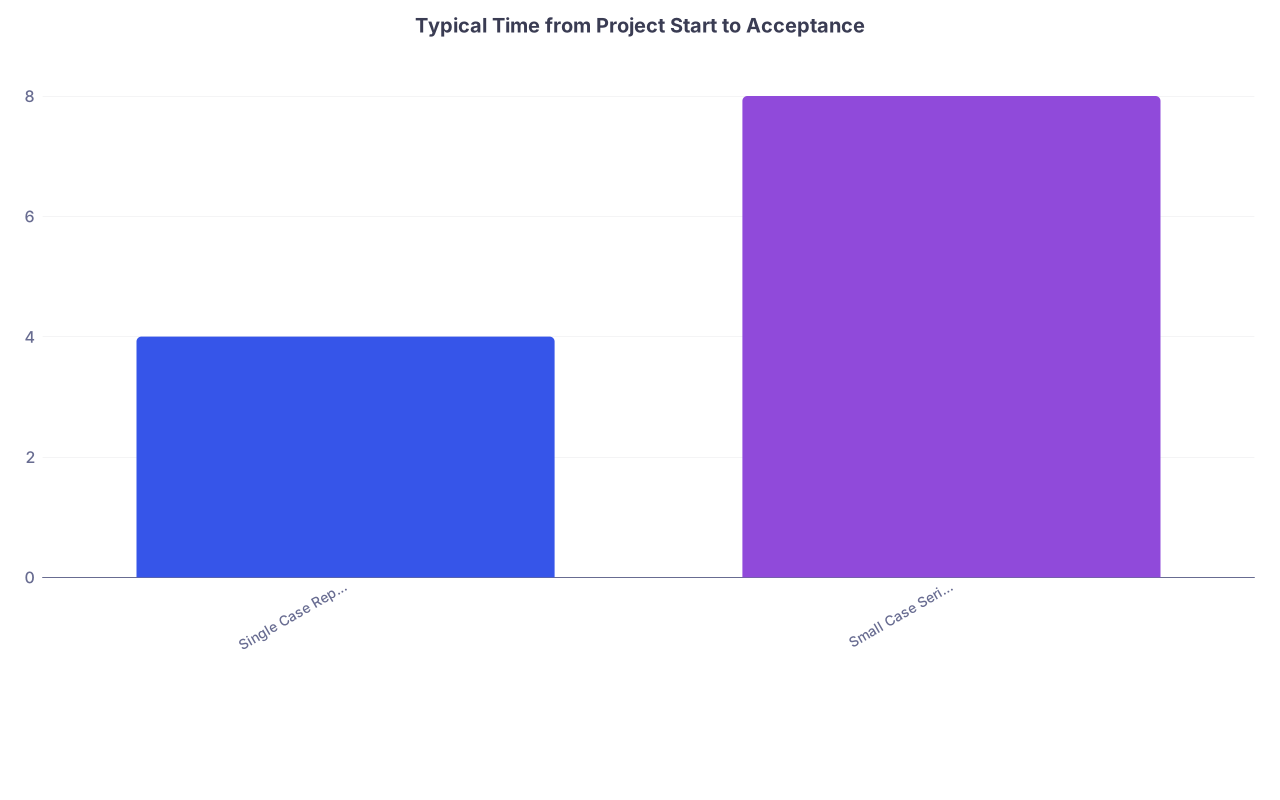
| Category | Value |
|---|---|
| Single Case Report | 4 |
| Small Case Series (5–10 pts) | 8 |
Interpretation (these are rough, real‑world averages in months if you are reasonably organized):
Single case report:
- Data gathering: 1–2 weeks
- Writing: 2–4 weeks part‑time
- Revisions with attending: 2–4 weeks (can drag if they are slow)
- Peer review + acceptance: 2–4 months, sometimes longer
- Total: 3–6 months from first draft to acceptance is common
Case series (5–10 patients):
- Case identification & chart review: 4–6 weeks
- Data abstraction + cleaning: 2–4 weeks
- Writing + basic tables: 4–6 weeks
- Revisions with coauthors: 4–8 weeks
- Peer review + acceptance: 3–6+ months
- Total: 6–12 months is realistic
So the smarter choice depends heavily on where you are in your training and match timeline.
4. Phase‑Specific Strategy: MS3, MS4, and Gap Years
Different answer if you are a rising M3 vs 6 months from ERAS submission. Let me break it down precisely.
Rising MS3 or early MS3 (12–18 months to ERAS)
This is the sweet spot where a case series becomes very attractive if you can get a reliable mentor.
Best move:
- Aim for a small, focused case series aligned with your target specialty.
- Example:
- Internal medicine hopeful: “Case series of myasthenic crisis in patients with thymoma on targeted therapy”
- Ortho hopeful: “Case series of atypical femoral fractures associated with long‑term bisphosphonate use at our institution”
Why smarter than multiple case reports here?
- You have enough time to collect 5–15 patients.
- Your learning curve in data abstraction and basic stats shows up in interviews.
- If it gets accepted in a mid‑tier specialty journal, you suddenly look much stronger than peers with 2–3 generic case reports.
You can still start with a single case report to learn the structure, then extend into a series once you realize, “We have 7 of these over the last 5 years.”
Late MS3 / early MS4 (6–12 months to ERAS)
Now your margin is thinner. You must be careful.
Here is a very direct rule:
- If you are <9 months from ERAS submission and starting from zero: a brand‑new case series is risky as your primary plan. You might end up with an “in progress” line that is not accepted anywhere.
- Smarter plan:
- 1–2 fast but meaningful case reports you can get submitted within 2–3 months.
- Join an ongoing series where data collection is already well‑advanced.
Typical scenario I have seen:
You find an attending who says, “We actually have 10 patients with this, we have a spreadsheet half‑done, we just never wrote it up.”
That is gold. Now a case series is absolutely worth your time even this late. Your job is mostly:
- Clean data
- Redo or finalize abstraction
- Draft manuscript
- Push the attending to submission
Then pair that with a single classic case report you can control the timeline on.
3–6 months before ERAS, borderline panic phase
At this point, starting from zero:
- A new case series is almost always dumb as your primary research plan.
- You do not have the time for full IRB approval + chart review + writeup + revise + submit, let alone acceptance, unless your system has a well-oiled pathway.
Better moves:
- One well‑written case report you can submit quickly.
- A research abstract or poster from existing hospital data (mini QI project, small retrospective review).
- Slide into already established projects where you can be middle author and still talk about your contribution.
The rule now is: certainty of completion trumps theoretical academic superiority.
Program directors would rather see a completed, published case report than a hand‑wavy “case series in preparation” that may never see PubMed.
5. Impact on ERAS: Lines That Actually Matter
On ERAS, your research items get flattened to:
- Type (Journal Article, Abstract, Poster, etc.)
- Role (First author, middle, etc.)
- Status (Submitted, Accepted, Published)
- Journal name and indexed status
The CV does not label something “case report” vs “case series” explicitly. But anyone who actually opens the paper will see it.
Here is how this plays out:
- “First author, published, PubMed‑indexed” is the holy trinity, regardless of case report vs case series.
- That said, when a faculty interviewer actually clicks your paper and sees a case series with 12 patients, tables, and some legit analysis, the impression is higher than a simple one‑patient anecdote.
- In competitive specialties, many PDs can smell when your entire research experience is “weird one‑off patients I turned into low‑tier case reports.”
So from an ERAS optics standpoint:
- One or two case reports: Fine, especially early.
- One solid case series: Noticeably better signal if done in your desired specialty, as first author, in a decent journal.
6. Mentorship, Access, and How Much Control You Actually Have
You are not choosing in a vacuum. You are constrained by:
- How strong your mentor is academically
- What data or patients they can give you access to
- Their track record of actually getting things published
Here is the uncomfortable truth: a mediocre case series with a strong mentor in a good department beats a heroic solo case report in a no‑name journal with no guidance.
What I listen for when students describe their project:
- “My attending has 3–4 published case series in this area.”
Good. They know the drill. - “They said we should just send it to ‘any journal that will take it’.”
Red flag. You will probably end up in a predatory or non‑indexed outlet. - “They have a database of cases from the last 5 years.”
Perfect for case series. - “We just had a crazy patient, my resident said ‘this would make a great case report.’”
Fine starter project, but probably not your flagship research.
If your mentor is research‑light:
- A single case report may be more realistic. Less complex methodology, fewer moving parts.
- Trying to drag them through a full case series design, IRB, abstraction templates, and revisions can stall and leave you with nothing.
If your mentor is research‑heavy:
- Push for a small, focused series, especially if they already have an existing case log or database.
7. IRB, Bureaucracy, and Hidden Time Costs
Students often miss this part completely. Time is not just writing and revising. It is:
- IRB review or exemption
- Chart access permissions
- HIPAA safe‑guarding
- Attending sign‑offs, revision cycles
- Journal formatting nonsense
Roughly:
Single case report:
- Many institutions treat single de‑identified case reports as exempt from IRB or under “not human subjects research.”
- So you can often move fast—less paperwork, quick attending OK, and you are writing.
Case series:
- Nearly always requires IRB review or at least formal determination of exemption.
- This alone can add 4–8 weeks if your IRB is slow, especially if this is your mentor’s first time with that IRB.
So if your institution has:
- Clunky IRB + no existing protocol = starting a case series late in the game is bad strategy.
- Streamlined IRB + mentor with prior approvals = a case series becomes very doable in M3.
8. Learning Value: What You Actually Gain as a Trainee
Forget optics for a second. Ask what each format actually teaches you.
Case report teaches you:
- How to structure a scientific manuscript
- Basic PubMed search and literature review
- Scientific writing style and referencing
- Navigating a journal submission portal
- Responding to peer review comments
Case series teaches you all of the above plus:
- Creating a data abstraction sheet
- The frustration of incomplete charts
- Basic statistics (even if just medians, ranges, and percentages)
- Table design: what is worth reporting, what is noise
- More nuanced discussion: patterns, hypotheses, potential confounders
From a training perspective, a well‑run case series is better education. You actually learn the skeleton of clinical research.
That matters when an interviewer asks, “Tell me about your research—what was your role?” and you can answer:
- “I helped collect and abstract data for 14 patients, designed the table structure, and worked with our statistician on descriptive analysis.”
That sounds like you did real work. Compare that to:
- “I wrote up one interesting patient with a rare complication and reviewed the literature.”
Not useless. Just clearly more superficial.
9. Specialty‑Specific Nuances: When Series Matter More
Some specialties care more about patterns and outcomes; others are more image‑driven or anecdotally friendly. Let me walk through a few.
Surgical fields (general surgery, ortho, neurosurgery, ENT, plastics)
- Case reports are everywhere: “Rare complication of X,” “Unusual anatomic variant,” etc.
- They are fine starter projects but do not stand out by themselves.
- Case series that actually answer a question (e.g., complications after a specific flap, outcomes after a specific fixation pattern) get talked about and cited more.
For a student: one well‑done case series in your surgical interest that lands in a mid‑tier specialty journal can do more for your narrative than three scattered case reports.
Internal medicine subspecialties (cards, GI, heme/onc, rheum)
- These fields love patterns, risk factors, response to treatments.
- A series of 10–15 patients with a specific phenotype or drug effect is far more interesting scientifically.
- Even small registries or local series matter in rare diseases.
Here, a case series has real academic legs. If you can join one, do it.
Radiology, pathology, derm
These are image‑heavy, phenotype‑oriented fields. Case reports and series both exist in large numbers.
- Case reports with striking imaging can do fine, especially if they highlight classic teachable patterns.
- Case series that define a subgroup, a new classification, or typical radiographic features of a rare entity stand out more.
For radiology and derm especially, a well‑illustrated series with consistent imaging findings is a high‑yield educational piece. Worth the extra work.
10. Common Pitfalls That Waste Students’ Time
I have seen students kill 6–9 months on bad projects. Here are the big failure modes.
Chasing a “perfect” rare case report that never gets finished.
Endless “we should add this” from the attending, never submitted, nothing to show.Starting an ambitious case series with a mentor who has zero bandwidth.
They promised you the charts. They never send them. You are now doing nothing but polite follow‑up emails.Submitting to predatory or garbage journals.
They accept anything in 48 hours if you pay a fee. PDs know these names. It does not help you.Overbuilding the project beyond the timeline.
Turning what should be a 4‑patient case series into a 50‑patient major retrospective with survival analysis. You do not have that time as an M3/M4.No clear first‑author agreement up front.
You think you are first author. The attending’s pet fellow appears at the end and takes that spot. Now your time investment yields less ERAS value.
Avoid these and even a simple case report can be efficient and beneficial.
11. So, Which Is Smarter—Case Series or Case Report?
Let me answer the actual question clearly.
If you are a time‑limited student applying for residency:
Best‑case scenario:
A small, well‑executed case series, ideally in your target specialty, as first author, in a PubMed‑indexed journal, started early enough (M3 or earlier).Pragmatic scenario (most students):
One decent case report you can surely complete and submit + involvement in a partially done case series, even if it ends up accepted after ERAS. You can still list it as “submitted” or “in progress,” and talk about your role.Worst‑case but still acceptable:
One solid case report, well written, in a legitimate journal, is far better than nothing—especially if you have other scholarly activities like QI projects, posters, or presentations.
If you are within 6–8 months of ERAS and starting from scratch, the “smarter” project is the one that will be fully written, submitted, and ideally accepted by then. For many, that is a case report, not a brand‑new case series.
So the decision algorithm, if I had to put it simply, is:

| Step | Description |
|---|---|
| Step 1 | Time until ERAS >= 12 months? |
| Step 2 | Strong research mentor with data access? |
| Step 3 | Need fast, guaranteed output |
| Step 4 | Aim for small case series in target specialty |
| Step 5 | Start with a case report, explore add-on cases |
| Step 6 | Prioritize 1–2 solid case reports |
12. How to Decide in One Real Conversation With Your Attending
Here is how I would handle it, verbatim, if you are trying to choose:
You:
“I am applying in [specialty] and I would really like at least one first‑author publication before ERAS. We have this patient that might make a solid case report. Do you think we also have a few similar patients that we could turn into a small series, or is it more realistic to just do a single case?”
Their reaction tells you almost everything:
“Oh yes, we have 8 of these over the last few years; I just never had anyone to help.”
Lean hard into a case series.“This is the only one I’ve seen in my entire career.”
Do a clean, educational case report, do it quickly, and move on.
Then you anchor the timeline:
You:
“I have about [X] months before I need this on my ERAS. If we go the series route, do you think we can realistically get it submitted by [month]?”
If they hesitate, waffle, or say, “We should be able to, I think,” with no sign of a plan—downshift your expectations. Probably do the case report and help them with the series on the side if time allows.
You do not earn extra points for aspirations that never leave your laptop. You get credit for what is on ERAS and what you can defend in an interview.
Case reports are the on‑ramp. Case series are the sturdier bridge toward being taken seriously as a budding clinician‑investigator. If you choose based on your real timeline, your mentor’s actual capacity, and your specialty’s culture, you will not waste effort on vanity projects.
Once you have one or two of these under your belt, you will be ready to think beyond anecdote and mini‑cohorts—to retrospective cohorts, QI interventions, and eventually prospective work. That is where the real academic signal lives. But that is a next‑step problem, and you can tackle it once Match is safely behind you.