
The biggest mistake med students make with “quick ERAS research” is pretending a complex project can be compressed into three months. It cannot. But a carefully designed small project? That can absolutely be finished before ERAS opens—and actually help you.
Let me break this down specifically, the way I’ve seen it play out on real CVs and in real program director conversations.
Step 1: Start With Brutal Constraints, Not Dreams
You do not start by asking, “What topic interests me?” You start with: “What can I actually finish before ERAS?”
You have three hard constraints:
- Time to submittable output (not just “data collected”)
- Logistics (IRB, data access, collaborators)
- Your bandwidth (rotations, Step 2, away electives)
For most rising M4s, we are talking about a 6–12 week runway from “I should get something done” to “ERAS is live.” That means:
- Anything needing full IRB review: usually dead on arrival.
- Prospective enrollment projects: too slow.
- Multicenter trials: fantasy.
You are hunting for projects where:
- IRB is already in place
- Or no IRB is required
- Data is already collected or trivially accessible
- Analysis and writing can be done on nights/weekends
Let’s quantify it. If you start 10–12 weeks before ERAS:
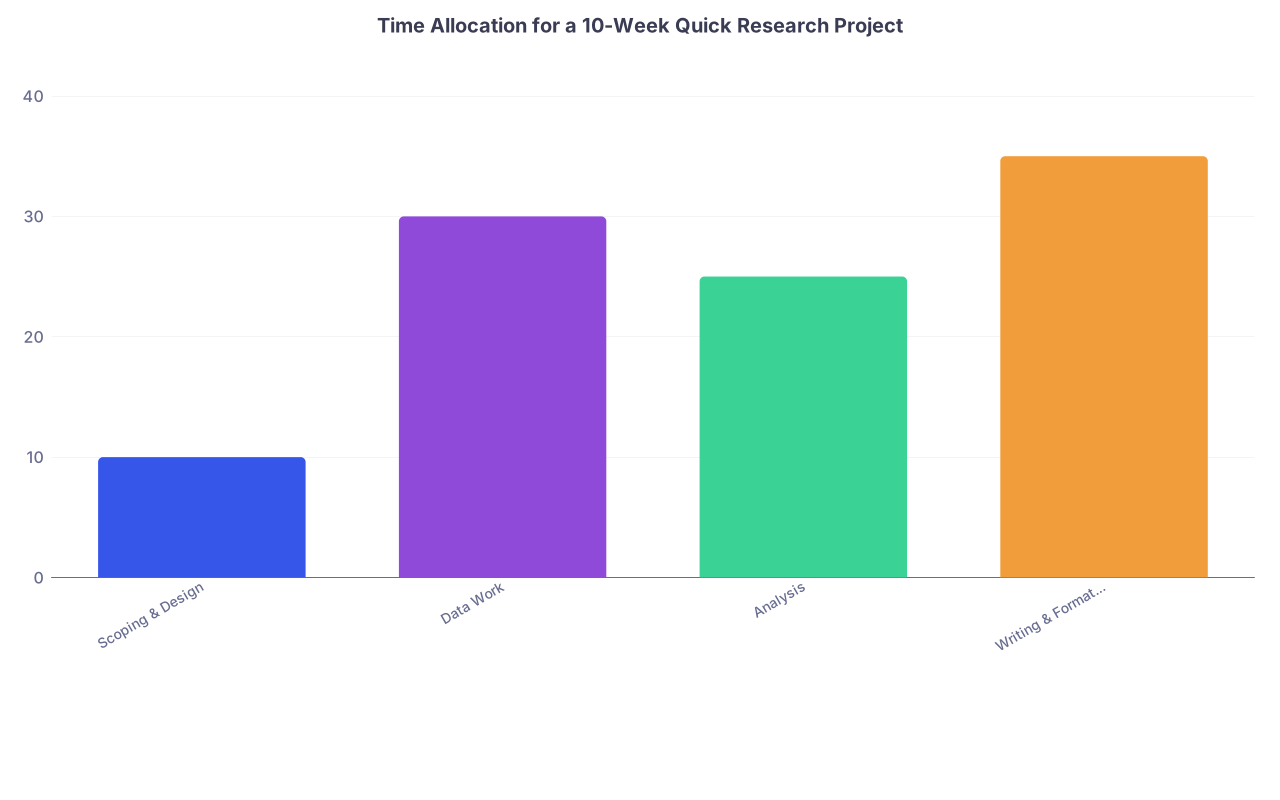
| Category | Value |
|---|---|
| Scoping & Design | 10 |
| Data Work | 30 |
| Analysis | 25 |
| Writing & Formatting | 35 |
If your idea cannot realistically fit into that distribution, it is not a “small project.” It is self-sabotage.
Step 2: Choose the Right Type of Project (Not All Count the Same)
Some kinds of research are built for tight timelines. Others are guaranteed to spill past ERAS, no matter how hard you grind.
Here is how I rank project types by feasibility and ERAS impact under a 2–3 month runway.
| Project Type | Feasibility in 2–3 Months | Strength on ERAS | IRB Need? |
|---|---|---|---|
| Case report (single case) | Very high | Moderate | Often exempt |
| Micro case series (2–5 cases) | High | Moderate-Strong | Usually exempt |
| Retrospective sub-analysis of dataset | Moderate-High | Strong | Existing IRB |
| Narrative review (with mentor) | High | Moderate | No |
| Brief survey of residents/students | Moderate (IRB bottleneck) | Moderate | Usually needed |
If ERAS is coming up this cycle, your realistic menu is:
- Single case or very small case series
- “Slice” of an existing retrospective project
- Narrative review, scoping review, or short systematic review under tight scope
- Quality improvement project with at least one cycle completed and written up
Trying to start a full de novo retrospective chart review involving hundreds of patients from scratch in late spring of M3 is how students end up with “project in progress” lines that never mature.
Step 3: Where to Find a Project That Is Already Half-Done
You will not finish a meaningful project before ERAS unless something about it is already in motion. That might be:
- IRB already approved
- Data already collected or partially collected
- Mentor already has a draft, slide deck, or abstract
- QI process already underway on the ward
Here is the part students underestimate: mentors hoard partially finished ideas. They also complain constantly (to each other) about not having enough help to finish them.
You tap into that.
Concrete places to look:
Specialty-specific research faculty
- Example: Applying to IM? Email the cardiology, pulm/crit, or hospitalist research leads.
- Subject line that actually gets opened:
“Rising MS4 seeking small, short-turnaround project before ERAS”
Fellows and senior residents
These are your best bet for already-started:- Case reports with images ready
- Sub-analyses from fellowship research
- Small QI projects that just need data checks and a write-up
Departmental conferences
- Morbidity & mortality: ripe for case reports and QI writeups
- Grand rounds / specialty conferences: often feature single interesting cases that never get written up
When you reach out, do not say “I’m open to anything” and then act surprised when someone hands you an impossible database project. Say:
- “I’m specifically looking for a small project that can reasonably be written and submitted as a case report, brief report, or short review before September.”
- “I have X weeks and Y hours per week.”
- “I can: [list concrete skills—basic stats, EndNote, Excel, chart review, drafting sections].”
Vague gets you vague. Specific gets you a project.
Step 4: Design a Project That Actually Fits the Clock
Now assume you have a mentor and a rough idea. Before you say yes, structure the project ruthlessly around ERAS timing.
Think in weeks, not months.
A realistic 8-week micro-project timeline
Let’s take a typical case report / brief retrospective analysis that you pick up in, say, mid-May.
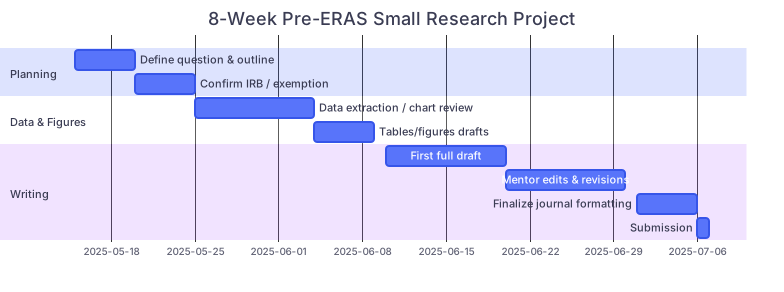
| Task | Details |
|---|---|
| Planning: Define question & outline | a1, 2025-05-15, 5d |
| Planning: Confirm IRB / exemption | a2, after a1, 5d |
| Data & Figures: Data extraction / chart review | b1, 2025-05-25, 10d |
| Data & Figures: Tables/figures drafts | b2, after b1, 5d |
| Writing: First full draft | c1, 2025-06-10, 10d |
| Writing: Mentor edits & revisions | c2, after c1, 10d |
| Writing: Finalize journal formatting | c3, 2025-07-01, 5d |
| Writing: Submission | c4, after c3, 1d |
If someone hands you a project that clearly needs 8+ weeks just for data cleaning, you will not be hitting “submit” before ERAS.
Key design rules if you want to finish:
Limit scope to one tight primary question
Wrong: “Analyze predictors of mortality, LOS, readmission, and complications in all ICU patients over 10 years.”
Right: “Describe outcomes of patients with X diagnosis who received Y intervention at our center over the last 3 years.”Cap your sample size intentionally
This makes statisticians twitch, but you are optimizing for completion, not grant-level power.
Example: instead of 600 charts, take all patients from the past 2 years or limit to a specific inpatient service.Define your minimum publishable unit (MPU) on day one
Ask: “What is the smallest coherent piece of this that can be written as:- A case report
- A brief communication
- A short original article
- A QI report?”
Start there. Expansion can happen after ERAS.
Align the project with fast-responding journals
Do not target NEJM. Or JAMA. Or anything that makes your attending say, “We can try, but…”
You want journals that:- Publish case reports or brief reports
- Are specialty-focused
- Have online-only, quick-review formats
Step 5: Pick One of These Proven “Small Before ERAS” Templates
Let me make this even more concrete. Here are templates I’ve seen multiple students actually finish before ERAS.
1. High-yield case report
Scenario: You saw an unusually young patient with a classic “board question” disease, or a rare complication after a common procedure.
What you need:
- Interesting angle (rare, novel association, diagnostic challenge, or management twist)
- Imaging or pathology you are allowed to use
- A willing attending co-author
Process:
Week 1:
- Confirm no one else is already writing it.
- Get attending and possibly specialist on board.
- Outline: Introduction (2–3 paragraphs), Case description, Discussion (3–6 paragraphs), References.
Week 2–3:
- Draft the case section from chart notes.
- Pull 10–15 key references.
- Draft intro and discussion around a single focused teaching point.
Week 4–5:
- Refine images (HIPAA-compliant).
- Get attending edits.
- Decide on a case-report-friendly journal (many specialties have one or two go-tos).
Week 6:
- Final edits, author forms, submit.
On ERAS you can truthfully write:
“Co-author, case report on [X] submitted to [Journal]; under review.”
Programs will not crucify you if it is not accepted yet. They will care that you drove something to submission.
2. Retrospective micro-analysis from existing dataset
Scenario: Your mentor or fellow has a big database of patients with disease X. They already published the main outcomes paper. You carve out a small secondary angle.
Examples:
- Subgroup of patients over 80
- Impact of a lab value at admission on ICU transfer
- Differences between weekend vs weekday admissions
What you need:
- Existing IRB that covers your question
- Cleaned dataset with your variables of interest
- Basic stats capacity (or a fellow/biostatistician who agrees to help)
Process:
Week 1:
- Clarify the single primary question and main outcome measure.
- Verify IRB coverage.
- Get a codebook / data dictionary.
Week 2–3:
- Run simple descriptive stats and 1–2 key comparisons.
- Produce 1–2 tables and maybe 1 figure.
Week 4–5:
- Draft Methods and Results first (this keeps you honest).
- Then write a short, tightly focused Introduction and Discussion.
- Keep word count modest—target journals with 2,000–3,000 word limits.
Week 6–8:
- Iterative edits with mentor.
- Choose a mid-tier specialty journal and submit.
This kind of project looks very good to residencies because it signals you can handle data, not just “I saw an interesting patient once.”
3. Narrow narrative review with clinical mentor
Scenario: You and your mentor see the same clinical question come up repeatedly on rounds. For example:
- Anticoagulation management around common procedures
- Workup of mildly abnormal lab values in outpatients
- Post-op pain control in patients with OUD
This becomes a narrative review or “clinical update” piece.
What you need:
- A mentor who is genuinely willing to co-write
- A topic that is not so broad it turns into a textbook
Process:
Week 1:
- Define a very crisp title: “Approach to [niche problem] in [specific population].”
- Outline headings: 4–6 main sections max.
Week 2–3:
- Do a targeted PubMed sweep to identify 20–40 key articles.
- Create a very simple evidence table in Excel or Word.
Week 4–5:
- Draft the review section-by-section.
- Keep it practical and clinically framed, not a systematic review.
Week 6–8:
- Mentor edits, refine, format, and submit to a specialty journal that publishes narrative reviews or “Clinical Practice” style articles.
On ERAS, this displays as a more substantial scholarly product, especially if your specialty is very guideline-driven.
Step 6: Understand What ERAS Actually Cares About
Students obsess about “accepted vs submitted vs in prep.” Program directors look at a much cruder set of signals:
- Have you engaged with scholarly work at all?
- Did you actually finish something, or are all your entries “in progress”?
- Are your projects even slightly coherent with your chosen specialty?
- Do your role descriptions sound like you were a passive name on a list or someone who drove the work?
Here is roughly how the strength stacks up for a small project if you execute well:
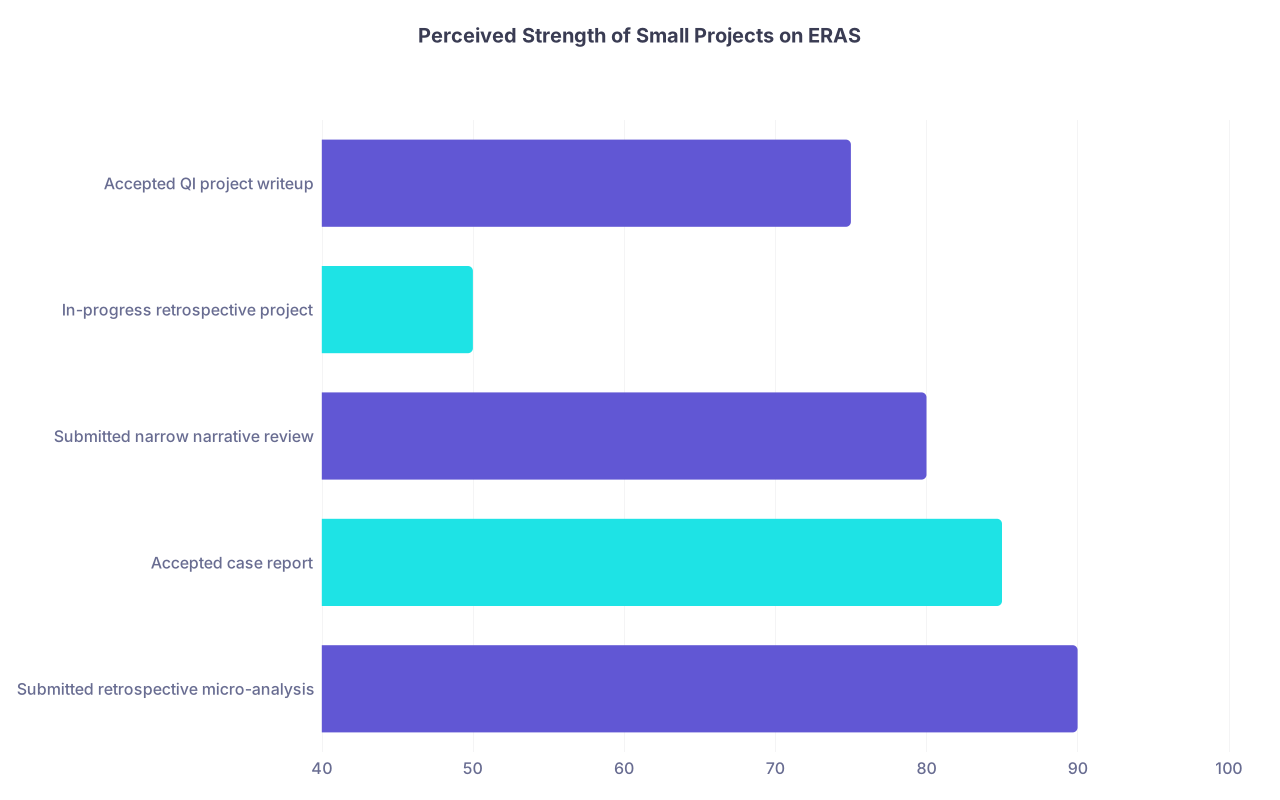
| Category | Value |
|---|---|
| Submitted retrospective micro-analysis | 90 |
| Accepted case report | 85 |
| Submitted narrow narrative review | 80 |
| In-progress retrospective project | 50 |
| Accepted QI project writeup | 75 |
You would be surprised how often an accepted but tiny QI paper or case report looks better than a giant “in progress” database project that never materialized.
On the ERAS form:
- Use “Submitted” accurately. Do not lie; people do check.
- If it is under review, say so: “Manuscript submitted, under review at [Journal].”
- In the description, explicitly note your role: “Led data collection and primary drafting of manuscript.”
If you spin fluff—“Assisted with analysis” when you sent one email—interviewers can smell it.
Step 7: Align the Project With Your Specialty Narrative
A thrown-together dermatology case report looks odd on an ERAS dominated by internal medicine electives and letters. Does it disqualify you? No. But it does not help tell a coherent story.
Design your small project to do three jobs simultaneously:
- Add a line to the “Publications/Presentations” section
- Provide talking material for interviews
- Subtly reinforce your commitment to the field you say you love
Examples:
Applying to EM?
- Case report on an unusual airway complication in the ED.
- Retrospective snapshot of patients leaving AMA from the ED.
Applying to Gen Surg?
- Brief review of management of incidental imaging findings pre-op.
- Micro-analysis of SSI rates after a protocol change.
Applying to Psych?
- Narrative review on management of antidepressants in pregnancy.
- Case series on catatonia presentations on your inpatient psych rotation.
You want attendings to glance at your ERAS and think: “Okay, this person at least tried to engage with our field.”
Step 8: Negotiate Scope and Authorship Up Front
This part gets ignored, then blows up in July.
With your mentor, explicitly lock down:
- The project’s scope: “We’re doing this narrow angle, not the entire universe.”
- Your role: data collection, drafting which sections, handling submission.
- Timeline: “Our goal is to submit by [date], which is before ERAS opens. Is that realistic to you?”
- Authorship order: do not be weird about this, but clarify expectations.
Most faculty respond well if you are straightforward:
“I am very motivated to do the work, but I want to be honest that I’m hoping to have a completed submission before residency application season. If that seems unrealistic for this project, I’d rather adjust scope now.”
If they hem and haw, or dump a massive, sloppy dataset on you with “we’ll see,” that is a red flag. You are not obligated to accept that project.
Step 9: Execution Tactics That Separate “Finished” From “Almost”
The number one difference I see between students who actually submit vs those who stall: they treat it like a serious obligation, not an optional side quest.
Some very practical tactics:
Book protected writing blocks
Literally put “Research writing 6–8 pm” on your calendar 2–3x/week. Treat it like clinic.Send structured updates to your mentor
Every 1–2 weeks: short email, bullet summary of what you did, what you will do next, and what you need from them. They are more likely to respond quickly if you show momentum.Ask focused questions
Instead of “What do you think of the draft?”, say:
“Can you specifically comment on: (1) whether the discussion is too long; (2) if the journal I suggested is appropriate?”Use templates and checklists
Most journals have a standard structure for case reports/QI/reviews. Download 2–3 recent articles from your target journal and mimic the format ruthlessly.Do the annoying admin work yourself
Submission portals, author disclosures, word count trimming, reference formatting. If you take this off your mentor’s plate, your timeline shortens dramatically.
Step 10: What If You Start Too Late?
Let’s say you wake up in August and ERAS opens in a few weeks. You are not going to submit a paper before then. But you still have options that are not complete theater.
Realistic late options:
Abstract for local or regional conference
Many fall/winter meetings have August/September abstract deadlines. Even a small case or QI project can become a poster. On ERAS, “Abstract submitted to [Regional Meeting]” is still a real, verifiable activity.Well-structured “scholarly project in progress”
If your project has:- Defined research question
- IRB approval or exemption
- Draft sections started
You can list it accurately as “Research project – in progress,” with a very clear description of what stage you are at. Weak, but better than vapor.
QI with completed cycle, write-up pending
A small Plan-Do-Study-Act cycle on a ward process, with basic data collected, can be framed as a substantive QI activity, even if not yet published.
What you must not do is create a fake impression of completion. Programs are almost pathologically tolerant of “under review” and “in progress” if things look honest. They are not tolerant of dishonesty.
Two Example Project Blueprints
To make this ultra-concrete, here are two complete, realistic project blueprints you could implement.
Blueprint A: Internal Medicine Case Report
- Specialty: Internal Medicine (applying to IM or subspecialties later)
- Title: “Severe Hyponatremia Following Initiation of [Drug X] in an Elderly Patient: A Diagnostic and Management Challenge”
- Journal Target: A mid-tier internal medicine journal that accepts case reports
Weeks 1–2:
- Confirm with attending that no one else is writing it.
- Request de-identified lab and note excerpts from the chart.
- Draft a detailed case narrative (~1,000–1,500 words).
Weeks 3–4:
- Literature search: “drug X hyponatremia”, “SIADH case reports”.
- Build reference list of 15–25 articles.
- Draft introduction and discussion:
- Known adverse effects of the drug
- Mechanisms of hyponatremia
- Why this case is clinically instructive (presentation, pitfalls, management decisions).
Weeks 5–6:
- Work with radiology/path to obtain one or two anonymized images if relevant.
- Send full draft to attending.
- Incorporate feedback, trim to target word limit.
- Prepare cover letter and submit.
ERAS entry:
- Experience Type: Publications/Presentations
- Role: Co-author
- Description:
“Co-authored case report describing severe hyponatremia associated with [Drug X] in an elderly inpatient, focusing on diagnostic reasoning and management decisions. Led case write-up and literature review. Manuscript submitted to [Journal], under review.”
Blueprint B: EM Retrospective Micro-Analysis
- Specialty: Emergency Medicine
- Title: “Characteristics and Short-Term Outcomes of Patients Leaving the Emergency Department Against Medical Advice at a Single Urban Center”
- Data Source: Existing ED administrative database, IRB already in place from a larger ED utilization study.
- Journal Target: EM journal with brief report format.
Weeks 1–2:
- Meet with EM research director who has ED database.
- Define simple question: descriptive stats on AMA patients over 2 years, compare basic demographic and visit characteristics vs non-AMA.
- Confirm IRB allows this subanalysis.
Weeks 3–4:
- Extract relevant variables: age, gender, chief complaint category, triage acuity, time of day, day of week, disposition, 72-hour return visits.
- Run descriptive stats + 1–2 comparisons (chi-square, t-test).
- Build 2 tables:
- Characteristics of AMA vs non-AMA
- 72-hr return visit rates.
Weeks 5–6:
- Draft Methods and Results tightly.
- Write Introduction (2–3 paragraphs) and Discussion (4–5 paragraphs) focusing on implications for ED workflow and patient safety.
Weeks 7–8:
- Mentor edits.
- Format for journal, submit.
ERAS entry:
- Experience Type: Publications/Presentations
- Role: First author
- Description:
“First-author brief report examining demographic and visit characteristics of patients leaving the ED against medical advice and associated 72-hour return visits. Conducted data extraction, performed preliminary analysis with oversight from EM research director, and drafted manuscript. Submitted to [Journal], under review.”
Both of these are completely doable, if you start early enough and resist scope creep.
Final Thoughts: What Actually Matters
Three key points and you are done:
Design from the deadline backward.
If ERAS is in September, you must pick a project type, scope, and data source that can be turned into a submitted manuscript or abstract by then. Anything else is wishful thinking, not planning.Small and finished beats big and unfinished.
A single honest, submitted case report or micro-analysis does more for your ERAS than an overambitious retrospective project that lives forever as “in progress” on your CV.The project must be real, specific, and yours.
That means a clearly defined question, a documented role you can describe in interviews, and a product (even if just submitted) that fits your specialty story and timeline.
Design the project around your reality, not your ego. That is how you actually get something on ERAS before it opens.