
The blunt truth: a co‑author line on your CV still matters—but not the way most applicants think it does.
Program directors are not impressed simply because your name appears on a paper. They’re impressed when that co‑author status clearly signals seriousness, persistence, and some kind of real contribution. If it looks like you just “rode along” on a big group paper? That halo effect is fading fast.
Let’s walk through what co‑authorship actually buys you in the residency selection game—and when it’s just decorative ink.
What Program Directors Actually Care About (Not What Premeds Told You)
Most applicants massively overestimate how much any single line of research—first author, co‑author, whatever—moves the needle alone.
Here’s what most program directors care about, in roughly this priority order (with exceptions, obviously, for research-heavy programs):
- Can you do the work? (Scores, clinical grades, letters, performance on rotations)
- Are you normal and not a headache? (Professionalism, communication, interview impression)
- Do you fit this program and this specialty?
- Do you bring extras that make you stand out? (Research, leadership, teaching, unique background)
Research—whether as first author or co‑author—usually lives in bucket #4.
That means:
- It rarely rescues weak clinical performance.
- It rarely compensates for poor professionalism or weak letters.
- It does differentiate you meaningfully among similar applicants in competitive fields.
So no, co‑author status alone won’t “get you in.” But it can be exactly what tips you over a similar applicant with no research, especially in specialties like dermatology, radiation oncology, neurosurgery, plastics, ortho, ENT, or academic internal medicine.
Co‑Author vs First‑Author: How Big Is the Gap Really?
Program directors absolutely distinguish between first‑author and co‑author work. Pretending they don’t is delusional.
Here’s the basic hierarchy most of them use when scanning your CV:
| Rank (High → Low) | Type of Research Output |
|---|---|
| 1 | First‑author original research in specialty |
| 2 | First‑author case report / review in specialty |
| 3 | Co‑author original research in specialty |
| 4 | Co‑author work outside specialty / basic science |
| 5 | Abstracts/posters only, no full manuscripts |
Where does co‑author status land?
- Co‑author in their specialty → solid plus, shows alignment and exposure.
- Co‑author in anything medically relevant → still a plus, especially if you can explain your role.
- Co‑author on a massive multi‑center trial where you just “helped collect two charts” and can’t explain the methods → they can smell the fluff.
The big misconception: “If it’s not first‑author, it’s worthless.” That’s wrong.
Here’s what co‑authorship does signal, if used right:
- You’ve seen how a project runs from idea to publication.
- You can work on a research team.
- You’re at least comfortable enough with data, writing, or clinical work to be trusted with a named role.
- You cared enough to stay involved long enough to get on the paper.
Is first‑author stronger? Yes. Obviously.
But multiple solid co‑author papers, especially across time and tied to coherent interests, absolutely impress many program directors more than one random first‑author case report you barely remember.
How Program Directors Read Your Co‑Author Lines
Think like a program director for a second. It’s 11:30 p.m., you’ve just finished notes, and now you’re skimming 80 ERAS applications for a preliminary sort. You’re not doing a deep dive on anyone’s PubMed history.
Here’s the mental process I’ve seen and heard over and over in faculty rooms:
“Does this person even have research?”
- None: neutral or slight minus in academic or competitive fields.
- Some: keep reading.
“Is it remotely connected to my specialty or academic medicine?”
- Yes: labels you as “interested” and “engaged.”
- No, but still biomedical/clinical: still good; shows you can do scholarly work.
“What’s the pattern?”
- One isolated paper from four years ago: maybe a summer project.
- Several papers, posters, abstracts over time: this person follows through.
“What was their level of involvement?”
- Implied by authorship position, context in personal statement, and how you talk about it.
Here’s the key: The line itself is the hook. The real impression is formed when you talk about it on your application or in the interview.
If you say: “I was third author on a retrospective study looking at readmissions in heart failure patients. I was responsible for data extraction, cleaning, and helped draft the results section. It took us almost two years to get through peer review, but it taught me how much work it really takes to produce good data.”
That’s impressive.
If you say: “Oh, I think I was on a paper about… maybe sepsis? I mostly helped recruit patients I think?”
That hurts you. Co‑author status doesn’t save you from sounding like you just wanted your name on something.
Where Co‑Author Status Matters A Lot (And Where It Barely Registers)
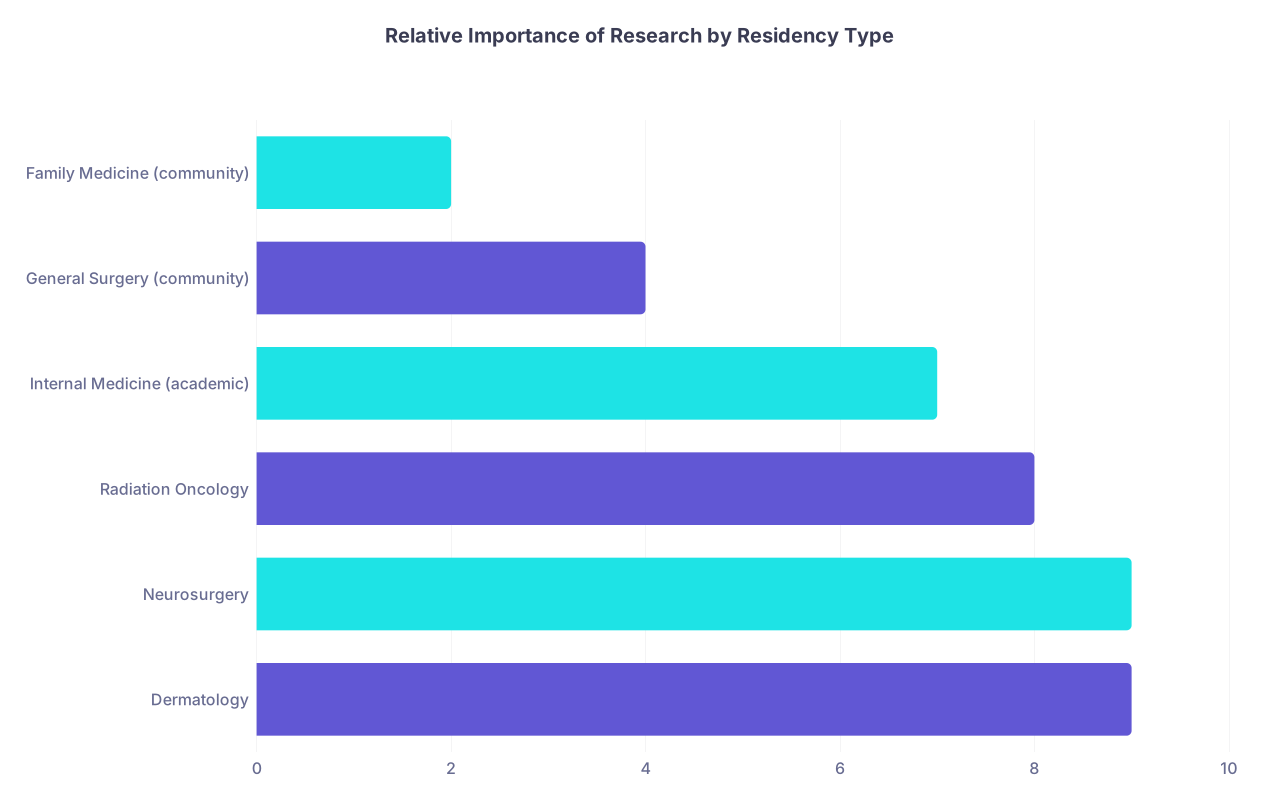
Not all residency programs weigh research the same. Some live and breathe PubMed. Others genuinely don’t care.
Here’s the rough landscape:
| Category | Value |
|---|---|
| Dermatology | 9 |
| Neurosurgery | 9 |
| Radiation Oncology | 8 |
| Internal Medicine (academic) | 7 |
| General Surgery (community) | 4 |
| Family Medicine (community) | 2 |
On a 1–10 scale of “how much research matters”:
- Dermatology, neurosurgery, rad onc → Your research portfolio is part of your identity. Co‑author status here still impresses, especially on specialty‑related or high‑impact work.
- Academic internal medicine, university‑based surgery, ENT, ortho → Research is a strong plus. Co‑author work helps signal that you’ll contribute to the department’s scholarly output.
- Community-based internal medicine, OB/GYN, general surgery → Co‑authored research is a bonus, but not a primary selection factor.
- Family medicine, psych (non‑research heavy), community programs → Often much more focused on clinical performance and fit; research is nice but rarely decisive.
The more competitive and academic the program, the more your co‑author lines are scrutinized for:
- Relevance to the specialty
- Rigor of the journal/study
- Pattern over time
- Your described role and actual understanding
If you’re gunning for derm with only one middle‑author basic science paper from undergrad, that won’t cut it. But if you’re applying IM, that same co‑author paper, plus a poster, plus a QI project? That looks good.
What Makes a Co‑Author Line Actually Impressive
Let me be specific. Program directors are impressed by co‑authorship when three things are true:
- The project aligns logically with your story.
- Your role sounds real, not token.
- The project shows persistence and follow‑through.
Here’s what that looks like in practice.
1. Logical alignment
If you’re applying to neurosurgery and your co‑author paper is:
- “Outcomes after surgical clipping vs coiling of intracranial aneurysms” → Strong alignment.
- “Neural correlates of motor learning in stroke rehab” → Still good, neuro‑adjacent.
- “Ant behavior in colony optimization algorithms” from your CS major → Still counts as research, but doesn’t scream “future neurosurgeon.”
Does misalignment kill you? No. But relevant work is a cleaner narrative.
2. A real, describable role
You should be able to clearly answer:
- What was the main research question?
- What were the methods, in plain language?
- What exactly did you do?
- What did you learn that changed how you think clinically or scientifically?
Notice none of these require first‑author status. A strong answer from a co‑author can easily outshine a weak, vague answer from someone who nominally “led” a project.
3. Evidence of persistence
Program directors like signs that you stick with things when they’re not shiny anymore.
Multiple co‑authored works over several years, even if they’re not glamorous, tell them:
- You show up.
- You finish what you start.
- You’re reliable on teams.
One flashy first‑author case report you barely recall? Less impressive than applicants think.
Red Flags: When Co‑Author Status Backfires
Yes, research can hurt you if it looks like you’re padding.
Here’s what raises eyebrows:
- Long author lists where you can’t explain your real contribution.
- Dozens of posters/abstracts but no full manuscripts anywhere.
- Projects you “swear are under review” but can’t describe or show a draft of.
- Obvious “CV stuffing” with extremely tenuous roles (e.g., “Helped brainstorm title on journal club article.” No.)
I’ve literally heard in committees:
“Look at this—14 posters, zero papers, and they can’t explain any of them. Someone told them quantity matters more than substance.”
Co‑author work helps when it’s real and you can show that. It hurts when it exposes you as image‑focused and superficial.
How To Talk About Your Co‑Author Work So It Actually Helps You
The value of co‑author status is multiplied or destroyed by how you frame it in:
- ERAS descriptions
- Personal statement
- Interviews
Here’s the basic framework I recommend you use every time you mention a project:
- One sentence: What was the question?
- One sentence: How did you study it?
- One–two sentences: What did you personally do?
- One sentence: What did you learn or how did it shape you?
Example for a co‑author retrospective study:
“I worked on a retrospective study evaluating 30‑day readmission rates in patients with decompensated heart failure. We reviewed charts over a 3‑year period and used logistic regression to identify predictors of readmission. My role was extracting and cleaning the data, building the REDCap database, and drafting the results section. It taught me how messy real‑world data is—and how important clear definitions and protocols are both in research and in clinical practice.”
That’s a co‑author description that actually impresses.
Here’s how not to do it:
“Helped with a paper on heart failure readmissions.”
Zero value.
Is It Better To Chase First‑Author At All Costs?
No. And this is where a lot of students waste time.
You’re better off with:
- Two or three solid co‑author projects that actually get published
than - Five “in progress” first‑author case reports that never leave your desktop.
Residency programs care a lot more about what’s finished than what’s hypothetically happening. The ERAS filter doesn’t reward ambition—it rewards completed output.
If you can get a meaningful first‑author project done before ERAS season, great. Do it.
But if you’re choosing between:
- A guaranteed, real role as co‑author on a project that will likely submit in 6–9 months
and - A theoretical first‑author case report with an unreliable mentor you barely see
Take the real co‑author work 9 times out of 10.
How Many Co‑Author Papers “Look Impressive”?
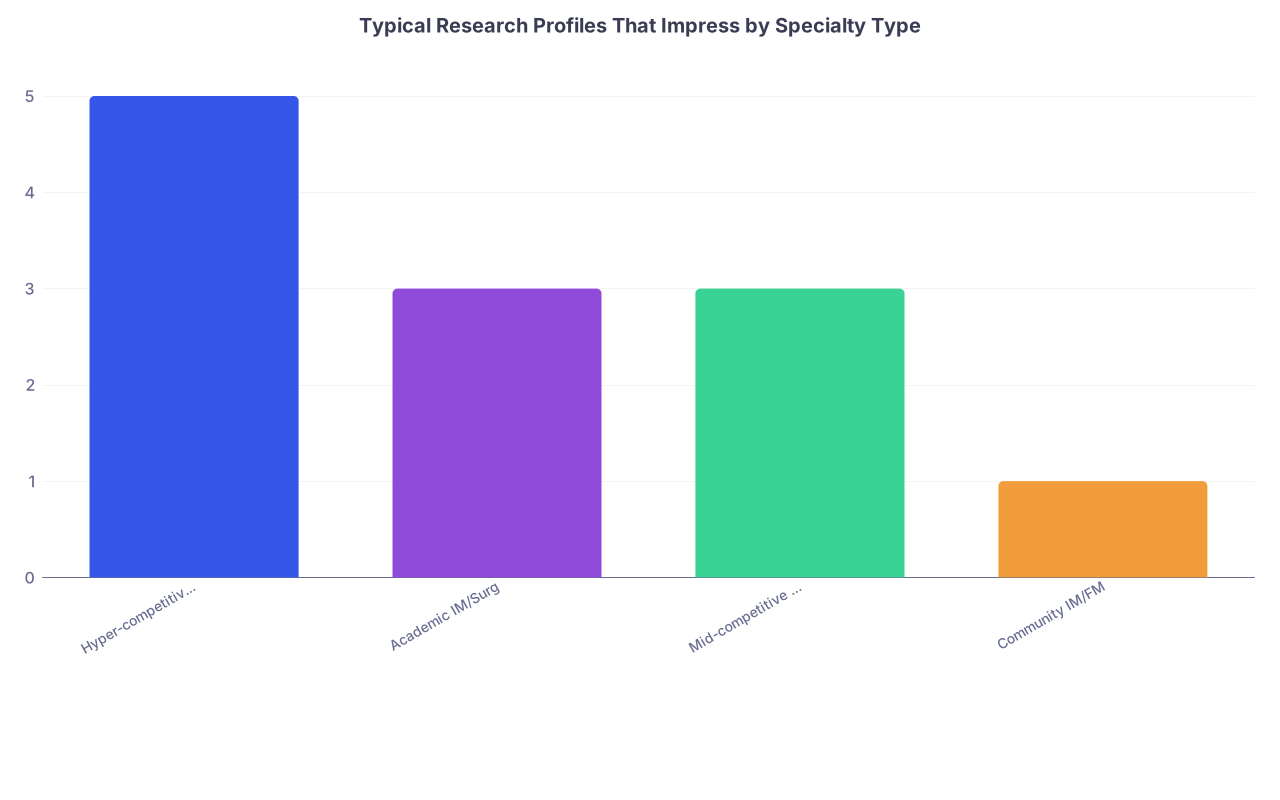
There’s no magic number, but here’s a rough, honest sense of scale by specialty. This is impression, not a requirement list.
| Category | Value |
|---|---|
| Hyper-competitive (Derm/NSGY) | 5 |
| Academic IM/Surg | 3 |
| Mid-competitive (ENT/Ortho) | 3 |
| Community IM/FM | 1 |
Think in terms of total scholarly output (papers, abstracts, posters, major QI). For co‑authored publications specifically:
Hyper‑competitive (derm, neurosurg, plastics, rad onc):
3–5+ publications/major projects (mixed first and co‑author), ideally with at least some specialty relevance.Academic IM / surgery / subspecialties:
2–4 publications or strong QI + a few abstracts/posters looks very solid.ENT, ortho, EM at academic centers:
2+ meaningful research outputs (first or co‑author) help a lot.Community IM/FM/psych:
0–1 publication is common; any co‑author paper generally looks like a plus, not a requirement.
Again: these aren’t rules. I’ve seen people match neurosurgery with fewer and people not match derm with more. But it gives you a realistic ballpark.
The Bottom Line: Does Co‑Author Status Still Impress?
Yes—when it points to real work, fits your story, and you can talk about it intelligently.
No—when it’s obviously a name‑collecting exercise you barely remember.
So, if you’re staring at your CV wondering if those co‑author lines are “enough,” here’s the checklist that actually matters:
- Can you clearly explain what each project asked, how it was done, and what you did?
- Do at least some of your projects connect to your chosen specialty or broader clinical interests?
- Is there a pattern of sustained involvement, not just one random summer blip?
- Are at least a couple of your projects actually published or accepted, not all “submitted” or “in preparation”?
If you can honestly say yes to most of those, your co‑author work is helping you more than you think.
If not, your next move is simple.
Today, pick one co‑authored project on your CV, open the paper, and write a 4–5 sentence description of the question, methods, your role, and what you learned—tight enough that you could say it out loud in under 30 seconds. That’s how you turn a name on a paper into something that actually impresses a residency program director.