
The mythology around “required research” for residency is exaggerated and, frankly, often wrong.
Here’s the blunt version: for many residencies, you need less research than Reddit tells you. But for a few specialties, you probably need more than your school advisors are willing to say out loud.
Let’s get specific.
The Real Answer: It Depends on Specialty, Not Vibes
Programs do not care about “research” in the abstract. They care about two things:
- Can you produce academic work if their program expects it?
- Does your record match what people like you usually bring to the table in that specialty?
So the first filter is not your school. It’s the competitiveness and culture of your specialty.
Here’s a rough, honest breakdown.
| Specialty Tier | Examples | Typical Expectation |
|---|---|---|
| Research-Heavy Competitive | Dermatology, Plastic Surgery, Neurosurgery, Radiation Oncology, ENT | 8–20+ “scholarly products,” some first-author, often gap year(s) |
| Competitive but Mixed | Orthopedics, Ophthalmology, Diagnostic Radiology, Anesthesiology (top programs), EM (top programs) | 4–10 items, at least a couple real publications or abstracts |
| Middle Road | Internal Medicine, General Surgery, OB/GYN, Pediatrics | 2–6 items, any mix of posters, abstracts, small projects |
| Less Research-Centric | Family Medicine, Psych, Neurology, PM&R, Pathology | 0–3 items; research helpful but not required for most programs |
Notice I said “items,” not “first-author NEJM papers.” NRMP and ERAS count everything: posters, abstracts, oral presentations, case reports, QI projects, book chapters, local conferences.
So if you’re asking, “How much research do I need?” you should really ask:
“Given my specialty and target program tier, what does a plausible research profile look like?”
What Counts as “Research” on ERAS (That People Forget)
You do not need wet lab bench work at an R01 institution to “have research.”
ERAS lets you list:
- Peer-reviewed journal articles (original research, reviews, case reports, meta-analyses)
- Conference abstracts, posters, oral presentations (local, regional, national)
- QI and patient-safety projects
- Educational research or curriculum development (if systematic and presented)
- Book chapters or invited articles
- Non–peer-reviewed publications (blog posts for major organizations, online CME content) – lower yield, but still something
If you helped collect data, did chart reviews, cleaned up a dataset, or wrote parts of a poster—even if you were not the primary brain behind it—that can count.
What does not really move the needle:
- “Shadowed in a lab” without a definable product
- “Helped with data” but cannot explain methods or results
- Putting your name on something you can’t actually discuss (program directors do sniff this out on interview day)
Concrete Targets by Specialty (Realistic, Not Fantasy)
Let me give you numbers you can actually use to plan.
If you’re applying to research-heavy competitive specialties
Think: Dermatology, Plastic Surgery, Neurosurgery, Radiation Oncology, ENT.
You are in “research-as-currency” territory.
Reasonable competitive target:
- Total scholarly items: 10–20+
- Peer-reviewed articles: 3–6 (at least 1–2 first- or second-author)
- Specialty-specific work: at least 2–4 projects directly in your field
- Many applicants at top programs will have taken 1–2 dedicated research years
Can you match with less? Yes. But once you’re below:
- 5–7 total items and
- 1–2 real peer-reviewed papers
you are swimming upstream unless you have a stellar Step 2, insane letters, or a strong home institution connection.
If you’re not doing (or cannot do) a research year, you must be ruthlessly efficient:
- Jump on ongoing projects with near-term completion
- Prioritize case reports, retrospective chart reviews, and conference abstracts
- Align tightly with faculty who are known to produce
If you’re applying to competitive but mixed specialties
Orthopedics, Ophtho, Radiology, Anesthesia (especially academic), EM at top programs.
Solid target:
- Total items: 4–10
- Peer-reviewed: 1–3 (case reports are fine; specialty-specific is best)
- Mix of posters/abstracts/case series/QI
You do not need a research year for most of these. But at the top-tier academic programs (big-name university hospitals), you will see people with 8–15 items, especially if they’re gunning for fellowships later.
If your board scores are average for the specialty, research can be your tiebreaker. If your scores are stellar, fewer items are acceptable.
If you’re applying to IM, General Surgery, OB/GYN, Pediatrics
This is where the mythology gets weird. You’ll hear:
- “You must have research to match IM these days.”
- “Surgery is academic now—research is mandatory.”
Let’s correct that.
You can match community or many mid-tier academic IM, surgery, OB/GYN, and peds programs with:
- 1–4 total items, often from med school projects, QI, a poster or two
But there’s a catch: the top programs (think MGH IM, UCSF Peds, Michigan Surgery) are a different planet.
Reasonable split:
For normal solid programs:
- Items: 2–5
- Any mix: QI, posters, case reports, small prospective/retrospective projects
- Specialty-specific is preferred but not mandatory
For top academic programs:
- Items: 6–10+
- At least 2–3 peer-reviewed
- Some IM/Surg/OB programs strongly favor applicants with clear academic trajectory and mentorship
If you want an academic career, start behaving like a future academic:
- Join multi-project labs or clinical research groups
- Aim to present at a regional/national conference in your specialty
- Have at least one project where you can clearly state your contribution
If you’re applying to FM, Psych, Neuro, PM&R, Path
Despite online panic, many students still match these specialties with zero research.
Realistic breakdown:
- Truly no research: Still fine for many community and some university-affiliated programs
- “Ideal but not required” target:
- Items: 1–3
- A simple QI project, a poster at a local meeting, or a case report with a willing mentor
Where research matters more:
- If you are applying to top academic departments
- If you need to offset a weaker transcript/Step score
- If you’re an IMG or from a lower-ranked school
Then having 3–6 items, ideally including one publication, makes you much less risky in their eyes.
How Much Is “Enough” for You? A Simple Framework
Stop thinking in absolutes. Think in profiles.
Use this quick gut-check model. Aim to be at least “on par” with one of these lanes:
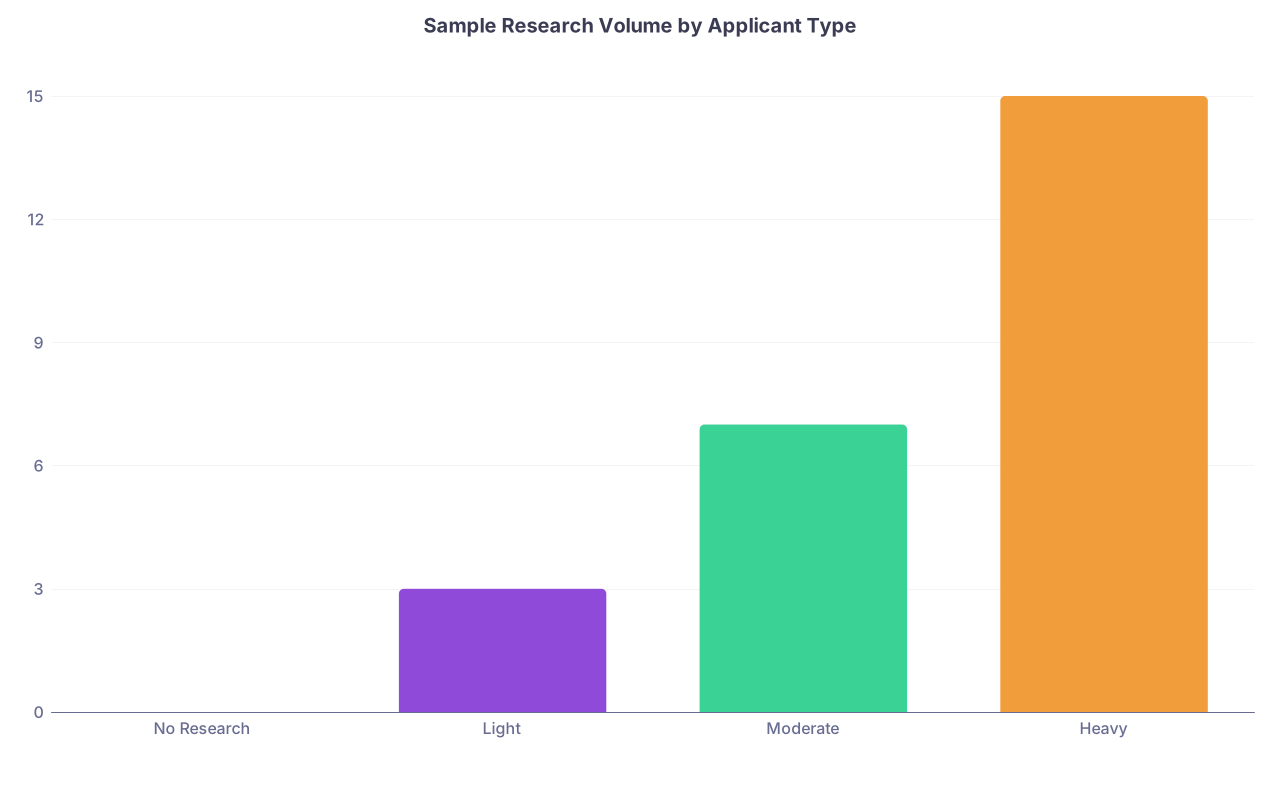
| Category | Value |
|---|---|
| No Research | 0 |
| Light | 3 |
| Moderate | 7 |
| Heavy | 15 |
No-research profile:
- Specialty: FM, Psych, Neuro, PM&R, Pathology
- Application target: Mostly community programs, not geographically picky
- Other strengths: Solid clinical evals, no red flags, decent Step 2
- Match probability: Reasonable but you’re less flexible on location/program tier
Light research (2–4 items):
- Specialty: IM, Peds, OB, General Surgery, EM, PM&R, Psych, Neuro
- Application target: Mix of community and academics
- Match probability: Good, especially if one item is specialty-specific
Moderate research (5–10 items):
- Specialty: Radiology, Ortho, Ophtho, Anesthesia, strong academic IM/Surg/OB/Peds
- Application target: You want academic options and some prestige
- Match probability: Strong at many programs if your scores and letters aren’t liabilities
Heavy research (10–20+ items):
- Specialty: Derm, Plastics, Neurosurg, Rad Onc, ENT, or hardcore academic in any field
- Application target: Top programs, academic career, fellowships
- Match probability: High at top programs if everything else is in range
How to Build Enough Research Without Wasting Your Life
The biggest mistake I see is students hoarding low-yield projects that never finish. Ten half-baked projects = zero ERAS entries.
You want “fast-to-product” work. That usually means:
Case reports and small series
You see an odd case on rotation → ask the resident/faculty: “Would this be worth a case report?”
If yes, volunteer to write the first draft. These can turn into posters + short publications.Retrospective chart reviews
High-yield if your mentor already has IRB and data. Your job: data extraction, stats help, first draft. These often generate at least one abstract/poster quickly.QI projects tied to a residency program
Residents love extra hands. QI often gets presented at hospital QI days, which you can list.Working with “known producers”
There is always that one faculty member in each department with a robust pipeline. Attach yourself to them; do the work; ride the wave.

| Step | Description |
|---|---|
| Step 1 | Identify mentor with track record |
| Step 2 | Join an ongoing project |
| Step 3 | Take a clearly defined role |
| Step 4 | Push for concrete product: poster or abstract |
| Step 5 | Convert to manuscript if feasible |
| Step 6 | List final products on ERAS |
If you are M1–M2:
- Do 1–2 small projects a year
- Try to have something ready to present by the end of M2
If you are M3 with nothing:
- Focus on fast projects during rotations
- Ask on every specialty: “Are there any ongoing projects students can help with that might be done in time for this year’s ERAS?”
- You’re not there to “hang out in a lab.”
- You’re there to walk out with: at least 3–5 tangible products (submissions, accepted abstracts, etc.)
IMGs and DOs: Your Bar Is Different
This part’s uncomfortable, so I’ll say it plainly.
If you’re an IMG or DO aiming for:
- Competitive specialties OR
- Top academic programs in IM/Surgery/etc.
Then research matters more for you than for a US MD at a big-name school.
For many program directors, research is a “safety signal”:
- Shows you understand US academic culture
- Demonstrates you can communicate in English in a scholarly way
- Adds objective evidence beyond school reputation
Realistic targets for IMGs/DOs aiming high:
- Competitive specialties: 10–20+ items, several in US-based projects
- Strong academic IM/Surg/OB/Peds: 5–10 items, at least a couple peer-reviewed
For IMGs aiming community IM/FM:
- 2–6 items is often enough to separate you from the pack
Signs You Are Overdoing It
Yes, you can over-invest in research to the point of hurting your application.
Red flags:
- Failing Step 1/2 or barely passing because you spent too much time in the lab
- Multiple incomplete projects and nothing to show on ERAS
- You cannot explain a single project clearly on interview day
- Your clinical evaluations are mediocre while your CV is stacked
Programs will always take the excellent clinician with average research over the mediocre clinician with 25 publications—unless they’re hiring a future lab rat, which is rare.
Balance:
- Do enough research to match your specialty norms and career goals
- Protect your Step 2 score and your clinical reputation at all costs
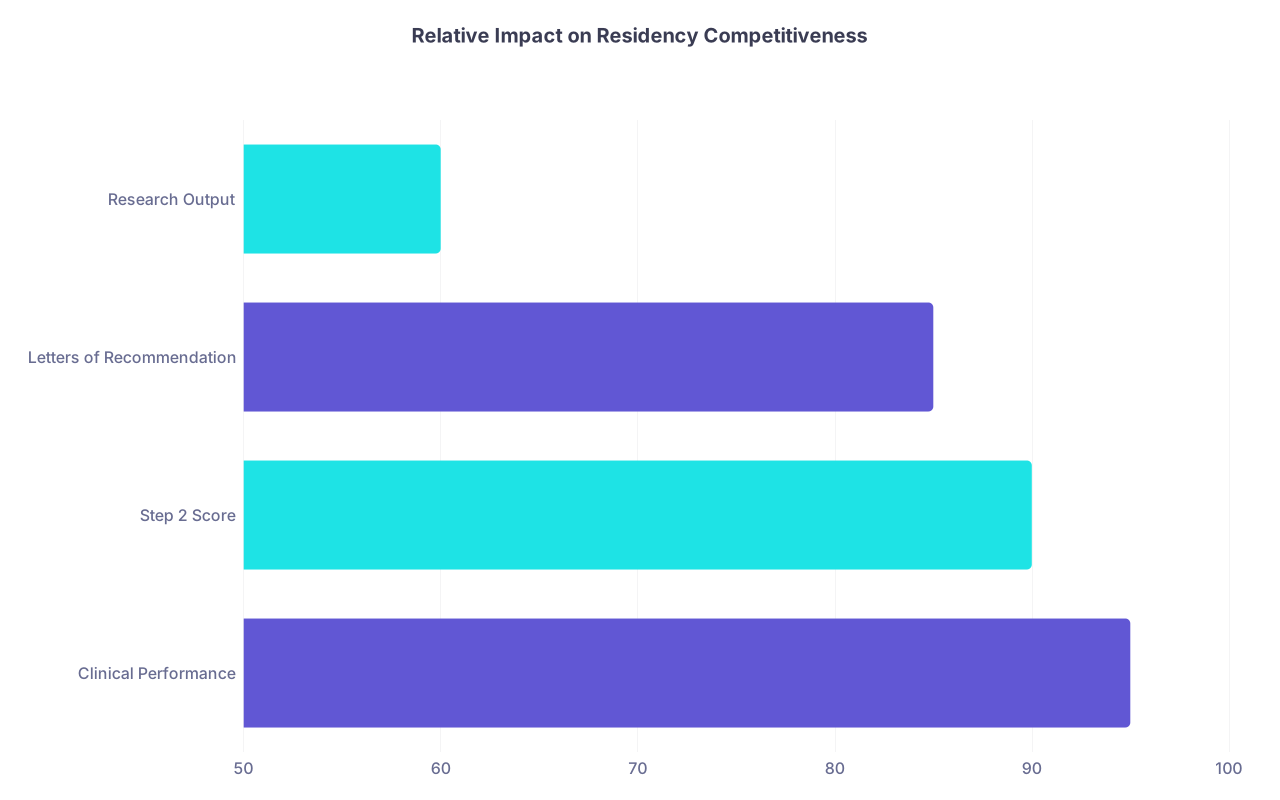
| Category | Value |
|---|---|
| Clinical Performance | 95 |
| Step 2 Score | 90 |
| Letters of Recommendation | 85 |
| Research Output | 60 |
Interpretation: Research is important, but it’s not the main driver for most applicants.
Quick Self-Check Before You Panic
Ask yourself these four questions:
- What specialty am I targeting, and is it research-heavy by culture?
- Where do I want to land: community, mid-tier academic, or top academic?
- Right now, how many real items could I list on ERAS if I had to submit tomorrow?
- Do I have time to realistically add 1–3 more items before applications?
If your answers look like:
- Community-leaning specialty + 1–3 items = probably fine
- Academic-leaning specialty + 4–8 items = solid
- Hyper-competitive specialty + under 5 items and no time left = you need to adjust expectations or consider a research year
And one more sanity check: talk to residents currently in the specialty you want. Ask what they had on their application. Not what the program “prefers.” What they actually had.
FAQ: Research and Residency Applications
1. Do I absolutely need research to match any residency?
No. You can still match into many FM, Psych, Neuro, PM&R, and even some IM and Peds programs with zero research. But having at least 1–2 small projects gives you more flexibility and helps if other parts of your app are average.
2. Is it better to have one big publication or several small posters?
For most applicants, several small, completed projects (posters, abstracts, case reports) beat one huge, never-finished project. That said, a solid first-author peer-reviewed paper carries more weight than three meaningless posters you barely participated in. Ideally, you want both breadth (several items) and at least one stronger anchor project.
3. How late is too late to start research for residency?
If you are already in the ERAS application year (M4) with nothing, it’s late for big publications but not for small wins. You can still:
- Join an ongoing project and get on an abstract
- Write a case report or two
- List “submitted” or “in preparation” honestly if your role is substantial
But the most reliable window for meaningful research is M1–M3 and any gap years.
4. Do Step scores matter more than research?
For most specialties and most programs, yes. Step 2 and clinical performance usually outrank research. Research becomes a major tiebreaker in competitive specialties or top academic programs, or when two applicants look otherwise similar.
5. Can QI projects really count as research?
Yes, if they’re real projects with structure. If there’s:
- A defined problem
- An intervention
- Outcome measurement
- Presentation or formal write-up
Then they’re absolutely ERAS-worthy. Many programs love QI involvement because it directly connects to residency life.
6. I’m at a non-research-heavy med school. Am I doomed?
No. You’ll just need to be more intentional. Find the few research-active faculty, use virtual/collaborative projects, and lean into smaller, faster-completion work. Plenty of residents at top places came from non-research schools but hustled into 4–8 solid items.
7. How honest do I have to be about my role on projects?
Completely honest. Program directors and interviewers can smell fluff. If you list a project, be ready to explain:
- What the question was
- What you actually did
- What the results roughly showed
If you cannot do that, either do more real work on that project or don’t list it.
Bottom line:
Match your research output to your specialty’s culture and your target program tier. Focus on real, completed products rather than glamorous, half-finished projects. And never sacrifice your Step 2 or clinical reputation just to pad your PubMed.