
It’s January. You’re halfway through third year, exhausted, and every other day someone asks, “Are you taking a research year?” Your classmates are talking about 4th-year leave forms, NIH fellowships, and suddenly everyone has strong opinions about “needing” a publication to match.
You’re staring at your CV thinking: I don’t hate research, but do I really need to lose a year of my life just to not go unmatched?
Here’s the answer you’re looking for:
For most people, taking a dedicated research year purely to “improve match chances” is a bad trade. For a small group of applicants and specific specialties, it’s exactly the right move. The trick is knowing which group you’re in.
Let’s break it down.
The Core Question: When Is a Research Year Actually Worth It?
Strip the emotion and FOMO away. You should consider a dedicated research year only if one of these is true:
You’re applying to a hyper-competitive specialty where:
- Almost everyone who matches has meaningful research (not 1 poster from M1).
- Your current CV and scores are clearly below what successful applicants usually have.
You need a reset:
- You failed or barely passed a major exam (Step 1/COMLEX 1) and need another clear strength on your app.
- You switched into a competitive specialty late and your CV doesn’t match that choice yet.
- You’re at a school with almost no exposure or mentorship in your target specialty.
You genuinely like research and can see it as:
- Part of your long-term career (academics, clinician-scientist, funding, etc.).
- A way to get powerful letters and connections, not just a line on your CV.
If none of that sounds like you, a full research year just “for the match” is usually overkill.
Where a Research Year Moves the Needle (And Where It Doesn’t)
Some specialties treat a research year like currency. Others frankly don’t care much.
| Specialty | Research Year Impact | Typical Scenario Where It Helps |
|---|---|---|
| Dermatology | Very High | Low research at home school, borderline scores |
| Neurosurgery | Very High | Late switch, minimal prior productivity |
| Plastic Surgery | High | No home program, minimal exposure |
| Radiation Oncology | High | Need academic connections & projects |
| Orthopedic Surgery | Moderate | Below-average scores, few abstracts |
If you’re going into:
- Family Medicine
- Pediatrics
- Psychiatry
- Community Internal Medicine
- Most primary care–oriented programs
A dedicated research year almost never makes or breaks you. Program directors in these fields will care 10x more about:
- Clinical performance
- Letters that say “this person is safe and pleasant to work with”
- Evidence you’re actually interested in their type of practice
They’re not impressed you spent a year doing bench work you barely remember.
What Program Directors Actually Think About Research Years
Here’s the part most students don’t hear clearly.
A research year is not a magic buff. It’s a signal. Program directors tend to interpret it in one of a few ways:
Positive interpretations:
- “This person is committed to our field and knows our literature.”
- “They built relationships with people I know and trust—this letter carries weight.”
- “They’ve shown they can finish a project, handle data, and work with a team.”
Neutral to negative interpretations:
- “They took a research year and only have 1 poster? That’s… underwhelming.”
- “Why did their med school take 5–6 years? Red flags elsewhere?”
- “Are they actually interested in academic work, or did they just chase lines on a CV?”
The truth: a mediocre or poorly structured research year can hurt more than help, because it raises questions:
- What did you do with all that time?
- Why doesn’t your PI sound excited in your letter?
- Why don’t your “20 abstracts” translate into any coherent story of what you worked on?
So if you take a year, it has to be productive and intentional, not just a long unstructured gap.
Decision Framework: Should You Take a Research Year?
Let’s be concrete. Work through this like a flowchart.

| Step | Description |
|---|---|
| Step 1 | Choose Target Specialty |
| Step 2 | Compare Stats to Matched Data |
| Step 3 | Likely No Research Year |
| Step 4 | Research Year Optional |
| Step 5 | Do Longitudinal Research While in School |
| Step 6 | Consider Research Year at Strong Institution |
| Step 7 | Hyper-competitive? |
| Step 8 | Scores & CV >= Median? |
| Step 9 | Access to Mentors & Projects Now? |
Ask yourself, step by step:
What specialty are you realistically targeting?
If it’s not in the “hyper-competitive” bucket, the bar for justifying a research year is high.How do you compare to typical matched applicants?
Use NRMP and specialty-specific data. If matched applicants in derm usually have:- High Step 2 scores
- Double-digit abstracts/pubs/presentations
- Strong letters from known faculty
And you have:
- Average Step 2
- 0–1 poster
- No meaningful specialty mentorship
Then yes, a research year might be one of the few levers you actually have.
Can you close the gap without a full year off?
Many students underestimate what they can get through:- 1–2 ongoing projects 3rd year
- A focused push early 4th year
- Electives with research-minded faculty
If your school has active researchers in your specialty and they’re even mildly accessible, start now. You might not need a whole year.
Are there other bigger red flags to handle first?
Example: you have poor clinical evals, shaky professionalism feedback, or a failed Step 2. A research year does not erase those. Sometimes the better move is strengthening clinical performance and getting killer letters in a slightly less competitive specialty.
What a “High-Yield” Research Year Actually Looks Like
If you’re going to do it, do it right. A good research year should produce:
Multiple tangible outputs:
Not all have to be first-author papers. A mix is fine:- Manuscripts (submitted or accepted)
- Posters and oral presentations
- Clearly explained contributions on your CV
At least one high-impact mentor:
Someone with:- Reputation in the field
- A track record of getting students into good programs
- Enough contact with you to write a detailed, enthusiastic letter
A coherent story:
On paper and in interviews, you want to be able to explain:- Why you did the research year
- What questions you tackled
- What you learned and how it shaped your goals
Here’s the part many miss: clinical exposure during the research year matters. If possible, pick positions where you can:
- Attend specialty clinics
- Go to tumor board / M&M / grand rounds
- Shadow in the OR or reading room
- Be seen and known by attendings who also interview applicants
That intersection—research plus clinical visibility—is where match benefit multiplies.
The Hidden Costs: Time, Money, and Momentum
Everyone talks about “increasing match chances.” Fewer people talk about the price tag.
A research year usually costs you:
1 year of attending salary on the back end.
For many fields, that’s hundreds of thousands of dollars delayed by 12 months.At least 1 year more of trainee-level income.
You’re either unpaid, lightly paid as a research assistant, or living off loans or minimal stipends.Momentum.
Some students come back sharper. Others feel out of sync with their class, rusty on clinical work, and slightly detached.Application fatigue.
You’ll be “selling yourself” for two extended periods:- Once to get the research position,
- Then again to match.
The big mistake: treating a research year as free. It is not free. You’re trading a year of your life and significant money for a better shot at a specific training path. That trade is sometimes smart. But it’s still a trade.
What To Do If You Decide Not To Take a Research Year
Opting out doesn’t mean you’re giving up on a strong application. It means you’re using other levers.
If you’re not taking a research year, your focus should shift to:
Maximizing clinical performance.
Honors in core rotations in your chosen specialty and related fields often carry more weight than a mid-level research year.Targeted, realistic research involvement.
Pick 1–2 projects you can actually complete, even if they’re small:- Case reports
- Retrospective chart reviews
- QI projects with clear outcomes
Strong letters from people who know you well.
A specific letter from a mid-tier program director who watched you excel clinically often beats a generic letter from a famous researcher who barely remembers you.Smart specialty and program choice.
If you’re a borderline applicant for a hyper-competitive specialty and refuse a research year, be honest:- Consider dual applying.
- Include plenty of mid- and lower-tier programs.
- Don’t build a rank list that assumes you’re the exception.
Practical Scenarios: Yes vs No
Let me walk through a few real-world patterns I’ve seen.
Scenario 1: Derm Hopeful, Weak CV, No Mentor
- Mid-range Step 2, pass Step 1
- No derm home program, one tangential poster from M1 in nephrology
- Wants academic derm in a big city
If they can land a good derm research fellowship at a major center with strong mentorship and built-in clinic exposure?
A research year (often 2 in derm) is almost mandatory to be competitive. For this person: Yes, it’s reasonable.
Scenario 2: Internal Medicine, Mid-Tier Aspirations
- Solid clinical evals, average scores
- 1 small QI project, some interest in hospitalist work
- Considering research year because “everyone else is doing it”
For IM, especially community or mid-tier university programs, a research year is rarely the limiting factor. Their time is better spent honoring IM, getting strong letters, and possibly doing a small IM-related project without pausing school.
For this person: No, skip the research year.
Scenario 3: Late Neurosurgery Switch
- Started med school thinking IM, decides on neurosurgery late M3
- Decent scores but absolutely no neurosurgery exposure or research
- No home neurosurgery program
In neurosurgery, this applicant is not viable without something significant. A structured neurosurgery research year at a center that actually matches people out is basically their only real shot.
For this person: Yes, if they’re truly committed.
Scenario 4: Step 1 Fail, Considering EM or Psych
- Step 1 fail, pass on retake, average to good Step 2
- Decent clinical comments, no real research background
A research year won’t erase a Step 1 fail. Programs will still see it. For EM or Psych, remediation and strong clinical performance matter more. They’d be better off pouring effort into auditions/sub-Is at realistic programs, plus good mentorship and letters.
For this person: No, research year is low yield.
How to Choose a Research Position If You Do It
If you’re now convinced you should take a research year, don’t just grab the first opening you see. Look at:
| Factor | What You Want |
|---|---|
| Mentor | Actively publishing, known in field |
| Output | Multiple projects you can join quickly |
| Visibility | Clinic/OR/rounds access available |
| Track Record | Prior students matched well |
| Structure | Clear expectations & weekly check-ins |
Red flags:
- “You’ll help the lab, and maybe we’ll find you a project later.”
- No prior track record of students matching into your specialty.
- PI is barely present or delegates everything to a postdoc who’s miserable.
Ask previous students. Directly: “Did this year help you match where you wanted? Would you do it again?”
Visual: Where Your Effort Actually Matters
Here’s how research stacks up against other factors in competitive vs less competitive specialties.
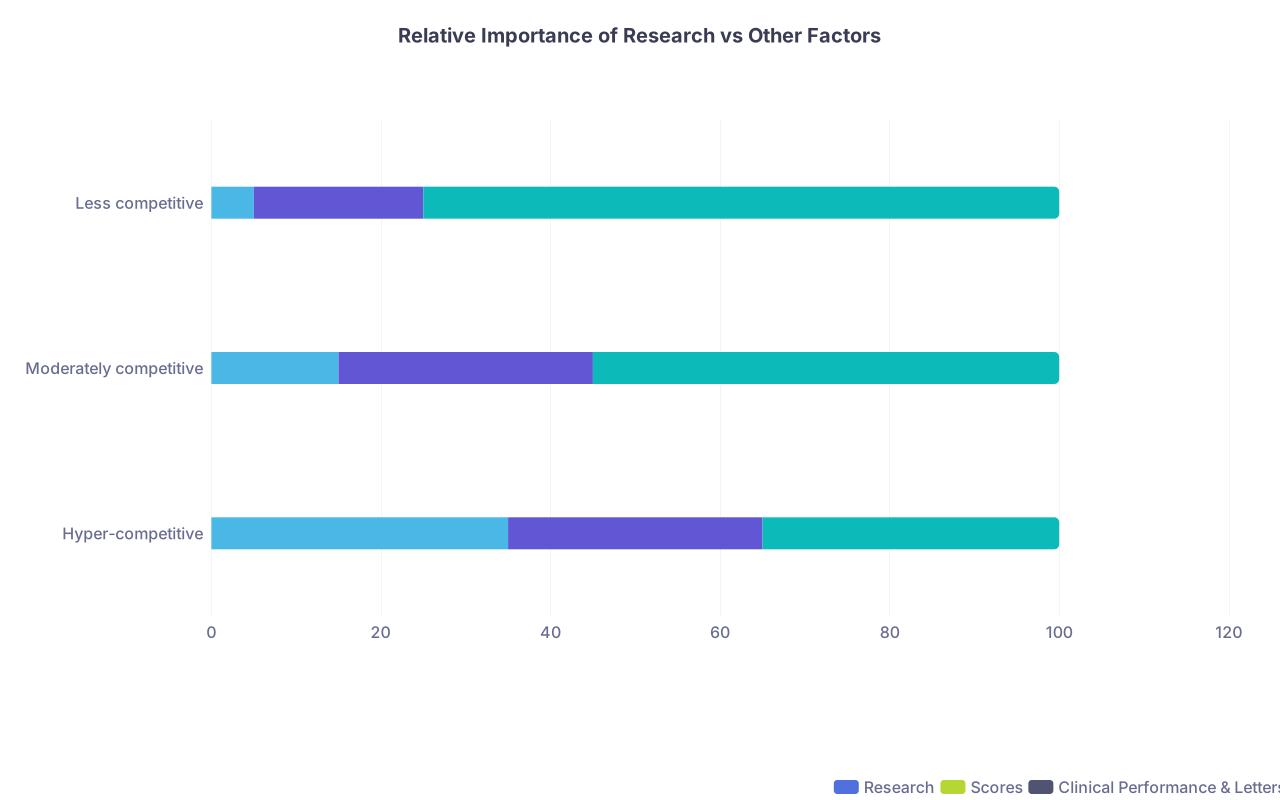
| Category | Research | Scores | Clinical Performance & Letters |
|---|---|---|---|
| Hyper-competitive | 35 | 30 | 35 |
| Moderately competitive | 15 | 30 | 55 |
| Less competitive | 5 | 20 | 75 |
In words:
The more competitive the field, the more research matters. But in every category, clinical performance & letters still matter most.
Big Picture: Research Year as a Career Decision, Not Just a Match Tactic
The smartest way to think about this:
A research year should ideally advance both:
- Your chance of matching in your target specialty,
- Your future career (skills, network, academic profile).
If a proposed research year only touches #1 slightly and does almost nothing for #2, that’s a poor use of 12 months.
If it does both—gives you real skills, a strong mentor, a clearer sense of whether you want an academic path, and a genuine bump in match odds—then it can absolutely be the right move.

FAQ: Dedicated Research Years and the Match
1. Will a research year guarantee I match into a competitive specialty?
No. It increases your odds if used well, especially in derm, neurosurgery, plastics, rad onc, and a few others. But if your scores are far below typical matched applicants or you perform poorly clinically, a research year alone will not “save” your application.
2. Is it better to do a research year at my home institution or somewhere famous?
If your home institution has weak presence in your target specialty, going to a major center with a strong program and known faculty can be a big upgrade. That said, a well-structured, high-output year with a strong mentor at your home school beats a brand-name place where you’re invisible and unproductive.
3. How many publications do I need to make a research year “worth it”?
There’s no magic number. But if after a full year you only have one low-impact abstract and no meaningful letters, that’s weak. A solid year often produces a mix of: 1–2 manuscripts (submitted/accepted), several abstracts/posters, and at least one strong letter from a well-known mentor.
4. Does a research year help if I’m going into primary care?
Rarely. For Family Med, most Pediatrics, Psych, and many community IM programs, your clinical evaluations, letters, and fit with the specialty matter far more. A dedicated research year for these fields is usually unnecessary unless you’re aiming at a highly academic niche or combined program.
5. How do I explain a research year in interviews without sounding like I did it out of panic?
Be direct but strategic. Focus on curiosity, skill-building, and exposure to the field: “I realized I wanted to understand X better and contribute to Y. The research year gave me time to build those skills, and it confirmed that I want an academic-career track in Z.” Do not lead with “I was worried I wouldn’t match.”
6. What if I start a research year and realize I hate research?
Happens more often than people admit. Your job then is to still be reliable, finish what you reasonably can, secure at least one decent letter, and re-evaluate your specialty choice. You do not have to become a lifelong researcher because you did a research year, but you also cannot check out and burn bridges—that will follow you.
Key takeaways:
- A research year is powerful for a small group of applicants in specific, highly competitive specialties; for most others, it’s unnecessary.
- If you do it, it must be structured, productive, and mentored—otherwise it can hurt more than help.
- Clinical performance and strong letters will always matter more than a padded research line on your CV.