
It’s late December. Interview season is in full swing. You’re watching classmates casually drop lines like “I have 12 publications, mostly first-author” while you’re sitting on 2 posters and a submitted manuscript… and you cannot stop asking yourself:
“Did I pick the wrong kind of research? Does the type of research matter more than just stacking publications?”
Let me give you the bottom line, then we’ll unpack it.
For residency applications, the type and quality of your research usually matters more than raw publication count, up to a point. Once you clear a basic “research credibility” threshold, what you worked on, with whom, and how you talk about it matter more than whether you have 3 vs 8 papers.
But it plays out differently across specialties.
Quick Answer: What Matters More—Type or Number?
If you want the straight ranking:
- For most competitive specialties (derm, plastics, ortho, neurosurgery, ENT, rad onc):
- Type + relevance + mentorship > Number (after ~3–5 strong items)
- For moderately competitive (EM, anesthesia, rads, OB/GYN, gen surg, etc.):
- Enough experiences to show commitment + some scholarly output > Massive PubMed list
- For less research-driven fields (FM, psych at many community programs, peds at some sites):
- Showing you can complete a project > First-author in NEJM
Publications are not Pokémon. You don’t need to “catch ’em all.” You need enough, in the right context.
Here’s how programs actually think about it.
How Program Directors Look at Research
Most program directors are not counting every citation like an academic accountant. They are asking a few blunt questions:
Can this person finish what they start?
A complete project (even a poster) beats five “oh yeah, that one is still in progress” stories.Is this relevant to my specialty or at least to patient care?
Derm PD: “You worked on a randomized trial in psoriasis. Great.”
Same PD: “You did a case report on a rare pediatric cardiomyopathy as an M1? Still good, but less directly useful.”Did they actually do anything substantial?
Deep involvement on 2–3 meaningful projects > your name at slot 17 on 10 mass-produced retrospective case series.Do they have someone credible vouching for them?
A strong letter from a known researcher in the field can outweigh an extra 5–10 low-impact publications.Is there a coherent story?
A focused, believable arc (“I got interested in stroke, did QI in stroke alerts, then clinical stroke research”) beats random scatter.
So yes, type matters. Because it signals relevance, depth, and seriousness in a way that raw numbers do not.
Types of Research: What Programs Actually Value
Let’s break down the common research types and how PDs really weigh them.
| Research Type | Typical Value for Residency Apps | Notes |
|---|---|---|
| Clinical (specialty-specific) | Very high | Best alignment with your chosen field |
| Clinical (general) | High | Still strong, shows patient-focused work |
| Basic science / translational | High (for academic programs) | Great for research-heavy places |
| Quality improvement (QI) | Moderate–High | Especially valued in surgery, IM, hospital-based fields |
| Case reports / series | Moderate | Good early step; low ceiling |
| Chart reviews with weak design | Low–Moderate | Commonly seen as “fluffy” if poorly done |
Clinical, Specialty-Specific Research
If you’re going into ortho and you have:
- 1–2 prospective clinical projects in ortho,
- 1–3 well-done retrospective studies,
- maybe a systematic review in the same domain,
you look focused and serious. That’s gold for competitive specialties.
One strong, prospective dermatology outcomes study with a big-name mentor can easily “beat” ten scattered, low-impact projects in unrelated fields.
General Clinical Research
Internal medicine, pediatrics, EM, anesthesia, etc. are fine with general clinical research:
- Hospitalist outcomes
- Sepsis protocols
- Readmission risk prediction
- ICU delirium projects
These show you understand clinical questions and can work with data. Even if it’s not perfectly aligned with your eventual fellowship interest, it’s still highly respected.
Basic Science and Translational Research
This is where nuance matters.
Good:
- You did 2 years of solid bench work in an immunology lab.
- You can explain your project clearly.
- You have a paper or at least a submitted manuscript.
- You have a strong letter from the PI.
Less good:
- You spent a summer counting gels and “optimizing” protocols and can’t explain the hypothesis.
- Nothing ever got finished.
- You list 8 “in preparation” papers.
Academic and research-heavy programs (e.g., IM at MGH, Hopkins, UCSF; derm at Penn; neurosurgery at WashU) love serious basic science experience, even if it doesn’t perfectly match the clinical specialty.
But you must be able to explain your work in normal language and show completion.
Quality Improvement (QI) Projects
QI is underrated because students frequently do it badly:
- No real data
- No pre/post metrics
- No sustainability
Done well, QI is very attractive, especially in:
- Surgery (OR efficiency, post-op complications)
- Internal medicine (readmissions, handoffs)
- EM (door-to-needle times, throughput)
If your QI actually changed practice and you can show before/after numbers or adoption across a unit, that is real impact—even if it never became a PubMed citation.
Case Reports & Case Series
They’re fine. They show effort. But they are the floor, not the ceiling.
PDs see tons of:
- “Interesting rare rashes”
- “Unusual presentation of common disease”
Good as part of a larger portfolio, not a replacement for deeper work.
When the Number of Publications Actually Does Matter
Number of publications isn’t useless. It starts to matter in a few specific situations.
1. Hyper-competitive, research-heavy specialties
Derm, plastics, neurosurgery, rad onc, ENT, ortho at top academic places—programs here often expect:
- Several actual publications (not just abstracts),
- With some first- or second-author roles,
- Preferably in their field.
In this world, 1–2 ophthalmology papers is a start, but 6–8 ophthalmology or vision-science outputs can push you into a different tier.
But even here, the pattern holds:
Ten low-quality, boilerplate chart reviews is not impressive to a program that sees serious, multi-year research from many applicants.
2. Research track / physician-scientist programs
If you’re aiming for:
- PSTP tracks
- R25 or T32-heavy programs
- “Research pathway” medicine or pediatrics programs
then yes, both type and number matter. They want:
- Clear evidence you can generate research ideas,
- Multiple completed outputs,
- And a trajectory pointing to an academic career.
Still, big message: quantity without depth reads hollow.
3. When your application is otherwise weak
If your Step scores and grades are on the lower side for your target specialty, research can be a differentiator. In that case:
- Multiple solid publications (even if not all perfectly on-topic) can help show academic capability.
- But again—completion and quality beats padding.
How Many Research Experiences Is “Enough”?
Let’s talk thresholds, since everyone wants numbers.
I’m going to give ballpark targets for a competitive but reasonable application, assuming US MD or strong DO, and not applying exclusively to the absolute top 5 programs in the country.
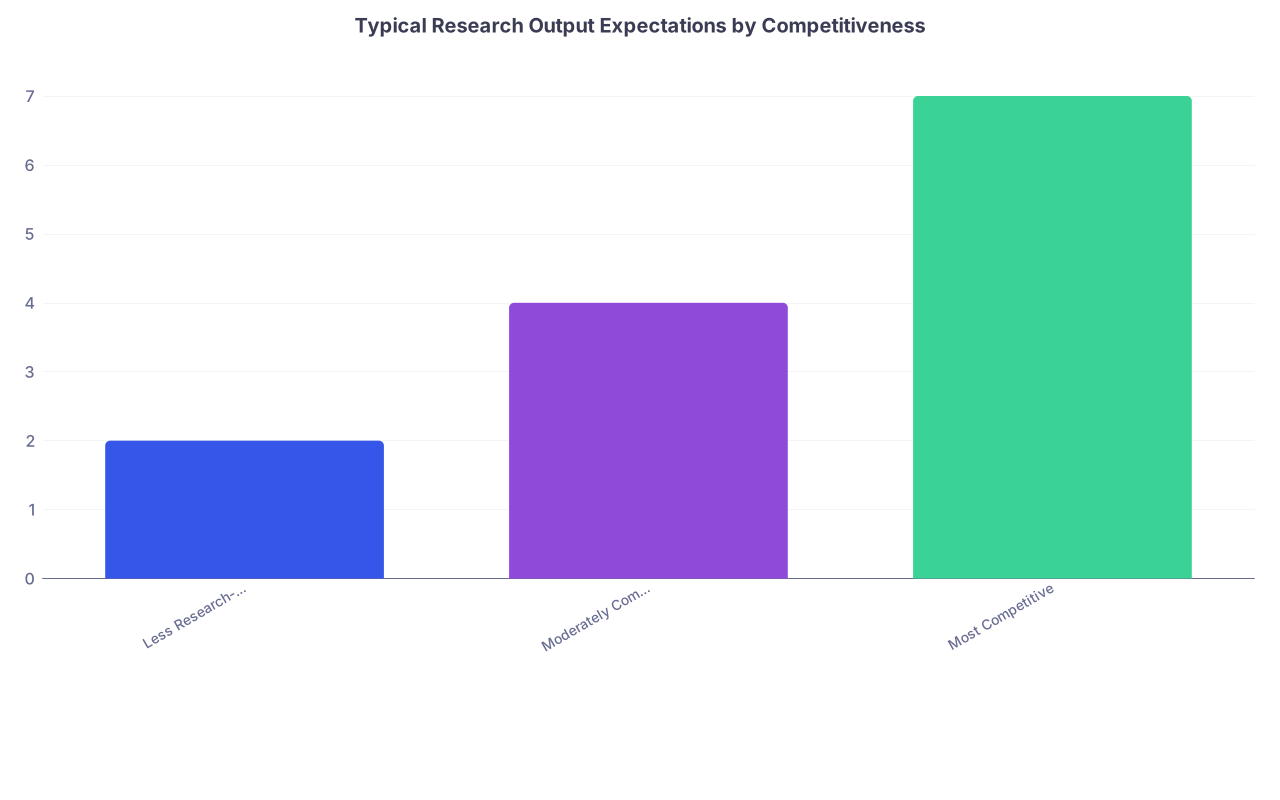
| Category | Value |
|---|---|
| Less Research-Heavy | 2 |
| Moderately Competitive | 4 |
| Most Competitive | 7 |
Where these rough numbers are:
- “Less Research-Heavy” (FM, psych at many community, some peds): ~1–3 completed research items (posters, abstracts, papers).
- “Moderately Competitive” (EM, anesthesia, radiology, OB/GYN, IM categorical at solid academics, gen surg): ~3–6 items, ideally 1–2 publications or national presentations.
- “Most Competitive” (derm, plastics, neurosurg, ortho, ENT, rad onc, top-tier academic IM): ≥5–8 items, multiple related to the specialty, with some first-author or major roles.
Those are outputs (abstracts/posters/papers), not distinct “projects you sort of helped with.”
Again, once you’re above that ballpark, it becomes more about what and how you talk about it than raw number.
What If Your Research Is “The Wrong Type”?
Here’s the scenario everyone secretly worries about:
“I spent 2 years doing bench immunology and now I want anesthesia. Was that all a waste?”
No. Not even close.
You salvage this by:
Translating your skills
“I learned to design experiments, analyze data, deal with setbacks, and work in a structured, hypothesis-driven way.”Showing completion
Make sure at least some of it became:- A poster
- An abstract
- A paper
- A thesis
Bridging to your specialty
In your personal statement and interviews, connect:- The questions you asked in the lab
- To the way you think about patients and clinical problems now.
Example:
“My work in T-cell signaling taught me how small molecular differences can radically change outcomes. That lens is part of why I’m drawn to critical care within anesthesia—where tiny shifts in physiology matter.”
Same logic if:
- You did psych research and now want EM.
- You did public health and now want surgery.
- You did engineering and now want radiology.
The only truly “wrong” type is: uncompleted, unexplainable, and irrelevant on paper and in your mouth.
How to Prioritize Your Time: Type vs Number
If you’re in M3/M4 or taking a research year and trying to decide:
- “Do I add another small chart review to bump my count from 4 → 6?”
- Or “Do I double down on one or two higher-quality, prospective or more substantive projects?”
Pick depth and relevance almost every time.
Here’s a practical decision guide.

| Step | Description |
|---|---|
| Step 1 | New Research Opportunity |
| Step 2 | Priority 1: Take it |
| Step 3 | Ask about mentorship; proceed cautiously |
| Step 4 | Priority 2: Consider for skills/output |
| Step 5 | Low priority or decline |
| Step 6 | Specialty-relevant? |
| Step 7 | Strong mentor? |
| Step 8 | High-quality & finishable? |
I’d tell you bluntly:
- One well-designed, specialty-relevant, mentored project you can talk about for 10 minutes without sounding lost is worth far more than three random low-impact add-ons.
How to Present Your Research So It Actually Helps You
Type and number only get you so far. You win (or lose) on how you present your work.
In your ERAS application and interviews, for each major project, be ready to hit:
The one-sentence question:
“We wanted to know whether X was associated with Y in patients with Z.”Your specific role:
“I designed the data collection form, collected 80% of the chart data, and did the initial analysis in R.”What came out of it:
“We found a 30% reduction in readmissions; we presented this at ACC and it’s now under review.”What it taught you:
Concrete, not fluffy.
“I learned how messy real-world data are, and how to work with a team across departments.”
That’s where type and depth show. One or two such stories will stick in a PD’s mind. Not “I’m author 12 on a dozen nearly identical case series.”
FAQ: Does Research Type Matter More Than Number?
1. I only have 1–2 publications, but they’re directly in my specialty. Is that enough for a competitive field?
It can be, depending on the rest of your application and the tier of programs you’re targeting. Two strong, specialty-specific publications plus:
- Solid board scores,
- Strong clinical evals,
- Good letters (especially from those research mentors),
is absolutely a workable application for many good programs. You may not be ultra-competitive for the very top 5–10 “research factories,” but you won’t be dismissed.
2. I have 10+ publications, but most are outside my specialty. Will PDs care?
They will care that you:
- Can complete projects,
- Can publish,
- And likely have good academic work habits.
You’ll still want at least some exposure to your chosen field—this can be:
- A smaller project,
- A case report,
- A QI project in that department,
- Or at least a rotation with a letter.
Use your personal statement and interviews to explain the shift and connect your prior research to how you think clinically now.
3. Is it better to be middle author on a high-impact paper or first author on a small project?
For residency applications, first author on a smaller, clearly understandable project is usually more valuable than being “author #7” on a huge paper you barely touched.
The exception: if that high-impact paper is directly in your specialty, your mentor is writing you a strong letter, and you genuinely did substantial work you can explain in detail. But generally, PDs want to see ownership.
4. I’ve done several projects but nothing’s published yet. Does that hurt me?
It depends on timing and how you frame it. Programs understand that:
- Manuscripts take time,
- Review can drag on for months.
What hurts is listing a ton of vague “in preparation” work with no concrete outputs. Push hard to turn at least a couple of projects into:
- Abstracts,
- Posters,
- Oral presentations,
- Or submitted manuscripts you can cite with journal names.
Then in your experiences, be specific: “Manuscript submitted to JAMA Derm in Oct 2025 (under review).”
5. I’m starting late (M3/M4). Should I chase any project I can, or focus on one type?
If you’re late to the game, prioritize:
- Projects that can realistically generate a concrete output (poster, abstract, short paper) before or early in application season.
- Specialty-relevant or at least clinically relevant work.
- Mentors who respond to email and have a track record of getting students onto papers.
Do not waste time on sprawling, multi-year projects that you’ll never see the end of before ERAS. You’re better off with one to two tight, finishable projects than half a dozen half-baked ones.
Key takeaways:
- Type and quality of research usually matter more than sheer number, once you hit a basic threshold of productivity.
- Specialty relevance, real involvement, and completion (posters, abstracts, papers) beat a padded CV full of forgettable middle-author lines.
- You win by telling a clear, believable research story that matches your specialty and shows you can finish what you start.