
The fastest way to make your “research credentials” look cheap is to brag about them badly on social media.
If you think faculty are not quietly checking what you post, you are underestimating how small and gossip-prone academic medicine really is.
You are applying for residency. That means you are not just a student anymore. You are a potential colleague. Your social media is often the only unfiltered look programs get at how you carry yourself when you think no one important is watching. They are watching.
Let me walk you through the posting habits that quietly make faculty roll their eyes, question your judgment, or even pull your file from the “interview” pile to the “no thanks” pile.
The Fantasy That “It’s Just Instagram”
First mistake: believing your accounts are “personal” and separate from your professional life.
You know this line:
- “My Twitter is private.”
- “I only use Instagram for friends.”
- “I never mentioned my program’s name.”
Faculty have heard it all. They still see the screenshots. Residents share them in group chats. Fellows DM each other: “Is this your student?” Screenshots live forever, even if your story disappeared.
And here is the critical point: programs do not need your handle to find you. They search:
- Your full name
- Your name + “MD” or “med”
- Your name + school
- Your research topic or paper title
And if they do not find you directly, they see you tagged in someone else’s post.
The mistake is assuming:
- “If I do not post patient stuff, I am safe.”
- “If it’s research-related, it makes me look academic.”
No. The danger is not only HIPAA. The danger is that your posts reveal:
- Arrogance
- Insecurity
- Poor judgment
- Lack of professionalism
- Inability to share credit
That is what kills you with faculty. Not a blurry photo. The pattern.
Cringe Research Bragging: The Greatest Hits
There is a specific flavor of research posting that makes faculty immediately skeptical of you as a future resident. I have seen it play out more than once: applicant looks “great on paper,” then a faculty member finds their Twitter. The tone changes.
Here are the worst offenders.
1. “Look at me, I’m built different” posts
Example genres:
- “First-author pub as an MS2 in [top journal]. Grateful for the grind. #NoDaysOff”
- Screenshot of an acceptance email with your name circled and some caption like “They doubted me.”
- Long thread about “proving the haters wrong” because you matched your dream specialty with “only” 5 pubs.
What faculty see:
- Narcissism
- Lack of humility
- A student who thinks they are the main character of the department
They know research is collaborative. When you make the narrative all about your genius and hustle, you implicitly erase:
- The PI who wrote the grant
- The postdocs who did the heavy lifting
- The biostatistician who saved your methods
- The co-authors who edited your train-wreck first draft
Programs do not want someone who will show up as an intern and act like everyone else is background noise in “The You Show.”
Better instinct:
- Post about the science, not your ego.
- Phrase it as joining a team effort, not conquering Mount NEJM solo.
- Skip the pseudo-motivational, hero origin story captions.
If your caption could double as a shallow LinkedIn hustle post, it is probably a bad sign.
2. Overstating your contribution (and getting caught)
Another fatal pattern: bragging about “your” paper in a way that wildly exaggerates your role.
You post:
- “Honored to have led this trial on [topic] at [big-name institution].” Reality:
- You were a student who helped with chart review and minor edits.
Faculty are not stupid. They know what a medical student can and cannot realistically “lead.” They may personally know your PI. They can read the author list and see where your name actually sits.
Where this really burns people:
- Your ERAS description claims “designed study, performed data analysis, wrote majority of manuscript.”
- Your social media boasts sound like you were the PI.
- Then, in the interview, you cannot answer basic questions about methodology or interpret your own figures.
That combination—public overclaiming + shallow understanding—is lethal. Faculty talk. “Looks great on paper, but when I asked about X, they clearly barely touched the analysis.”
If you must post:
- Use neutral, accurate language: “Contributed to a project on…” or “Grateful to be part of…”
- Only say “led” or “first author on” when it is factually and clearly true.
- Be prepared, in depth, to discuss anything you broadcast online as a major achievement.
If there is a mismatch, people assume you embellish everything.
3. Flexing your “publication count” like a scoreboard
One of the most off-putting habits:
- “10 pubs. 6 first-author. Before residency. Let’s go.”
- “Hit double-digits on PubMed today.”
- Posting screenshots of your PubMed results page.
Faculty see that and think:
- “Do they understand anything they worked on?”
- “Did their PI use them as a citation machine?”
- “Are these 10 low-impact, salami-sliced case reports and letters?”
There is a growing skepticism toward “CV inflation.” If you advertise your raw numbers like you are collecting Pokémon cards, you invite scrutiny:
- Did you have any real intellectual ownership?
- Are you a thoughtful researcher or just chasing lines on a CV?
- Do you know the difference between quantity and impact?
And residents know this game well. They will absolutely pull up your listed titles and roll their eyes if it is all:
- Case reports in obscure journals
- “Review articles” assembled from UpToDate
- Minimal contribution multi-author pieces where you were student #7
I am not saying those things are worthless. I am saying bragging about them like they are equivalent to rigorous, original work makes you look unserious.
If you must mention volume:
- Do it privately in ERAS, and even there, be proportionate.
- Online, emphasize what you learned rather than how much you produced.
- Do not publicly frame your research as a body count.
Subtle Ways Your “Humble Brag” Still Backfires
Some of you try to soften the brag with a “grateful” or “humbled” caption. Faculty can still smell the flex.
1. The performative gratitude script
“I am incredibly humbled to share that our manuscript was accepted to [prestigious journal]. Eternally thankful to my amazing team.”
On paper, fine. But then we see:
- 20 similar posts in a year.
- Always tagging “#Match202X” or “#Premed” or “#MedTwitter” to maximize reach.
- Threads that morph from “team effort” into a mini-CV advertisement.
The pattern reveals your intent: this is not genuine gratitude. This is strategic self-marketing to build a brand. Which is fine, until it starts to look obsessive, self-promotional, and disconnected from real clinical work.
Faculty reaction:
- “Do they care more about optics than substance?”
- “Are they going to be posting about every QI project they touch?”
- “Will they be able to keep anything offline?”
You are allowed to be proud. Just understand frequency and tone matter. If half your feed is academic humble brags, it stops reading as humility.
2. Tagging programs and big-name faculty
Another landmine: tagging every institution and senior author you can to inflate reach.
Example:
- “Honored to publish with @FamousSurgeon at @BigNameHospital on [topic].”
- Tagging your dream residency program in a paper that barely involves them.
- Fishing for retweets from specialty giants.
This can make you look:
- Desperate
- Clout-chasing
- Politically naive
The worst case: you tag someone who finds your post exaggerated, sloppy, or tone-deaf. Now your name is associated with “that student who misrepresented my work on Twitter.”
If you want to mention collaborators:
- Tag sparingly and appropriately.
- Ask yourself: “Would they be pleased or mildly annoyed to be pulled into this?”
- Never tag a program you are applying to in a way that suggests they “own” you already. It can be socially awkward and presumptuous.
Confidentiality and Boundary Violations (That You Think Are Harmless)
You already know not to post identifiable patient information. Good. The problem is many research-related posts break professional boundaries in more subtle ways.
1. Posting photos from the lab / OR / wards carelessly
You share:
- A celebratory lab photo with charts and names on whiteboards in the background.
- A “research meeting” in a conference room with protected data on the projector.
- A shot in the OR with a visible operative field in the frame.
Even if you blur faces or think the resolution is low, programs see:
- Careless judgment with confidential spaces
- Poor understanding of professionalism in clinical areas
I have seen faculty reject applicants over one Instagram story from the call room that showed a whiteboard list in the background. Not драмatically. Just: “If they are that casual on social media as a student, imagine them as a resident.”
Get this rule into your bloodstream: If it involves:
- A hospital badge
- A patient space
- A whiteboard
- A computer screen
- A chart Do not post it. Or make it aggressively bland and background-safe, and even then ask yourself why it needs to be online at all.
2. Sharing inside information about trials or projects
Painful but common:
- Posting about “exciting early results” from an ongoing trial.
- Dropping hints about outcomes before publication.
- Sharing preliminary figures that were in a closed departmental talk.
You might think:
- “It is just a de-identified bar graph.”
- “Everyone in our subspecialty kind of knows this anyway.”
Faculty see:
- Breach of trust.
- Lack of respect for embargoes and confidentiality.
- A risk for future regulatory issues.
In research, PIs need people who will keep their mouths shut until the work is ready. If your public persona screams “I love sharing cool inside stuff for likes,” you are a liability.
Red Flags That Make Faculty Question Your Maturity
Beyond bragging, certain patterns on your research-related feed raise questions about your judgment and emotional control.
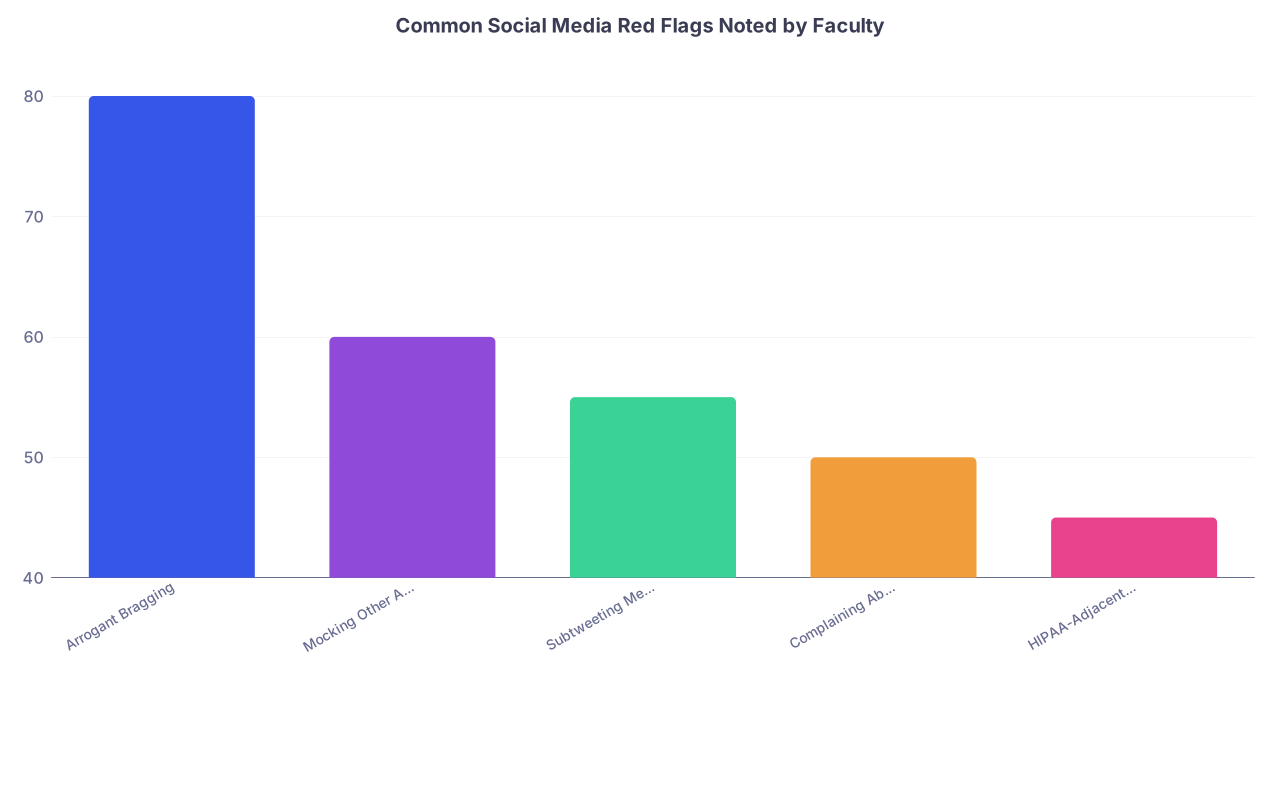
| Category | Value |
|---|---|
| Arrogant Bragging | 80 |
| Mocking Other Applicants | 60 |
| Subtweeting Mentors | 55 |
| Complaining About Match | 50 |
| HIPAA-Adjacent Posts | 45 |
These are the ones that come up repeatedly in faculty conversations.
1. Trashing other students’ research
I have heard this exact line from a program director:
“Any applicant who publicly mocks someone else’s poster is off my list.”
Forms this takes:
- Screenshots of someone’s abstract with “How is this even research?”
- Jokes about “low-tier journals” your classmates publish in
- Threads dunking on “case report factories” while you present yourself as “real science”
Academia already has enough insecurity and ego. No one wants a junior trainee who punches down publicly.
It signals:
- Poor team spirit
- Immaturity
- Inability to disagree respectfully
You can have opinions about research quality. Just do not broadcast contempt for your peers. That is the sort of thing that haunts you.
2. Subtweeting or complaining about mentors and projects
Examples:
- “Funny how some PIs only remember you exist when the deadline is tomorrow.”
- “Wild that people put their names first when they did basically nothing.”
- “Love spending 6 months on a project that never gets submitted.”
Do mentors sometimes behave badly? Yes. Do faculty know that? Absolutely.
But when they see you drag that frustration into the public square, they worry:
- “Will they do this about us?”
- “Can they resolve conflict through proper channels?”
- “Are they going to air residency grievances on Twitter?”
Programs want residents who can handle conflict offline. If your instinct is to turn every professional irritation into content, you are a reputational hazard.
The Illusion That Building a “Brand” Always Helps You Match
There is a seductive narrative right now: if you build enough of a social media presence around your research, programs will chase you.
Reality: it cuts both ways.
| Posting Style | Likely Faculty Reaction |
|---|---|
| Thoughtful threads on methods, no self-glorification | Respectful interest |
| Occasional, accurate project updates | Neutral to positive |
| Constant “grind” + pub count flexes | Annoyance, skepticism |
| Subtweeting mentors or peers | Strong negative |
| Tagging programs to fish for attention | Mild to strong negative |
Yes, some specialties and programs like to see intellectually engaged applicants on social media. But they are watching for:
- Insight
- Humility
- Curiosity
- Ability to discuss science clearly
They are not impressed by theatrics, self-promotion on steroids, or a public persona that looks like you care more about your follower count than your patients.
If you insist on being visibly online, be strategic:
- Ask yourself: “Would I be comfortable with a program director reading this out loud in conference with my name attached?”
- Assume anything you post may land in the inbox of your PI, your dean, or your future chief resident.
If the answer makes you sweat, do not post it.
A Safer Way To Talk About Your Research Online
I am not telling you to disappear from the internet. I am telling you to stop shooting yourself in the foot with ego-driven posts.
Here is the pattern that tends to go over well:

| Step | Description |
|---|---|
| Step 1 | Want to post about research |
| Step 2 | Do not post or rewrite |
| Step 3 | Remove details or cancel |
| Step 4 | Safe to post |
| Step 5 | Is it about the science or about me? |
| Step 6 | Any confidential data or settings? |
| Step 7 | Tone: humble and accurate? |
Aim for posts that:
- Explain an interesting finding in simple language.
- Highlight what you learned about methods or clinical impact.
- Acknowledge the team and mentors without over-the-top flattery.
- Avoid numbers and rankings (pub counts, journal IF, h-index talk, etc.).
You want to come across as:
- Serious
- Reliable
- Team-oriented
- Less interested in self-promotion than in doing good work
That is the kind of applicant faculty fight to recruit. Not the one measuring their worth in likes per publication.
FAQs
1. Is it ever okay to post that a paper or abstract was accepted?
Yes, if you do it once in a while, keep the caption factual and modest, and avoid grandiose language about “proving everyone wrong” or “grind culture.” Something like: “Grateful to have worked with Dr. X’s team on [topic]. Our abstract was accepted to [conference]. Looking forward to feedback and discussion.” Then stop. You do not need a 10-tweet thread listing your contributions and your evolving CV.
2. Can programs really see my “private” accounts?
They might, indirectly. Private is better than public, but it is not a shield. Screenshots travel. Friends tag you. A coauthor follows you, sees a questionable post, and shows their attending. I have watched more than one faculty meeting pivot after someone said, “You should see what they post on Instagram.” If you would be embarrassed for it to leak, do not assume privacy settings will save you.
3. What if my research presence online is actually strong and thoughtful? Can that help?
Yes, when it is obviously about ideas, not ego. If you write clear, thoughtful threads explaining methods, limitations, and clinical relevance without exaggeration, some faculty will be genuinely impressed. But the moment your feed shifts toward constant self-referencing, scorekeeping (pub numbers, impact factors), or drama with mentors and peers, whatever advantage you had evaporates.
4. I already posted some questionable braggy stuff. Should I delete it?
Probably. Clean it up. Remove anything:
- That exaggerates your role.
- That trashes others’ work, mentors, or programs.
- That shows clinical or research spaces with sensitive info. Then, going forward, change the habit, not just the history. Programs care less that you were once a little overeager and more that you currently show judgment and maturity. Your posting pattern over the months leading up to application season says far more about you than a one-off old mistake.
Key points:
- Faculty are watching your social media more than you think, and research bragging is one of the fastest ways to look immature, arrogant, or untrustworthy.
- Overstating your role, flexing publication counts, and publicly venting about mentors or peers create red flags that your ERAS cannot hide.
- If you are going to be visible online, keep it about the science, be accurate and humble, and never post anything you would not want read aloud in front of a rank committee with your name attached.