The biggest lie about “research for residency” is that you can cram it into a few months before ERAS. You cannot. If you want something meaningful on your application—actual PubMed lines, posters, or at least a serious ongoing project—you treat it like a year‑long project, not a last‑minute checkbox.
Here is your 12‑month, idea‑to‑ERAS research calendar. Month by month. What you should have done, what you still can do, and what to stop pretending will work.
Assumptions:
- You are applying in September (standard NRMP / ERAS cycle).
- Month 1 = September of the year before you apply.
- You are a med student (M3/M4) or prelim/TY resident aiming to strengthen your residency or re‑application.
Adjust months as needed if your timeline is shifted; the sequence stays the same.
Big Picture: What Has To Be Done By When
Before we break it down, here is the real constraint: research runs on institutional time, not your time. IRB, mentors, and coauthors move slowly. You plan around that.
| Desired Output on ERAS | Latest Reasonable Start Month | Reality Check Note |
|---|---|---|
| First‑author original paper | Month 1–2 | Anything later is gambling |
| Case report / small series | Month 4–6 | Feasible if you hustle and choose well |
| Poster / abstract at conference | Month 3–5 | Depends on conference deadlines |
| Ongoing project (no publication) | Month 7–9 | Still useful if clearly defined and active |
| “Fake” research buzzwords only | Month 10+ | Programs can smell this a mile away |
Now let’s walk the year. Month by month. At each point, what you should be doing—and what you should already have done.
Months 1–2: Idea, Mentor, and Scope (12–11 Months Before ERAS)
At this point you should be figuring out who you are in research, not collecting PubMed IDs.
Month 1: Define the Target and Take Inventory
Goal: Figure out what level of research you realistically need and what bandwidth you have.
Clarify your competitiveness needs
- Applying derm, plastics, ortho, ENT, rad onc, integrated IR? You need real output. Preferably:
- 2–3+ PubMed‑indexed items
- At least one with you as first or second author
- Applying IM, peds, FM, psych, neuro, EM? You still benefit from research, but:
- 1–2 solid projects or a combination of posters + QI is fine
- Depth in your intended specialty helps more than random bench work
- Applying derm, plastics, ortho, ENT, rad onc, integrated IR? You need real output. Preferably:
Audit your current CV
- List each prior project:
- Status: published / in‑review / draft / abandoned
- Your role: first author, data work, chart review, etc.
- Decide which efforts are:
- Salvageable and finishable this year
- Dead weight that will never move (be honest)
- List each prior project:
Time and logistics reality check
- How many hours per week can you consistently give research? Not fantasy hours. Real ones.
- Call, rotations, Step 2, sub‑Is—map these on a 12‑month calendar.
You should finish Month 1 with:
- A target research “portfolio” (e.g., 1 original paper + 1 case report + 1 poster).
- A very clear sense of free time vs rotation blocks.
Month 2: Find a Mentor and a Feasible Project
Goal: Lock in a human being who will attach their name and infrastructure to your effort.
You are doing 3 parallel things:
Identify realistic mentors
- Look for:
- Faculty in your specialty of interest with recent publications (past 2–3 years).
- People who are known to work with students (ask senior residents).
- Avoid:
- Famous names who publish, but are ghosts.
- Faculty with 50 ongoing projects and no one actually graduating papers.
- Look for:
Cold‑but‑targeted outreach
- Your email:
- 3–4 sentences only.
- One line on your background, one on interest in their area, one asking if they have projects for a motivated student.
- Attach:
- 1‑page CV.
- If you have it: a prior abstract or publication.
- Your email:
First meetings: scope the real options
- Ask:
- “What kind of projects do you usually involve students in?”
- “What is a realistic timeline for something to be submitted before next summer?”
- Listen for:
- Clear structure and prior student success. If they cannot name recent student pubs, that is a red flag.
- Ask:
By the end of Month 2 you should:
- Have one primary mentor and 1–2 backup contacts.
- Have selected one main project that:
- Can realistically reach submit/abstract stage in 6–8 months.
- Fits your time constraints.
If you end Month 2 with only vague promises like “we’ll find something,” you are already behind. Push for a concrete plan or move on.
Months 3–4: Design, IRB, and Data Access (10–9 Months Before ERAS)
At this point you should be moving from idea to structure. Not collecting data yet—getting permission to exist.
Month 3: Nail Down the Project Design
Goal: Turn a fuzzy “I’ll do research” into a protocol someone could actually execute.
Clarify the project type
- Retrospective chart review
- Prospective cohort (riskier for timeline)
- Case report / series
- QI project with formal data
- Systematic / scoping review
Draft a one‑page protocol
- Background: short paragraph.
- Research question and hypothesis.
- Inclusion / exclusion criteria.
- Data points you will collect (make a clean table).
- Basic analysis plan (even if simple descriptive stats).
Agree on roles and authorship early
- Ask directly:
- “If I do the bulk of data collection and writing, would I be first author?”
- Get verbal clarity now, or you will regret it in Month 8.
- Ask directly:
Month 4: IRB and Access
Goal: Move the project into the institutional pipeline.
Submit IRB or determine if exempt
- Your mentor should:
- Plug your project into existing IRB when possible, or
- Help you submit a new one using institution templates.
- Your job:
- Fill in every student‑doable section.
- Make sure the IRB form matches your one‑page protocol.
- Your mentor should:
Set up data access
- Request:
- EHR access if you don’t have it.
- Database access (REDCap, institutional data warehouse).
- Build:
- A data collection sheet (Excel or REDCap) that exactly mirrors your variables list.
- Request:
Parallel Track: “Fast” Wins
- Start lining up case reports while IRB is pending.
- When you see an interesting patient:
- Flag with attending.
- Briefly search if it is rare enough or has a unique twist.
- Start a one‑page outline.
By the end of Month 4:
- IRB is submitted or confirmed as not required (for case reports / QI depending on your institution).
- Data collection template is ready.
- You likely have 1 potential case report identified.
Months 5–6: Data Collection and Early Writing (8–7 Months Before ERAS)
Now you are living in the charts. At this point you should be building the dataset and drafting the skeleton of your paper.
Month 5: Structured Data Collection
Goal: Build a clean, analyzable dataset.
Block out recurring data sessions
- Example:
- 3 evenings per week, 1.5–2 hours each.
- One longer weekend block if rotation allows.
- Track:
- Patients abstracted per hour.
- Total remaining.
- Example:
Avoid data chaos
- Keep:
- A “data dictionary”—what each variable means, coding rules, units.
- A log of any ambiguous cases and how you handled them.
- If you have multiple students:
- Do a pilot of 10 patients each, then compare for consistency.
- Keep:
Begin writing sections that do not require results
- Introduction: 3–5 paragraphs.
- Methods: write as you collect. Much easier now than later.
Month 6: Finish Data, Start Analysis
Goal: Have your data close to done and a basic idea of results.
Finish most data collection by end of Month 6
- You want:
80% of data done.
- Clear sense of any missing fields or problems.
- You want:
Preliminary analysis
- If you are not a stats person:
- Ask your mentor who usually helps with analysis.
- Set a meeting as soon as you have a near‑final dataset.
- Generate:
- Basic descriptive stats (means, medians, counts).
- 1–2 simple tables.
- If you are not a stats person:
Conference abstract scouting
- Identify 1–2 good conferences in your field:
- National (e.g., AHA, ATS, APA).
- Regional section meetings.
- Write down abstract deadlines and formats now.
- Identify 1–2 good conferences in your field:
By the end of Month 6:
- Dataset is essentially complete.
- Draft of intro and methods exists.
- You know 1–2 realistic abstract submission targets.
Months 7–8: Drafts, Abstracts, and Case Reports (6–5 Months Before ERAS)
At this point you should be turning data into products: abstracts, posters, manuscripts, and case reports.
Month 7: Abstract and Manuscript Draft 1
Goal: Get something out of your head and into your mentor’s inbox.
Write the core results
- Text:
- 2–3 paragraphs: key findings, important comparisons.
- Tables / figures:
- 1–2 clear, simple tables.
- Maybe one main figure if it adds value.
- Text:
Draft a conference abstract
- Aim for:
- One general‑audience abstract (for a big national meeting).
- One niche or regional option if timing is better.
- Ask your mentor:
- “Which conference would showcase this best and is realistic for acceptance?”
- Aim for:
Start or push case reports
- For each case:
- Get patient consent if required by your IRB / institution.
- Write structure: Introduction, Case Description, Discussion, Conclusion.
- Target:
- Specialty‑specific open‑access journals that routinely take case reports.
- Journal turnaround time < 3–4 months.
- For each case:
Month 8: Revisions and Submissions
Goal: Submit at least 1–2 abstracts and one case report if feasible.
Abstract polish and submission
- Send to mentor and maybe one senior resident for quick edits.
- Fix:
- Clarity.
- Overstatements. Programs love honesty over hype.
- Submit by the earliest viable deadline. Late abstract scrambling is how people get sloppy.
Manuscript Draft 2
- Incorporate mentor feedback.
- Tighten introduction:
- One paragraph of context.
- One paragraph of gap.
- One clear sentence: “We aimed to…”
- Methods and results should be basically done now.
Submit at least one case report
- Do not be precious. Perfect is the enemy of submitted.
- Choose a journal:
- Clear scope match.
- Reasonable fees (or waivers).
- Send, move on, and start another if you have bandwidth.
By the end of Month 8:
- At least one abstract is submitted or ready to go within a couple weeks.
- One manuscript is in decent second‑draft shape.
- One case report is submitted or very close.
Months 9–10: Manuscript Submission and ERAS Positioning (4–3 Months Before ERAS)
Now the focus shifts: you need to convert your research work into ERAS‑ready entries.
Month 9: Manuscript Submission
Goal: Have your primary project under review at a journal.
Choose journal tiers strategically
- Do not chase prestige if it costs you the cycle.
- Real talk:
- A solid mid‑tier specialty journal with “submitted / under review” on ERAS beats an aspirational journal that has not seen your paper yet.
- Ask your mentor:
- “Where have similar papers from your group been accepted?”
Finalize and submit the manuscript
- Make sure:
- All authors approve the final version.
- Authorship order is correct and agreed upon.
- Figures and tables meet formatting rules.
- Make sure:
Continue smaller projects
- If time remains, tack on:
- A second case report.
- A small QI‑type project you can at least write up and submit as an abstract.
- If time remains, tack on:
Month 10: Translate to ERAS Language
Goal: Build the ERAS entries while research details are fresh.
Draft ERAS research entries
- For each project:
- Title (consistent with your manuscript / abstract).
- Your role (“Designed study, collected and analyzed data, drafted manuscript”).
- Status:
- “Submitted for publication”
- “In revision”
- “Accepted” (once true)
- “Ongoing project”
- Use concrete verbs:
- Designed, led, analyzed, wrote, presented.
- For each project:
Decide how to present “works in progress”
- If realistic to be submitted before ERAS:
- List as “in preparation” but be ready to give details on request.
- If very early:
- Classify as “Ongoing Research Project” or under “Work / Leadership” with honest description.
- If realistic to be submitted before ERAS:
Coordinate with letter writers
- Tell research mentors:
- Your ERAS submission date.
- Which projects you hope they will reference.
- They should be able to say:
- “This student led X project and was key to Y abstract / paper.”
- Tell research mentors:
By the end of Month 10:
- Main manuscript is submitted.
- ERAS research entries are drafted.
- Mentors understand that your work is a key part of your application narrative.
Months 11–12: Final Polish, ERAS Submission, and Interview Prep (2–0 Months Before ERAS)
At this point you should be transitioning from doing research to talking about research like a serious future resident.
Month 11: Final ERAS Prep and Status Updates
Goal: Lock ERAS, but keep research momentum visible.
Freeze what you will list
- Anything:
- Submitted.
- Accepted.
- Presented.
- With clear structure and ongoing work.
- Should be on ERAS with accurate dates and statuses.
- Anything:
Align your personal statement with your research story
- One short paragraph:
- Why this area of research matters to you.
- One key project and what you learned (not just what you did).
- Do not:
- Fake a “career in bench science” if you clearly are a clinician‑educator type. Programs will feel the mismatch.
- One short paragraph:
Tell mentors ERAS is submitted
- Ask them:
- To let you know if a project gets accepted or published so you can update programs.
- If you get an acceptance:
- You can send a brief, professional update email to top‑choice programs.
- Ask them:
Month 12: Interview Season Research Prep
Goal: Be ready to speak like the person who actually did the work—because you did.
Create a one‑page “research cheat sheet”
- For each project:
- 2–3 sentence summary.
- Your exact role.
- Key result or takeaway.
- One limitation you would fix next time.
- Keep this on your phone or printed in your folder.
- For each project:
Practice the 60‑second research pitch
- Structure:
- Context: “We saw that X was poorly studied / an issue in Y patients.”
- Question: “So our question was…”
- Method: “We reviewed Z patients / did A.”
- Result: “We found…”
- Why it matters: “This suggests…”
- You should be able to do this calmly, without sounding memorized.
- Structure:
Keep small, low‑bandwidth progress going
- Respond to coauthor emails.
- Review proofs.
- Work on revisions.
- If something gets accepted:
- Update your CV.
- Mention briefly during interviews if it comes up: “Since submitting ERAS, that paper was accepted in [Journal].”
Visual: Your 12‑Month Research Timeline
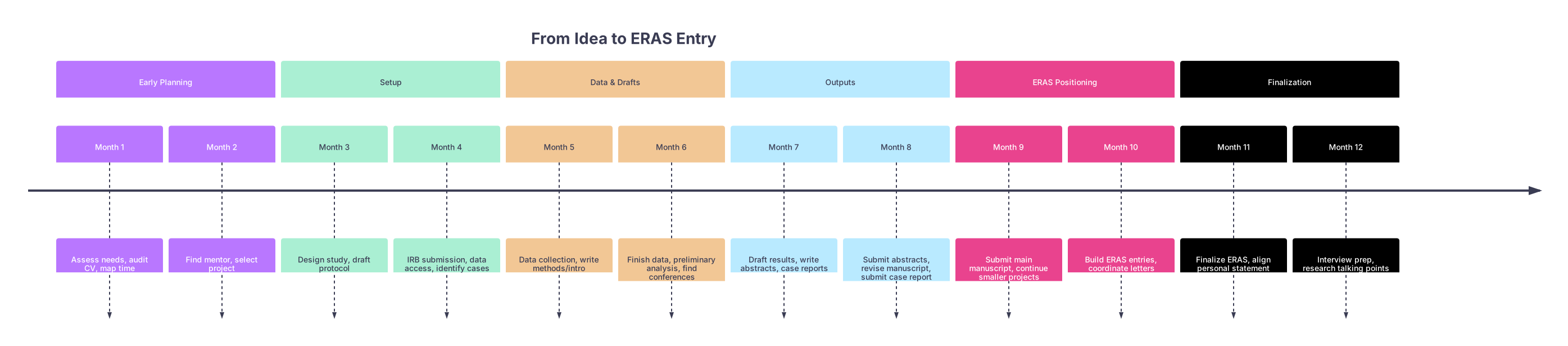
| Period | Event |
|---|---|
| Early Planning - Month 1 | Assess needs, audit CV, map time |
| Early Planning - Month 2 | Find mentor, select project |
| Setup - Month 3 | Design study, draft protocol |
| Setup - Month 4 | IRB submission, data access, identify cases |
| Data & Drafts - Month 5 | Data collection, write methods/intro |
| Data & Drafts - Month 6 | Finish data, preliminary analysis, find conferences |
| Outputs - Month 7 | Draft results, write abstracts, case reports |
| Outputs - Month 8 | Submit abstracts, revise manuscript, submit case report |
| ERAS Positioning - Month 9 | Submit main manuscript, continue smaller projects |
| ERAS Positioning - Month 10 | Build ERAS entries, coordinate letters |
| Finalization - Month 11 | Finalize ERAS, align personal statement |
| Finalization - Month 12 | Interview prep, research talking points |
Weekly and Daily Rhythm: How This Actually Fits In Your Life
Research dies when it becomes “I’ll work on it when I have time.” You will never “have time.” You make it.
A Sustainable Week (During Busy Rotations)
At this point (anywhere from Month 3 onward) you should have a default research week:
- 2 weekdays:
- 60–90 minutes each after dinner.
- Specific micro‑tasks: “abstract 10 charts,” “revise intro section,” “build table 1.”
- 1 weekend block:
- 2–3 hours, protected like an appointment.
- Bigger tasks: drafts, revisions, meeting with co‑authors.
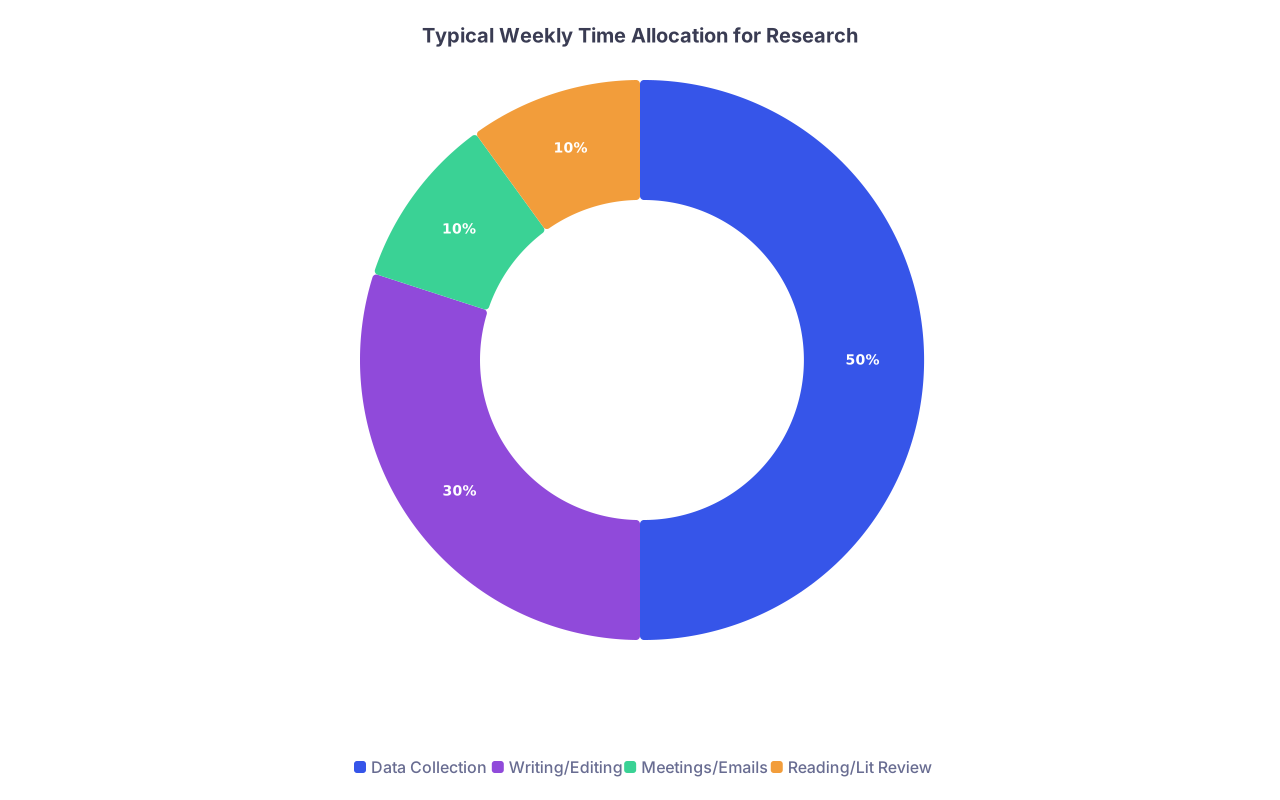
| Category | Value |
|---|---|
| Data Collection | 5 |
| Writing/Editing | 3 |
| Meetings/Emails | 1 |
| Reading/Lit Review | 1 |
A Productive Research Session (90 Minutes)
You sit down. What happens?
- First 10 minutes:
- Open your project tracker.
- Decide the one thing you must finish this session.
- Next 70 minutes:
- Work on only that. No toggling between tasks.
- Last 10 minutes:
- Write a 2–3 line note to “future you”:
- What you did.
- Where to start next time.
- Write a 2–3 line note to “future you”:
That small note is the difference between momentum and “I forgot where we left off” paralysis.
When You Are Late To The Game
Someone will read this in Month 7 or 8 of the cycle and panic. Fine. Here is your condensed play.
- If you have 6 months or less to ERAS:
- Forget ambitious prospective studies.
- Focus on:
- Case reports that can be submitted quickly.
- Joining ongoing projects where data is already collected.
- QI projects that can at least yield a poster.
- If you have 3 months or less to ERAS:
- You are not creating new publications.
- Your move:
- Get involved in an ongoing project so you can honestly say “active research involvement.”
- Make sure prior half‑baked projects are cleaned up and listed accurately.
- Lean hard on your clinical strengths and whatever research you already have.
I have watched people pull off 1–2 legitimate PubMed lines in under a year. But every single one of them started no later than Month 2 and treated research time as non‑negotiable.
Final Takeaways
- Serious research for ERAS is a 12‑month project, not a last‑minute chore. By Month 4 you should have IRB and data access; by Month 9 your main manuscript should be submitted.
- The sequence matters: mentor → design → IRB → data → abstracts → manuscripts → ERAS entries. Skip or compress steps and you pay for it later in weak or dishonest‑looking application entries.
- The real goal is not just lines on a CV. It is being the applicant who can discuss their project clearly—what you did, what you found, what you learned—when a program director looks up from your ERAS and says, “So, tell me about this study.”