
The worst time to ask for a research letter of recommendation is when you suddenly need it.
If you want research LORs that actually move the needle in residency applications—not generic “hardworking student” fluff—you have to work backwards from ERAS deadlines and from human behavior. Mentors are busy, memory fades, and programs care about certain letters more at specific points in the cycle.
Here’s the timeline I’d use if you were sitting in my office asking, “When should I ask?”
Big Picture: Anchor Dates You Cannot Ignore
Before we go month‑by‑month, fix these in your head (adjust slightly for the current year, but the sequence doesn’t change):
| Milestone | Typical Timing |
|---|---|
| Start of Key Research Block | 12–18 months before ERAS |
| ERAS Opens for Entry | Mid-June |
| ERAS Application Submission | Early–Mid September |
| MSPE Release | Oct 1 |
| Interview Season | Oct–Jan |
For research letters:
- You want your main research LORs requested 8–12 weeks before you submit ERAS.
- You want your mentor to have known you at least 3 months and ideally seen a full arc: data collection → analysis → presentation/publication.
- You want at least one letter fully uploaded by early September and others trailing in over the next 2–4 weeks, not November.
Now let’s walk this out chronologically.
18–12 Months Before ERAS: Set Up the Future Letter
At this point you should not be asking for a letter yet. You should be setting up the conditions that make a strong letter almost inevitable.
Step 1: Choose Projects with Letter Potential
At this point you should:
- Join 1–2 substantial projects, not 6 token ones.
- Prioritize:
- A PI who writes a lot (you’ll know from their PubMed page and their constant “I have to get this revision in tonight” grumbling).
- A team where your role can be defined and visible (data lead, first author, protocol development).
Red flag: hopping on a multi‑site RCT where you’re one of 12 students doing chart review. Nobody will know you well enough to write anything specific.
Step 2: Signal Early That You Care About Residency
Within the first month with your research mentor, you should casually make the future ask possible:
“Long-term I’m thinking of applying to internal medicine, and I’d really like to build a strong research track record. I’m hoping that as we work together you can get to know me well enough to support my residency application later.”
You’re not asking yet. You’re planting the seed. Good mentors start mentally tracking how you perform from that moment on.
Step 3: Build a Track Record (3–9 Months)
At this point (3–9 months before any letter request) you should:
- Show up to meetings prepared, with updated data, clear questions.
- Send brief, structured emails:
“Attached is the updated figure,” “Here are 3 options for the abstract conclusion,” etc. - Volunteer for visible tasks:
- Drafting parts of the manuscript (Intro/Methods/Results).
- Presenting to the lab meeting.
- Submitting to a local or national conference.
The goal here: when you eventually ask for a letter, they can honestly say things like:
- “She led the data analysis for our multi-site project on X.”
- “He presented our work as first author at the ATS meeting.”
If they cannot say anything like that after 6 months, you picked the wrong mentor or you were too invisible.
9–6 Months Before ERAS: First Explicit Letter Conversation
This is where most students mess up. They either ask way too early (“Can you write me a letter next year?” with nothing to write about yet) or way too late (“ERAS is due in three weeks, help!”).
At this point (roughly 9–6 months before ERAS submission, so December–March for a typical September submitter) you should:
Clarify If This PI Is a “Primary Letter” Candidate
You’re deciding: is this person going to be one of your 2–3 core letters for ERAS?
Ask yourself:
- Have I worked with them at least 3–4 months, consistently?
- Do they know my:
- Clinical goals (specialty, type of program)?
- Career interests (academic vs community, research focus)?
- Work style and reliability?
If yes, it’s time for a soft early ask, not the formal ERAS request yet.
Script (email or in person):
“Dr. Smith, I expect to apply to internal medicine this coming cycle and I’m starting to plan my letters of recommendation. If things continue to go well with our work together, would you feel comfortable writing me a strong letter focused on my research and potential as an academic resident?”
Why now?
- If they’re hesitant, you still have time to pivot to another mentor or strengthen the relationship.
- They may start intentionally giving you more responsibility so they can legitimately praise you later.
6–3 Months Before ERAS: Convert to a Concrete Letter Plan
Around March–June (for a September ERAS submission) the clock starts getting real.
At this point you should:
1. Make Sure You’ve Completed Something Tangible
Mentors write better letters when there’s a “win” to point to. By now, aim to have at least one of these:
- Abstract submitted or accepted (local, regional, or national).
- Manuscript draft in circulation.
- Poster or talk delivered.
- Major milestone: IRB approval, dataset built, primary analysis completed.
If nothing is finished, push to get some concrete output before you trigger the formal ERAS letter request.
2. Give Your Mentor a Specific Timeline
In late May or early June, email or talk in person:
“ERAS opens for entry in June and I plan to submit my application in early/mid September. I’d be very grateful if you could write a letter of recommendation focusing on my research work with you. Could you have it uploaded by late August so it’s there when programs first review my application?”
This does two things:
- Gives them 8–12 weeks lead time.
- Signals that you’re submitting early (which serious applicants do).
3. Prepare a Letter Packet (Do Not Skip This)
When they say yes, respond with a bundle. At this point you should send:
- Updated CV (highlight your work with them).
- Draft ERAS experiences section (especially research entries).
- Personal statement draft or at least a one‑page “career goals” summary.
- A brief bullet list of key points they might comment on:
- “Led data cleaning and primary analysis for X project.”
- “First author abstract submitted to Y conference.”
- “Consistently met deadlines and coordinated communication with collaborators.”
You’re not writing your own letter. You’re jogging their memory and making it easy to be specific.
This is also when you clarify letter focus:
- “If possible, I’d appreciate if the letter could comment on my potential as a future academic internist and my ability to engage in clinical research during residency.”
3–0 Months Before ERAS Submission: Formal Request and Tight Management
Now we’re in June–September of the application year.
Early June: Official Ask + ERAS Request
At this point you should:
Confirm again in person or via email: “Just confirming—would you still be willing to write a strong research‑focused LOR for my internal medicine residency application?”
Once they say yes, immediately send the ERAS LOR request with:
- Correct letter type (e.g., “Internal Medicine”).
- Waiver signed (you should waive your right to view the letter—programs expect that).
- Clear deadline: usually 2–3 weeks before you plan to submit.
In the email accompanying the ERAS request, restate:
- Your planned submission date.
- Any key programs you’re particularly targeting, especially if they’re academic and research heavy.
July–August: Follow‑up Without Being Annoying
This is where people either ghost their mentors or become a nuisance. You need a middle path.
At this point you should:
- Track your letter status in ERAS weekly.
- If the letter isn’t in by 4 weeks after your request, send a short, respectful reminder:
“Hi Dr. Smith,
Just a friendly reminder about my ERAS research letter. I plan to submit my application around September 10. If you’re still able to write it, it would be ideal to have it uploaded by September 1 so it’s included in the first wave of reviews. Please let me know if that timing is difficult.”
If they still haven’t uploaded by 1–2 weeks before your submission date, send one more:
“I know your schedule is very busy, and I appreciate your support. I’ll be submitting ERAS on September 10. If you’re unable to complete the letter by that time, I completely understand—just let me know so I can adjust my letter mix.”
This gives them an honorable exit. If they bail, you don’t want that letter anyway.
How Timing Changes With Different Situations
Not everyone has the luxury of a 12–18‑month ramp. Let’s deal with the real‑world scenarios I see constantly.
Scenario 1: Research Year Students (Dedicated Research Year Before Application)
If you’re doing a full‑time research year, the timeline compresses a bit but actually favors you.
At this point you should:
- Month 1–3 of research year: Build the relationship. No letter ask yet.
- Month 4–6: Soft‑ask about being a potential letter writer.
- Month 8–10: Have a major output (abstract/manuscript). Start the concrete plan conversation with timelines.
- June of application year: Formal ERAS request.
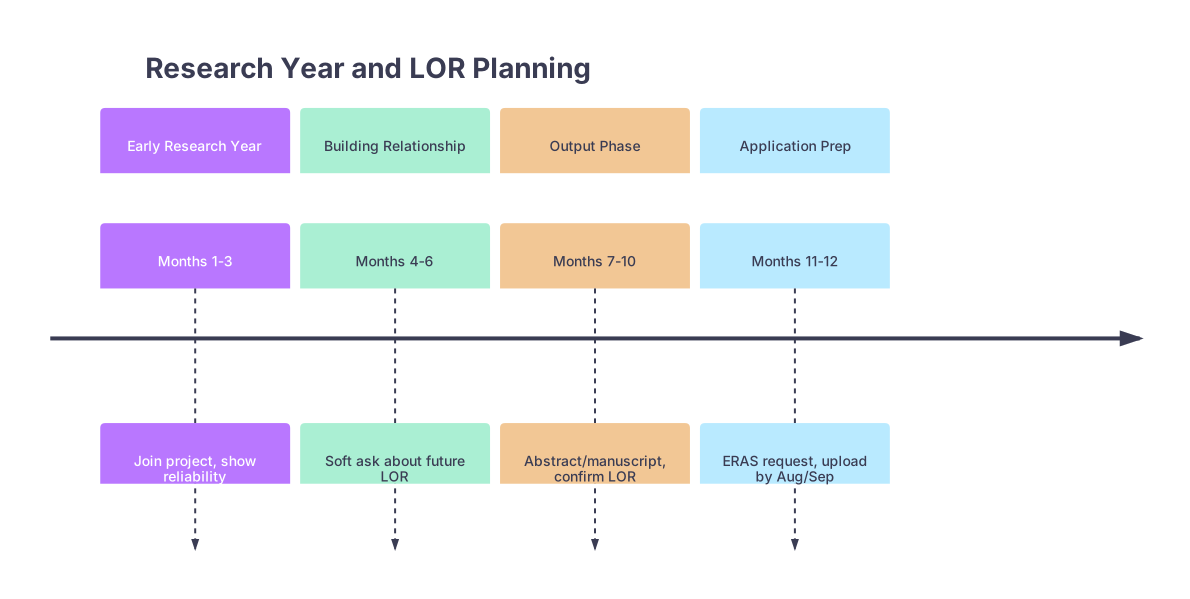
| Period | Event |
|---|---|
| Early Research Year - Months 1-3 | Join project, show reliability |
| Building Relationship - Months 4-6 | Soft ask about future LOR |
| Output Phase - Months 7-10 | Abstract/manuscript, confirm LOR |
| Application Prep - Months 11-12 | ERAS request, upload by Aug/Sep |
Big advantage: your PI has seen you full‑time, which makes them more credible when they say you can handle academic work in residency.
Scenario 2: Late Research Starter (You Joined a Project 4–6 Months Before ERAS)
This is common and not ideal, but salvageable.
At this point you should:
Decide quickly if this PI can realistically know you well in 3–4 months. If the answer is no, do not rely on them as a primary letter.
If yes, you accelerate:
- Month 1–2: Maximum visibility. Take on hard tasks. Meet weekly.
- Month 2–3: Soft‑ask about potential letter.
- Month 3–4: Formal ERAS request with a shorter lead time (still try for 6–8 weeks).
If they hesitate even a little when you ask “strong letter,” don’t push. Use them as a secondary letter for research‑heavy programs only, not one of your core three.
Scenario 3: You Have an Old Research Mentor From Early Med School
You did a project M1–M2 and haven’t worked with them in over a year.
At this point (6–9 months before ERAS) you should:
- Reconnect now. Do not show up in July asking for a letter out of nowhere.
- Send:
- Updated CV.
- Quick summary of your current work and specialty interests.
- Ask if they’d be comfortable updating their impression of you with a brief Zoom/meeting.
If they remember you clearly and you had a strong role, they can still write a good letter, but you must:
- Ask earlier (by spring), because they’ll need time to remember, review old work, maybe reread the paper.
- Provide more scaffolding in your bullet points and CV.
Specialty‑Specific Timing Nuances
Not every specialty values research letters the same way. Timing your ask is also about when your research will impress.
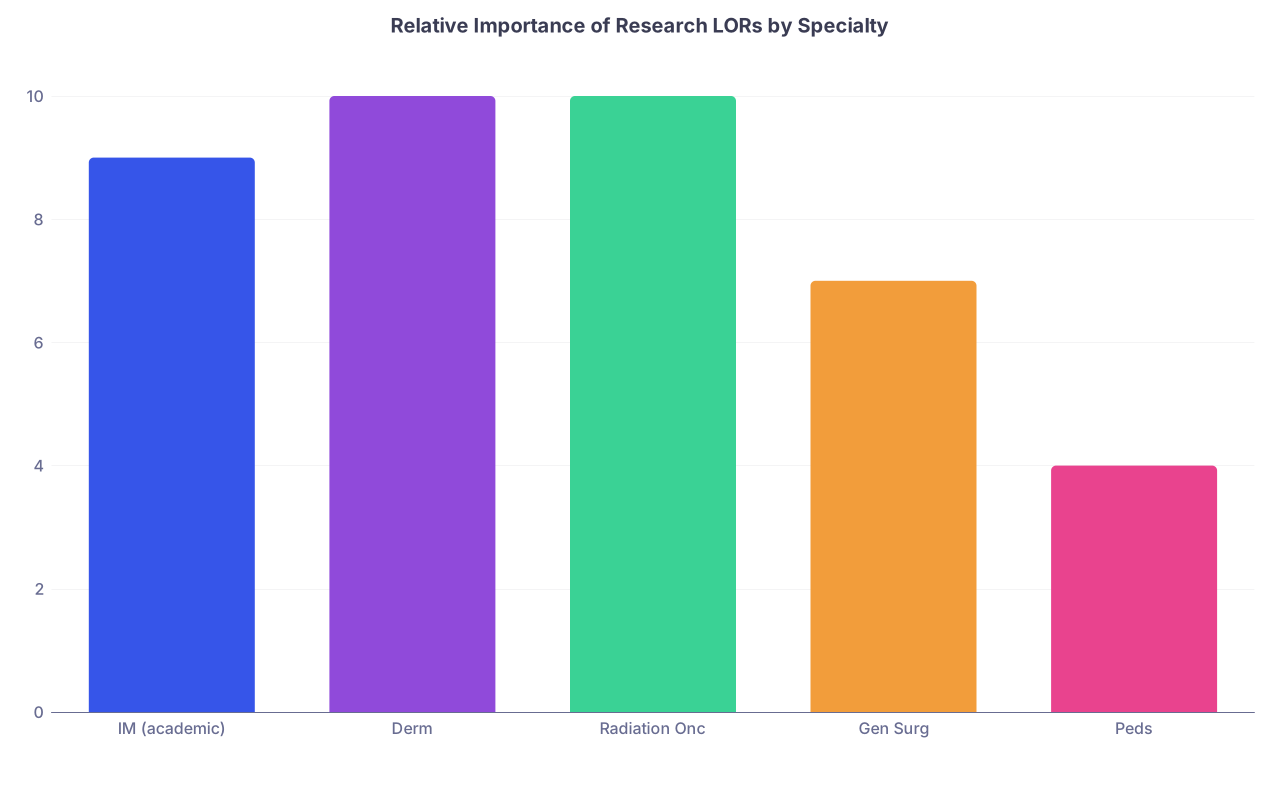
| Category | Value |
|---|---|
| IM (academic) | 9 |
| Derm | 10 |
| Radiation Onc | 10 |
| Gen Surg | 7 |
| Peds | 4 |
Highly Academic/Competitive Specialties (Derm, Rad Onc, Neurosurgery, ENT)
At this point (a full year before ERAS) you should:
- Identify your main academic mentor early.
- Make sure your major output (poster, paper) hits before or during the application year.
- Ask slightly earlier for letters (March–April) because:
- These attendings are constantly writing letters.
- Their timelines for away rotations and internal ranking discussions can start earlier.
Broad but Academic‑Friendly Specialties (Internal Medicine, General Surgery)
At this point you should:
- Time your strongest research LOR to be active during:
- ERAS screening (Sept–Oct).
- Early interview invites (Oct–Nov).
- A June formal request with an August upload is usually perfect. Programs are skimming letters as they decide whom to invite.
Community‑Heavy Specialties (Family Med, Peds, Psych in Non‑Academic Settings)
Research letters matter less, but if you have one:
- Ask on the same timeline, but use it as a complement, not core.
- Make sure the letter explicitly frames why your research skills make you a better clinician/teacher, not just a data analyst.
Micro‑Timeline: 12 Weeks Before ERAS Submission
Let’s compress this into a “you’re 3 months out” plan, assuming a mid‑September ERAS submit.
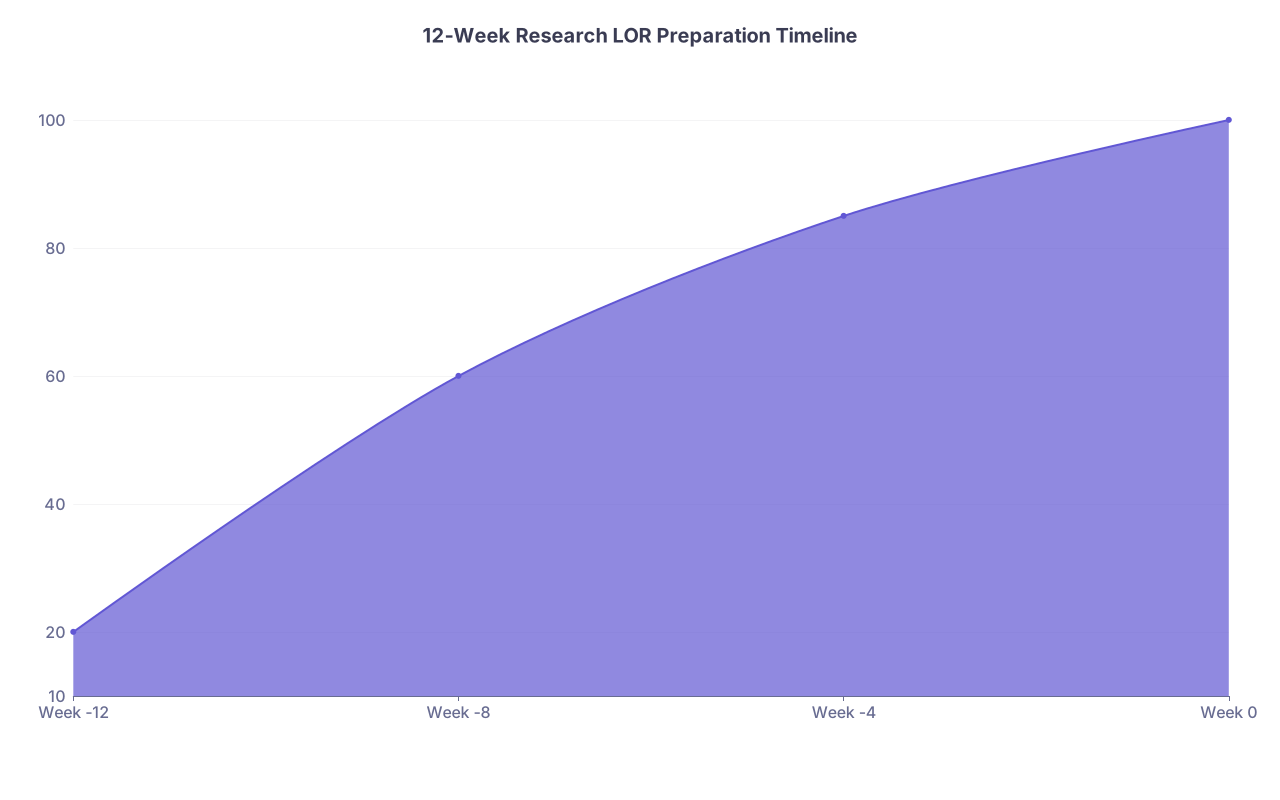
| Category | Value |
|---|---|
| Week -12 | 20 |
| Week -8 | 60 |
| Week -4 | 85 |
| Week 0 | 100 |
Week −12 (mid‑June):
- Confirm who your research letter writers are.
- Ask explicitly for strong letters.
- Send ERAS LOR requests + your full packet (CV, PS draft, bullet list).
Week −10 to −8:
- Meet or check in once with each letter writer (15–20 minutes).
- Update them on:
- Any new abstracts, acceptances, or awards.
- Your evolving program list and goals.
Week −6:
- Check ERAS: which letters are in, which are pending.
- Send a gentle reminder to anyone outstanding.
Week −3:
- Final reminder if still not uploaded. Offer an out if they’re too busy.
- If one letter collapses, pivot:
- Ask another faculty you’ve worked with clinically or in research.
- They only have 2–3 weeks, so you send an even more detailed packet.
Week 0:
- Submit ERAS with at least 3 solid letters attached, including your best research LOR if at all possible.
- Late letters can still be added, but your application has already been seen; the impact is smaller.
Red Flags and Hard Lines
A few timing‑related signals you should not ignore:
- If a PI says, “Sure, send me your personal statement and I’ll see what I can do,” in August and then doesn’t respond for weeks—that’s not a reliable letter writer.
- If someone has only known you 4–6 weeks when you’re about to apply, they shouldn’t be a primary research letter unless you had intensive daily contact (e.g., sub‑I research hybrid).
- If you’re asking for a letter less than 4 weeks before ERAS submission, assume it will be late and plan for alternatives.
And one more: if you never explicitly used the word “strong” in your ask (“a strong letter of recommendation”), don’t be shocked if what you get is lukewarm. Timing and clarity go together.
Key points:
- Strong research LORs are built months before you ever ask—through consistent work, visible responsibility, and an early soft conversation.
- For a September ERAS submission, you should formally request research letters in June, with upload targets in August, and use polite reminders to keep things on track.
- If you’re late, compress the relationship‑building and be brutally honest about who actually knows you well enough to write something specific; a timely, detailed letter from a slightly “smaller name” beats a last‑minute, generic one from a famous PI every single time.