It's July 1st. Your dedicated research year just started. Your classmates are on wards getting their first “Dr. ___” from patients, and you’re staring at a REDCap project, an empty EndNote library, and a rough idea that this year is supposed to “help your application.”
Here’s the problem: ERAS opens in roughly 14 months. That sounds like a lot of time. It isn’t. If you don’t structure this year, you’ll wake up next July with “data almost cleaned,” “manuscripts in progress,” and nothing actually published or submitted.
I’m going to walk you month-by-month, then week-by-week toward the key deadlines before applications open. At each point: here’s what you should already have done, what you’re doing right now, and what absolutely cannot slip.
Big Picture: The Research Year in Relation to ERAS
First, anchor the whole thing.
Assume this timeline:
- You apply for residency: September of Year +1
- You start dedicated research year: July of Year 0
So:
- Month 0 = July (start of research year)
- Month 14 = September next year (ERAS submission)
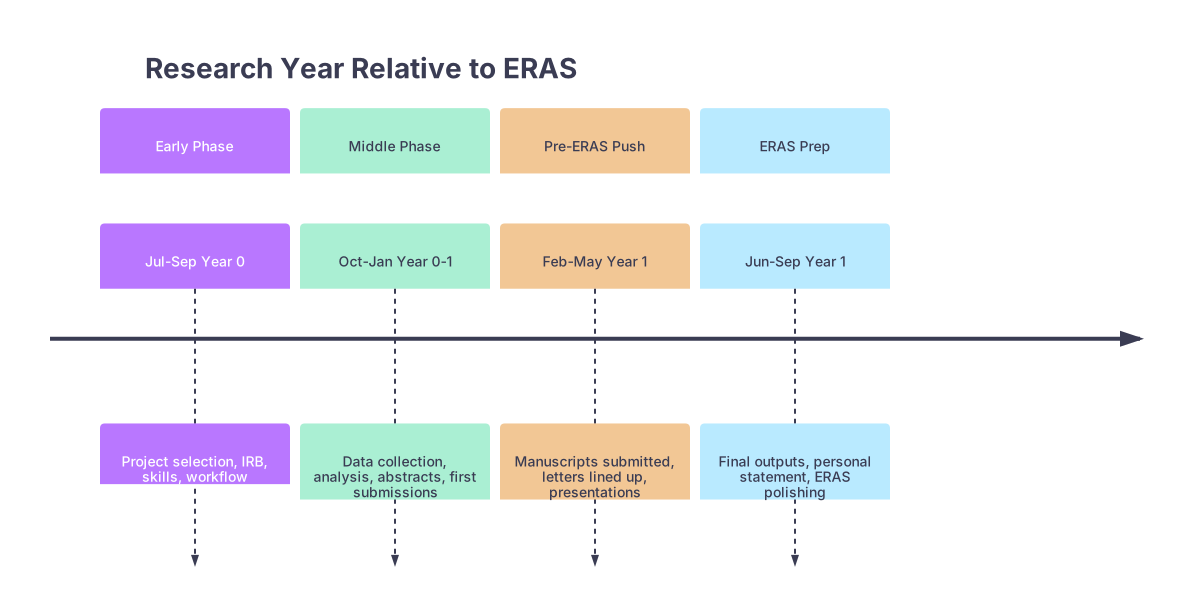
Here’s the high-level arc:
| Period | Event |
|---|---|
| Early Phase - Jul-Sep Year 0 | Project selection, IRB, skills, workflow |
| Middle Phase - Oct-Jan Year 0-1 | Data collection, analysis, abstracts, first submissions |
| Pre-ERAS Push - Feb-May Year 1 | Manuscripts submitted, letters lined up, presentations |
| ERAS Prep - Jun-Sep Year 1 | Final outputs, personal statement, ERAS polishing |
At this point, you should understand one harsh truth: anything not at least submitted by April–May before ERAS is unlikely to help much on your actual application.
So we back-time everything from there.
Months 0–2: Setup, Positioning, and Project Commitments (July–September)
You’re not here to “explore.” You’re here to produce.
By the end of Month 0 (July), you should:
Know your target specialty (or two)
- You want to be past, “Maybe derm, maybe EM, maybe psych?” That kills focus.
- If you’re still truly unsure, pick one primary for research alignment and accept that you might pivot later.
Lock in your primary research mentor
- Not just any PI. You want:
- Track record of publishing with students.
- Projects already in motion (so you’re not waiting on IRB for 6 months).
- Someone who actually answers email.
- If they have fellows/postdocs who co-mentor, even better. Those people get things across the finish line.
- Not just any PI. You want:
Commit to 2–3 real projects
- At least:
- 1 project that can realistically be submitted as a manuscript before ERAS.
- 1–2 “faster” things: case series, retrospective chart review, QI project, or review.
- Do not get trapped in one massive prospective trial with a 3-year endpoint. That’s academic purgatory.
- At least:
By late July, your calendar should have:
- Standing weekly meeting with main mentor.
- Standing 1–2x/week work blocks reserved for writing only (no email, no data, just writing).
By the end of Month 1–2 (August–September), you should:
Have IRB or approvals submitted for any new human-subject work
- If your IRB isn’t at least submitted by September, you’re already behind.
- If your mentor says, “We’ll get to the IRB later,” that’s a red flag. Push.
Be actively working with existing datasets whenever possible
- Ideal situation: get access to a dataset that’s already approved and partially collected so you can:
- Clean data in August.
- Run first analyses in September.
- Have outline + draft by October.
- Ideal situation: get access to a dataset that’s already approved and partially collected so you can:
Define the exact deliverables per project Write it down. For each project:
- Aim: “Submit to X journal by Month Y.”
- Planned outputs: 1 abstract, 1 manuscript, possibly a poster or oral presentation.
- Your role: data extraction? analysis? first author writing?
Get your basic infrastructure in place
- Reference manager set up (EndNote, Zotero, Mendeley).
- Shared folders with your mentor (Drive, Dropbox, institutional).
- Data management workflow that doesn’t live randomly on your desktop.
At this point, you should already have at least one project where:
- You know the research question.
- You have a rough outline of sections.
- You’ve started a literature search file.
If not, you’re drifting.
Months 3–6: Data, Analysis, and Your First Real Outputs (October–January)
This is the engine of the year. The months most people waste “cleaning data forever” and “refining the question.”
Month 3 (October): Turn the corner from planning to producing
By end of October, you should:
- Have active data collection or data already in hand for your main project.
- Have at least one project with a working draft of Methods and Results skeleton. Even if numbers aren’t final, structure the paper now.
Strategy here:
- Write the Introduction and Methods while data collection/cleaning runs in the background.
- Methods should be almost done before your final analysis is.
Month 4 (November): Drafting + First Abstract Targets
Now you push for concrete deadlines:
-
- Look up major specialty conferences: ATS, AHA, ASCO, RSNA, etc.
- Lots of abstract deadlines hit between December–March.
- Reverse engineer: if abstract is due January, your first full draft should be ready by early December.
First manuscript rough draft By the end of November, on at least one project, you should have:
- Intro: ~75% done
- Methods: 90% drafted
- Results: partial tables/figures in progress
You want to be showing your mentor writing, not just “progress slides.”
Month 5–6 (December–January): Submissions and Multiple Irons in the Fire
By the end of January, this is what a strong research-year student’s status looks like:
- 1–2 abstracts submitted to at least one regional or national meeting.
- 1 manuscript in active revision with your mentor (not just “I sent them a draft once”).
- 2nd and possibly 3rd project moving into serious analysis phase.
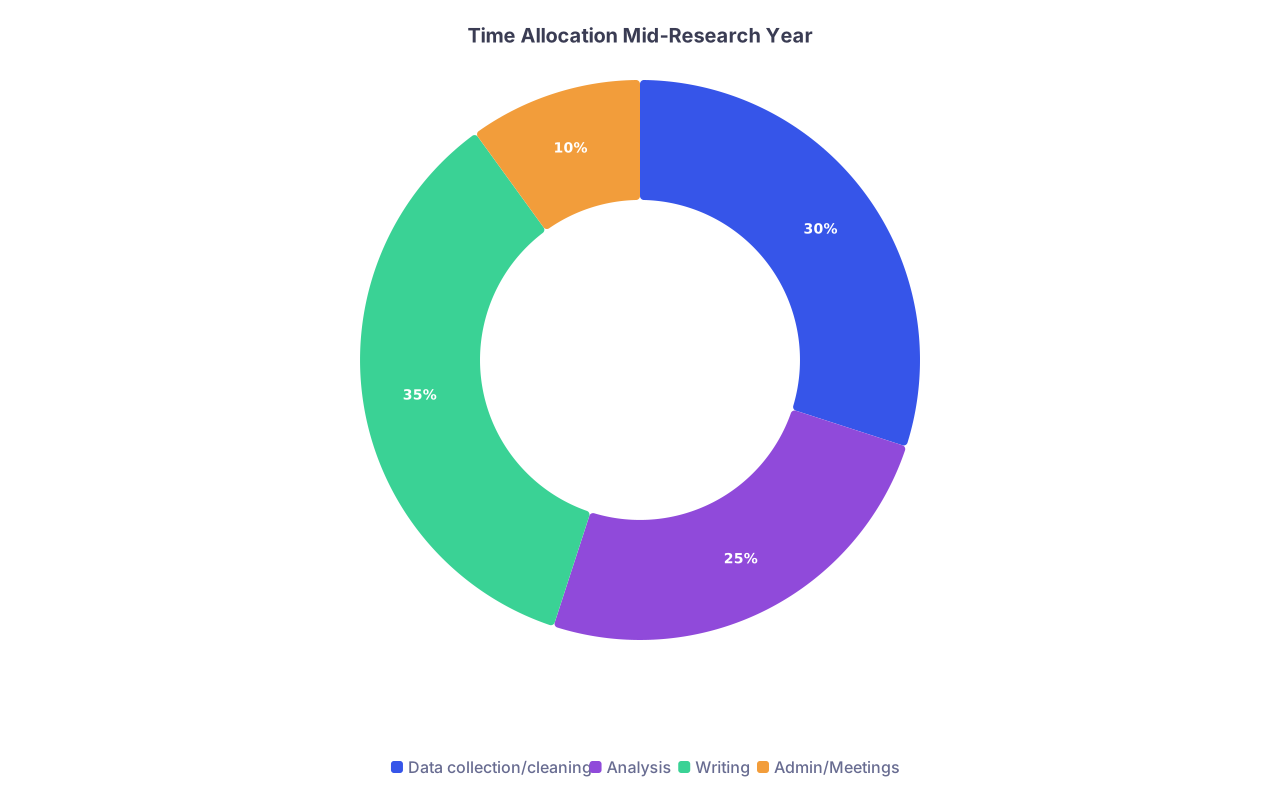
Here’s what your time allocation should roughly look like now:
| Category | Value |
|---|---|
| Data collection/cleaning | 30 |
| Analysis | 25 |
| Writing | 35 |
| Admin/Meetings | 10 |
If writing is less than 25–30% of your time by January, you’re probably underproducing.
At this point, you should also:
- Start a running CV and keep it updated monthly.
- Maintain a list of every project, role, and status (idea, data collected, analysis done, submitted, accepted, etc.).
Months 7–9: The Critical Window Before ERAS Prep (February–April)
This is where most people either consolidate into strong applications or stall out with half-finished manuscripts.
Month 7 (February): Manuscripts Out the Door
By the end of February, if you’re serious, you should have:
- At least one first-authored manuscript submitted to a journal.
- Another paper in late-stage drafting or about to be submitted.
If nothing is submitted by February, you can still salvage, but the margin is getting thin.
Your checklist for February:
- Nail down target journals for each project.
- Format manuscripts correctly. Do not burn 3 weeks “figuring out author guidelines.”
- Push co-authors hard on revisions. Give them explicit deadlines (“I’ll plan to submit by March 1, so please send edits by Feb 20.”).
Month 8 (March): Build Presentation and Network Value
March should focus on two parallel tracks:
Presentations
- By now, some abstract decisions will be back.
- Turn accepted abstracts into:
- Posters (aim for you to present, not a random co-author).
- Oral presentations if possible.
- Every presentation is a line on ERAS and a talking point in interviews.
Letters of recommendation groundwork Start deliberately now:
- Identify 2–3 faculty who could write strong letters:
- Your primary mentor.
- Another PI or collaborator.
- A clinically respected faculty in your target specialty.
- Increase face time: present at lab meetings, join clinical meetings, ask for feedback on your work.
- Identify 2–3 faculty who could write strong letters:
At this point, you should be thinking:
“Which 2–3 people will be able to say, in detail, what I actually did this year?”
If you don’t have those people yet, fix that in March–April.
Month 9 (April): Final Big Push for Submissions
April is your last comfortable month for new submissions to potentially be accepted or at least under review before ERAS.
By end of April, aim for:
- 2–3 manuscripts submitted (they can be under review, “submitted” still counts).
- Most data analysis wrapped on all your active projects.
- Any new project started now should be:
- Very targeted.
- Fast: case series, brief report, invited review, etc.
At this point, you should be saying “no” more often:
- No to brand-new, long-shot projects that will live in draft forever.
- No to work where you’re 7th author and not learning anything.
You’re now entering the ERAS-focused phase.
Months 10–12: Transition from “Research Output” to “Application Assembly” (May–July)
You’re not done with research, but the priority shifts. You now have to package the year for programs.
Month 10 (May): Lock in Letters and Update Your Story
By May, you should:
Secure commitment for letters
- Explicitly ask: “Would you feel comfortable writing me a strong letter of recommendation for residency?”
- Do this with:
- Your main research mentor.
- At least one clinically-facing faculty in your target specialty.
- Provide them:
- Updated CV.
- One-page summary of your work with them.
- Draft of your personal statement once you have it (or at least your career goals).
Document your role on each project Programs hate vague “involved in many projects” statements. Create a short record:
- Project title
- Your role: designed data collection, extracted 500 charts, performed statistical analysis, wrote first draft, etc.
- Status: submitted, under review, accepted, in prep.
Decide what your “main narrative” is You need a clear, short answer to:
- “So what did you do during your research year?” And it cannot be “a bit of everything.” It should sound something like:
- “I focused on outcomes research in heart failure—three retrospective projects, one of which is under review at [journal], plus a quality improvement project that we implemented on the floor.”
Month 11 (June): First Drafts of Application Materials
Now we’re getting close.
By end of June, you should:
- Have a rough personal statement draft.
- It should connect:
- Your clinical interests.
- Why you took a research year.
- What you learned and how it shaped your goals.
- It should connect:
- Have a clean, updated CV with:
- All submitted manuscripts clearly labeled as “Submitted” or “Under review.”
- Posters and presentations correctly formatted.
- Have a preliminary program list:
- Reach, target, and safety programs.
- You should know whether your research focus aligns with certain departments.
At this point, your research work should be 60–70% maintenance:
- Responding to reviewer comments.
- Minor analyses.
- Final polishing.
Not starting anything fundamentally new.
Months 13–14: Final ERAS Prep and Last-Minute Polish (August–September)
This is where details separate “good” from “excellent.”
Month 12–13 (July–August): ERAS Entries and Final Proofing
By the time ERAS opens for entry (usually early-mid July), here’s what should already be done:
All research entries structured for ERAS
- Every project clearly categorized:
- Published papers.
- Submitted manuscripts.
- In-progress projects (only include if they’re real and substantial).
- For each: 1–2 sentence description of your role.
- Every project clearly categorized:
-
- By early August, you’re not rewriting from scratch.
- At this point, you’re just tightening language and aligning it with your mentors’ feedback.
Letters requested and confirmed
- ERAS LoR portal entries created.
- Every letter writer given:
- Deadline you need it by (be blunt: “Could you upload it by August 25th?”).
- Your CV and personal statement.
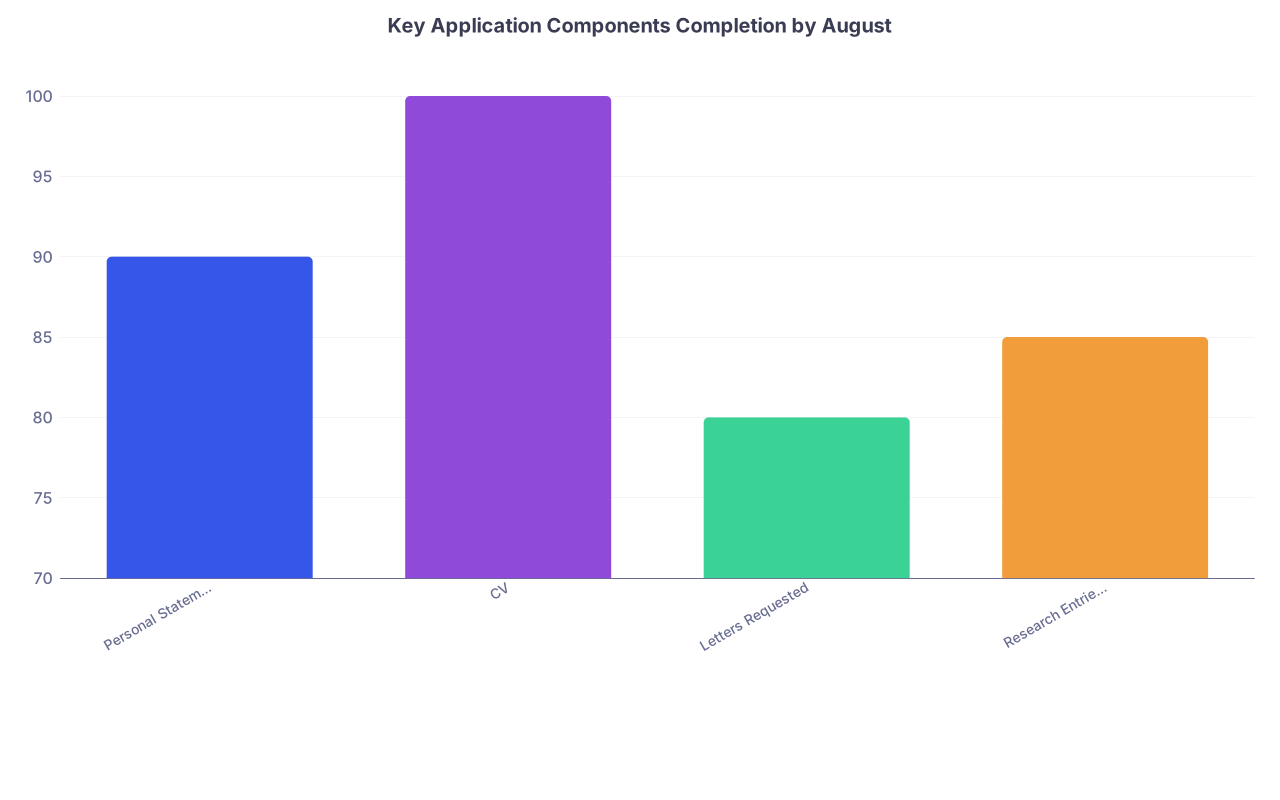
| Category | Value |
|---|---|
| Personal Statement | 90 |
| CV | 100 |
| Letters Requested | 80 |
| Research Entries in ERAS | 85 |
By late August, nothing major on the application should be unfinished. If a paper gets accepted in September, great—you update it. But you’re not counting on that.
Month 14 (September): Submission and Last Adjustments
When ERAS submission opens:
At this point, you should:
- Be ready to submit on or near opening day.
- Have your research year summarized in:
- Your personal statement.
- Your ERAS experiences section.
- The narrative your letter writers echo.
Any last-minute tasks:
- Double-check that all research is labeled correctly:
- “Published,” “Accepted,” “In press,” “Under review,” “Submitted.”
- Don’t lie. Programs see right through “in preparation” with no details.
- If something big comes through (acceptance, major presentation), you can:
- Update programs via email later.
- Bring it up on interview day.
Concrete Example Timeline: One Strong Research-Year Output Path
To make this less abstract, here’s how a single main project should move if timed well.
| Month | Milestone |
|---|---|
| Jul | Project defined, IRB submitted (or exempt/approved dataset identified) |
| Aug | Data extraction begins, Methods drafted |
| Sep | Data collection mostly done, start analysis |
| Oct | Analysis finalized, Results + tables drafted |
| Nov | Full manuscript draft to mentor |
| Dec | Revisions + co-author feedback |
| Jan | Manuscript submitted to Journal A |
If your main project is still “cleaning data” in February, that’s how you end up with nothing concrete to show.
How This Year Looks on Paper vs. Reality
Programs don’t see your sleepless nights with R scripts crashing. They see:
- Number of first-author and co-author papers.
- Type of journals.
- Posters and talks.
- Names of letter writers.
- Whether your story is coherent.
Your reality is more chaotic. That’s normal.
To keep chaos controlled, I recommend a simple weekly rhythm:

| Step | Description |
|---|---|
| Step 1 | Monday: Plan week |
| Step 2 | Tue-Thu: Deep work blocks |
| Step 3 | Fri: Mentor check-in |
| Step 4 | Update tracking sheet & CV |
And a project tracking sheet where each project is labeled:
| Project | Role | Status | Next Action |
|---|---|---|---|
| HF outcomes | First author | Under review | Wait for decision |
| QI handoff | Second author | Drafting Results | Finish figures |
| Case report | First author | Submitted | Respond to minor revisions |
You’ll thank yourself in July when you’re filling out ERAS.
Visual: When Major Tasks Should Land
Here’s a simplified view of what you should be doing across the year:
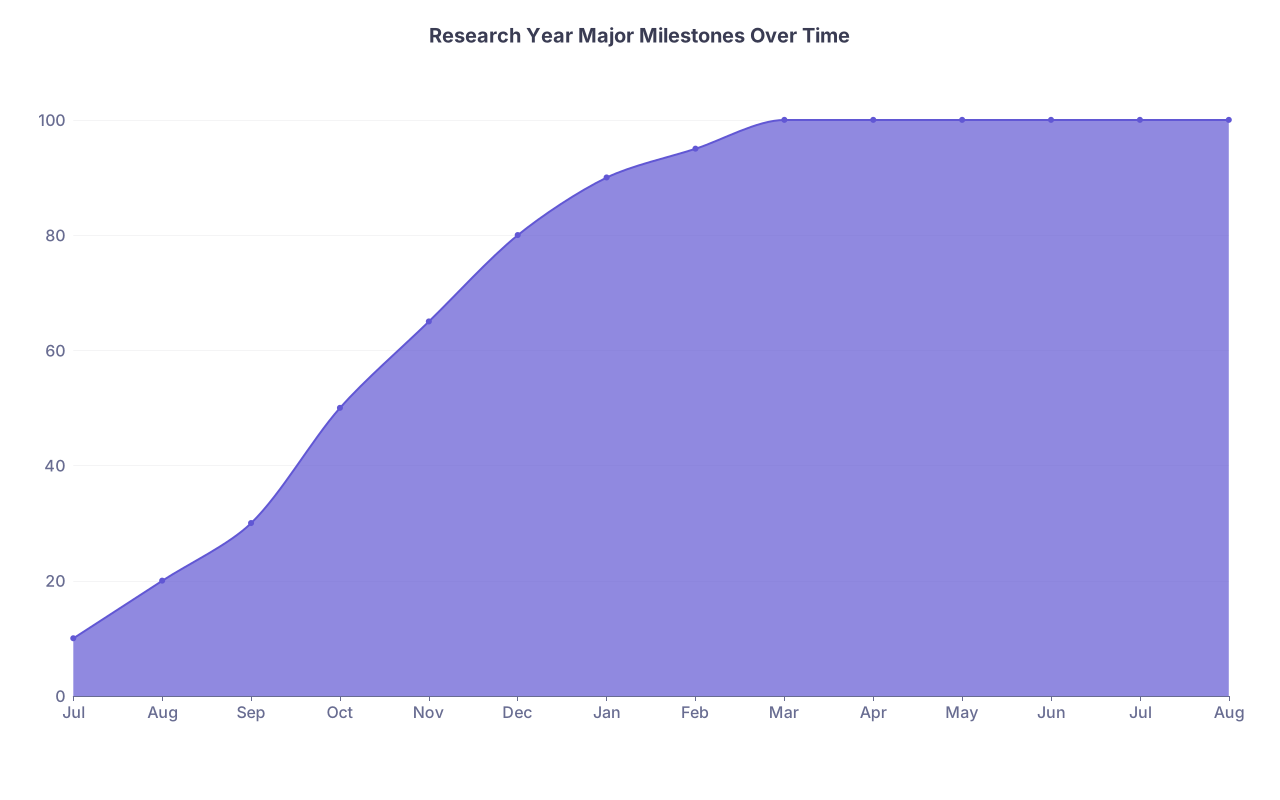
| Category | Value |
|---|---|
| Jul | 10 |
| Aug | 20 |
| Sep | 30 |
| Oct | 50 |
| Nov | 65 |
| Dec | 80 |
| Jan | 90 |
| Feb | 95 |
| Mar | 100 |
| Apr | 100 |
| May | 100 |
| Jun | 100 |
| Jul | 100 |
| Aug | 100 |
Think of that line as “percent of key milestones completed.” You want it steep early, not flat until spring.
And one more perspective: how many manuscripts should you realistically aim to submit before ERAS?
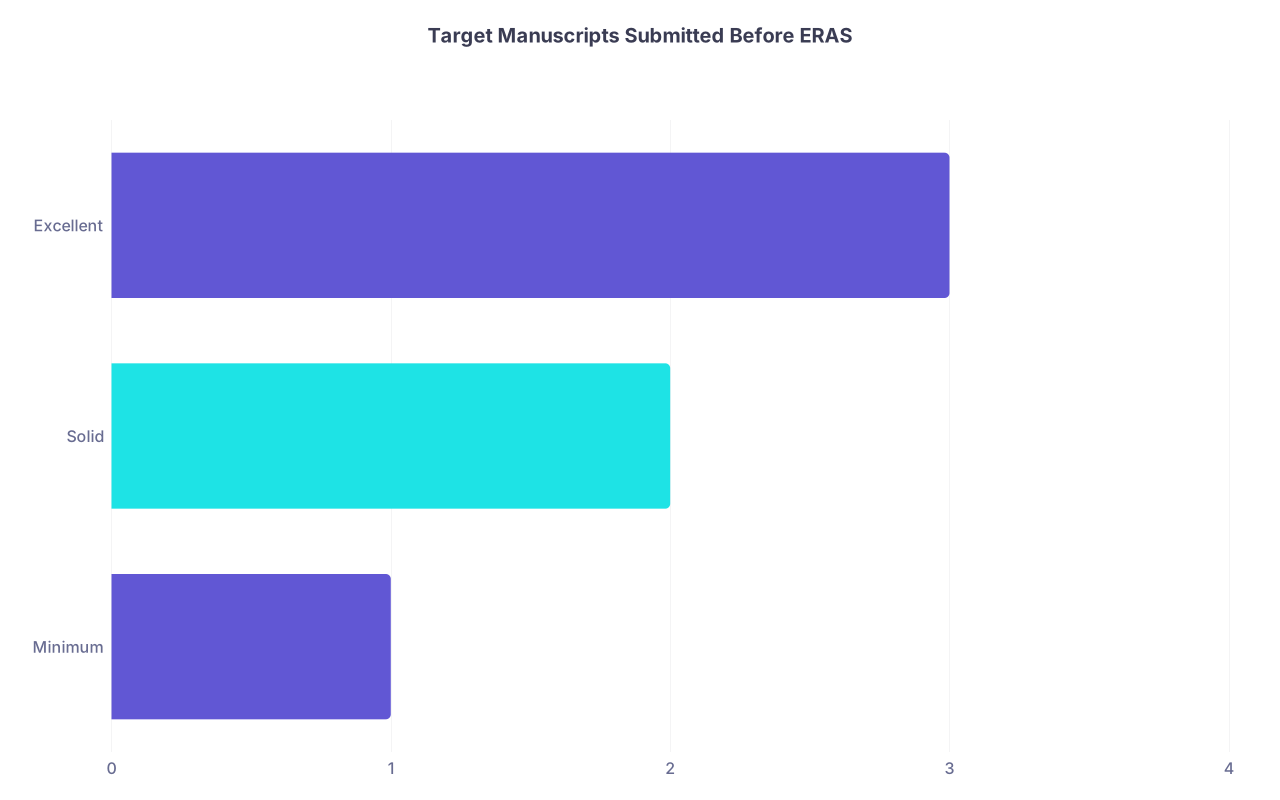
| Category | Value |
|---|---|
| Minimum | 1 |
| Solid | 2 |
| Excellent | 3 |
- 1 submitted: acceptable, especially in less research-heavy specialties.
- 2: strong for most fields.
- 3+: very strong, especially if at least one is first author and in a reasonable journal.
Final Takeaways
Keep it short:
- Front-load the year. IRB and project selection delayed = everything delayed.
- Aim to have manuscripts submitted by February–April before ERAS; don’t wait for acceptance to count them.
- Use the last 3–4 months to convert output into a coherent story, with letter writers who can actually describe what you did—not just list your name on a paper.