
The last 30 days before ERAS submission will make or break how your research looks. Most applicants waste this window fixing commas instead of fixing the story. You are not going to do that.
You’ve already done the work—projects, posters, maybe a manuscript or two. Now the game is: can you turn that pile of semi-random experiences into a coherent, credible research identity on ERAS?
Here’s the day‑by‑day, week‑by‑week timeline to make that happen.
30–21 Days Out: Define Your Research Identity Before You Touch ERAS
At this point you should stop editing ERAS entries and step back. The first mistake people make is polishing each activity in isolation. Programs do not read your CV that way. They look for a pattern.
Step 1 (Day 30–28): Audit everything you’ve ever done
Block off 60–90 minutes. No distractions.
Make a master list (not in ERAS yet):
- All research projects (clinical, bench, QI, education, public health)
- Every presentation:
- Posters, oral talks, local research day, national meetings
- Publications:
- PubMed indexed, non‑indexed journals, preprints, case reports, letters
- “Almost but not quite” projects:
- Drafted but not submitted manuscripts
- Abstracts in review
- Data collected but analysis pending
For each item, jot:
- Project title or a 1‑line description
- Your role (PI, sub‑I, data collector, first author, etc.)
- Dates you were involved
- Mentor(s)
- Status: “Published 2023,” “Submitted,” “In progress,” “Abandoned”
Do this first. If you start straight in ERAS, you’ll miss half your work or double‑count things.
Step 2 (Day 28–26): Sort and kill clutter
Now you clean.
At this point you should decide what is not worth highlighting. Being “busy” is not impressive; being focused is.
Create three buckets:
Core projects – central to your story
These should:- Align with your target specialty (or at least with medicine broadly)
- Have real intellectual involvement from you
- Often be your first‑author or major contributor work
Supportive projects – still worth listing, but not the star
Examples:- A QI project from a different specialty where you did real work
- A short‑term data collection role on a big trial
- Educational research for a curriculum project
Low‑yield clutter – strongly consider omitting or minimizing
Patterns I cut without mercy:- 1‑week “chart review” where you barely remember the topic
- A project you joined only to help recruit 3 patients
- Something you worked on for 2 days and then ghosted
If you cannot explain what the project was about or what you learned in 1–2 sentences, it does not deserve prime real estate.
Step 3 (Day 26–24): Choose your research “angle”
At this point you should be able to answer:
“What kind of research person are you?”
Not in buzzwords. In 1–2 clear themes.
Examples of good angles:
- “I’m an internal medicine applicant with a focus on outcomes research in heart failure and inpatient quality of care.”
- “I’m a psych applicant who’s worked on suicide risk prediction and mental health services access for underserved groups.”
- “I’m a future surgeon who’s done trauma outcomes work and surgical education research.”
You’re not inventing something fake here. You’re selecting the strongest through‑line from what you actually did.
Look at your core and supportive projects and ask:
- What clinical themes repeat?
- Are there common methods? (retrospective chart review, QI, education)
- Are there consistent populations? (pediatrics, elderly, underserved, ICU)
Pick 1–2 themes max. Anything more looks unfocused.
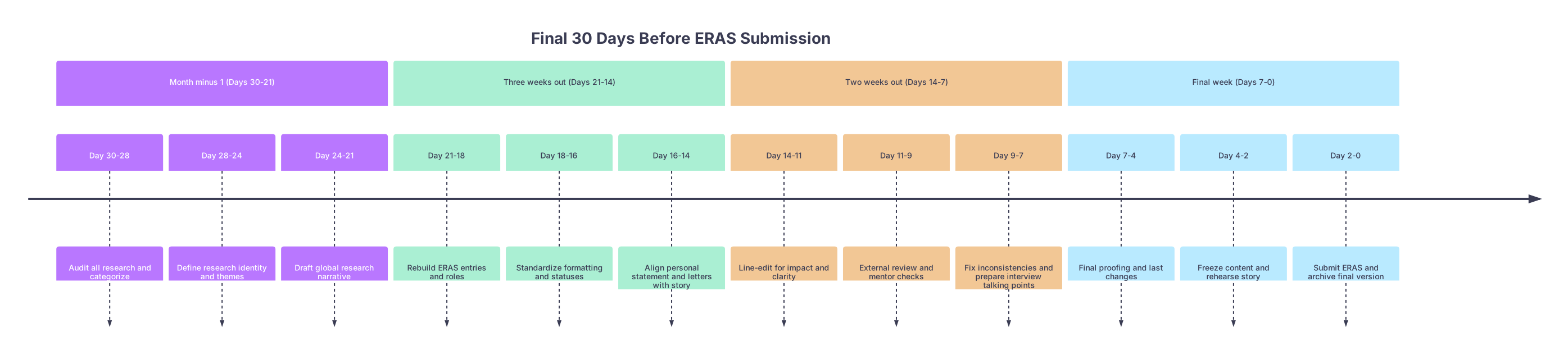
| Period | Event |
|---|---|
| Month minus 1 (Days 30-21) - Day 30-28 | Audit all research and categorize |
| Month minus 1 (Days 30-21) - Day 28-24 | Define research identity and themes |
| Month minus 1 (Days 30-21) - Day 24-21 | Draft global research narrative |
| Three weeks out (Days 21-14) - Day 21-18 | Rebuild ERAS entries and roles |
| Three weeks out (Days 21-14) - Day 18-16 | Standardize formatting and statuses |
| Three weeks out (Days 21-14) - Day 16-14 | Align personal statement and letters with story |
| Two weeks out (Days 14-7) - Day 14-11 | Line-edit for impact and clarity |
| Two weeks out (Days 14-7) - Day 11-9 | External review and mentor checks |
| Two weeks out (Days 14-7) - Day 9-7 | Fix inconsistencies and prepare interview talking points |
| Final week (Days 7-0) - Day 7-4 | Final proofing and last changes |
| Final week (Days 7-0) - Day 4-2 | Freeze content and rehearse story |
| Final week (Days 7-0) - Day 2-0 | Submit ERAS and archive final version |
21–14 Days Out: Rebuild Your ERAS Research Entries From the Ground Up
Now you know your angle. At this point you should rewrite your research entries so they support that angle ruthlessly.
Step 4 (Day 21–19): Fix structure before wording
Common ERAS research disasters I see:
- Duplicate entries for the same project (once as “research,” once as “poster”)
- Vague roles: “helped with data” or “assisted with research”
- Status lies: “manuscript in preparation” for something no one has touched in 2 years
First, decide where each item belongs:
- Research experience section:
- Project itself: hypothesis, methods, your role
- Publications/Presentations section:
- The outputs of those projects: posters, oral talks, manuscripts
One project can appear in both sections, but:
- In research experiences: focus on what you did
- In products: focus on the citation
Do not create 4 different “experiences” for the same study.
Step 5 (Day 19–17): Rewrite role descriptions like you actually did something
At this point you should strip out fluff verbs (“exposed to,” “participated in”) and replace them with concrete actions.
For each research entry:
Start with one short sentence of context:
“Single‑center retrospective study of 500 heart failure admissions evaluating 30‑day readmissions.”Then 2–3 bullet‑style phrases (in ERAS prose) that show contribution:
- “Designed data collection tool and extracted EMR data for 120 patients”
- “Performed univariate and multivariate analyses in R under PI supervision”
- “First author on abstract accepted to AHA 2024 (poster)”
Avoid:
- “Assisted with research”
- “Involved in data analysis”
- “Participated in manuscript writing”
You want each line to pass the “interview test”:
- If they ask, “Tell me more about that,” do you have a specific story?
Step 6 (Day 17–15): Standardize your publications and statuses
At this point you should eliminate every fuzzy verb about your manuscripts.
Use a simple status taxonomy and stick to it:
| Status | ERAS Wording Example |
|---|---|
| Published | Published 2024 (JAMA Cardiol) |
| In press | In press 2024 (Circulation) |
| Accepted, not in press | Accepted 2024 (Chest), in production |
| Submitted | Submitted 2024, under review |
| In preparation (real) | Manuscript in preparation, drafting results |
If “in preparation” = Google Doc with a title and nothing else, either:
- Move it to a future plans comment in a research entry, or
- Delete the status entirely
Do not pad with fake productivity. Programs see through “10 manuscripts in preparation” with zero posters, zero presentations, zero acceptances. It screams exaggeration.
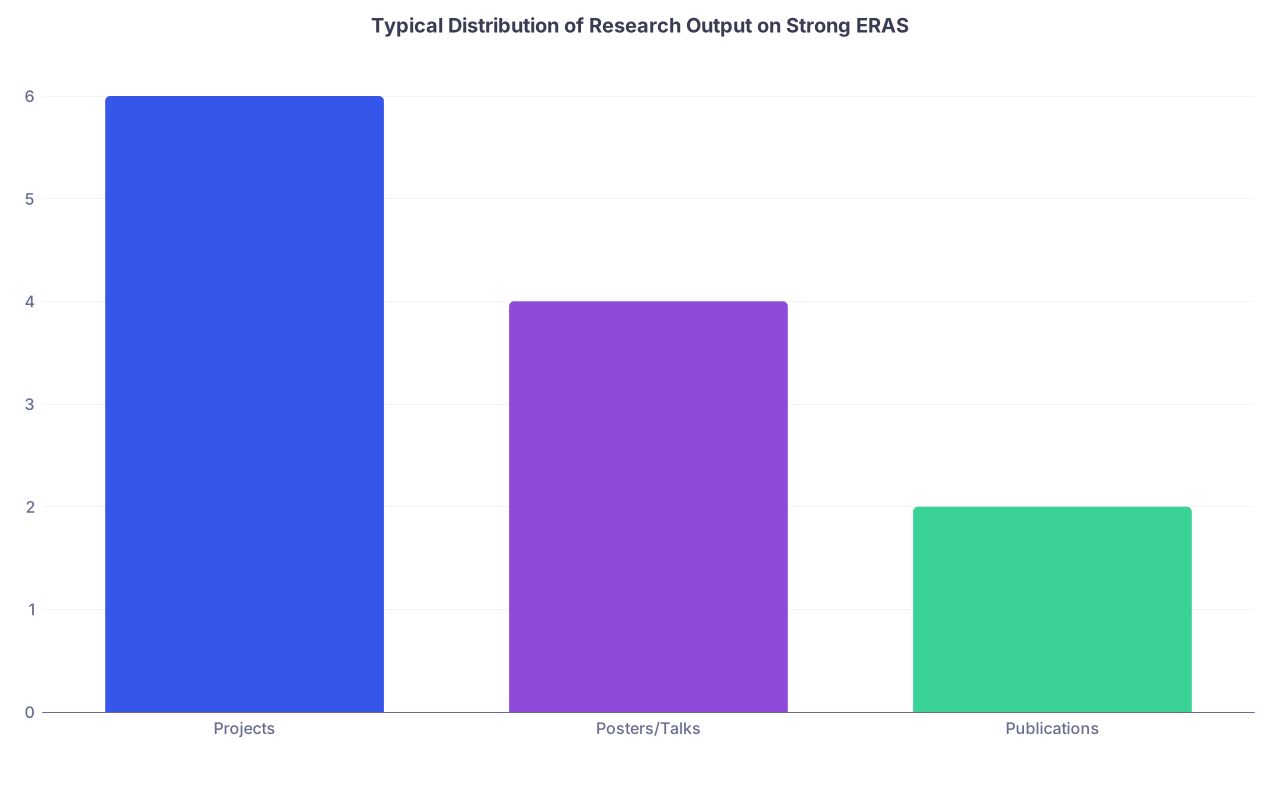
| Category | Value |
|---|---|
| Projects | 6 |
| Posters/Talks | 4 |
| Publications | 2 |
14–7 Days Out: Align Your Research Story Across ERAS, PS, and Letters
At this point you should stop treating research as a separate silo. Programs read your file as a whole.
Step 7 (Day 14–12): Sync research with your personal statement
Pull up your current personal statement. Read it straight through, then ask:
- Does it acknowledge that I’ve done research?
- Does it connect my research to why I like this specialty or patient population?
- Does it mention one or two flagship projects by theme (not by PubMed ID)?
You’re not writing a “research statement” for residency, but you also shouldn’t pretend your research never happened.
Good integration sounds like:
- “Working on outcomes in heart failure readmissions showed me how system‑level decisions play out at the bedside.”
- “Our study on access to inpatient psychiatry for uninsured patients forced me to confront structural barriers that my clinic patients face daily.”
Revise 1–2 paragraphs to:
- Name the area (not the journal)
- Connect it to your clinical motivation
- Show that you understand why the questions matter, not just how you ran STATA code
Step 8 (Day 12–10): Check research alignment with letters of recommendation
At this point you should avoid one of the simplest but biggest errors: mismatch between your ERAS entries and what your research mentor writes about you.
Actions:
- Email your research mentors:
- Thank them again for writing a letter.
- Attach your polished CV or a snapshot of your ERAS research entries.
- Briefly remind them of 1–2 key contributions:
“I especially appreciated working on the ICU delirium project where I led the data collection and presented at ATS.”
You’re not rewriting their letter, you’re jogging their memory and aligning emphasis.
Also:
- Double‑check that:
- The project titles in your entries roughly match what they’ll remember.
- You’re not claiming lead authorship if you know your name is buried in the middle.
If you realize you exaggerated a role, fix ERAS now. Do not hope the letter doesn’t contradict you.
Step 9 (Day 10–7): Build your 3–4 go‑to interview research stories
At this point you should shift from writing to speaking. ERAS is not the end; it’s the script for your interview answers.
You need 3–4 “anchor” stories ready to go:
Flagship project
- The one you’d be happy to talk about for 15 minutes.
- Know:
- The clinical question
- The basic methods
- One interesting finding
- What you personally did
- One challenge/problem you solved
Failure or stalled project
- A study that never got published, a trial that stopped recruiting, or a negative result.
- Be ready to explain:
- What went wrong
- What you learned (about research design, feasibility, IRB, etc.)
Non‑specialty or “left field” project
- The random peds project when you’re applying to anesthesia, for example.
- Show:
- Transferable skills (data analysis, collaboration, QI)
- Intellectual curiosity beyond one niche
Teamwork/mentorship example
- Maybe you mentored a junior student on a project.
- Or were mentored closely by a fellow or postdoc.
- Use it to show how you function on a research team.
Write bullets, not scripts. Practice answering:
- “Tell me about your research.”
- “Which project are you most proud of?”
- “What did you actually do on this study?”
Final 7 Days: Tightening, Proofing, and Last Honest Edits
This is the week people waste on font anxiety. Focus on higher‑yield fixes.
Step 10 (Day 7–5): Do a ruthless clarity pass on all research entries
At this point you should aim for simple, jargon‑light language that a busy intern can understand in 5 seconds.
Go entry by entry and ask:
- Can a non‑specialist understand the basic topic?
- Do the first 1–2 words of each bullet highlight your role? (“Led…”, “Analyzed…”, “Presented…”)
- Are there any orphan phrases like “etc.” or “various tasks”?
Quick edits:
Replace:
“Participated in various aspects of a retrospective chart review evaluating outcomes and interventions in a population of…”
With:
“Abstracted EMR data and helped design analysis plan for a retrospective study of 300 stroke patients.”Replace:
“Worked with team to help with quality improvement regarding handoffs.”
With:
“Co‑developed and piloted a new handoff checklist for night float admissions; tracked wrong‑bed and delayed‑order errors before/after rollout.”
Step 11 (Day 5–3): External sanity check
At this point you should get one or two real humans to scan the entire research section plus your personal statement.
Ideal reviewers:
- A resident in your target specialty
- A research‑oriented faculty mentor
- A trusted classmate with a strong ERAS of their own
Ask them specific questions:
- “Do these entries feel honest and substantial?”
- “Can you tell what my main research themes are?”
- “Any entry that feels confusing or underwhelming?”
If two people independently flag the same entry as confusing or unimpressive, fix or cut it.
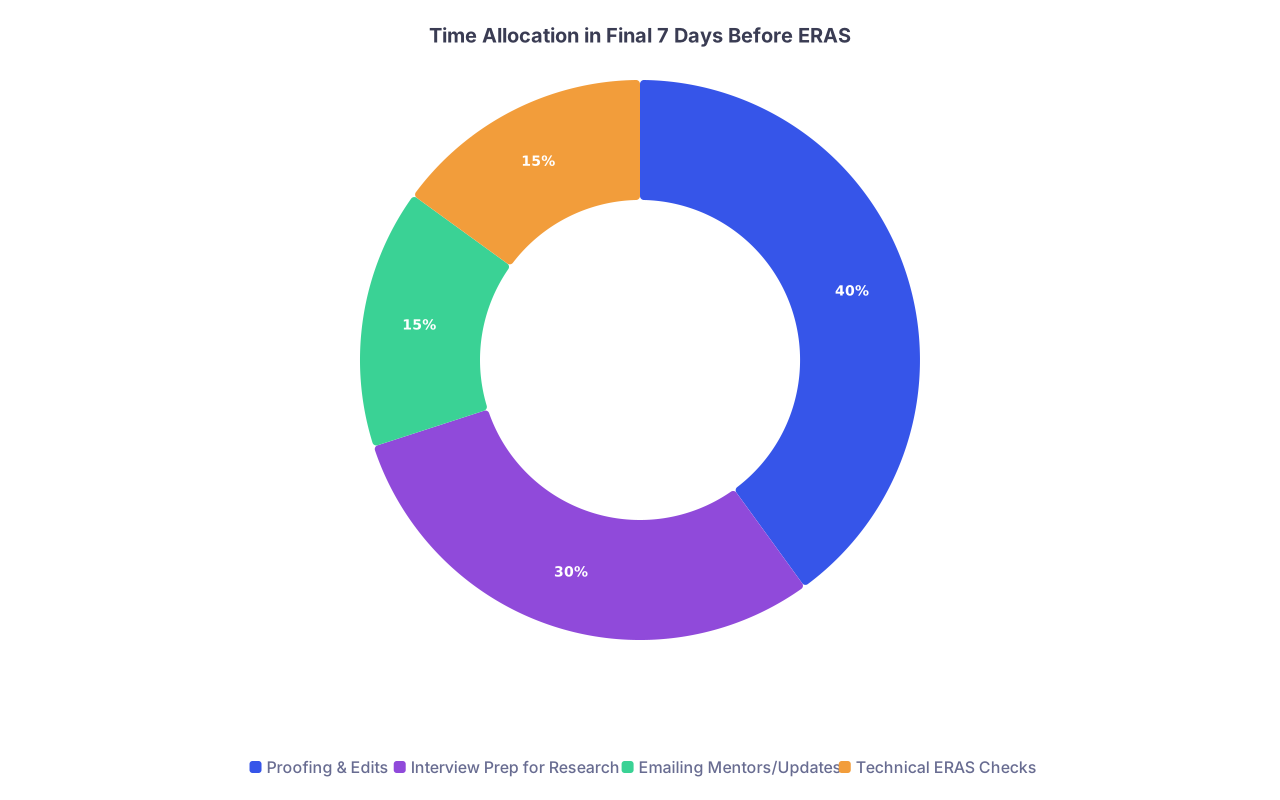
| Category | Value |
|---|---|
| Proofing & Edits | 40 |
| Interview Prep for Research | 30 |
| Emailing Mentors/Updates | 15 |
| Technical ERAS Checks | 15 |
Step 12 (Day 3–2): Freeze content; stop adding fake “in preparation” items
This is where people sabotage themselves. They spend the last 72 hours trying to squeeze in imaginary papers.
At this point you should:
- Lock in which projects you’re listing as:
- Published / accepted
- Submitted
- In preparation (only if there is a real, ongoing effort)
If a project is just starting, you can:
- Mention it briefly in a research experience as a “current project,” or
- Talk about it in interviews as “ongoing work with Dr. X”
But don’t inflate it into a publication entry.
Also:
- Triple‑check:
- Dates make sense and don’t contradict each other
- Mentor names are spelled correctly
- The same paper isn’t listed twice under slightly different titles
Step 13 (Day 2–0): Final pass and mental rehearsal
At this point you should assume someone will quiz you on any line of your ERAS.
Last‑day checklist:
Read every research entry and ask:
- “Can I explain this project in 2–3 sentences without notes?”
- “Do I remember roughly when I worked on it and with whom?”
- “Do I know at least the general outcome or current status?”
Skim your personal statement:
- Confirm that any research mentioned there appears in ERAS and is labeled consistently.
Open your publications list:
- Check that PubMed citations match what you wrote.
- Fix any reversed author orders or wrong years.

Red Flags You Must Fix Before You Hit Submit
As Timeline Guide, I’m going to be blunt. At this point—within 48 hours of submission—if any of these are true, fix them immediately:
You have more projects “in preparation” than published/presented.
Trim or reclassify. It looks unserious.You can’t clearly explain at least one meaningful, multi‑month project.
That means your ERAS overstates your involvement. Downgrade your role or remove it.Your story is incoherent.
Five random case reports in five specialties with zero connection to your target field? You can’t erase them, but you can:- Emphasize the ones closest to your chosen area
- Frame the rest as broad clinical curiosity
Your mentor might contradict you.
If you took generous “credit” for design or writing that you didn’t actually do, correct your entries now. Panels believe letters over ERAS bullet points.

The Bottom Line in These Final 30 Days
Three key points:
- In the last month, your job is not to add more research—it’s to organize and present what you already did as a coherent, honest identity.
- Every research entry should tell programs, in a few clear lines, what the project was, what you actually did, and how it fits your broader interests.
- By submission day, you should be able to speak comfortably about 3–4 anchor projects that match what’s on ERAS, your personal statement, and what your mentors will say about you.
Follow the timeline above. By Day 0, your research story will look like what it actually is: the work of a thoughtful, developing physician who used medical school to ask and answer real clinical questions.