The biggest waste of good research is letting it sit on your CV while you mumble one sentence about it in interviews.
You are entering interview season with active, evolving projects. That is leverage. If you treat it like a static bullet point, you are giving away free points.
Here is how to use fresh research deliberately, week by week and day by day, from the moment interview invites start until Match Day.
1. Late Summer–Early Fall (Aug–Sep): Set Up Your “Fresh Research” Engine
At this point you should not be improvising. You should be building the system that will feed you updates and talking points all season.
1.1. Clarify what counts as “fresh”
By late summer, go through your projects and label them:
- Live and moving – data collection, analysis, drafting, revising, or under review.
- Recently finished – accepted, in press, or presented in the last 6–9 months.
- Old and static – anything older, with no realistic new developments before Rank List.
Focus your interview strategy around the first two. Those give you “since we submitted ERAS…” material.
Build a one-page master list with:
- Project title (short, conversational name)
- Role (1st author, data lead, etc.)
- Current status (collecting, analyzing, drafting, submitted, accepted)
- Key skills used (R, Python, REDCap, QI methods, chart review, etc.)
- One sentence: “So what?” for patient care or systems.
This becomes your research control center for the season.
1.2. Lock in realistic milestones
Now you decide what “fresh” will actually mean 2–3 months from now.
For each live project, commit to specific, modest milestones:
- “Have descriptive statistics done by October 15.”
- “Submit abstract to APHA by November 1.”
- “Draft intro and methods by September 30.”
- “Finalize IRB amendment by early October.”
Do not fantasize about Nature Medicine. Think small and concrete. Interviewers will be more impressed by steady movement than by wild promises.
| Project | Current Stage | Pre-interview Milestone |
|---|---|---|
| HF readmission QI | Data collection | Complete data cleaning |
| COVID vaccine uptake | Analysis | Finish primary regression |
| Case report – vasculitis | Drafting | Submit to journal |
| Education OSCE tool | Planning | Submit IRB |
1.3. Build your tracking ritual
You do not want to be guessing status the night before an interview.
By the end of September you should:
- Create a living document (Notion, Google Doc, whatever) with:
- Project list (from above)
- Status dates (last updated, next expected step)
- People involved (PI, co-authors, data team)
- Schedule a 10–15 minute weekly research check-in with yourself:
- Update statuses
- Note any small wins (email acceptance, IRB approval, abstract submitted)
- Convert each “win” into 1–2 interview talking points.
This document is gold. You will use it the night before each interview.
2. Early Interview Season (Oct–Nov): Program-Specific Research Prep
At this point you should be past “I like research” and into “Here is how my work intersects with your department.”
2.1. Two weeks before your first interview: build your research narrative
You need a default “research story” that you can customize per program.
Write out (literally write, not in your head):
The through-line (2–3 sentences).
Example: “My research has focused on how we deliver care to high-risk cardiology patients. I started with readmission prediction models, then moved into a QI project trying to reduce 30-day HF readmissions, and now I am working on implementation—what actually sticks on the wards.”Three anchor projects (most recent and relevant):
- 1–2 sentence summary
- Your role
- One challenge you faced
- One impact or next step
A clear “What I want next”:
“On residency I want to keep doing X type of work, ideally with Y kind of mentor, using Z methods.”
This is the spine of your conversations. Everything “fresh” gets hung on this frame.
2.2. One week before first interview: map yourself to each program
Now the leverage moves from “I have research” to “I belong here.”
For each upcoming program, spend 20–30 minutes:
- Look up:
- Department research themes
- Scholars whose work overlaps yours
- Ongoing trials/QI initiatives
- Pick 2–3 faculty whose work truly aligns.
Now create a brief mapping:
- “My HF QI work → Dr. Smith’s transitions-of-care program.”
- “My machine learning project → their predictive analytics group.”
- “My education research → their simulation-based curriculum.”
You are not just name-dropping. You are drawing clean lines between your last 2–3 years and what they are doing now.
3. Week-by-Week During Interview Season: Updating and Leveraging Fresh Progress
Interview season feels chaotic. You need a weekly rhythm so your research presence grows instead of decaying.
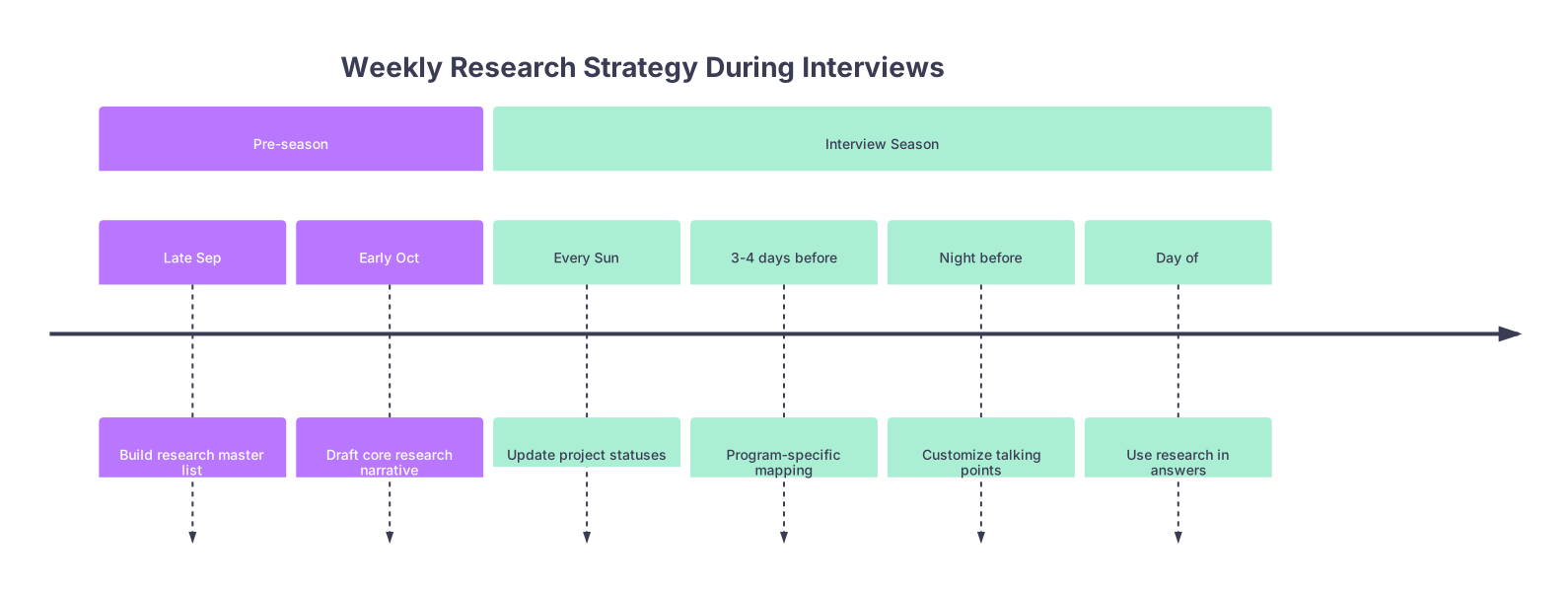
| Period | Event |
|---|---|
| Pre-season - Late Sep | Build research master list |
| Pre-season - Early Oct | Draft core research narrative |
| Interview Season - Every Sun | Update project statuses |
| Interview Season - 3-4 days before | Program-specific mapping |
| Interview Season - Night before | Customize talking points |
| Interview Season - Day of | Use research in answers |
3.1. Every Sunday: 20-minute research reset
During October–January, your Sunday routine should include:
- Open the research tracking doc.
- For each project, ask:
- Did anything change this week? (IRB, data, drafts, responses from journals?)
- Did I send any important emails related to it?
- Update status lines:
- “Submitted to JGIM 10/12.”
- “Revisions requested 11/2.”
- “Abstract accepted for SGIM 1/5.”
Then, crucial step:
Write 3–5 “fresh” one-liners you can plug into interviews:
- “Since submitting ERAS, our team actually just finished the initial analysis—prelim data suggests…”
- “We just heard last week that the abstract was accepted to [Conference].”
- “We finalized IRB approval in October, so we are about to start enrollment.”
These will keep your answers sounding current, not like you copy-pasted from August.
3.2. 3–4 days before each interview: micro-target your research pitch
For each program on your calendar that week:
Revisit your faculty mapping.
Update with any new connections:
- “Oh, they have a transitions-of-care clinic, perfect for my HF project.”
- “They just published in NEJM on sepsis bundles; ties to my QI rotation.”
Build a mini research bullets sheet for that program (5–7 bullets):
- 1 sentence: how your overall research theme matches their mission.
- 2 sentences: how your freshest project relates to specific program resources (registry, database, clinic, center).
- 2–3 questions you would ask faculty about future work:
- “How do residents get involved in your sepsis QI collaborative?”
- “Are there opportunities to link resident QI projects to your health system data warehouse?”
This is what you glance at the night before.
4. Day-Before and Day-Of: How to Actually Talk About Fresh Research
Now you are at the tactical level. At this point you should have your stories ready and your updates sharp.
4.1. The day before: 30-minute rehearsal
Do not cram the whole CV. Focus on:
- Two “fresh update” stories you can deploy anywhere.
- One “failure or challenge” story tied to research.
- One “future plans” story tailored to that program.
Practice out loud. Brief, not epic:
- 60–90 seconds per project.
- No slide deck. No jargon dump. Just: what you did, what happened, what you learned, where it is going.
If you bore yourself, you will bore the interviewer.
4.2. Day of: where research should show up in your answers
You should not wait for the “tell me about your research” prompt. You can weave research into many standard questions.
Here is where it fits naturally:
“Tell me about yourself.”
Version: brief chronological sketch that includes how research entered your training and what you are doing now.“Why this specialty?”
Link your clinical interests with how your research sharpened that interest.
Example: “Taking care of complex HF patients drove me to ask why our 30-day readmissions were so high, which is how I got into this QI project…”“What are your career goals?”
Use your fresh projects to prove that your future plans are not hypothetical.“Tell me about a challenge or failure.”
Underpowered study, rejected abstract, IRB delay. Excellent material if you can show growth.“Any questions for me?”
This is where you demonstrate you understand research as a living ecosystem, not a solo hobby. Ask targeted questions about integration with their ongoing work.
5. Concrete Scripts: Before, During, and After the Update
Let’s get specific. Here is how you bring fresh research into the room without sounding like a robot.
5.1. Updating a project from your ERAS application
You submitted ERAS in September. It is December, and something has changed.
Use a clean, three-part structure:
Anchor to what they may have read:
- “You may have seen on my application that I was working on a heart failure readmission project…”
Deliver the update succinctly:
- “…Since then we have completed data collection and preliminary analysis on about 600 patients…”
Connect to impact or next step:
- “…and we are now testing a new discharge checklist on the wards. I am excited because we are already seeing fewer 30-day bounce-backs in our pilot unit.”
Total time: 20–30 seconds. No extraneous detail unless they ask.
5.2. Using fresh research to answer “Why our program?”
You are in an interview with a program that has a strong hospitalist research group.
You say:
“Most of my recent work has focused on hospital-based care quality. For example, I have been part of a QI project on HF readmissions where we just finished our first PDSA cycle. When I looked at your hospitalist division’s work on care transitions, especially Dr. Patel’s program, it felt like a natural extension. I can see myself plugging into that infrastructure quickly and continuing to iterate on this kind of project as a resident.”
That is specific alignment, anchored in something you are actively doing.
5.3. Handling “Tell me about your most meaningful research project”
You should not recite methods. Use a narrative arc, then drop in the fresh detail at the end.
Example skeleton:
- Problem: “We were seeing 25–30 percent 30-day readmission rates in our HF population.”
- Your role: “I led the data collection and worked with a statistician to build the model.”
- Obstacle: “The EHR export was a mess; I had to learn SQL and redo our extraction.”
- Result: “We built a model that identified a high-risk group with 40 percent readmissions.”
- Fresh update: “Since ERAS, we have actually moved into implementation. Our team just launched a nurse-led follow-up phone call protocol for the highest-risk quintile, and we are collecting early data on feasibility now.”
That last line is the leverage. It moves you from “I did a project” to “I drive ongoing work.”
6. Using Fresh Research Outside the Formal Interview Room
You do not stop leveraging research when the structured questions end.
6.1. Pre-interview and social events
At pre-interview dinners or resident socials:
Do not launch into monologues about regression models.
Instead, use fresh research as a way to ask about the culture:
- “I am working on a small QI project now around discharge summaries—how do residents usually get plugged into QI at your program?”
- “We just had an abstract accepted for a regional meeting. Do residents here get support for conference travel?”
You are doing two things at once: signaling that you are active and probing whether the program actually supports that work.
6.2. Post-interview thank-you notes
If you have a new research milestone a week or two after an interview, you can very briefly mention it in a follow-up or thank-you email—if it ties to that interviewer’s interests.
Structure:
- Thank them, reference a specific part of your conversation.
- One line: “Since we spoke, our manuscript on X was accepted to Y journal, and I remain very excited about the chance to continue this kind of work in a program like yours.”
Do not send weekly updates. One well-timed, genuine note is enough.
7. Late Interview Season (Jan–Feb): Closing the Loop and Thinking Ahead
By late season, you should be thinking not just “How do I talk about my research?” but “How do I transition this work into residency?”
7.1. Update your story as projects mature
Some of your “fresh” projects will change category:
- Submitted → accepted
- IRB pending → enrollment started
- Data collection → analysis complete
Refresh your core narrative once in January:
- Replace stale examples with more advanced ones.
- Emphasize momentum: “Over the course of this year, my role has shifted from just contributing to others’ projects to actually leading my own.”
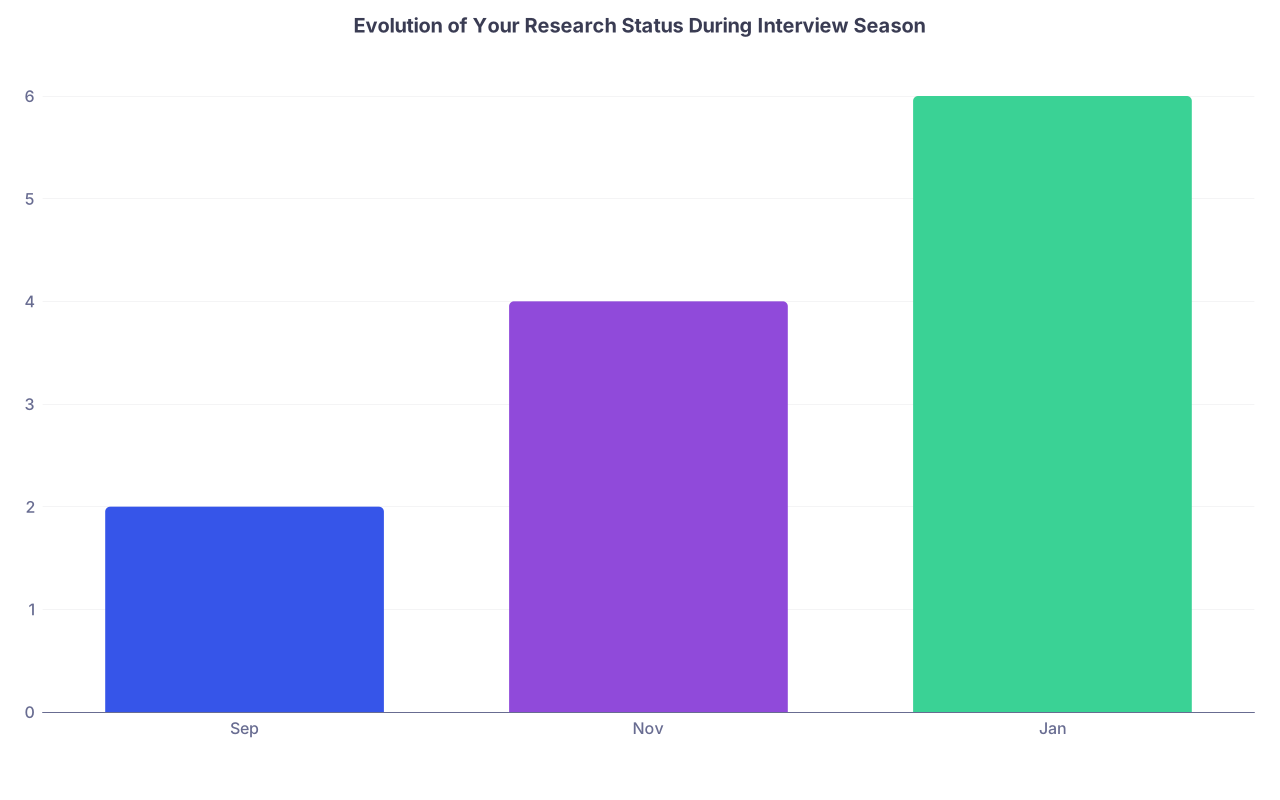
| Category | Value |
|---|---|
| Sep | 2 |
| Nov | 4 |
| Jan | 6 |
(Think of that bar as the number of projects that moved forward—your goal is an upward trend.)
7.2. Start framing “how I will continue this as a resident”
Programs want people who will not drop everything on July 1.
Have one clear answer ready:
“I want to do two things in residency:
- Finish and publish the projects I have in motion now—especially the HF QI work and our vaccine uptake study.
- Within the first year, identify a faculty mentor here and start a resident-level project that builds on those skills but focuses on a local need. For example, I could imagine adapting our discharge checklist model to your general medicine service, working with your QI office to align it with existing initiatives.”
You sound like someone who finishes what they start. Programs like that.
8. Common Mistakes with Fresh Research – And How to Avoid Them
At this point, let me be blunt. I have watched many applicants sabotage themselves with research talk.
Three patterns:
Overexpanding updates.
Turning “we submitted an abstract” into a 5-minute detour. Fix: 1–2 sentences per update unless they ask for more.Overpromising.
Hinting that everything is about to be in a top-tier journal. Interviewers can smell desperation. Fix: emphasize process and what you controlled, not speculative outcomes.Name-dropping without understanding.
“I want to work with Dr. X” but you cannot summarize their work in one sentence. Fix: if you mention a name, be able to say exactly why and how your current project fits.
9. Final 2 Weeks Before Rank List: Reviewing How You Used Your Research
When you are sitting down to make your rank list, your research conversations should actually help you.
Ask yourself for each program:
- Did anyone engage with my research deeply?
- Did I leave with a clear sense of how I could continue my current projects there?
- Did the program offer realistic structures—protected time, mentorship, data access?
Use your interview notes. The programs that gave you concrete answers and seemed energized by your fresh work probably align with your long-term goals far better than places that politely nodded and moved on.
Key Takeaways
- Treat research as a living story, not a static CV entry. Update it weekly and translate every small milestone into crisp talking points.
- Customize your research narrative to each program, drawing explicit lines between your current projects and their ongoing work.
- Use fresh research strategically across the entire interview season—from “tell me about yourself” to thank-you emails—to show momentum, maturity, and a clear plan for continuing scholarly work in residency.