
The worst advice MS3s get about research is “just keep doing as much as you can.” That is how you burn out, tank your clerkship evals, and still end up with half-finished projects that do not help your residency application.
Here is the reality: during clinical year, research momentum depends on ruthless timing and controlled volume, not on heroic effort.
I am going to lay out your MS3 clinical year week by week and month by month. At each point, I will tell you exactly what you should and should not be doing for research if you want strong letters, solid shelf scores, and a growing CV.
Big Picture: Your Research Capacity Across MS3
Before we zoom into the timeline, you need a rough “budget” for how much research your brain and schedule can realistically support on rotations.
On a typical full-time core clerkship (medicine, surgery, OB, peds), you can sustainably manage:
- 3–5 hours per week of research during busy rotations
- 5–8 hours per week during lighter rotations (FM, psych, neuro at some schools)
- 10–15 hours per week during electives and vacation / research blocks
Trying to double those numbers? That is when shelf scores slide and you start sending “sorry for the delay” emails.
Here is what that capacity usually looks like across the year:
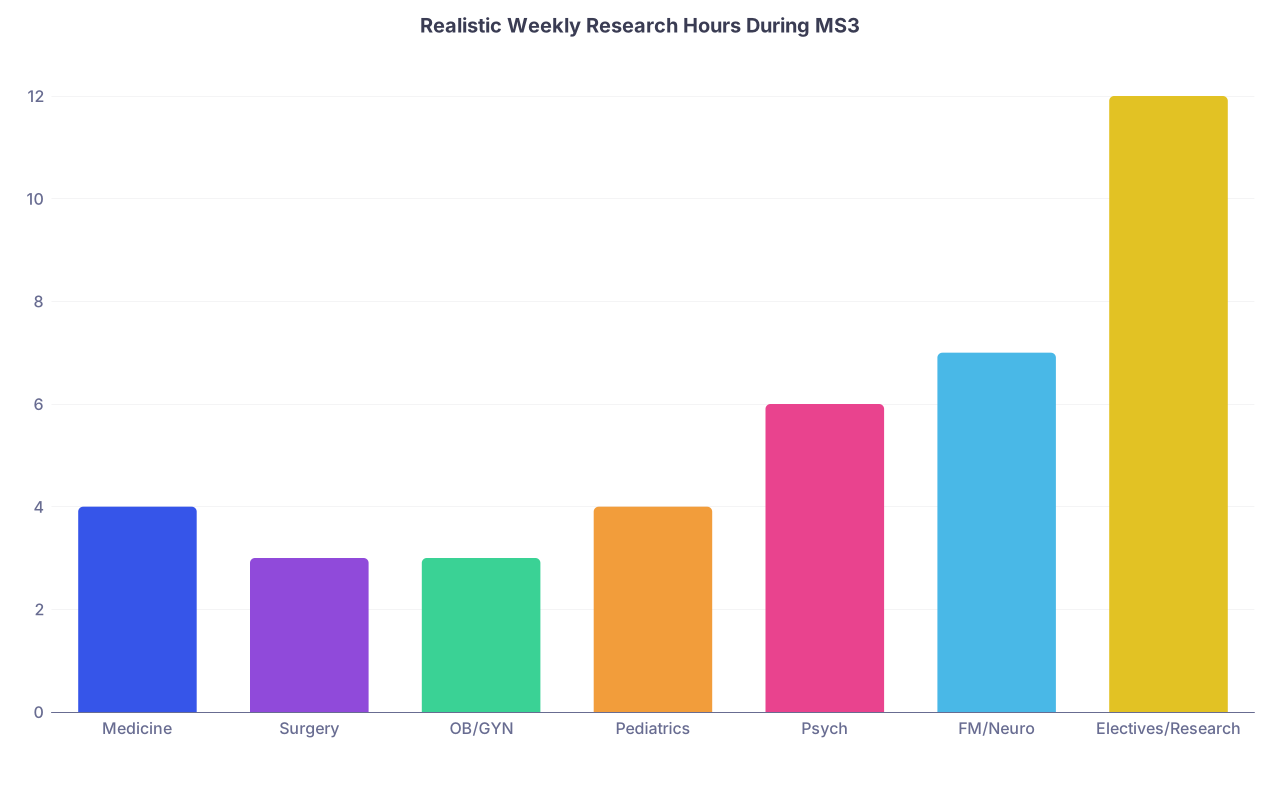
| Category | Value |
|---|---|
| Medicine | 4 |
| Surgery | 3 |
| OB/GYN | 3 |
| Pediatrics | 4 |
| Psych | 6 |
| FM/Neuro | 7 |
| Electives/Research | 12 |
At this point, your mindset should be: I am not trying to start 10 projects. I am trying to advance 1–3 strategically chosen ones in a controlled, predictable way.
Pre–MS3 (2–4 Weeks Before Clinical Year Starts)
This is where most students either set themselves up beautifully or sabotage the entire year.
Week –4 to –3: Audit and Ruthless Pruning
At this point you should:
List every project you are attached to.
For each: title, mentor, your role, status (idea / data / analysis / writing / submitted).Kill or pause most of them. You should enter MS3 with:
- 1 “primary” project where you are first or strong middle author and work is already at:
- data collected or
- analysis in progress or
- writing in progress
- 1–2 small, well-defined, low-maintenance roles (e.g., chart reviewer, data extractor, figure maker).
- 1 “primary” project where you are first or strong middle author and work is already at:
If you are earlier than data collection on every project? Fine. Pick one that is most likely to finish within 12 months and explicitly mark everything else as “on hold until MS4.”
Have hard conversations now.
Email mentors:- “I am about to start my core clerkships and need to be realistic. I can commit X hours/week. Here is what I think I can complete this year on this project: [specific tasks]. Does that match your expectations?”
If a mentor replies with “we’ll just see how much you can do”? Red flag. Lock in concrete expectations, or reduce your role.
Week –2 to –1: System and Schedule Setup
At this point you should:
Block standing research time on your calendar for the entire first 3 months. Examples:
- Medicine rotation:
- Tuesday 7–8:30 pm
- Saturday 9–11 am
- Surgery rotation:
- Sunday 10 am–12 pm only
- Medicine rotation:
Create a single research notebook/system (Notion, OneNote, paper, whatever) with:
- A page per project with:
- Aim
- Current status
- Next 3 concrete tasks that can be done in 30–60 minutes each
- A log where you quickly jot down:
- Date
- What you did (2–3 bullet points)
- Questions for mentor / team
- A page per project with:
Prep low-cognitive-load tasks that you can do post-call:
- PDFs saved and organized
- A Zotero / EndNote library ready
- Draft tables / figure shells started
You should be entering Day 1 of MS3 knowing:
- Exactly which project is primary
- When in the week you will touch it
- What the next micro-task is
Quarter 1 (Months 1–3 of MS3): Survival Mode with Strategic Progress
These are usually your heaviest rotations. Think internal medicine + surgery + OB/GYN in some order.
At this stage, your research goal is not expansion. It is controlled, incremental progress.
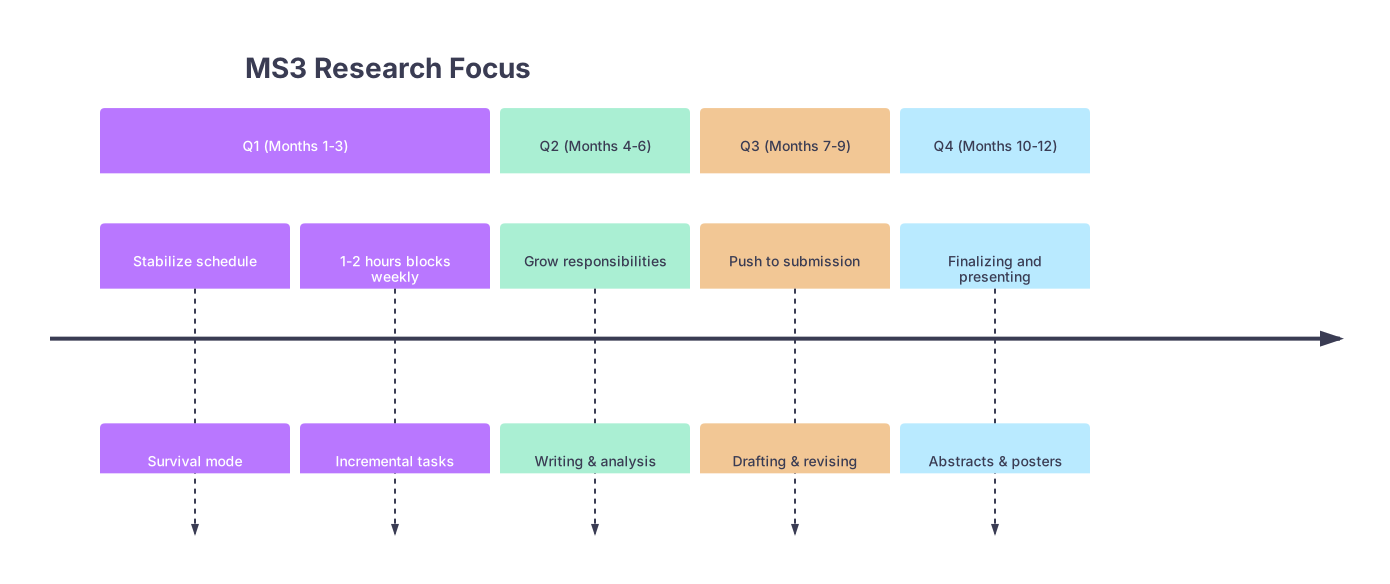
| Period | Event |
|---|---|
| Q1 (Months 1-3) - Stabilize schedule | Survival mode |
| Q1 (Months 1-3) - 1-2 hours blocks weekly | Incremental tasks |
| Q2 (Months 4-6) - Grow responsibilities | Writing & analysis |
| Q3 (Months 7-9) - Push to submission | Drafting & revising |
| Q4 (Months 10-12) - Finalizing and presenting | Abstracts & posters |
Month 1: Stabilization and Reality Check
Weeks 1–2 (New Rotation Shock)
At this point you should:
- Do no new research commitments. None.
- Only do:
- Previously defined micro-tasks (e.g., extract 10 charts, draft 1 paragraph of intro)
- 1–2 hours per week, max
Your only job this month: prove to yourself you can hold a 2-hour/week research habit without your clinical performance slipping.
Weeks 3–4
If your evaluations are solid and you are not drowning:
- Increase to 3–4 hours/week maximum:
- One weekday evening 60–90 minutes
- One weekend 2-hour block
At this point you should:
- Complete at least one meaningful milestone on your primary project:
- Finished data collection on your assigned chunk
- Completed first draft of introduction or methods
- Cleaned and finalized dataset for analysis
If nothing has moved in 3–4 weeks, your “system” is not working. Fix that before adding time.
Month 2: Establish a Predictable Weekly Pattern
By now you know the rhythm of rounds, consults, notes, and the commute.
At this point you should:
Pick a standard weekly research pattern and protect it:
- Example (medicine):
- Wed 7–8:30 pm – data/reading
- Sat 9–11 am – writing or figure building
- Example (surgery):
- Sun 10 am–12 pm – only
- Example (medicine):
Shift focus to higher-leverage tasks:
- Move from note-taking and lit searching to:
- Cleaning data
- Drafting methods
- Outlining results tables
- Move from note-taking and lit searching to:
Update mentors every 3–4 weeks with short, pointed emails:
- “Since we last spoke, I completed X and Y. Next I plan to [specific tasks] over the next 2 weeks. Any adjustments you would recommend?”
This keeps you “alive” on people’s radar without constant meetings.
Month 3: First Deliverables
By the end of Month 3, you should have at least one of:
- A near-final dataset
- A complete draft of one section (intro, methods, or results skeleton)
- A draft abstract for a conference even if the paper is not done
If you do not have any deliverable, you probably:
- Picked a project that was too early stage
- Tried to help on too many fronts
- Let clerkship chaos erase your research blocks
Correct that before the next quarter. That might mean stepping down from one project to actually finish another.
Quarter 2 (Months 4–6): Building Momentum Strategically
This is often when you hit psych, family medicine, neuro, or a lighter block. This is your window to make bigger pushes on your primary project.
At this point your mindset should shift from “keep it alive” to “push something toward submission.”
Month 4: Choose Your Horse
Early Month 4, you should:
- Look across all active projects and ask two blunt questions:
- Which one has the clearest path to a manuscript or abstract within 6–9 months?
- Which mentor actually responds, edits, and moves things forward?
Pick one as your “must-finish” project before ERAS submission.
If none fits? You need a new project. But you must be tactical:
- Aim for:
- Case series
- Retrospective chart review with existing dataset
- Short communication or brief report
- Avoid:
- Starting a prospective trial
- Overly complex multi-center anything
Month 5: Writing and Analysis Blocks
On a lighter rotation (or at least less malignant one), your weekly research time can bump to 5–8 hours, carefully.
At this point you should:
Convert that extra time into deep work blocks, not scattered minutes:
- 2–3-hour blocks for:
- Running analyses with a resident / statistician
- Drafting full sections of the manuscript
- Building complete tables / figures
- 2–3-hour blocks for:
Lock in:
- One meeting with your primary mentor this month
- A clear, written outline of the full paper with headings and planned figures
This is also the right time to ask for authorship clarity if it is not already explicit.
Month 6: Aim for a First Full Draft or Abstract Submission
By the end of Month 6, your goal should be:
- Either:
- A full rough draft of the manuscript ready to send to your mentor
- Or:
- An abstract submitted to a regional/national meeting
Here is how these milestones line up with ERAS impact:
| Timepoint | Ideal Research Milestone | ERAS Impact Level |
|---|---|---|
| End of Month 3 | Data or section draft | Low–Moderate |
| End of Month 6 | Full draft or abstract submitted | Moderate |
| End of Month 9 | Manuscript submitted | High |
| End of Month 12 | Acceptance or in revision | Very High |
You are not aiming for acceptance by ERAS (nice if it happens, not mandatory). You are aiming for “submitted” with you as first or meaningful co-author.
Quarter 3 (Months 7–9): Convert Work Into Submissions
By now, you are not “building” new research. You are converting existing work into things that show up on your CV.
Month 7: Feedback and Revision Loops
At this point you should:
- Have already sent a full draft or substantial partial draft to your mentor by early Month 7.
- Block 2–4 hours per week for:
- Responding to comments
- Rewriting sections
- Tightening figures/tables
This is the point where many students disappear because they are tired. Do not. This is the boring, unglamorous part that actually produces PubMed IDs.
Month 8: Submission Push
Your main job this month: get at least one concrete product out the door.
- Manuscript submitted to a journal
- Abstract submitted to a conference
- Case report finalized and submitted
Plan backward:
- Week 1–2: Final mentor revisions
- Week 3: Formatting, cover letter, final reference fixes
- Week 4: Submission
Use checklists so nothing drags out for silly reasons. Example mini-checklist for final week:
- Journal chosen and author guidelines reviewed
- Word count and references checked
- Figures sized and formatted per instructions
- All co-authors confirmed authorship order
Month 9: Backup and Small Wins
At this point you should:
- Have your primary project submitted or very close.
- Shift some energy to:
- Small, quick-win roles on other projects (data extraction, minor analysis help)
- Drafting second smaller manuscripts if there is already data ready
This is also a smart time to identify any:
- Posters
- Oral presentations
you can give during MS4 that will already appear in your ERAS as “accepted presentations.”
Quarter 4 (Months 10–12): Clean-Up, Presentation, and MS4 Setup
Now you have two parallel realities:
- You are still finishing MS3 rotations.
- You are 6–9 months from ERAS submission.
Your research goal is not to start anything major. It is to tighten, present, and line up MS4 work that will carry you into applications.
Month 10: Presentation Season and Letters
At this point you should:
Identify at least one venue where you can present:
- Departmental research day
- Regional or national meeting
- Student research symposium
Ask mentors for targeted support:
- “Can I be first author on this abstract?”
- “Would you be comfortable writing a letter of recommendation focusing on my research work with you if needed?”
Do not wait until ERAS season to ask. People forget details; they remember you best when you are in the middle of presenting something with them.
Month 11: Package Your Work for ERAS
This month is about turning scattered accomplishments into clean, credible entries.
At this point you should:
Create a single document that lists:
- All publications (accepted / in press / submitted)
- All abstracts and presentations
- Your exact authorship position
Confirm statuses:
- Submitted but not yet accepted: know the journal, date of submission
- “In preparation” projects: brutally honest about which will actually be submitted before ERAS
You should aim for:
- 1–3 solid, real, verifiable outputs
over - 7 “in preparation” fantasies.
Month 12: MS4 Research Block and Final Push
If your school allows an MS4 research elective early, this is how you use it strategically:
- Finish:
- Revisions from peer review
- Remaining analyses on a second paper
- Additional abstracts from the same dataset
Do not use it to start something completely fresh that cannot possibly mature before your applications. That is ego, not strategy.
Weekly and Daily Patterns That Prevent Burnout
You do not burn out only from hours. You burn out from context switching and guilt. Here is how to structure your time to avoid both.
A Sustainable Week on a Busy Rotation
Example: Medicine month
Monday–Friday:
- Focus: Patients, notes, reading for shelf
- Research: at most one 60–90 minute block (choose one evening where you are usually home by 7–8 pm)
Saturday:
- Morning 2-hour research block
- Afternoon shelf studying
Sunday:
- Lighter or off – only research if you missed your Saturday block
This gives you 3–4 hours/week and preserves one true off evening or day.
What a Single Research Block Should Look Like
You sit down, sleep-deprived and slightly fried. The only way you get anything done is if the task is already defined.
At this point you should:
- Open your project page and look at the top “Next 3 tasks” list
- Pick exactly one 30–60 minute task, e.g.:
- Extract data for 5 more patients
- Write the first paragraph of the methods
- Clean and label variables in one column
- Start a 25-minute timer (Pomodoro), then a 5-minute break, then another 25 minutes
End each session by writing 1–2 lines:
- “Next time: finish X / check Y / email Z”
Your future post-call self will thank you.
Non‑Negotiable Rules To Avoid Destroying Yourself
By this point you have noticed a theme: controlled scope wins. To make that concrete, here are hard rules I have seen successful MS3s follow:
No new major projects on surgery and OB/GYN.
You can keep old ones moving, but you do not start a brand-new chart review during a month when you are leaving the hospital at 7 pm post-call.Stop saying “yes” in vague terms.
Replace “Sure, I’d love to be involved” with:- “I can commit about 2 hours/week. What specific role do you need and what is the expected timeline?”
Shelf and evals before research. Always.
A slightly weaker research year is survivable. A weak medicine eval is not.Burnout red flags = automatic reset:
- Skipping meals regularly to fit research in
- Staying up past midnight multiple weekdays for research
- Feeling dread when you see your mentor’s name in your inbox
If those show up for two weeks straight, cut your research time in half and step off at least one project.
Concrete Step You Can Take Today
Open whatever you use to track your life—Google Calendar, Outlook, Notion, a paper planner.
Now:
- Block two 1–2 hour research sessions for the next 7 days that you can realistically keep.
- Under each block, write one very specific task you will do (e.g., “extract 10 charts,” “write methods sample size paragraph”).
If you do not have a task clear enough to write down, your first job is to email your primary mentor today and ask: “What is the next concrete piece of work I can complete on this project in 1–2 hours this week?”