
The last 9 months before ERAS will make or break the value of your research. Not the years you already spent pipetting or abstract-writing. What matters now is what is finished, visible, and verifiable by the time programs read your application.
Let me walk you month-by-month, then week-by-week as deadlines close in, and finally day-by-day in the ERAS crunch. At each point: what you must lock down, who you should be emailing, and which research tasks you can safely abandon instead of pointlessly dragging along.
Big-Picture Timeline: 9 Months Out To ERAS Submission
Assume a “standard” timeline:
- ERAS opens to you: early June
- ERAS submission date: mid-September
- Programs can start reviewing: usually Sept 15 or so
We will count backward from mid-September.
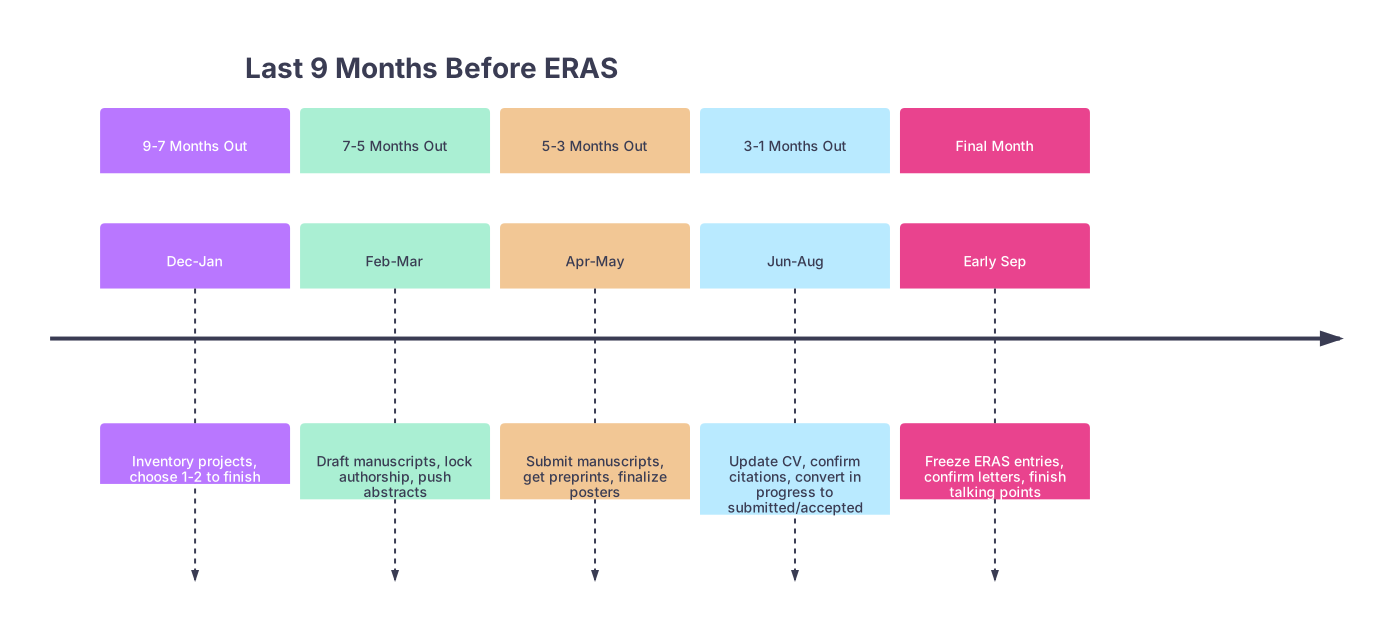
| Period | Event |
|---|---|
| 9-7 Months Out - Dec-Jan | Inventory projects, choose 1-2 to finish |
| 7-5 Months Out - Feb-Mar | Draft manuscripts, lock authorship, push abstracts |
| 5-3 Months Out - Apr-May | Submit manuscripts, get preprints, finalize posters |
| 3-1 Months Out - Jun-Aug | Update CV, confirm citations, convert in progress to submitted/accepted |
| Final Month - Early Sep | Freeze ERAS entries, confirm letters, finish talking points |
9–7 Months Before ERAS: Ruthless Inventory And Triage
At this point you should stop pretending every project will be done in time. You need a brutal, realistic inventory.
Week 1–2: Make a Master Research Inventory
Sit down with your CV, email, and memory. List every research item:
- Published papers
- Manuscripts in progress
- Abstracts / posters / oral presentations
- Case reports
- QI projects
- Database/retrospective work
- Basic science that is nowhere near done
Then sort them into a simple table:
| Category | What It Means | Action |
|---|---|---|
| ERAS-Ready | Already published/accepted | Just verify details |
| High-Yield | Can realistically be submitted before ERAS | Prioritize and schedule |
| Salvageable | Could become poster/abstract/case report | Convert and minimize scope |
| Deadweight | Not finishing before ERAS | Drop or freeze |
At this point you should:
- Identify 1–2 anchor projects you want visible on ERAS (substantial manuscript, major abstract, or large QI).
- Decide which smaller things you will actually convert to abstracts or case reports.
- Explicitly mark what you are dropping. No more vague “maybe I’ll finish later.”
Week 3–4: Talk To Every PI
You cannot do this silently. Your mentors control authorship order, timing, and letters.
By the end of month 9 you should:
- Email each PI with:
- A brief status summary (“data collected, preliminary analysis done”).
- A concrete proposal: “I would like to aim to submit this manuscript by May 15 to Journal X so it can be listed as ‘submitted’ on ERAS.”
- Clarify authorship position:
- If you are not first or second author, ask honestly how visible your contribution will be.
- Decide if the project is still worth heavy time investment for this cycle.
If a PI is noncommittal or vague (“let’s see how it goes”), move that project to “Salvageable” or “Deadweight” and stop banking on it.
At this point you should also:
- Ask at least one research mentor if they might write you a letter focused on your research, if things go as planned.
- Start a simple deadline spreadsheet (Google Sheet or Notion, I do not care—just something visible every day).
7–5 Months Before ERAS: Manuscript Drafts, Abstracts, And Data Lock
This is your main “build” phase. The work you do here is what becomes visible on ERAS.
Month 7: Lock Scope And Timeline
At this point you should:
- Finalize which projects must reach which stage by ERAS:
- Manuscript submitted?
- Abstract accepted?
- Case report written and submitted?
- Set drop-dead internal deadlines:
- Data “locked” by end of this month (no more endless adding of patients).
- First full manuscript draft by specific dates.
Week-by-week in Month 7:
Week 1–2
- For each anchor project:
- Freeze the study question. No more scope creep.
- Confirm with PI: “We will not expand the cohort again. We will analyze the current dataset and aim to submit by [date].”
- Schedule 1–2 standing weekly work blocks (3–4 hours) for writing only.
Week 3–4
- Start the results and methods sections first (they are more objective).
- Build tables and figures early. Programs respect concrete results more than hand-wavy “we’re analyzing.”
- If you are missing stats help, identify a biostatistician this month, not later.
Month 6: Push Abstracts And Case Reports Out The Door
Many conferences that help your ERAS (national specialty meetings) will have deadlines 4–8 months before the meeting. If that meeting is in fall, deadlines can land around now.
At this point you should:
- Identify one or two conferences where you can realistically present:
- Specialty major meeting (e.g., AHA for cards, ATS for pulm/crit).
- Regional meetings if timing works.
- Convert any half-done project into something “presentable”:
- Even a single-center retrospective with descriptive stats can be a decent poster.
- Interesting patient → rapid case report or case poster.
Week-by-week in Month 6:
Week 1
- Collect all existing figures, tables, and partial analyses.
- Draft at least one conference abstract per anchor project, even if the deadline is not publicly posted yet. You can tweak later.
Week 2–3
- Circulate abstracts to co-authors and PI:
- Give them a 48–72 hour review window.
- Explicitly say: “If I do not hear back, I will submit as is to meet the deadline.”
Week 4
- Submit at least one abstract/manuscript this month. You need momentum and a psychological shift from “working on it” to “submitted.”
5–3 Months Before ERAS: Submission, Preprints, And Documentation
Now you move from drafting to getting things technically countable on ERAS.
Month 5: Manuscript Submission Or Bust
By this month, extended polishing is your enemy. ERAS cannot see your “almost ready” Word documents.
At this point you should:
- Finalize full drafts for your anchor project(s).
- Select target journals realistically:
- For a decent clinical paper: a mid-tier specialty journal is fine.
- A guaranteed desk reject from a top-3 journal helps no one before ERAS.
Week-by-week in Month 5:
Week 1
- Finish all sections, including introduction and discussion. Ugly is allowed. Incomplete is not.
- Standardize references with a manager (Zotero, EndNote, whatever).
Week 2
- Send manuscript to PI with a clear timeline:
- “If I can submit this by [date], it will appear on my ERAS as ‘submitted.’”
- Nudge politely after 5–7 days if no response.
Week 3–4
- Submit the manuscript. Stop tinkering.
- If appropriate for your field and journal policy, consider simultaneous posting to a preprint server (medRxiv, bioRxiv) so you have a citable DOI by ERAS.
Month 4: Confirm Acceptances, Prepare For “In Progress” Status
You will start to see some results:
- Conference abstract decisions
- Reviewer comments
- Maybe an acceptance, maybe a rejection
At this point you should:
- Track exact status for every project in your spreadsheet:
- “Submitted – under review”
- “Accepted – in press”
- “Revise and resubmit”
- “Poster accepted at [Conference]”
- Decide how you will label each on ERAS:
- ERAS allows Published, Accepted, Provisionally Accepted, Submitted, or “Other than Published.”
Week-by-week in Month 4:
Week 1–2
- If conference abstracts are accepted, immediately:
- Save official notices.
- Ask about presentation type (oral vs poster).
- Plan travel/funding roughly; you do not need details yet, just know you can go.
Week 3
- Address revise-and-resubmit quickly:
- Make a checklist of reviewer comments.
- Knock out all feasible edits in 1–2 focused sessions.
- If a manuscript is rejected:
- Same week, pick the next journal and resubmit.
- Do not let it sit on your desktop for 3 months.
Week 4
- For any project still stuck in “endless analysis,” schedule a hard conversation:
- “Given ERAS timing, can we at least turn this into an abstract or brief report?”
- If answer is no and progress is slow, demote its importance for this cycle.
3–1 Months Before ERAS: Convert Chaos Into Clean ERAS Entries
This is where most students mess up. They actually have decent research, but their ERAS looks scattered, incomplete, or misleading.
Month 3 (June): ERAS Opens – Start Translating Work To Entries
When ERAS opens, you do not submit yet, but you can start building the Activities and Publications sections.
At this point you should:
- List every research-related item that qualifies as:
- Peer-reviewed article
- Abstract
- Poster / presentation
- Book chapter
- QI project with formal presentation or deliverable
Week 1–2
- Draft ERAS entries outside the application first:
- Use a doc or spreadsheet so you can edit freely.
- For each research activity:
- 1–2 line description of:
- Your role (designed project, collected data, ran analysis, wrote manuscript).
- Outcome (poster at X, manuscript submitted to Y, etc.).
- 1–2 line description of:
- Get your ERAS-friendly citations correct:
- Author list, title, journal, year, volume, pages, DOI or “Epub ahead of print”
Week 3–4
- Clean up overlapping entries:
- Do not list the same project five times under different labels unless there is a clear, distinct product (e.g., abstract + manuscript + QI implementation).
- Decide which 1–2 research experiences might be Most Meaningful (for specialties where this matters, like IM or research-heavy fields).
Month 2 (July): Lock Status Labels And Sync With Letters
By now, most of what could be submitted should be submitted. You are clarifying status, not starting big new things.
At this point you should:
- Freeze which projects you will call:
- Published vs Accepted vs Submitted.
- Stop initiating brand-new ambitious projects that you believe will “definitely” be done by ERAS. They will not.
Week 1
- Confirm with PIs:
- Any pending acceptance decisions?
- Any new conference acceptances?
- Update spreadsheet and ERAS draft to reflect:
| Real Status at This Time | ERAS Label |
|---|---|
| PubMed indexed | Published |
| Accepted, no PubMed yet | Accepted / In Press |
| Submitted, under review | Submitted |
| Abstract accepted, not presented yet | Accepted (Meeting) |
| Draft in progress only | Do not list as publication |
Week 2–3
- Coordinate with letter writers:
- Make sure they know:
- Which projects you led.
- Which manuscripts/abstracts actually went out.
- Send them your updated CV and a short “research highlights” paragraph.
- Make sure they know:
Week 4
- For any remaining project that is not and will not be submitted:
- Decide if it deserves a generic “Research Assistant” type ERAS entry (based on your work) without listing a fake or premature product.
- Do not invent statuses. Programs can smell that.
Final Month Before ERAS Submission: Precision And Proof
Now you are not really doing research. You are doing presentation and verification.
4–3 Weeks Before Submission: Freeze Content, Tighten Descriptions
At this point you should:
- Assume no new acceptances will arrive in time to matter.
- Treat your current project statuses as final for ERAS purposes.
Week 1
- Go line-by-line through your ERAS research entries:
- Check for:
- Consistent author order
- Correct spellings
- Matching titles across CV, ERAS, and any personal website.
- Check for:
- Shorten bloated descriptions:
- 1–3 concise sentences is usually enough.
- Emphasize impact: “Led data collection for 120-patient cohort; first author on manuscript submitted to X.”
Week 2
- Ask one trusted person (mentor, resident, or chief) to:
- Review your research section only.
- Specifically look for:
- Overstated roles
- Confusing duplication
- Anything that feels like padding.
If they are confused, programs will be too.
2–1 Weeks Before Submission: Align Your Story With Your Application
Research is not just lines on ERAS; it has to fit your narrative.
At this point you should:
- Decide which 1–2 projects you will talk about in:
- Personal statement (briefly, if appropriate).
- Supplemental application responses.
- Interviews.
Week 1
- For each key project, write a 3–4 sentence spoken summary:
- The question.
- Your role.
- The main finding or what you learned.
- Where it was/will be presented or submitted.
This becomes your default script for interview days.
Week 2
- Make sure your specialty choice and your research line up at least loosely:
- If you are applying to neurology but all your research is orthopedics, you need a clean way to explain that.
Final Days Before You Hit “Submit”
In the last 3–5 days, you want zero drama.
At this point you should:
5–3 Days Before Submission
- Final check for any late-breaking acceptances:
- If a paper literally gets accepted now, you may update its status to “accepted.”
- Do not constantly reopen and edit unless there is a genuine change.
- Ensure your CV and ERAS match about:
- Number of publications.
- Titles, journals, dates.
2 Days Before Submission
- Print or PDF your entire ERAS and scan the research section:
- Look for inconsistencies like:
- The same project listed as “submitted” in one place and “in preparation” in another.
- Check for any missing co-authors you know will see your application.
- Look for inconsistencies like:
Submission Day
- Stop editing.
- Submit your ERAS application with a research section that:
- Reflects reality.
- Emphasizes what is done and visible.
- Does not promise the moon for “in progress” work.
Quick Visual: Where Your Effort Should Go Over Time
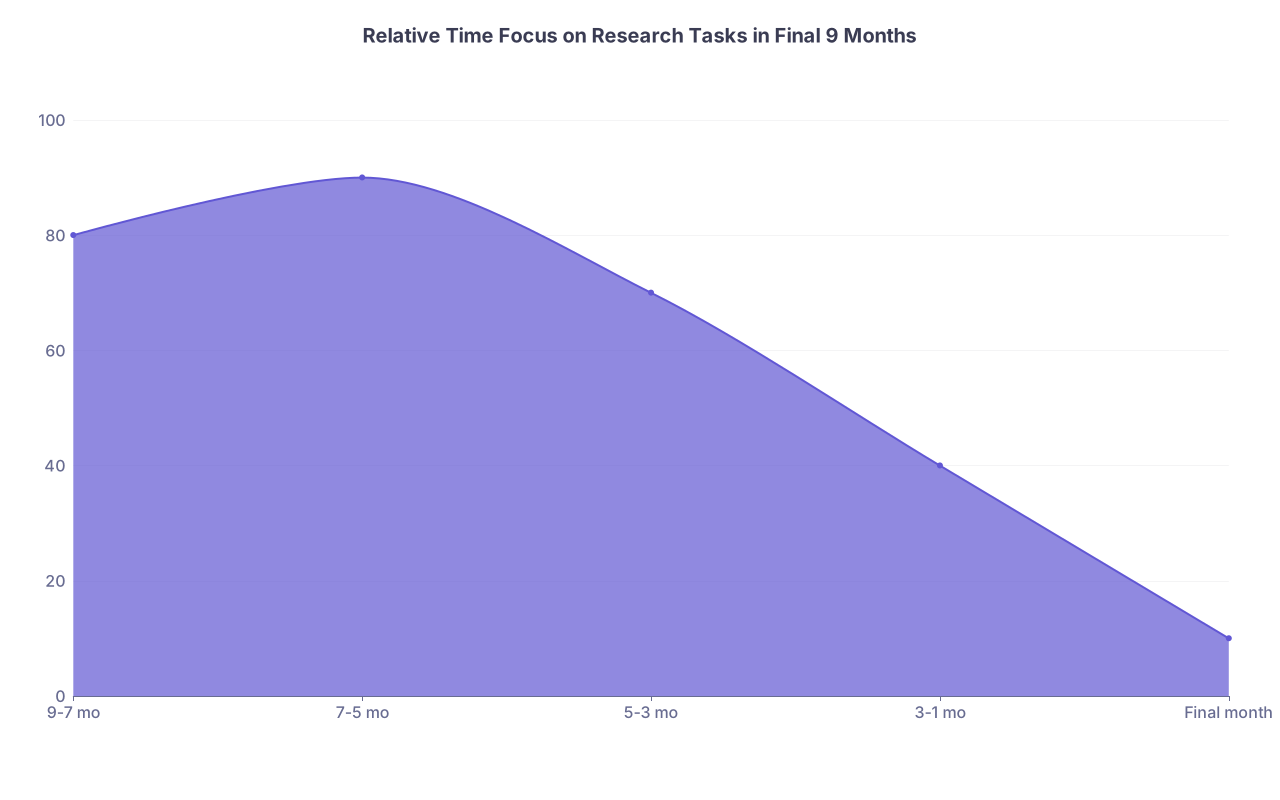
| Category | Value |
|---|---|
| 9-7 mo | 80 |
| 7-5 mo | 90 |
| 5-3 mo | 70 |
| 3-1 mo | 40 |
| Final month | 10 |
Peak heavy lifting is 7–5 months out. After that, effort should shift from creating new work to locking in, documenting, and presenting what you already did.
One More Thing: What To Do If You Feel “Behind”
You might be reading this at 5 months or even 3 months before ERAS and thinking: I am already late.
Here is the blunt version of what you can still do:
- 5–4 months out:
- Rapidly convert ongoing clinical work into case reports or small retrospective studies.
- Aim for conference abstracts and smaller journals where review timelines are faster.
- 3–2 months out:
- Focus on quality ERAS descriptions of the research and scholarly work you actually have (QI, teaching, projects).
- Submit at least something (even a small case report) so you can truthfully write “submitted.”
- Within 2 months:
- Stop starting new research.
- Double down on clarity, honesty, and coherent narrative with what exists.
Key Takeaways
- At 9 months out, your main job is triage: pick 1–2 anchor projects and kill the rest for this cycle.
- From 7–3 months out, your priority is turning work into submitted manuscripts and accepted abstracts, not polishing in secret.
- In the final 3 months, shift entirely to clean documentation, consistent ERAS entries, and a clear research story that you can defend on interview day.