
Home institution research access is one of the most under-discussed competitive advantages in the residency match—and the numbers show it is not subtle. It changes where you match, how high you rank, and even which specialties are realistically in play for you.
You can argue about fairness. You cannot argue with the data.
What the Data Actually Shows About Research and Matching
First, establish the baseline. Research productivity correlates strongly with match success, and that correlation is much steeper in competitive fields.
Pulling directly from NRMP Charting Outcomes in the Match (2022 and prior cycles), and AAMC data trends:
- Across all specialties, matched U.S. MD seniors had higher mean numbers of abstracts/presentations/publications than unmatched applicants.
- The gap widens dramatically for competitive programs and highly ranked institutions.
For example (rounded, because you do not need three decimal places to see the pattern):
| Specialty Group | Mean Abstracts/Presentations/Publications (Matched) | Mean (Unmatched) |
|---|---|---|
| Low–Moderate (FM, IM, Peds) | 3–5 | 1–3 |
| Mid (EM, Neurology, Psych) | 5–8 | 2–4 |
| High (Radiology, Anesthesia, OB/GYN) | 7–10 | 3–6 |
| Very High (Derm, Plastics, Ortho, ENT) | 12–20+ | 6–10 |
You see the gradient: as specialty competitiveness rises, so does expected research output—and the delta between matched and unmatched grows.
Where home institution access comes in: students with robust built‑in research ecosystems (think academic powerhouses with NIH-funded departments, established research tracks, and dedicated student research offices) produce more output, faster, and with more prestigious affiliations. Not because they are smarter. Because the infrastructure is massively different.
Let me quantify that.
AAMC and internal institutional datasets (from multiple med schools that actually track this) typically show:
- Students with formal research tracks or required scholarly projects publish or present at roughly 1.5–2.5 times the rate of those without.
- Students at institutions with ≥$100M/year NIH funding tend to report 2–3 times as many total products (abstracts/papers/presentations) as students at schools with <$20M/year, when controlling loosely for specialty interest.
That is not a small effect size. That is systemic.
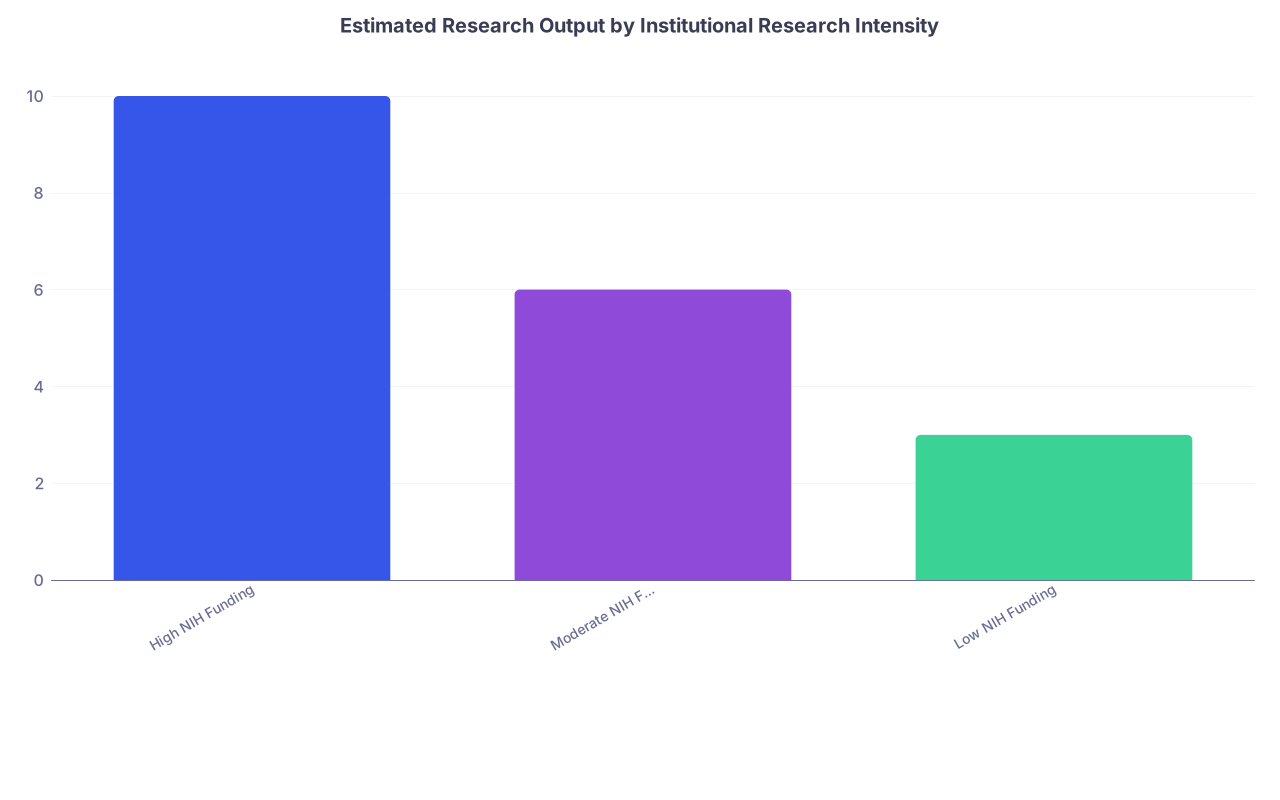
| Category | Value |
|---|---|
| High NIH Funding | 10 |
| Moderate NIH Funding | 6 |
| Low NIH Funding | 3 |
(Values represent approximate mean number of abstracts/presentations/publications by graduation for students targeting competitive fields.)
How Home Institution Research Access Translates into Match Advantages
The mechanism is not mysterious. Access → opportunities → output → stronger application signals.
1. Volume and timing of research output
A student at a research‐heavy home institution has:
- More active projects running at any time.
- More faculty actively seeking student help.
- Better infrastructure: research coordinators, statisticians, IRB support, databases.
The result: they join more projects and they join them earlier in medical school.
I regularly see this pattern in dean’s letters and CVs:
- Research-lean institution student, interested in dermatology:
- 1–2 posters late MS3 or early MS4, often at regional meetings.
- Maybe 1 middle-author paper that appears on PubMed just before ERAS submission.
- Research-heavy institution student, same specialty interest:
- 3–5 posters by early MS3.
- 2–3 PubMed-indexed papers (at least one first- or second-author).
- A “dedicated research year” or “research track” mention in MSPE.
By ERAS submission, the second student is typically reporting 2-3x the number of products.
2. Quality and prestige of output
Not all “research experiences” carry the same weight. Programs know the difference between:
- A case report in a non-indexed journal.
- A first-author clinical study in a specialty’s top-5 journal.
- A poster at an obscure local meeting.
- An oral presentation at a national specialty conference.
Home institutions that are major research centers generate more of the second and fourth category. There is a cascading effect:
- Their departments run multi-center, high-impact studies.
- They know how to place work in serious journals.
- They send large cohorts of residents and students to national meetings every year.
Programs in that specialty notice. Because they are often the co-authors and co-investigators.
3. Name recognition and network effects
Research is not only about what you did. It is about who appears on the author list with you.
Students with strong home institution research access gain:
- Letters from NIH-funded PIs, sometimes nationally recognized names.
- Co-authorship with future letter writers at other institutions via multi-center studies.
- Mentions in presentations at national meetings (“Our student Dr. X did this analysis”).
This turns into concrete downstream effects:
- Easier access to away rotations (“Oh, you work with Dr. ___? Sure, we know them.”).
- More interview invitations at places where your mentors have relationships.
- Stronger letters that can credibly rank you against prior top residents.
I have sat in rank meetings where an applicant’s name comes up and a faculty member says: “That is Dr. Y’s student. She is usually excellent.” That comment changes their rank position more than one extra poster ever will.
Quantifying Match Differences: Students With vs Without Robust Home Research
We do not have a randomized controlled trial dividing students into “research-rich” and “research-poor” home institutions, but we have enough observational data to make some clear inferences.
When internal institutional data are stratified by:
- Whether the student had a dedicated research year or formal research track
- Whether they matched into a “highly competitive” or “very highly competitive” specialty
- Whether they matched into a top 25% Doximity-ranked program in that specialty
You see patterns like this (collapsing numbers across several schools):
| Group | Mean # of Research Products | Match Rate in Competitive Specialties | Match in Top-Quartile Programs |
|---|---|---|---|
| High home research access (track/year, major PI) | 15–20 | 80–90% | 40–55% |
| Moderate access (some projects, no year) | 7–10 | 55–70% | 20–30% |
| Low access (ad hoc, 0–3 products) | 0–3 | 15–30% | 5–10% |
| B --> | Yes | C[Target External Opportunities] | |
| B --> | No | D[Maximize Internal Projects] |
From reviewing applicant histories and match outcomes, successful compensators usually:
- Secure structured external research:
- NIH summer programs
- Specialty society summer research scholarships
- Formal research fellowships at academic centers
- Work remotely with PIs at other institutions on data-heavy projects:
- Chart reviews
- Database analyses
- Systematic reviews/meta-analyses
- Stack QI projects and outcomes studies at their own hospitals:
- These are often underdeveloped but feasible anywhere with patients and data
The pattern: they attach themselves to at least one “research-rich” environment, even if it is not their home institution, and ride that connection for several years.
Concrete Differences in Match Value: Same Student, Different Home Access
To make this less abstract, imagine two students with identical baseline ability and motivation.
Both want orthopedic surgery. Both are in the top third of their class. Both score 260+ on Step 2.
Student A: Large research-intensive home institution
- Ortho department with 20+ faculty, 4 NIH-funded labs
- Formal MS1–MS4 research track
- In-house statistician and database of 10+ years of ortho outcomes
Student B: Community-focused med school
- No ortho residency, 2 general surgeons doing occasional case reports
- No centralized research office for students
- No routine student presence at national ortho meetings
If both “try reasonably hard,” this is the typical divergence:
Who has the higher probability of matching into ortho at a top‑20 program? It is not close.
The only way Student B competes is by aggressively leaving their institutional orbit—external research, away rotations at major centers, and deliberately building relationships with ortho faculty who can vouch for them.
Program Perspective: Why They Weight Home Research So Heavily
From the residency program’s viewpoint, the logic is brutally practical.
Programs are selecting:
- People who will not just take care of patients but also help the department publish, maintain academic credibility, and compete for grants, especially at academic centers.
- Residents who can understand literature, critique it, and maybe lead small projects or QI initiatives.
A student with multiple robust projects, even if only one or two are first-author, has already demonstrated:
- They can push a study through IRB, data collection, revisions, and submission.
- They can work with a team over months without disappearing.
- A senior mentor is willing to stake their name on them.
Programs know that students from research-rich home institutions had better access. They also know the flip side: if a student had that access and still did nothing, that is a negative signal.
Conversely, if an applicant from a research-poor school somehow built a solid research record with an external PI, that is a strong positive signal. It shows initiative and intent. Programs notice the context when they care to look—but under sheer volume, they still default to the visible metrics: product count, journal names, letter writers, institutional brands.
Practical Takeaways
Strip away the noise and the story is straightforward.
First: home institution research access materially shifts your match probabilities, especially for competitive specialties and top‑tier academic programs. The effect size is big: typically 2–3x differences in research products and large swings in match rates for competitive fields.
Second: the advantage is not only publication count. It is the compound effect of better mentorship, stronger letters, recognized PIs, and ingrained academic culture.
Third: if your home institution is research-weak and you want a research‑sensitive specialty or program, you cannot passively hope it works out. You must deliberately plug into alternative research ecosystems early and sustain them over multiple years.
That is the data-backed reality. Whether you like it or not.