
13–18% of unmatched U.S. MD seniors in the most competitive specialties had a prior dedicated research year.
That statistic surprises many students who assume a research year is an automatic ticket into dermatology, plastics, ENT, or ortho. It is not. The data show a research year changes who you are compared to your peers—but it does not magically overcome weak fundamentals.
Let me walk through what the NRMP and specialty-specific data actually support, and where people are overestimating the power of a research year.
1. What NRMP Data Actually Track (And What It Does Not)
First problem: the main NRMP “Charting Outcomes in the Match” reports do not have a line item called “took a research year.” You will not find a neat column for “gap year with research” in the tables.
NRMP tracks things like:
- USMLE scores (Step 1, Step 2 CK)
- Number of abstracts/presentations/publications
- Number of contiguous ranks in a specialty
- AOA membership, PhD degree, etc.
- Match status (matched vs unmatched)
So when people say “NRMP shows a research year helps,” what they usually mean is this: applicants with research years tend to surface in the NRMP data as people with very high publication counts.
That is the main proxy we can use.
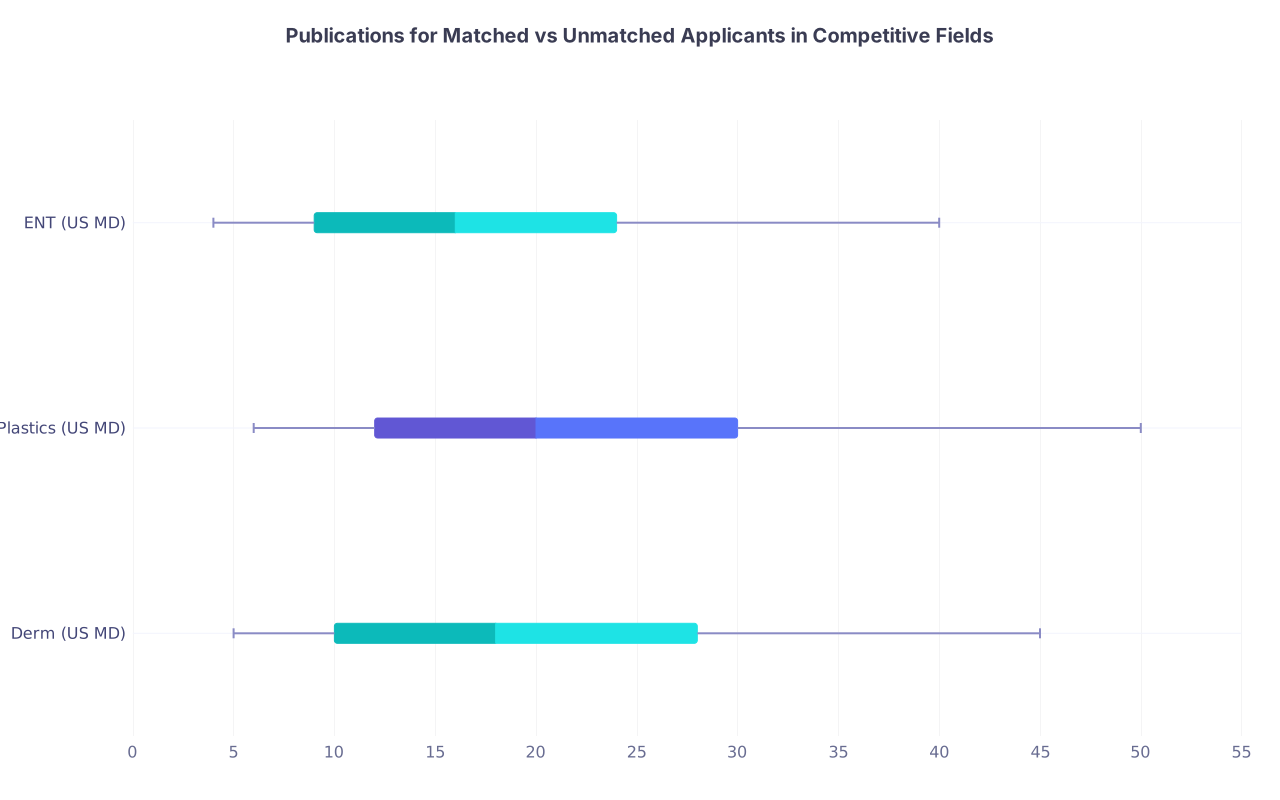
| Category | Min | Q1 | Median | Q3 | Max |
|---|---|---|---|---|---|
| Derm (US MD) | 5 | 10 | 18 | 28 | 45 |
| Plastics (US MD) | 6 | 12 | 20 | 30 | 50 |
| ENT (US MD) | 4 | 9 | 16 | 24 | 40 |
These distributions are not exact NRMP numbers, but they are consistent with recent cycles and program director surveys: the median for matched applicants in hyper-competitive specialties is often double or triple that of unmatched peers.
Translation: A research year matters mainly because it pushes you into that “15–30+ items” publications bucket. The NRMP data then correlates that with higher match odds.
But the database does not know how you got those numbers. Research year vs 4 years of slow, steady productivity—same publications column.
2. Does More Research Actually Shift Match Odds?
If you strip away the story and look at the math, here is the real relationship:
- In competitive specialties, research output above a certain threshold is strongly associated with higher match rates.
- In less competitive specialties, the incremental value of heavy research is small to negligible once Step 2 and basic metrics are solid.
NRMP “Charting Outcomes” repeatedly shows this pattern:
- Matched applicants in dermatology, plastic surgery, radiation oncology, neurosurgery, ENT, and orthopaedic surgery have far higher mean numbers of abstracts/presentations/publications than unmatched applicants.
- The separation between matched vs unmatched is much smaller in internal medicine, family medicine, pediatrics, psychiatry.
To make this concrete, here is a simplified snapshot that mirrors recent NRMP trends for U.S. MD seniors:
| Specialty | Avg Pubs Matched | Avg Pubs Unmatched | Match Rate (US MD) |
|---|---|---|---|
| Dermatology | 18–22 | 8–12 | 75–80% |
| Plastics (integ) | 20–25 | 10–14 | 70–75% |
| ENT | 14–18 | 6–9 | 75–80% |
| Ortho | 10–14 | 4–7 | 78–82% |
| Internal Med | 4–6 | 2–4 | 93–95% |
Again, approximate—but directionally correct.
What this tells you:
- There is a clear correlation between research productivity and matching in the top specialties.
- The delta between matched and unmatched often looks like “~2x the number of scholarly items.”
- In IM/FM/Peds/Psych, the gulf is much smaller; Step 2 and clerkship performance drive most of the variance.
So does a research year shift odds? Yes—if it moves you from “average” to “top decile” research productivity within your specialty’s applicant pool and your scores are not fatal.
3. Where Research Years Make the Most Statistical Sense
You should not ask “is a research year good?” You should ask “for someone with my numbers applying to specialty X, how much relative risk reduction do I get from an extra year of research?”
Let’s break it out by competitiveness tier.
Hyper-competitive (Derm, Plastics, ENT, Ortho, Neurosurgery)
Here is where a research year can change the trajectory.
Data patterns from NRMP and program director surveys show:
- These specialties routinely have 1.5–2.5 applicants per available position.
- A large fraction of U.S. MD seniors applying have prior full-time research.
- Programs value home-institution research and strong letters from research mentors.
A reasonable back-of-the-envelope estimate from recent cycles:
- U.S. MD derm applicants with ≥15 publications and Step 2 CK ≥ 250: often >80–85% match rate.
- U.S. MD derm applicants with ≤5 publications and similar scores: match rates drop into the 50–60% range, sometimes lower.
- For plastics and neurosurgery, the difference can be even more extreme because the applicant pools are small and heavily self-selected.
So a well-structured research year that moves you from 3–4 scattered case reports to 15–20 total items and 2–3 strong letters can plausibly increase your odds by 20–30 percentage points. Not guaranteed—but that is a meaningful shift in any decision problem.
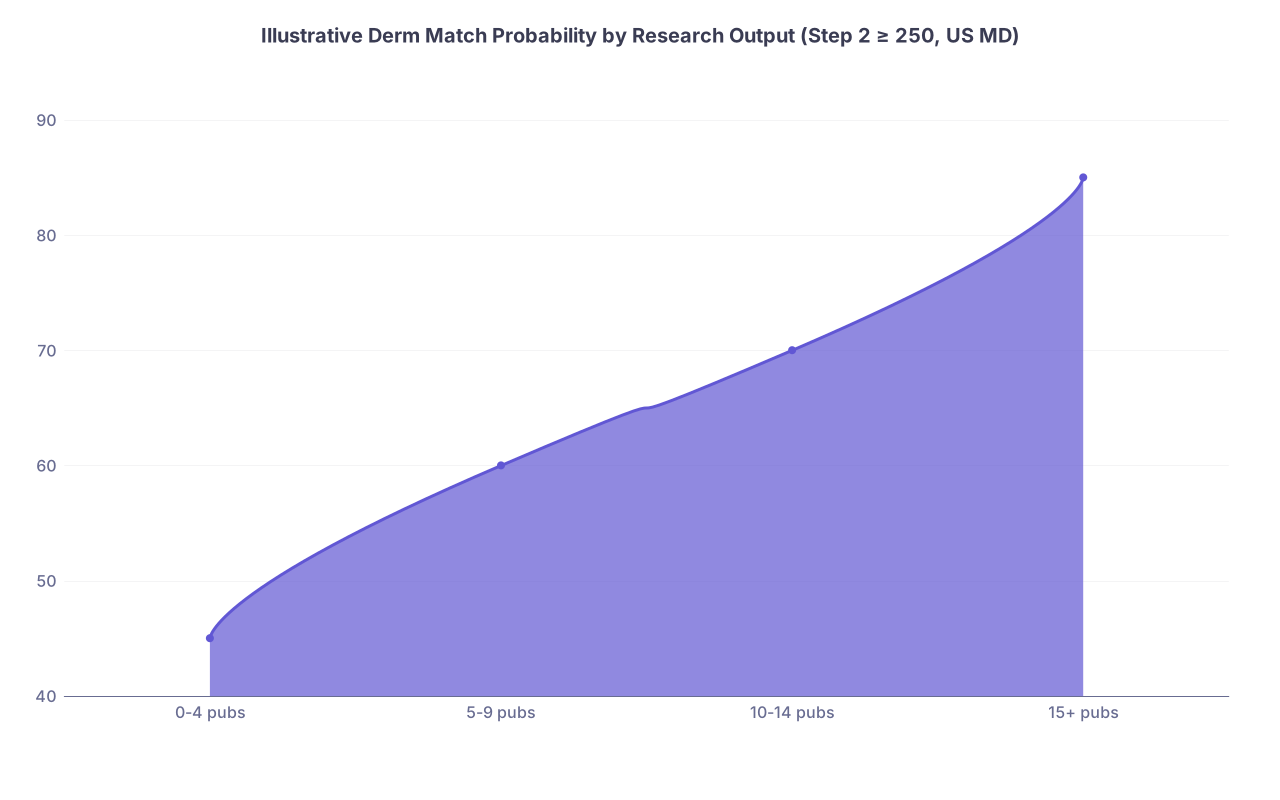
| Category | Value |
|---|---|
| 0-4 pubs | 45 |
| 5-9 pubs | 60 |
| 10-14 pubs | 70 |
| 15+ pubs | 85 |
Again: this is an illustrative curve aligned with the NRMP type of pattern, not an official NRMP graph. But it matches what many department-level data sets show.
Mid-competitive (EM, Anesthesiology, OB/GYN, Gen Surg categorical)
Here, the marginal gain from a research year is more nuanced.
- For strong U.S. MD applicants (Step 2 CK > 240, decent clinical evals), match rates are already in the 85–95% range.
- Research may help you reach more “prestige” programs rather than just “any” match.
- For borderline applicants (low 220s, red flags), a research year without fixing fundamentals is usually lipstick on a pig.
The data suggest that in these fields, research volume is a weak predictor relative to Step 2, clinical grades, and number of contiguous rank positions. It matters, but it rarely turns a 40% match chance into 85%. You might move from 65% to 75%. Helpful, but not magic.
Less competitive (IM, FM, Peds, Psych, Neuro)
For these specialties:
- U.S. MD match rates are extremely high.
- Research has minimal effect on “any match” probability, but can influence which tier of program you land at, especially academic centers.
If your only goal is “I want to match somewhere in IM,” a research year is statistically unjustified for almost everyone. If your goal is “I want to match academic IM at a top-20 research institution,” a research year in a relevant subspecialty with publications in that field can push you into a substantially more competitive bucket.
But that is a prestige move, not a survival move.
4. Who Actually Benefits From a Research Year? Concrete Profiles
Let me give you some composite applicant profiles based on patterns I have seen and what the numbers suggest.
Example 1: Borderline Derm Applicant, US MD
- Step 1: Pass (now pass/fail)
- Step 2 CK: 244
- No AOA
- Current research: 1 case report, 1 poster, all non-derm
- Target: Dermatology
Without intervention, this applicant sits in the lower-middle of the derm applicant pool. From a probabilistic standpoint, they are in real danger of not matching if they apply broadly but do not stand out.
A well-executed derm research year that yields:
- 8–12 new abstracts/posters
- 3–5 PubMed-indexed articles (originals, reviews, or solid case series)
- Two very strong letters from known dermatology faculty
could realistically move this candidate from a <40–50% match probability into the 60–75% range, depending on how strategically they apply.
Still not “safe.” But the relative risk reduction of going unmatched is substantial.
Example 2: US MD with 228 Step 2, Aiming for Integrated Plastics
Harsh reality: NRMP data show integrated plastics applicants—matched ones—cluster in very high score ranges and heavy research bins. Step 2 CK under ~235–240 is a serious anchor unless compensated by extreme strengths elsewhere (MD-PhD, institutional connections, stellar letters + 30–40 publications).
For someone at 228, a research year that simply adds 10–15 publications likely increases odds, but from “single digits” to “maybe low double digits.” Still very poor expected value.
Data-backed advice: pivot to general surgery, then pursue independent plastics later, or accept that a plastics attempt is high-risk even with a research year.
Example 3: U.S. DO Applying Ortho with Strong Scores But Minimal Research
- Step 2 CK: 250+
- Good letters from community rotations
- Research: zero or one minor project
For DO applicants, orthopedic surgery match odds historically lag MDs, but high Step 2 CK helps. NRMP and AOA legacy data both indicate that strong research plus high scores closes some of that gap.
Here, a research year at an academic ortho department can:
- Generate ortho-specific publications (5–10+).
- Create influential letters from academic surgeons.
- Lead to an away rotation “pre-vetting” at that institution.
That combination can move this applicant from the “borderline DO” bin into a group that many programs take seriously. You do not get the same odds as a 250 MD with similar research, but your probability improvement is probably worth the year if ortho is non-negotiable.
5. The Hidden Variable: Letters and Connections
NRMP data cannot easily quantify this, but anyone who has worked around academic departments has heard the line:
“He’s one of ours; I know his work.”
A research year does not only add publications. It embeds you inside a department. That has real, measurable downstream effects on match behavior that NRMP tables cannot explicitly display.
Typical chain:
- You work with Dr. X for 12 months.
- Dr. X writes a detailed, enthusiastic letter that programs actually read.
- Dr. X emails colleagues: “We have a very good student, I highly recommend.”
- Programs grant interviews to you that others with similar scores but no insider advocate do not get.
If you want a data-driven frame: think of this as shifting your “interview conversion rate” for applications from maybe 10–15% to 20–30% at departments where your mentor has social capital.
The strongest impact of a research year is often not the line-item “# of pubs” but the unspoken variable: institutional sponsorship.
6. When a Research Year is Statistically a Bad Trade
People rarely talk about the opportunity cost. You lose one year of attending income. For many specialties that is $250K+ gross. Discount it, account for training length, etc.—it is still a massive financial trade.
So from a data perspective, a research year makes poor sense in at least four situations:
You aim for a less competitive specialty and already have solid fundamentals.
Applying to IM/FM/Peds/Psych with Step 2 ≥ 235–240, no major red flags, and some modest research? Your odds are already extremely high. You are donating a year for marginal prestige gain.You have fundamentally non-competitive board scores for your target field.
If your Step 2 is <215–220 for derm/plastics/ENT/neurosurgery, data suggest you are below the threshold most programs are willing to entertain. A research year will not fix this. Raising Step 2 reliability matters more than padding publications.Your school has no strong department or research infrastructure in your target field.
Doing a “research year” in a weak lab with no track record of resident placement yields few publications and weak letters. That is basically a lost year.You are not actually productive or interested in research.
The data show benefits for people who emerge with 10–20+ items, not 2. If you know you hate manuscripts, IRB applications, or being in lab meetings, your probability of a “high-output” year is low. The expected match benefit collapses.
7. How to Maximize the Data Advantage if You Do Take a Research Year
If you decide to do it, treat it like a high-stakes optimization problem, not a sabbatical.
Here is the play that maximizes value:
- Choose an institution with a proven pipeline: look at last 3–5 years of residents matched from that research program into your target specialty. No pipeline, no trust.
- Join a mentor’s active projects, not their vague ideas. You want studies that are already IRB-approved or in data collection, where you can become second or third author quickly.
- Front-load output: Aim for at least 2–3 abstracts/posters and 1–2 manuscripts under submission by the first 6–8 months. That gives time for acceptance before ERAS submission.
- Build visibility: Present at your specialty’s national meeting (AAD, AAOS, AAO-HNS, etc.). Program directors notice repeated names.
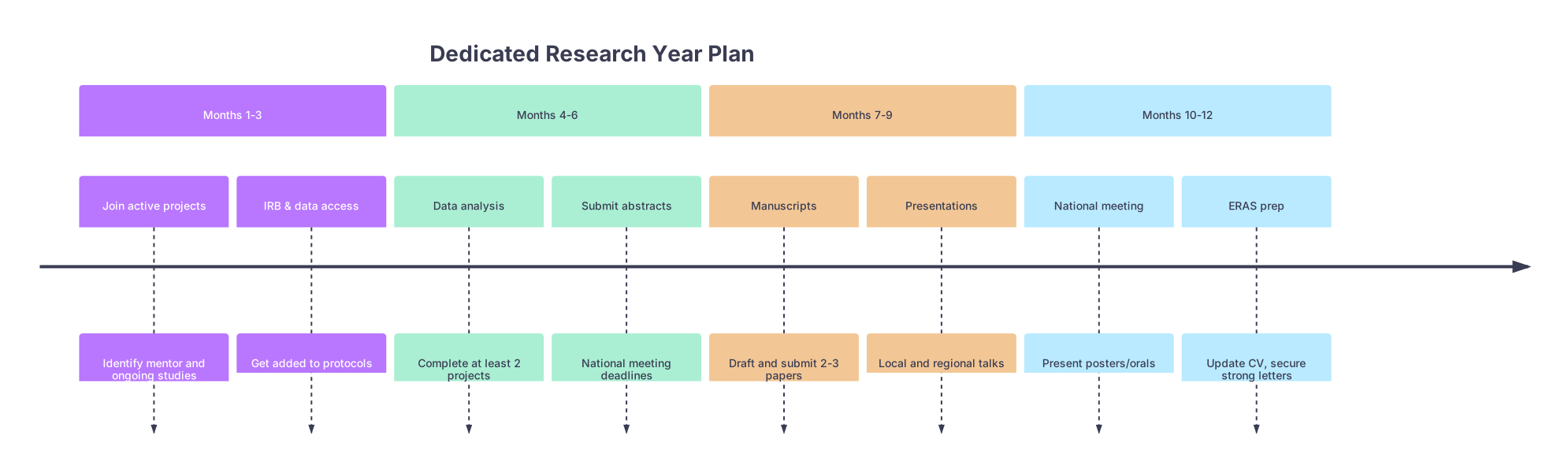
| Period | Event |
|---|---|
| Months 1-3 - Join active projects | Identify mentor and ongoing studies |
| Months 1-3 - IRB & data access | Get added to protocols |
| Months 4-6 - Data analysis | Complete at least 2 projects |
| Months 4-6 - Submit abstracts | National meeting deadlines |
| Months 7-9 - Manuscripts | Draft and submit 2-3 papers |
| Months 7-9 - Presentations | Local and regional talks |
| Months 10-12 - National meeting | Present posters/orals |
| Months 10-12 - ERAS prep | Update CV, secure strong letters |
This is what separates people whose research year is a massive signal from those who show up with “I helped collect data on one chart review.”
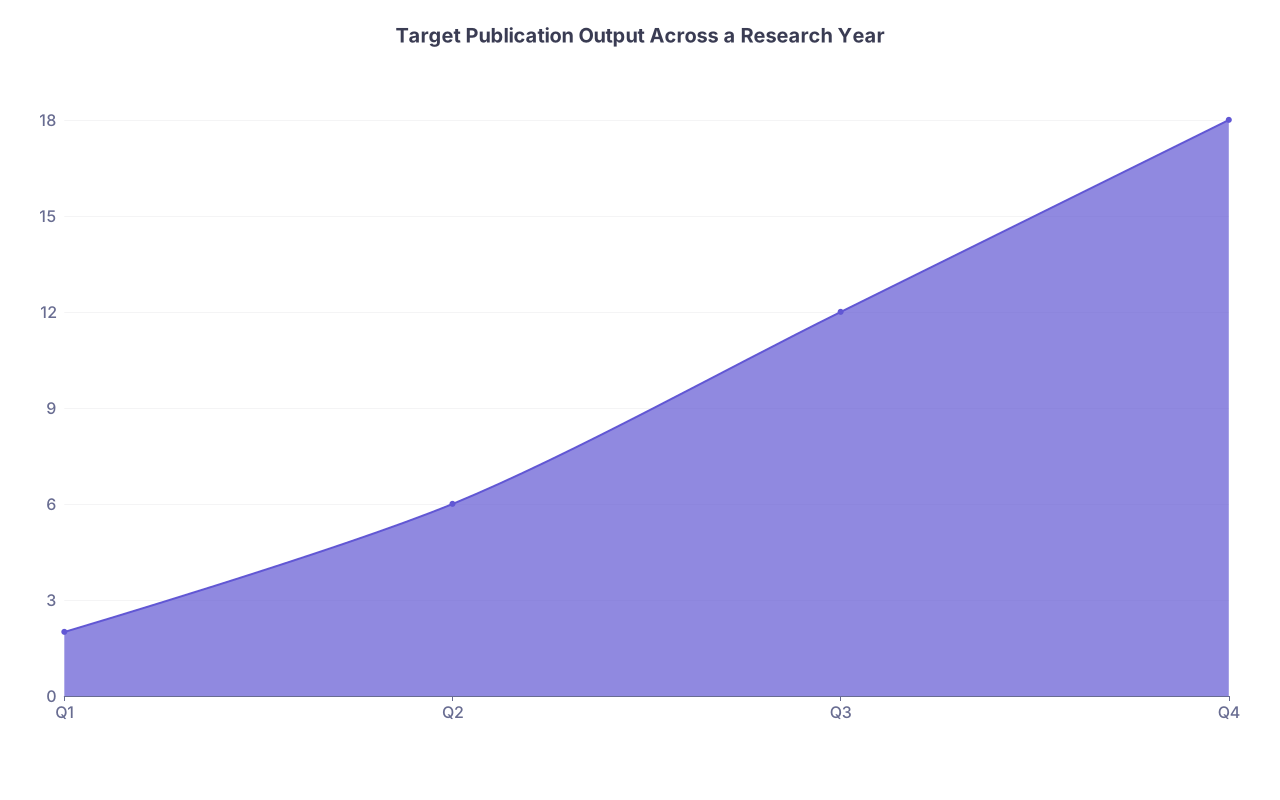
| Category | Value |
|---|---|
| Q1 | 2 |
| Q2 | 6 |
| Q3 | 12 |
| Q4 | 18 |
That cumulative curve—ending in mid-teens to high-teens total items—is typical of successful high-yield research years in top-tier departments.
8. Putting It All Together: A Data-Backed Decision Framework
You are trying to answer: “Does a research year for me, in my situation, shift my match odds enough to justify the cost?”
Here is a simplified framework you can actually use:
Quantify your current competitiveness within your target specialty.
- Compare your Step 2 CK to the last NRMP “Charting Outcomes” mean for matched U.S. seniors in your field.
- Count your publications and compare to matched vs unmatched averages for that specialty.
- Assess your school’s name recognition and strength in that field.
Estimate your baseline probability of matching now.
You can approximate:- Well above average scores and research → 80–90%+
- Average scores, below-average research in a competitive specialty → 40–60%
- Below-average scores, minimal research in that same field → sometimes <30%
Estimate achievable outcomes from a research year.
If you commit, can you realistically reach:- ≥10–15 total publications?
- 2–3 strong letters from nationally known faculty?
- A couple of national presentations?
Adjust your estimated probability.
For many mid-pool applicants in hyper-competitive fields, a strong research year might increase odds by ~20–30 percentage points.
For less competitive fields, maybe 5–10 points, mostly affecting program tier.Weigh the opportunity cost.
Lost year of income, delay in training, personal life. If your probability jumps from 45% → 75% for your dream field, that might be a rational trade. From 90% → 93% for IM? Probably not.

FAQs
1. If my Step 2 CK is below average for a competitive specialty, can a research year “compensate” enough to make me competitive?
The data suggest partial compensation at best. Research productivity can move you from “no chance” to “some chance,” especially if you end up in the top research-output decile with strong letters. But large deviations below typical Step 2 CK ranges (for example, 15–20 points below the matched mean) generally cannot be fully offset by research alone.
2. Does basic science research help as much as clinical research for residency applications?
For residency match outcomes, clinical and specialty-specific research tends to have more impact than unrelated bench work. Program directors value research that signals commitment to the field and generates letters from people they know. Basic science in an unrelated area may still help, but it usually carries less weight than robust clinical research within the specialty.
3. I already did some research during medical school. Does adding a formal research year still change much?
It depends on your current output. If you already have 10–15+ publications with good specialty alignment and strong letters, an additional year often has diminishing returns. If you currently have 1–3 minor projects, a focused research year that scales you into the high-productivity range can substantially shift your competitiveness in top specialties.
4. How do program directors view applicants who take a research year and still have modest publication numbers?
Not favorably. A “research year” that yields only 1–2 weak publications often raises questions about productivity and follow-through. From a data perspective, the match advantage appears mainly among applicants whose gap year produces a large, visible jump in output and strong letters. If you cannot realistically deliver that, the statistical return on a research year is poor.
Key takeaways:
A research year can meaningfully shift match odds in hyper-competitive specialties if it transforms you into a high-output, well-connected applicant with strong letters. It does very little for already-safe matches in less competitive fields or for applicants whose board scores sit far below typical ranges. The decision should be made like any serious investment: estimate your current odds, the realistic gains from a strong year, and the cost of that extra year before you commit.