
The mythology around “needing 20+ publications to match” is statistically wrong, and the numbers prove it.
Most applicants never bother to look at the underlying NRMP and AAMC data. They repeat forum anecdotes, panic over screenshots of CVs with 40 “publications/abstracts/posters,” and then massively misallocate their time. If you want a rational strategy, you need real benchmarks: publications per matched applicant, cut by specialty competitiveness.
That is exactly what I will lay out here.
1. What the Data Actually Measures (And Why People Misread It)
Before we talk numbers, you need to understand the metric.
NRMP’s Charting Outcomes in the Match reports do not show “peer‑reviewed PubMed papers only.” They show a combined research metric, usually labeled:
“Mean number of research experiences”
“Mean number of abstracts, presentations, and publications”
Those last three are grouped. One poster = one. One oral presentation = one. One case report = one. A paper “submitted” or “in preparation” sometimes ends up counted by applicants when filling ERAS. It is a very noisy measure.
So when you see a competitive specialty with “23.9 abstracts/presentations/publications,” you are not looking at 24 PubMed-indexed original research papers. Far from it.
In practice, for most successful applicants:
- A large chunk of that count is posters and conference presentations
- A smaller subset are actual peer‑reviewed publications
- A handful are book chapters, case reports, or “submitted” work
When I talk about “publications per matched applicant” here, I will stay close to what programs actually see in ERAS: the combined abstracts/presentations/publications metric, then translate that into a realistic estimate of how many true publications that usually implies.
2. Benchmark Numbers by Competitiveness Tier
The data are clear: more competitive specialties correlate with more research output. But the slope is not infinite and not linear. There are realistic bands.
To organize this, I will use three competitiveness tiers, roughly aligned with NRMP match rates and Step score expectations:
- Tier 1 – Ultra‑competitive: Dermatology, Plastic Surgery (Integrated), Neurosurgery, Radiation Oncology, Orthopedic Surgery, ENT
- Tier 2 – Competitive: Diagnostic Radiology, Anesthesiology, Emergency Medicine, General Surgery, OB/GYN, PM&R, Neurology
- Tier 3 – Less competitive: Internal Medicine (categorical), Family Medicine, Pediatrics, Psychiatry, Pathology
The exact numbers vary by year and report, but trends are stable. Let me quantify.
| Tier | Example Specialties | Mean Abstracts/Presentations/Publications | Typical True Publications |
|---|---|---|---|
| Tier 1 (Ultra) | Derm, Plastics, Neurosurg, Ortho, ENT | 15–25 | ~3–7 |
| Tier 2 (Competitive) | Rad, Anesthesia, EM, Gen Surg, OB/GYN | 6–12 | ~1–3 |
| Tier 3 (Less) | IM, FM, Peds, Psych, Path | 3–8 | ~0–2 |
Those “Typical True Publications” ranges are based on the pattern I have seen reading dozens of ERAS applications and CVs: posters outnumber papers, often 2:1 or 3:1.
So if you have 10 line items in ERAS, a realistic distribution might be:
- 4 conference posters
- 3 oral presentations
- 2 case reports
- 1 original article in a mid‑tier journal
That is 10 by NRMP’s metric. But only 1–3 of those will be what people informally call “real pubs.”
3. Specialty‑Specific Publication Benchmarks
Let us get out of abstractions and into actual ballpark numbers by specialty. These are derived from recent Charting Outcomes, program director surveys, and what matched vs unmatched CVs look like, but rounded to practical targets.
3.1 Ultra‑Competitive Surgical and Procedure‑Heavy Fields
These are the ones that scare people: Dermatology, Integrated Plastic Surgery, Neurosurgery, Orthopedic Surgery, ENT, and often Radiation Oncology.
For US MD seniors who match these specialties, the data usually show:
- Mean abstracts/presentations/publications in the high teens to mid‑20s
- Unmatched applicants often have only slightly lower raw counts, but fewer first‑author items and weaker institutional names
Realistic breakdown for a matched applicant in this tier:
- 15–25 total research items
- Usually 3–7 actual peer‑reviewed publications
- At least 1–3 first‑author pieces (including case reports or small series)
- Several projects clearly tied to the chosen specialty
If you want something more concrete:
| Specialty | Mean Abstracts/Presentations/Pubs | Estimated True Publications | “Strong but Not Unicorn” Target |
|---|---|---|---|
| Dermatology | 18–25 | 4–7 | 3–5 papers, 10–15 total items |
| Plastics (Int) | 18–24 | 4–7 | 3–5 papers, 10–15 total items |
| Neurosurgery | 20–30 | 5–8 | 4–6 papers, 12–18 total items |
| Ortho Surgery | 12–20 | 3–5 | 2–4 papers, 8–12 total items |
| ENT | 12–18 | 3–5 | 2–4 papers, 8–12 total items |
You will always find the outliers: the applicant with 40+ line items and 20+ PubMed entries. Ignore them. They are not the norm; they are either MD/PhD, gap‑year postdocs, or had a 4‑year research job before med school.
The real data show that you are competitive in these fields if you are in the middle of that distribution with:
- Solid Step/COMLEX scores
- 2–3 years of consistent research continuity
- Clear alignment between your work and the specialty
Not everyone in derm has 10 RCTs in JAMA Dermatology. Many have two middle‑author papers, a couple of posters, one case report, and a strong mentor letter.
3.2 Competitive but More Accessible Fields
Now move to specialties like Diagnostic Radiology, Anesthesiology, Emergency Medicine, OB/GYN, PM&R, General Surgery (non‑categorical or mid‑tier programs), and Neurology.
These fields care about research, but they are not research‑gated in the same way derm or plastics are.
For matched US MD applicants:
- Typical abstracts/presentations/publications: 6–12
- That usually translates to 1–3 true PubMed‑style papers
- A not‑trivial share have 0 publications but 1–3 posters or QA projects
Reasonable expectations:
- Diagnostic Radiology: often around 8–12 total research items for matched; 2–3 publications is common among stronger applicants
- Anesthesiology: 6–10 total; 1–2 publications is enough if other metrics are strong
- EM: historically less research heavy, but rising; 4–8 total; 0–2 publications common
- OB/GYN & PM&R: 5–10 total; 1–2 publications
- General Surgery: strongly program dependent; academic programs want more, community programs less
Let me compress this into a more precise table.
| Specialty | Mean Abstracts/Presentations/Pubs | Estimated True Publications | Safe Competitive Band |
|---|---|---|---|
| Diagnostic Rad | 8–12 | 2–3 | 1–3 papers, 6–10 items |
| Anesthesiology | 6–10 | 1–2 | 1–2 papers, 4–8 items |
| Emergency Med | 4–8 | 0–2 | 0–2 papers, 3–6 items |
| OB/GYN | 6–10 | 1–2 | 1–2 papers, 4–8 items |
| PM&R | 5–9 | 0–2 | 0–2 papers, 3–7 items |
| Neurology | 5–9 | 1–2 | 1–2 papers, 3–7 items |
If you are applying in this band and thinking strategically, the marginal benefit of going from 2 to 5 papers is small compared to:
- Raising Step 2 CK by 5–10 points
- Honing a strong personal statement and coherent specialty story
- Building good relationships on key rotations to secure top‑tier letters
The data show diminishing returns in these specialties beyond the low single digits of true publications.
3.3 Less Competitive, Bread‑and‑Butter Fields
Internal Medicine (mainly community and mid‑tier categorical), Family Medicine, Pediatrics, Psychiatry, and Pathology are more forgiving.
Matched US MD applicants typically report:
- 3–8 abstracts/presentations/publications
- Many have 0–1 true publications
- A subset have more, especially those gunning for academic careers or top IM programs
Approximate numbers:
- Internal Medicine (pooled): 5–8 items, 1–2 publications for academic‑leaning applicants
- Family Medicine: 3–6 items, 0–1 publications
- Pediatrics: 4–7 items, 0–1 publications
- Psychiatry: 3–6 items, 0–1 publications
- Pathology: 4–7 items, 0–2 publications
Here, research is often more of a bonus than a gatekeeper. It signals “I can do academic work” and can help with higher‑tier programs, but it is rarely the deciding factor vs clinical grades, narrative comments, and specialty fit.
4. Matched vs Unmatched: Where Research Actually Moves the Needle
You are probably less interested in the mean for matched applicants and more interested in the difference between matched and unmatched.
That delta tells you where research actually differentiates candidates and where it mostly clusters as noise.
Across multiple Charting Outcomes cycles, several patterns are consistent:
Ultra‑competitive fields
- Unmatched applicants often have research numbers that are not dramatically lower than matched ones
- The key difference: first‑author vs middle‑author, quality of venues, and strong mentor letters
- Example: Matched derm US MD: ~18–25 items; unmatched: ~12–20. Overlap is big. Research is necessary but not sufficient.
Moderately competitive fields
- Here, research is more of a tiebreaker than an absolute barrier
- Matched vs unmatched might differ by only 1–3 total items
- Step 2, clerkship grades, and letters dominate
Less competitive fields
- Match rates are high, and research counts between matched and unmatched are very close
- A complete absence of any scholarly work can still hurt if your application screams “I did the bare minimum”
To visualize this, think in distributions rather than point values.
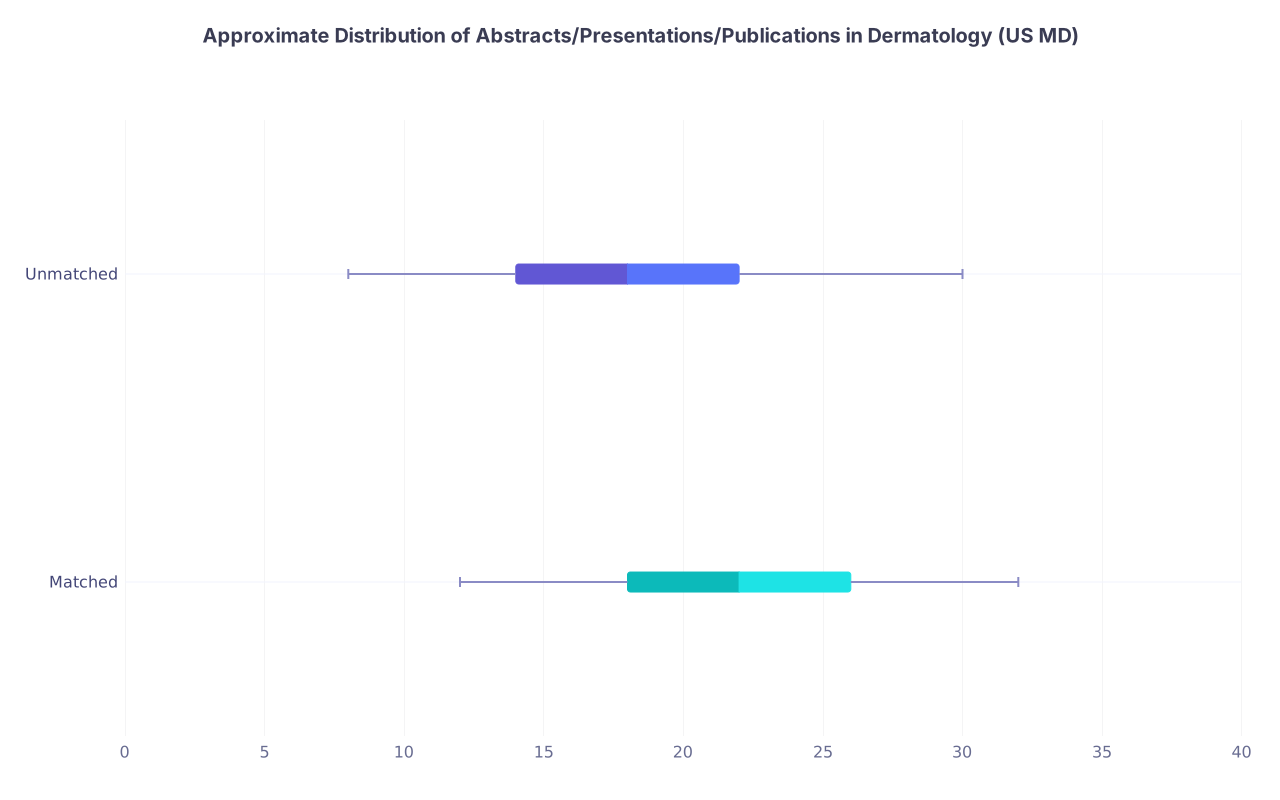
| Category | Min | Q1 | Median | Q3 | Max |
|---|---|---|---|---|---|
| Matched | 12 | 18 | 22 | 26 | 32 |
| Unmatched | 8 | 14 | 18 | 22 | 30 |
The overlap is obvious. You cannot “out‑publish” a big Step 1/2 gap, weak letters, or a poor interview. Research makes you viable in that pool, then other factors sort you.
5. Time, Yield, and the Point of Diminishing Returns
Most applicants underestimate the time cost of each incremental publication.
A rough production timeline for a medically reasonable paper:
- 2–4 months: project design, IRB, data collection
- 1–2 months: analysis, drafting
- 1–3 months: revisions, internal approval
- 3–12+ months: peer review and acceptance lags
You can compress this with pre‑existing datasets, case reports, and strong mentorship, but you do not get 5 solid original papers in a single dedicated research year without luck, infrastructure, or being a statistical outlier.
So your question should not be “How many publications can I get?” but “At what point does each additional unit of effort on research have minimal marginal impact on my match odds versus other levers?”
Here is a pragmatic cut:
Ultra‑competitive (Derm/Plastics/Neurosurg/ENT/Ortho):
- Target: 3–5 true publications + 8–12 total items
- Above 7–8 true papers, returns are modest unless you are pursuing academic‑track programs or MD/PhD‑type careers
Competitive (Rad/Anes/EM/OBGYN/Gen Surg/PM&R/Neuro):
- Target: 1–3 true publications + 4–8 total items
- Past 3–4 papers, improvement is marginal compared with upgrading scores or clinical performance
Less competitive (IM/FM/Peds/Psych/Path for general applicant):
- Target: 0–2 publications + 2–5 total items
- Any well‑done project can differentiate you; chasing 5+ is usually disproportionate unless you want an academic IM or subspecialty path
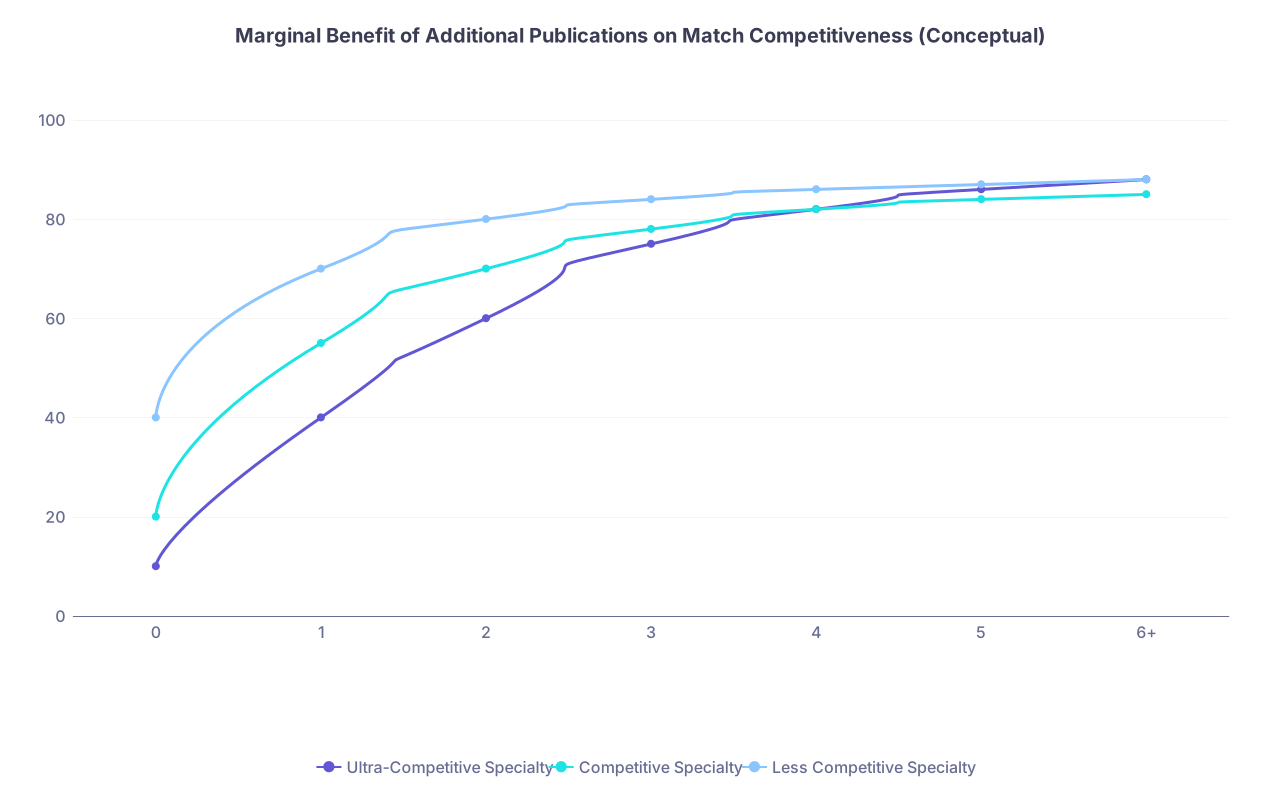
| Category | Ultra-Competitive Specialty | Competitive Specialty | Less Competitive Specialty |
|---|---|---|---|
| 0 | 10 | 20 | 40 |
| 1 | 40 | 55 | 70 |
| 2 | 60 | 70 | 80 |
| 3 | 75 | 78 | 84 |
| 4 | 82 | 82 | 86 |
| 5 | 86 | 84 | 87 |
| 6+ | 88 | 85 | 88 |
The y‑axis here is conceptual “relative competitiveness index,” not literal match probability. The plateau is the point.
6. How Programs Actually Read Your Research Section
Programs do not line up your CV and run a raw publication count. They evaluate:
- Specialty relevance: Does your work show genuine interest and early commitment?
- Role: First‑author vs second‑author vs “20th author in a mega‑consortium”
- Continuity: A coherent research story over 2–4 years vs one random summer project
- Setting: Well‑known mentors and institutions are a signal amplifier
- Rigor: Prospective work and original analyses usually score higher than a stack of low‑effort case reports
I have seen plenty of applications with “20+ abstracts/presentations/publications” that collapse on inspection:
- Multiple items are the same project sliced into four slightly different posters
- Journals are predatory or very low‑tier “pay‑to‑publish” outlets
- No first‑author work at all
- No clear link to the specialty being applied to
Programs are not blind to this gaming. A leaner but clearly impactful research record is often more compelling.
If you want to think like a data‑driven program director, your personal metric is not “N publications” but something closer to:
(Number of first‑author specialty‑relevant outputs) × (perceived quality of venue/mentor)
A single first‑author paper in a respected specialty journal with a strong letter from the PI is often more valuable than five loosely related case reports in obscure outlets.
7. Translating Benchmarks Into a Plan
Knowing benchmarks is pointless if you cannot turn them into decisions.
Here is how you operationalize this.
First, clarify your target tier and where you stand today:
- Step/COMLEX trajectory
- Class rank / clerkship grades
- Existing research count and quality
Then decide which bucket you belong to:
Research‑heavy, ultra‑competitive target with weak or mediocre scores
- You are trying to offset one liability with another domain of strength
- Strategy: Maximize high‑quality, specialty‑aligned research; consider a dedicated research year; aim for 4–6 strong publications
Strong scores, moderate or low research, ultra‑competitive target
- You have an academic baseline; your job is to clear the “not unserious” research bar
- Strategy: Aim for 2–4 solid publications, several posters; do not over‑sacrifice clinical performance
Competitive specialty, decent scores, minimal research
- Strategy: One serious project leading to 1–2 papers and a conference presentation is usually enough to move you into the average‑to‑above‑average bin
Less competitive specialty, no research, time limited
- Strategy: One well‑documented QA or educational project with a poster can materially help and is feasible in 3–6 months
A realistic timeline, if you are in early or mid‑M2 and want to hit these benchmarks:
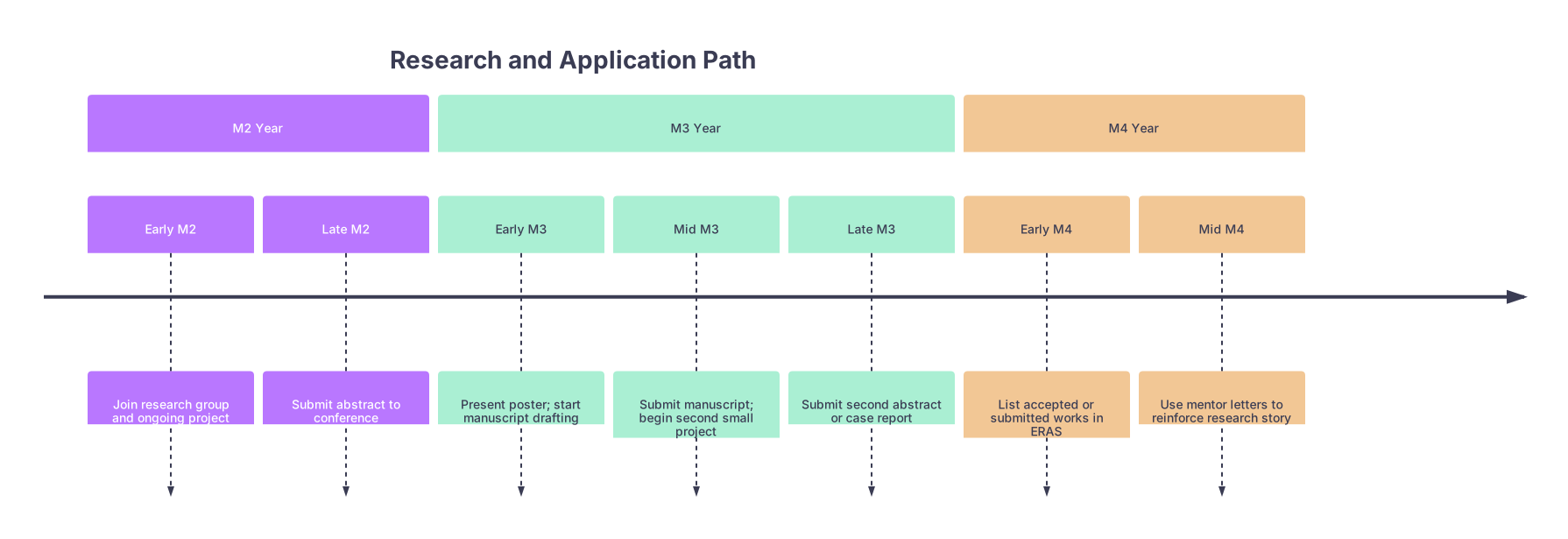
| Period | Event |
|---|---|
| M2 Year - Early M2 | Join research group and ongoing project |
| M2 Year - Late M2 | Submit abstract to conference |
| M3 Year - Early M3 | Present poster; start manuscript drafting |
| M3 Year - Mid M3 | Submit manuscript; begin second small project |
| M3 Year - Late M3 | Submit second abstract or case report |
| M4 Year - Early M4 | List accepted or submitted works in ERAS |
| M4 Year - Mid M4 | Use mentor letters to reinforce research story |
If you are already in late M3 with nothing on the board, you will not reach the 5–10 publication tier by magic. But you can still land 1–2 fast‑turnaround outputs (case reports, retrospective chart reviews, quality projects) that move the perception from “no research interest” to “has engaged academically.”
8. A Quick Reality Check on “How Many Is Enough?”
Let me strip this down to the numbers that actually matter for most people.
If you want a crude, data‑anchored rule of thumb:
Tier 1 (Derm / Plastics / Neurosurg / Ortho / ENT / Rad Onc):
- Target: 3–5 solid publications, 10–15 total abstracts/presentations/publications
- Below: 1–2 true publications and <8 total items: you are below average and need compensatory strengths
Tier 2 (Radiology / Anesthesia / EM / OB/GYN / Gen Surg / PM&R / Neuro):
- Target: 1–3 publications, 4–8 total items
- Above 4+ true publications: you are in the upper quartile for research
Tier 3 (IM / FM / Peds / Psych / Path):
- Target: 0–2 publications, 2–5 total items
- Zero research is not fatal, but one decent project measurably helps, especially for academic IM
And the most important constraint: none of this rescues toxic evaluations, terrible interviews, or chronically poor test performance.

Key Takeaways
- The data show that “abstracts/presentations/publications” in NRMP reports are inflated counts, not pure PubMed papers; for most matched applicants, only a fraction of those items are true publications.
- Ultra‑competitive specialties typically see 15–25 research items and 3–7 real publications among matched US MDs; competitive fields tend to cluster around 6–12 items and 1–3 publications; less competitive fields often match with 3–8 items and 0–2 publications.
- Beyond a modest, specialty‑appropriate threshold, the marginal benefit of extra publications is small compared to stronger scores, clinical performance, and letters—so aim for being in the middle of your specialty’s research distribution, not chasing vanity numbers.