
Basic science research is not useless for clinical residencies. But it is wildly misunderstood, often misused, and sometimes strategically dumb.
Let me be blunt: a lot of people are doing bench research for all the wrong reasons, with no idea how program directors actually read an ERAS application. On the flip side, a loud chorus online insists “only clinical research matters” or “research doesn’t help unless it’s in your specialty.”
Both sides are getting key parts wrong.
You want the real answer: when basic science meaningfully helps you, when it does nothing, and when it actually backfires.
We’ll go there.
The Myth: “Basic Science Research Doesn’t Help for Clinical Residencies”
This is the line I hear every year from MS2s:
“Everyone tells me bench work is pointless unless I want physician‑scientist or academic IM. For derm, ortho, anesthesia, EM, it doesn’t matter, right?”
No. That’s not what the data—or PDs—actually say.
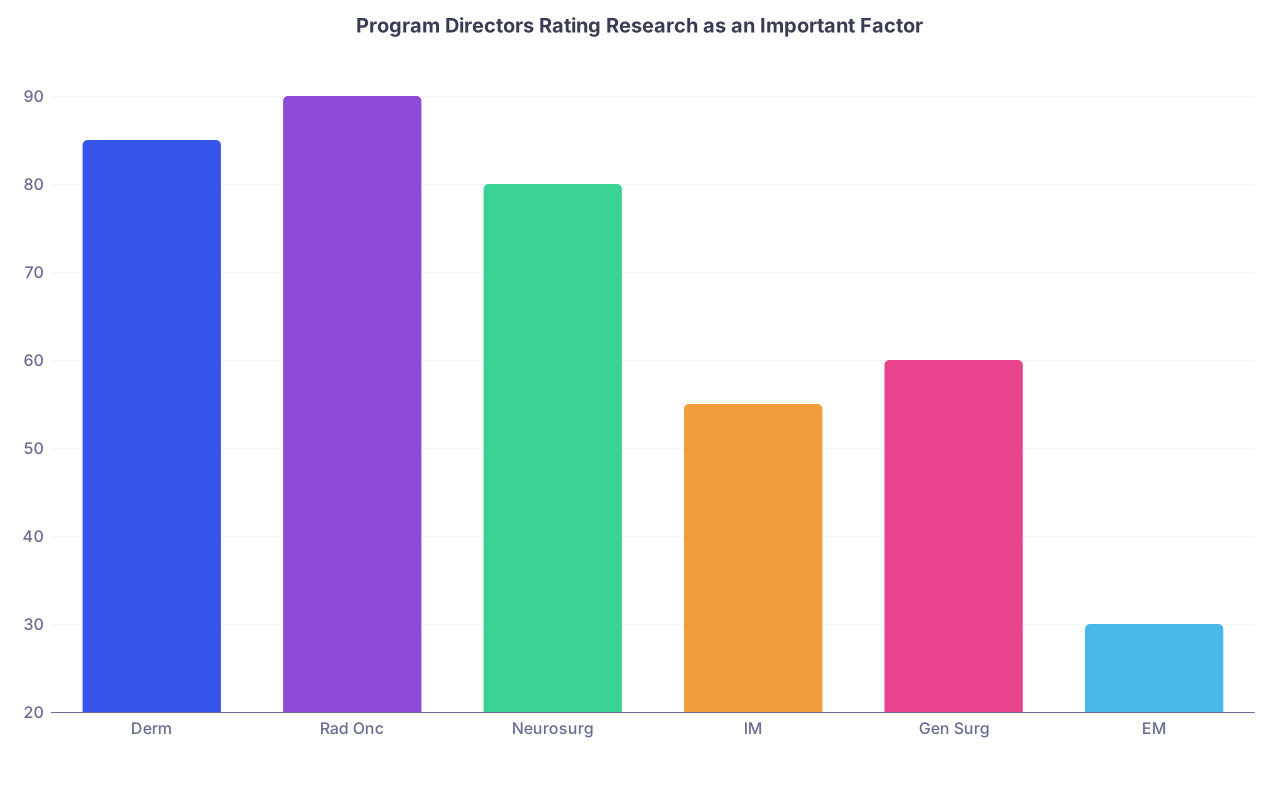
Let’s anchor this with what program directors report, not what anonymous SDN posters assert.
| Category | Value |
|---|---|
| Derm | 85 |
| Rad Onc | 90 |
| Neurosurg | 80 |
| IM | 55 |
| Gen Surg | 60 |
| EM | 30 |
These numbers reflect the general pattern from NRMP Program Director Surveys over multiple cycles: research importance is specialty-dependent, but it’s not zero almost anywhere, and in some fields it’s borderline mandatory.
Here’s what those surveys and follow‑up interviews with PDs consistently show:
- Competitive specialties (derm, rad onc, neurosurg, plastics, ENT): research volume and depth are major screening tools.
- Academic-heavy fields (IM at big-name university programs, academic neurology, radiation oncology): research—basic or clinical—signals fit and trajectory.
- Community-heavy or service-heavy fields (many EM, FM, psych, community IM): research is lower priority, but still occasionally helpful as a tiebreaker.
Nobody is saying, “We like research, but only if it’s clinical outcomes and only in our exact specialty.” That’s an applicant fantasy.
What PDs actually care about is a lot more boring and a lot more practical.
What PDs Actually See When They Look at Your Basic Science
When a program director opens your ERAS and sees basic science research, here’s the unromantic translation running in their head:
“Did this person:
- Show sustained commitment?
- Produce anything tangible?
- Have strong mentorship?
- Demonstrate they can finish what they start?”
If the answer is yes, most of them don’t care that your Western blots were in yeast and you’re applying to anesthesiology.
The key is signal, not topic.
Let me break that down.
Signal #1: Can you do long, cognitively heavy work without hand-holding?
Bench work, if done seriously, is brutal. Failed experiments. Repetition. Careful documentation. Reading primary literature you barely understand at first.
To a PD, someone who spent 1–2 years consistently in a wet lab and came out with a publication, poster, or at least a clearly articulated project is signaling:
- This person can push through ambiguity.
- They can work in a complex, multi-step environment.
- They haven’t only done checklist-style activities.
That’s closer to what residency feels like than yet another 4‑hour shadowing experience.
Signal #2: Is there actual output?
This is where most students overestimate the value of “research.”
Undergraduate lab for one semester, no poster, no abstract, no letter, minimal understanding of the project?
That’s an “activity.” Not a strength.
On the other hand, 1–2 serious basic science projects with:
- a conference presentation,
- maybe a middle-author paper,
- and a PI who writes you a strong letter…
now we’re somewhere. PDs don’t need you to have cured cancer. They need evidence that you can join a project and move it forward.
When Basic Science Helps a Lot vs. Barely at All
Basic science research is not a universal booster. It’s context-dependent. Here’s the real breakdown.
| Scenario | Basic Science Impact |
|---|---|
| Applying Derm/Rad Onc/Neurosurg at academic centers | High-very high |
| Applying Academic IM/Neurology/Pathology | Moderate-high |
| Applying Ortho/ENT/Plastics with decent scores | Moderate (helps if substantial) |
| Applying EM/Family/Psych at community programs | Low-moderate (tiebreaker) |
| Using weak, short-term lab work as main 'hook' | Near zero or negative |
Now, case by case.
High-value scenarios
You’re targeting extremely research-heavy specialties.
Dermatology, radiation oncology, neurosurgery, certain surgical subspecialties. In these worlds, having no research often puts you behind. Basic science with a strong mentor in a related or adjacent area is absolutely fine. Many derm applicants show up with immunology or molecular oncology bench work, not strictly “derm studies.”You want academic IM or neuro at a big-name place.
Strong bench experience, especially if it’s in anything vaguely related (immunology, oncology, metabolism), plays well. Why? These departments are stuffed with MD/PhDs and translational researchers. Basic science says, “I can live in that ecosystem.”You have a clear physician‑scientist trajectory.
MD/PhD, research track, PSTP, or you’re applying to programs that advertise “clinician-investigator” pathways. Raw lab time plus output makes you credible. Without it, you’re just telling a story you cannot back up.
Moderate / situation‑dependent value
You’re applying to competitive, procedural specialties but not at the absolute bleeding edge.
Ortho, ENT, urology, plastics. Many PDs like to see productivity—any productivity. A year of basic science with decent output is definitely better than no research and no meaningful scholarly work. But they won’t care that you used CRISPR if it’s not tied to a larger narrative or mentorship in that specialty.You’ve got a Step / Level score that’s good but not God-tier.
Strong research won’t erase a mediocre board score in ultra-competitive fields, but it can move you from “auto-filtered out” to “let’s at least look at them” in some programs, especially if your PI calls on your behalf.
Low or even negative impact
You dabble in a lab for 2 months, list it on ERAS, and call it “research.”
PDs are not idiots. They read your description. They ask, “What was your role?” in interviews. If you cannot explain the aim, design, and what you actually did in plain language, your “research” becomes a liability.You sacrificed core clinical performance to baby-sit a Western blot.
Shelf scores tanked. Clinical evals are lukewarm. You missed chances to build relationships with attendings. That tradeoff is rarely worth it, unless your research is extraordinary and you’re gunning for a heavily research-focused niche.You use basic science to pretend you’re “academic” but show no follow-through.
PDs see right through the applicant who did a year of research, then zero scholarly activity afterward, and no coherent story of how it connects to their career.
Basic Science vs Clinical Research: The False Dichotomy
One of the most annoying myths: “Only clinical research matters for residency.”
That’s not what the evidence shows.
What matters most is:
- Productivity: do things get finished and disseminated?
- Rigor: do you understand study design, sources of bias, and limitations?
- Teamwork: can someone vouch that you didn’t vanish when the work got hard?
Basic science can demonstrate all three.
| Category | Value |
|---|---|
| Clinical Case Reports | 1.5 |
| Clinical Retrospective Studies | 0.7 |
| Basic Science Lab Work | 0.5 |
You see the pattern in real life:
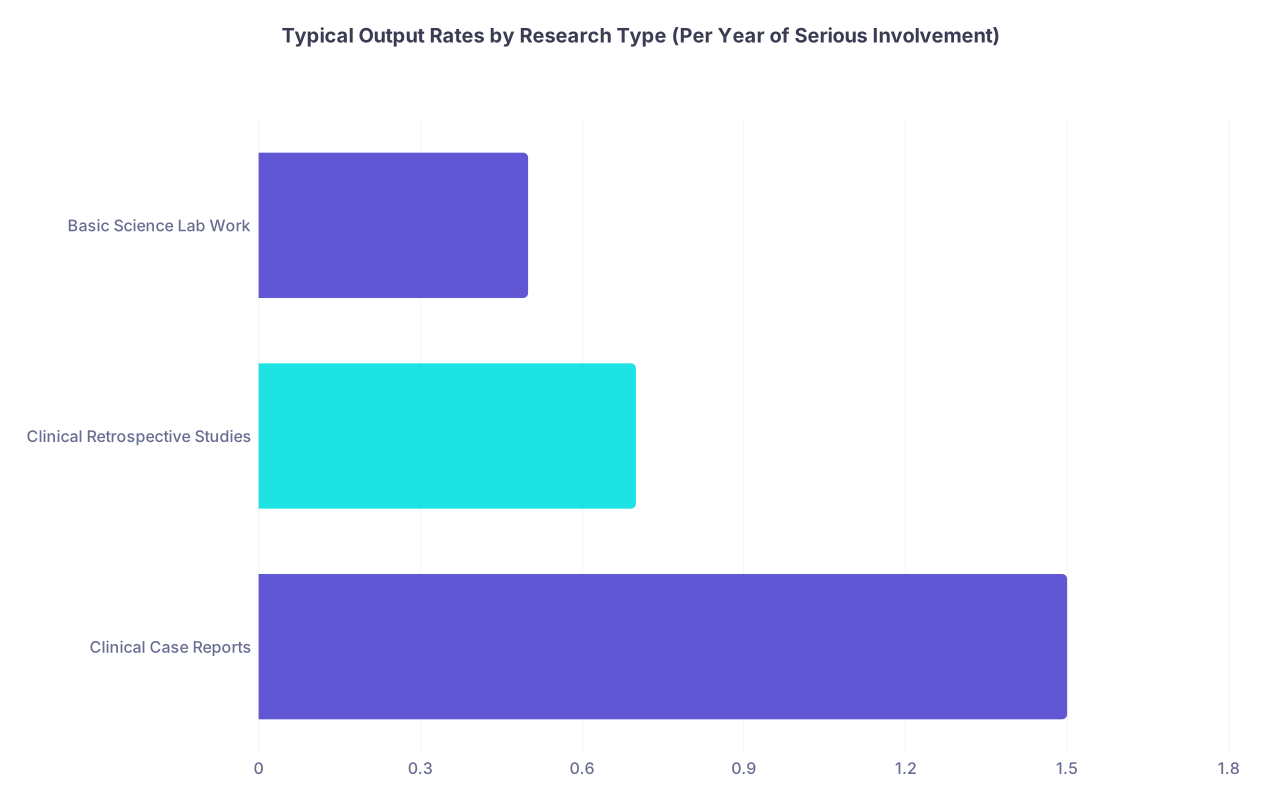
- Clinical case reports and chart reviews are quicker to produce but often shallow. Many students rack up 3–6 “publications” that are essentially single cases or minor retrospective bits.
- Basic science is slower, riskier, more likely to “fail” output-wise—but when it pays off, the work tends to look more rigorous, and PDs know it’s harder to fake.
So no, clinical isn’t universally “better.” It’s just usually easier and faster to turn into lines on your CV.
If you do basic science and you can intelligently walk through:
- the hypothesis,
- the experimental design,
- controls and confounders,
- what your data actually suggested (including negative results),
you’ll sound more sophisticated in an interview than someone who helped collect 300 chart reviews and can barely describe the methods section.
The One Thing That Matters More Than Type of Research
I’ve watched too many students obsess over the wrong question: “Should I pick this basic science PI or that clinical outcomes project?”
Wrong axis.
The real governing variable is: who is your mentor, and will they go to bat for you?
A strong, well-connected PI who:
- knows your name,
- can write a specific letter,
- and will pick up the phone or send emails…
is worth more than perfectly “matched” specialty research led by someone who barely remembers you.

For residency, a detailed letter that says:
“This student independently drove a complex lab project over 18 months, learned new techniques quickly, and was the most reliable member of the team. I would recruit them to my program in a heartbeat.”
…carries more weight than a vague, specialty-aligned letter saying:
“They helped on multiple small projects and were pleasant to work with.”
Basic science naturally lends itself to those deep, long-term relationships because labs are structured that way. Many clinical projects are quick-hit, high-churn operations. Think carefully about that tradeoff.
How to Make Basic Science Actually Work for You
If you’re already in a lab or considering it, here’s how to avoid wasting that time.
1. Commit long enough for real output
A random summer is rarely enough unless the project is tightly scoped. Serious PD‑noticeable work usually needs:
- 6–12 months at minimum of consistent part-time work, or
- a dedicated research year.
Shorter stints can work if the project is already in late stages and you’re the person who pushes it across the finish line.
2. Own a piece of the project
Do not just be “extra pair of hands.” That’s how you end up third author on a paper you can barely explain.
Push to own at least one of the following:
- A defined subset of experiments or analyses.
- A figure or table that is “yours.”
- Writing a significant chunk of the manuscript (introduction, methods, or results).
In interviews, PDs will ask, “Tell me about your research.” You want to be able to walk them through the project like it’s your patient.
3. Translate the science clinically in your story
You don’t have to pretend your Drosophila ion channel work is directly relevant to orthopedics. But you do need to be able to articulate:
- What you learned about scientific thinking.
- How you handle failure and uncertainty.
- How that mindset will show up on the wards and in your residency.
If you’re gunning for a specialty with any scientific overlap, even better. Onc-related bench work translating to rad onc. Immunology translating to rheum or derm. Neuroscience for neurology or neurosurgery.
But don’t overplay it. Most PDs are sophisticated enough to sniff out contrived “this totally connects to my dream specialty” narratives.

| Step | Description |
|---|---|
| Step 1 | Join Lab |
| Step 2 | Time & Commitment |
| Step 3 | Real Ownership of Project |
| Step 4 | Concrete Output |
| Step 5 | Strong Mentor Letter |
| Step 6 | Clear Story in ERAS/Interviews |
| Step 7 | Stronger Application |
When You Should Not Do Basic Science
Let me flip this around, because there are absolutely times when basic science is a terrible use of your limited time.
You probably should not invest heavily in bench work if:
- You dislike the day-to-day reality of lab life and are only doing it because “derm needs research.” Misery shows. Half-hearted effort shows.
- Your preclinical grades and board prep are shaky. Basic science won’t save you from poor scores in competitive fields. It’s an amplifier, not a substitute.
- The lab has a reputation for churning and burning students with no publications and no hands-on mentorship.
- You’re already late in the game (M4 ERAS season) with no prior experience. You’re better off finishing a focused clinical project than trying to fake “significant” bench research on a 3‑month timeline.
| Category | Value |
|---|---|
| No Output | 35 |
| Weak Mentorship | 25 |
| Hurt Exam Performance | 20 |
| Disliked Lab Work | 20 |
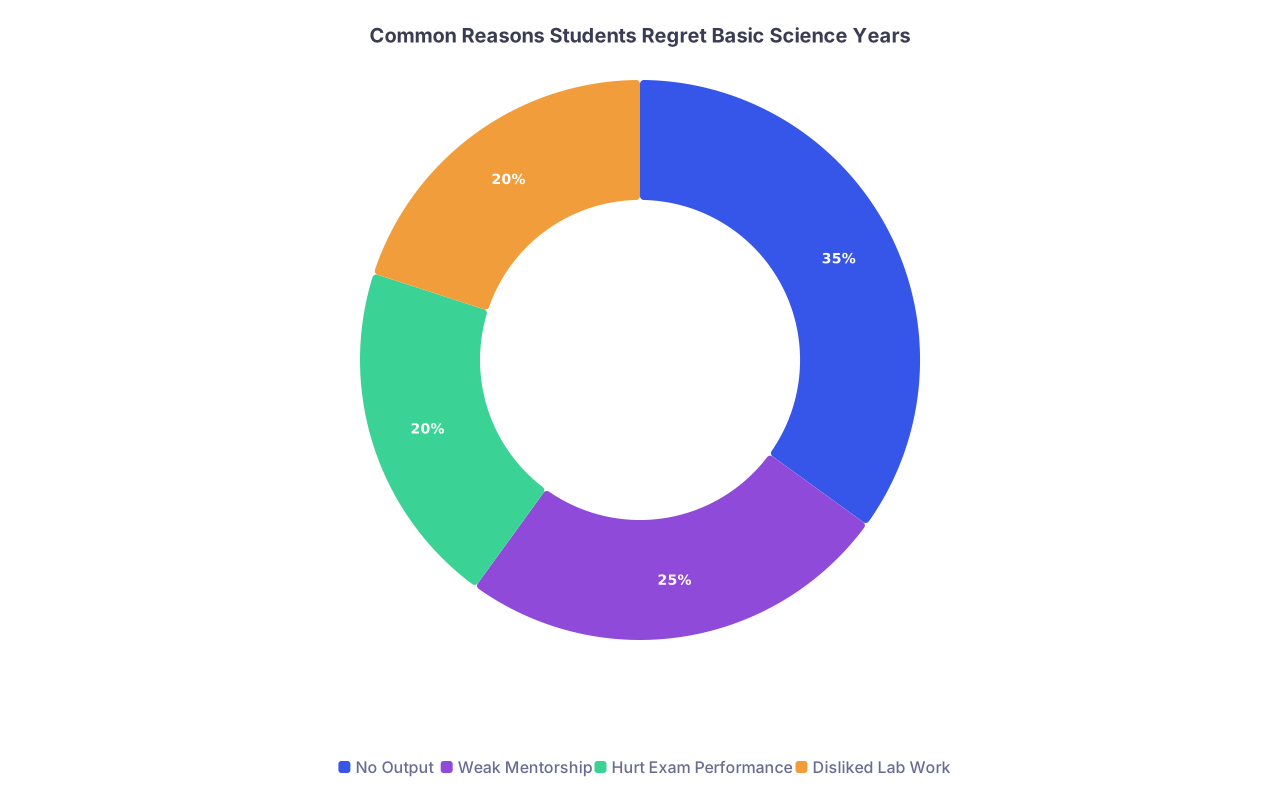
Those regrets aren’t about basic science itself. They’re about bad strategy.
The Bottom Line
Basic science research is not useless for clinical residencies. It’s just poorly understood and often executed badly.
If you strip away the online noise, three things are true:
Residencies care about evidence of deep, sustained, productive work.
Basic science can demonstrate that as well as—sometimes better than—clinical research, especially in competitive or academic programs.Type of research matters less than mentorship, output, and your ability to explain it.
A strong PI, a finished product, and a coherent story beat “perfectly aligned specialty research” led by someone who barely knows you.Badly planned lab time is a trap; well-planned lab time is a weapon.
If you commit long enough, own a real piece of the project, and tie it into your broader trajectory, basic science can be a serious asset. If you dabble, coast, or let it tank your clinical performance, it’s dead weight.
Use it deliberately, not blindly.