
You do not need a first‑author publication to match a competitive specialty. You need a convincing story that you can back up with something on paper. Most applicants get that formula backwards.
The cult of “first‑author or bust” is one of the most persistent, anxiety‑inducing myths in medical training. It’s also sloppy reading of the data and a complete misunderstanding of how program directors actually think.
Let me walk through what the numbers really show, what “research productivity” actually means in 2026, and when a missing first‑author paper is a problem—and when it is just noise.
What the Data Actually Shows (Not What Your Class Group Chat Says)
Let’s start with numbers, not vibes.
The NRMP Program Director Survey and Charting Outcomes are not perfect, but they are a lot better than Reddit threads and hallway gossip. Across the last few cycles, here’s the pattern:
- Competitive fields (derm, plastics, ortho, ENT, neurosurgery, rad onc) report:
- High average numbers of “research experiences”
- High average numbers of “abstracts/presentations/publications”
- But they do not say “first‑author publication required.”
In fact, the NRMP doesn’t track “first‑author” at all. It just counts output.
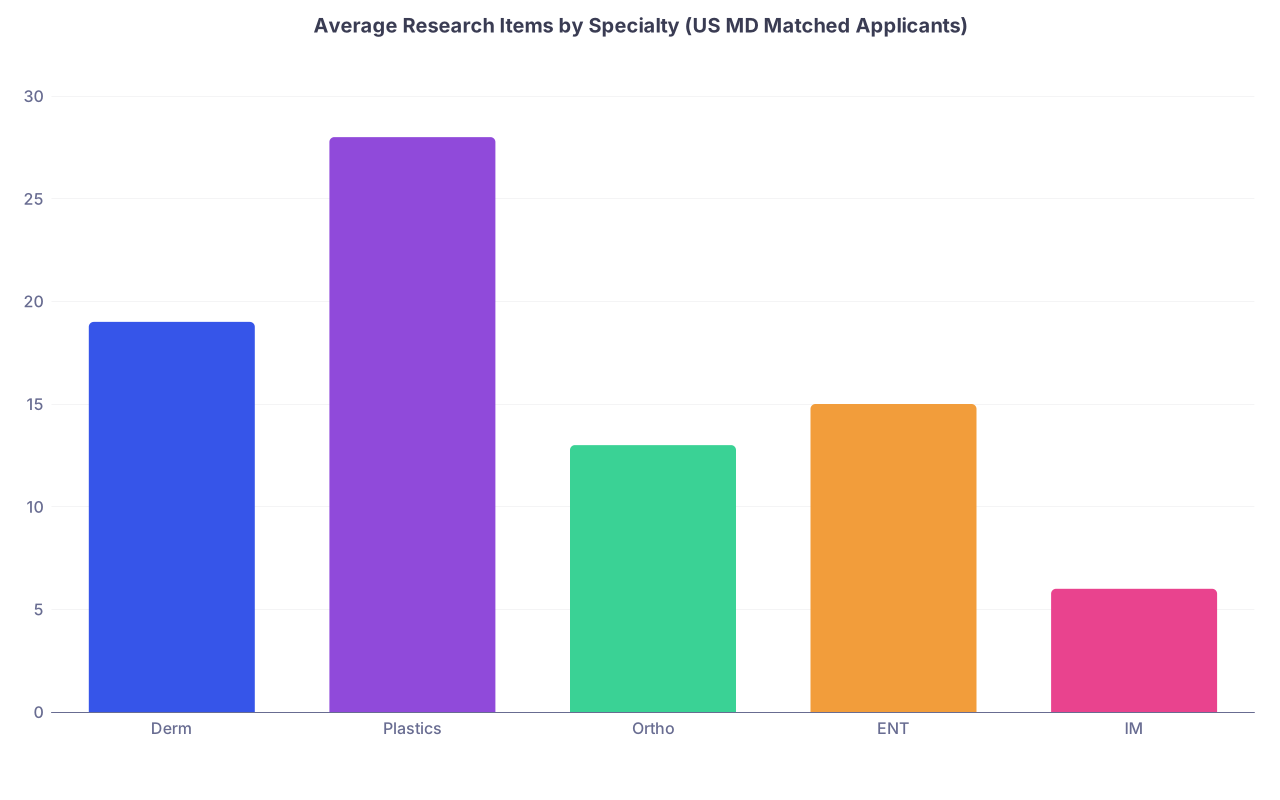
| Category | Value |
|---|---|
| Derm | 19 |
| Plastics | 28 |
| Ortho | 13 |
| ENT | 15 |
| IM | 6 |
Those numbers are from recent Charting Outcomes cycles (values rounded). They’re inflated by a few super‑producers, and they count everything—poster abstracts, case reports, conference presentations, tiny chart reviews, even that poster you presented to three sleepy residents at 7 am.
So when someone tells you, “You must have a first‑author paper for derm,” they’re quietly replacing “a lot of activity” with “one specific type of activity.”
That’s not what the data says.
Programs that care about research are looking for:
- Volume: Have you done enough that it changed you?
- Follow‑through: Did anything make it to a poster, abstract, or paper?
- Coherence: Does this fit your specialty story, or is it random scavenger‑hunt stuff?
- Ownership: Can you speak about one project like you actually led something?
Notice what’s missing: “PubMed‑indexed, first‑author, in a high‑impact journal by age 24.”
That requirement lives mostly in anxious group chats and the minds of people selling you “research fellowships.”
What Program Directors Actually Look For
Here’s the part students rarely believe until they see it from the other side.
Program directors don’t open ERAS, hit Ctrl+F for “first author,” and auto‑reject anyone who doesn’t have it. They look for signals.
I’ve sat in rooms where apps were screened for derm, ortho, and ENT. The conversation sounds more like this:
- “Okay, 260+ Step 2, strong letters, multiple ortho rotations, 6 ortho abstracts/posters, one under review. Does this feel like someone who’s serious about ortho?”
- “Research year at [known PI]. Two spine projects, one outcome paper accepted, couple of national posters. They clearly did real work.”
- “Five random case reports in unrelated fields, no ortho, no continuity. Did they actually care about this field?”
Nobody says: “Reject them, no first‑author.”
What they actually want to see is at least one project where it’s obvious you invested real time and thought. Whether your name is #1 or #3 is less important than:
- Can you explain the question, methods, and limitations without reading off a script?
- Did you stick with the project long enough to see it to a poster / abstract / submission?
- Does someone credible vouch for your contribution in a letter?
If you sound like a tourist in your own research, first‑author status will not save you. If you sound like you really owned a portion of the work, second‑ or third‑author is perfectly fine.
Myth vs Reality: First‑Author Publications
Let’s explicitly separate the mythology from the reality.
| Claim | Reality |
|---|---|
| You need a first‑author paper to match derm/ortho/ENT/etc. | You need credible, sustained research activity; first‑author is helpful but not required. |
| Co‑author papers “don’t count.” | Committees count all peer‑reviewed work; they care more about your role than author order alone. |
| No publications = no chance. | Plenty of matched applicants have posters/abstracts only, especially with strong clinical and letters. |
| First‑author case reports are a big flex. | They’re nice but low‑yield; one solid project in your field beats five random case reports. |
I’ve watched applicants match derm at solid academic places with:
- 0 first‑author pubmed‑indexed papers
- 4–5 derm posters/abstracts
- A strong home‑institution mentor letter saying, “They drove this project.”
And I’ve watched applicants with two first‑author case reports in completely unrelated areas (one in nephrology, one in psychiatry) fail to even get serious interviews for ortho because nothing in the file looked like real commitment to surgery.
The lesson is annoyingly simple: content and coherence beat author order.
When You Actually Need Strong Publications
Now let’s be honest. There are scenarios where lack of substantial research output can absolutely hurt you.
You are in a higher‑risk category if:
- You’re going for top‑tier academic programs in hyper‑competitive fields (UCSF derm, Harvard plastics, MGH neurosurgery).
- You’re doing a dedicated research year or post‑doc; then you’re expected to show real output.
- You trained at a med school with huge research infrastructure, and your file is completely empty.
Even then, the bar is usually “meaningful output,” not “first‑author or bust.” For example:
A research year in neurosurgery that yields:
- 1 middle‑author original article
- 1 first‑author conference abstract
- 2–3 posters or presentations
That’s fine. You didn’t waste the year.
A home‑grown derm applicant with:
- 1–2 decent co‑author papers
- 5+ abstracts/posters in derm
- A mentor letter that says “They were the engine of these projects”
That’s competitive, even if your name never sits in the #1 slot.
Where you truly get into trouble is this combination:
- No publications, no posters, no abstracts
- You claim research on the CV, but it’s “ongoing” with no end in sight
- You can’t explain what you actually did
Then programs start wondering: was this real, or did you just hang around lab meetings?
The Hidden Problem: Overvaluing Case Reports and Name Order
A lot of students chase the easiest way to see their name as first author: case reports and tiny chart reviews.
The logic: “If I crank out five first‑author case reports, I’ll look super productive.”
Here’s the uncomfortable truth: most academic PDs don’t care much about case reports unless they’re:
- In your chosen field
- Presented at a relevant conference
- Anchored by a mentor who can discuss your work in a letter
A pile of first‑author case reports in scattered fields reads like “CV padding.” It’s the research version of doing 15 random shadowing experiences for 2 hours each.
On the flip side, a more “anonymous” middle‑author paper on a major project in your specialty, where you genuinely did hard work for a year, is a stronger signal.
Programs know the game. They know:
- Case reports can be turned around quickly.
- Many “student first‑author” case reports are 90% attending work, 10% student pushing buttons.
- Authorship order is negotiable and political, not always a clean measure of contribution.
They’re much more likely to be impressed by:
- A project where you actually handled data collection, chart review, analysis, or drafting.
- A senior author who writes, “This student was effectively a co‑PI on this project.”
That impresses them whether you’re first or third on the author list.
How to Make Lack of a First‑Author Paper a Non‑Issue
If you’re reading this with zero first‑author pubs, here’s how you keep that from sinking your application.
1. Build Depth, Not Just Count
One to three projects with clear depth beats ten scattered line items.
Depth looks like:
- Longitudinal involvement (12–18 months with one group or mentor).
- Real technical growth: you moved from data entry to analysis, from copying templates to drafting.
- Multiple outputs from the same project: poster → talk → paper (submitted/accepted).
On an application, that reads as “serious, growing scientist,” even without first‑author.
2. Convert Something to a Tangible Output
Programs are wary of endless “works in progress.” At least one project must have a visible endpoint.
That endpoint can be:
- A national or regional conference abstract
- A poster presentation (even institutional)
- A submitted manuscript (yes, you can list “submitted” or “in revision,” accurately labeled)
Your job is to avoid the file that reads like: “Did research for 3 years, nothing ever got out the door.”
3. Own One Project in Your Story
In interviews, you need one clear flagship project where you can say, without flinching:
- “This was my role.”
- “Here’s the question we asked and why it mattered.”
- “If I did it again, I’d change X about the methods.”
That’s what “ownership” sounds like. And it matters more to a PD than whether you were name #1 or #4.
When a First‑Author Project Does Move the Needle
Let me be fair. There are cases where a first‑author paper really helps.
It can be a strong differentiator when:
- You’re in a big applicant pool with similar scores and similar generic research “noise.”
- You’re applying to a place that knows your PI and respects their bar for first‑authorship.
- The paper is in the specialty you’re targeting, in a credible journal, and you clearly drove it.
That kind of project can:
- Get mentioned in letters.
- Give you talking points in interviews.
- Signal “This person could actually survive fellowship or an academic path here.”
But that’s not the same as “required.” It’s more like “nice weapon to have if you can get it without losing your mind or sacrificing everything else.”
If chasing first‑author status means:
- You delay Step 2 and get a weaker score
- You tank your clinical grades to get one more figure done
- You do a research year with an absentee PI who never publishes
Then you’re trading real, high‑impact metrics for a fragile maybe.
Practical Scenarios: How Committees Actually Read This
Here’s how three simplified applications read in a real selection meeting for a competitive field:
Applicant A
- No first‑author
- 1 middle‑author original article in the specialty
- 3 posters at national meetings (all in‑field)
- Strong letter from PI: “Led data collection, great initiative, independent.”
- Solid Step 2, strong clinical evaluations
Verdict: “Clearly serious about the field, productive, worth interviewing.”
Applicant B
- 3 first‑author case reports (all in unrelated fields)
- 1 low‑tier journal letter to the editor
- No in‑field work
- Generic research mention in personal statement
Verdict: “Research looks like padding; where’s the actual commitment to this specialty?”
Applicant C
- No publications, 1 in‑field abstract accepted to a regional meeting
- Ongoing project with clear description of role and methods
- Home‑program letter says: “Our best student this year, very strong on the service”
- Great clinical comments, honors in core rotations
Verdict: “Research‑light but clinically strong, especially for our home program. Still competitive.”
Notice: the presence or absence of “first‑author” isn’t the axis here. Credibility, fit, and depth are.
Stop Worshiping the Wrong Metric
If you want an academic career, at some point you should aim to lead a project and see your name first on something meaningful. It’s good training. It shows you can drive a question from idea to publication.
But for the purpose of matching, especially on your first try, obsessing specifically over first‑author status is a distraction.
You’d be much better served if you:
- Got involved earlier, so time—not panic—creates opportunities for authorship.
- Chose a mentor with a track record of actually publishing with students.
- Focused on one or two substantial projects in your desired field.
- Made sure at least one thing ends up publicly visible—poster, abstract, or paper.
Programs aren’t just asking, “Did you publish?” They’re asking, “Does this look like someone who finishes what they start and cares about our field?”
Years from now, you will not remember exactly what slot your name occupied on that manuscript. You will remember whether you built work you’re proud to talk about—or whether you spent medical school chasing a line on your CV that never really mattered as much as people told you it did.