
What actually happens when a dermatology program director opens your ERAS and your only publication is in ICU sepsis outcomes?
Let me kill the main myth up front: no, only specialty‑specific research does not “count.” That line is usually pushed by anxious MS2s on Reddit and the one resident in your department who thinks their path is the only valid one.
The reality is more complicated. And frankly, way more forgiving.
The Myth: "If It’s Not in My Specialty, It’s Useless"
I’ve heard versions of this in a dozen dean’s offices and residency didactics:
- “I’m applying ortho; my psych research doesn’t help me.”
- “Cards fellowship won’t care about my QI poster.”
- “I shouldn’t waste time on broad research; it has to be hyper‑specific.”
This is how you end up with M3s turning down good projects because the attending doesn’t have “[future specialty]” in their email signature.
Here’s what the data and the people actually making the decisions show.
What Program Directors Actually Say
The NRMP “Program Director Survey” is not perfect, but it is the closest thing you have to reading PDs’ minds. Across competitive specialties (derm, ortho, plastics, ENT, rad onc), they consistently rate “demonstrated scholarly activity” as a positive factor.
Not “derm‑only scholarly activity.”
Just scholarly activity.
They care about:
- Can you finish what you start?
- Do you understand basic research methods?
- Can you work in a team, respond to feedback, hit deadlines?
- Do you have any evidence you’ll produce academically once you’re a resident?
Whether the paper is on melanoma or ICU rounding efficiency matters much less than applicants think.
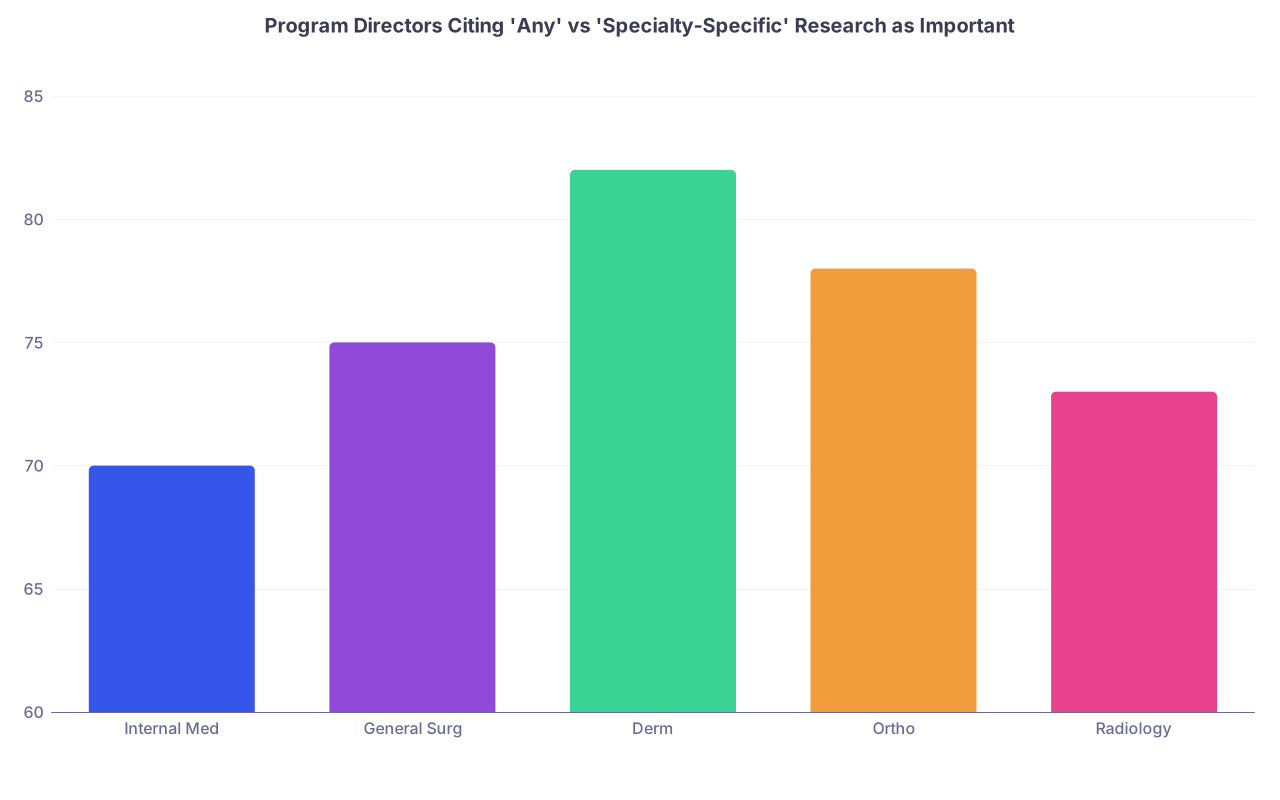
| Category | Value |
|---|---|
| Internal Med | 70 |
| General Surg | 75 |
| Derm | 82 |
| Ortho | 78 |
| Radiology | 73 |
That bar is overall importance of research/scholarly activity in the NRMP survey (percentage of PDs saying it’s a factor). What you do not see is a second bar saying “only specialty‑specific research counts.” Because they do not ask that. And most PDs do not think that way.
Ask around honestly and you’ll hear what I’ve heard in selection meetings:
- “I don’t care that it’s nephrology, that’s a legit RCT and they’re 3rd author as an MS2. That’s impressive.”
- “This one has five posters in Pulm/CC and a QI project; this other one has one case report in our field. I’ll take the first.”
The idea that a weak, ultra‑niche “in‑specialty” case report automatically beats a robust, methodologically sound “out‑of‑specialty” project is fantasy. Usually told by people defending their own CV choices.
What Actually “Counts” in Research
Let’s be specific. Because “counts” is vague.
When PDs weigh research, they are (implicitly) grading four things:
- Rigor – Was this real work or a checkbox project?
- Role – Were you actually involved or just person #17?
- Trajectory – Does this show growth and continuity?
- Relevance – Does any of this connect to how you think as a future [specialty] doctor?
Only one of those is “relevance to specialty.” And it’s rarely the primary driver.
Rigor vs. Relevance
Here’s a comparison that comes up all the time in committee:
| Applicant Profile | Typical PD Reaction |
|---|---|
| One case report in the exact specialty, 5th author, no follow‑up | "Okay, they touched the field. Minimal." |
| Two med‑ed projects + one ICU outcomes paper, a poster at a real conference | "They actually did work. They’ll likely produce here too." |
If you’re a PD trying to predict who will finish a residency QI project, who can analyze basic data, who will survive a research block without hand‑holding—the second profile is simply more convincing. Even if none of those topics match your subspecialty.
Rigor beats narrow relevance.
Role Matters. A Lot.
Program directors are not stupid. They know half the student authors on some mega‑collaboration papers did three hours of data entry and disappeared.
If your “derm research” is: “I was 11th author on a case series, didn’t write, didn’t analyze, didn’t present,” that is not more valuable than being 1st or 2nd author on a pulmonary QI project you can discuss fluently.
When you interview, the question is rarely “Why is this not in our field?” It’s:
- “Tell me about a project you worked on—what was your role?”
- “What surprised you about the results?”
- “If you could redo that project, what would you change?”
If your answer is: “Honestly, I just helped collect some charts; I don’t really remember the details,” then no, your “specialty‑specific” line item is not helping you. At all.
How Broad Research Is Actually Evaluated By Specialty
Let’s go specialty by specialty, because the rules are not identical.
Competitive, Research‑Heavy Fields (Derm, Plastics, Rad Onc, ENT, Neurosurgery)
Myth: “In derm/plastics/etc, every project must be in the field.”
Reality: These programs like to see some specialty‑relevant work, but they also heavily value volume and seriousness of research, regardless of topic.
If you’re aiming for dermatology with:
- 1 derm chart review, 6th author
- 1 derm case report, 4th author
- 0 anything else
you are not “stronger” than the applicant with:
- 1 derm review article (even mid‑tier)
- 2 ICU outcome posters where they presented
- 1 med‑ed study on diagnostic error they can explain cold
- 1 small QI project on clinic no‑shows
You know what derm faculty say when they see the second CV?
“This person will get things done if we give them a derm mentor.”
They are not blind to topic. But they are not slaves to it either.
Academic‑Lean Fields (IM, Peds, Psych, EM, Anesthesia)
These specialties care a lot about evidence of scholarly curiosity and often less about hyper‑specific field alignment.
An internal medicine PD seeing an applicant with:
- One cardiology paper
- One GI QI project
- One med‑ed paper on feedback
- And zero IM‑labeled projects
is not docking them because the work isn’t stamped “internal medicine.” They see an applicant who can thrive in the academic environment.
Same for EM: trauma, EMS systems, ultrasound, QI, education—all count. They are used to seeing broad work.
Community‑Heavy or Procedural Fields (FM, OB/GYN, some Gen Surg programs)
In many community‑focused or less research‑intense programs, the existence of any meaningful scholarly activity is the main signal.
I’ve seen program directors in family med literally say: “Oh nice, they did a poster. Good for them. Shows they can finish stuff.”
They’re not concerned that your project was on nephrotic syndrome or cognitive bias in diagnosis instead of primary care chronic disease management.
Broad work demonstrates the same basic competencies they want:
- Following something through over months
- Working with a faculty mentor
- Writing, presenting, being critiqued
That’s enough for a lot of them.
Where Specialty‑Specific Research Does Give You an Edge
Now, I’m not saying field‑specific work is irrelevant. It can absolutely separate you when everything else is equal.
There are three scenarios where specialty‑specific research matters more:
Tiebreaker cases.
Two derm applicants, nearly identical Step 2, grades, letters. One has a derm original research project and strong derm letter out of that lab. They’re getting the nod over the applicant whose best work is entirely in cardiology. Fair.Demonstrating late interest.
If you “switched into” a field late, a small but real project can prove it’s not just a last‑minute scramble. Even a single in‑field QI project can anchor your narrative.Showing conceptual fit.
If your broad research is on, say, health services or med‑ed, and you can explicitly link it to why you’re drawn to that specialty’s practice environment, that helps your application “cohere.”
But note what I just said: specialty‑specific work is an edge, not a binary switch.
Programs don’t throw away your ICU outcomes paper because they’re in nephrology. They ask you to interpret what it says about how you think.
How To Spin Broad Research So It Actually Helps You
This is where applicants either cash in their work—or waste it.
Your job is to translate your prior research into skills and mindset relevant to the specialty you’re pursuing. Not apologize that your data set wasn’t in the right organ system.
Example 1: ICU Research → Dermatology
Lazy framing (hurts you):
“I did some ICU research before I decided on derm; it’s not really related.”
Useful framing (helps you):
“I worked on an ICU outcomes project where we had to clean a massive dataset and build a multivariable model. That experience taught me how small biases in data collection can totally distort your conclusions—something that’s highly relevant in dermatology, where most of our ‘evidence’ is still from observational data and registries.”
What the interviewer hears:
You understand methods and can think critically. You respect evidence. You’ll be an asset in their academic conferences.
Example 2: Med‑Ed Research → General Surgery
Weak:
“It was just a med‑ed project; nothing surgical.”
Strong:
“We looked at how feedback timing affected resident performance on simulated procedures. Surgery is a procedural field where training and feedback directly affect patient outcomes, so that work really pushed me to think about how I’ll teach and be taught in residency.”
Again: direct line from “broad” to “this specialty’s daily reality.”
Example 3: Psych Research → Emergency Medicine
Weak:
“It’s psych, so not super related to EM.”
Strong:
“We studied predictors of repeat ED visits in patients with comorbid psychiatric illness. That made me appreciate how the ED is often the default mental health access point, and it’s one reason I’m drawn to EM—the mix of acute care and systems‑level impact.”
This is not spin. It’s good thinking. You are allowed to connect dots.
When Broad Research Is Not Enough (And You Need Something In‑Field)
There are times when you really should add at least a toe‑in‑the‑water project in your desired specialty.
- You’re going for the top 5–10 programs in a hyper‑competitive field, and everyone else has it.
- Your current record shows nothing that even hints at your target field.
- You’re coming from a lower‑tier school or have weaker scores and need to show extra commitment.
In those cases, you do not need a miracle RCT. But you should aim for:
- A small retrospective chart review
- A case report or series with you doing actual writing
- A modest QI project in that department
- A review paper or book chapter if that’s what’s available
And then you stack it on top of your broader work. Not instead of.

| Step | Description |
|---|---|
| Step 1 | Start of MS2 |
| Step 2 | Broad Research Opportunity |
| Step 3 | Gain skills, methods, outputs |
| Step 4 | Clarify Specialty Interest |
| Step 5 | Add 1-2 In-Field Projects |
| Step 6 | Translate Experience in Personal Statement & Interviews |
The mistake is to freeze and do nothing because the only available mentor is in nephrology and you “want ortho.” That is how you end up with zero real research experience and a story about all the things you would have done.
Quality, Not Perfect Alignment, Drives Match Outcomes
Let’s pull this together with how PDs actually choose residents.
Imagine two applicants to a mid‑to‑upper tier academic radiology program.
Applicant A:
- 3 radiology case reports, 4th–6th author
- One radiology poster, presented by the fellow
- Can barely remember details in the interview
Applicant B:
- 1 solid pulmonary outcomes paper, 2nd author
- 1 med‑ed abstract they presented nationally
- 1 small radiology QI project on report turnaround times
- Talks clearly about methods, limitations, what they learned
Applicant B wins 9 times out of 10. And deservedly so.
That’s not a thought experiment. I’ve watched that exact dynamic play out in selection meetings. Faculty will literally say things like:
- “I’d rather have the person who clearly did real work.”
- “Yeah their stuff isn’t all in our field, but we can plug them into our projects and they’ll run.”
Your portfolio is being judged for evidence that you can be a productive resident and, for academic programs, a junior academic. Specialty‑specific branding is nice. It’s not the core.
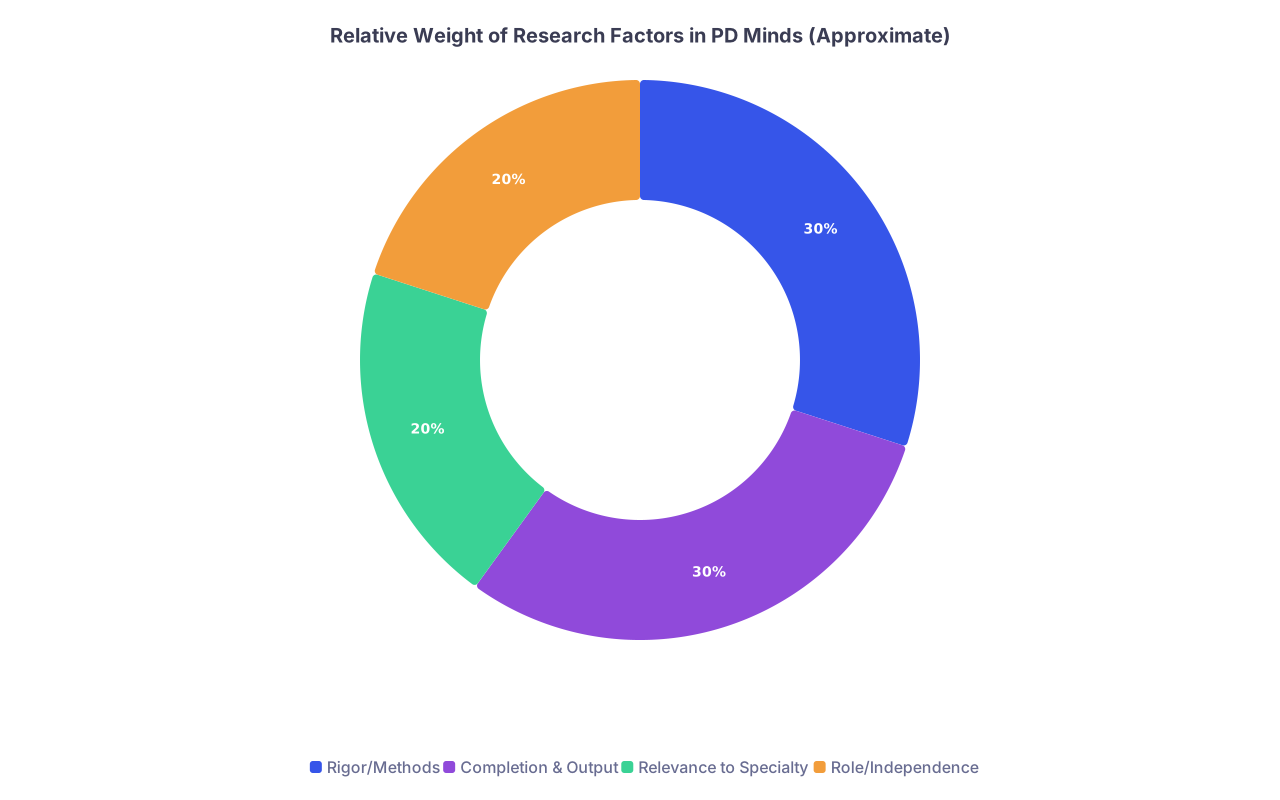
| Category | Value |
|---|---|
| Rigor/Methods | 30 |
| Completion & Output | 30 |
| Relevance to Specialty | 20 |
| Role/Independence | 20 |
Is that chart a formal study? No. It’s an honest approximation of how PDs talk behind closed doors. Relevance to specialty is a slice, not the whole pie.
How To Decide What To Say Yes To
When a research opportunity comes up, stop asking “Is it in my specialty?” as the first and only filter. Ask:
- Will I actually learn something (methods, stats, writing, QI)?
- Is there a realistic path to completion within my timeline?
- Will I have a clear role I can describe later?
- Can I, with some thought, connect this to my future specialty?
If the answer to those is yes—even if the project is in an adjacent or entirely different field—it’s probably worth doing. Especially early (M1/M2, early M3) before your interests fully solidify.
And if later you can add a focused project in your chosen field, great. Now you look like someone with breadth and depth. Programs like that.

| Step | Description |
|---|---|
| Step 1 | Research Offer |
| Step 2 | Probably Decline |
| Step 3 | Strong Yes |
| Step 4 | Maybe; Depends on Portfolio |
| Step 5 | Learn Skills? |
| Step 6 | Finishable? |
| Step 7 | Clear Role? |
| Step 8 | Connectable to Specialty? |
The Bottom Line
Only specialty‑specific research counting is a comforting myth for people who invested heavily in narrow projects and want that to be the only valid currency. The match does not work that way.
Broad, rigorous, well‑executed research—paired with a coherent narrative about how it shaped you—absolutely “counts” for residency. In many cases, it counts more than flimsy, name‑only specialty‑specific work.
Years from now, you won’t remember the neurotic debates about whether your ICU paper was “derm enough” or “ortho enough.” You’ll remember whether you learned how to do good work with smart people—and that, in the long run, is what actually moves your career.