
The obsession with “more papers = better match” is wrong. And it is warping how smart applicants spend their limited time.
If you are hoarding low‑quality abstracts like Pokémon cards, you are not being “competitive.” You are signaling that you do not understand how program directors actually think.
Let’s unpack what the data really says—and where applicants are getting baited by bad metrics.
The Misused Statistic That Started This Mess
You have probably seen that infamous NRMP Charting Outcomes graph: matched applicants in competitive specialties show higher averages of “publications / abstracts / presentations.”
Everyone screenshots it. Everyone misinterprets it.
Here’s the problem: that single blob metric is doing several dumb things at once:
It lumps together:
- peer‑reviewed original research
- review articles
- case reports
- book chapters
- posters you barely remember
- random local talks
All counted the same. A first‑author JAMA paper = your MS2 poster where you stood next to a trifold board for 45 minutes.
It’s descriptive, not causal.
People who match dermatology or plastics often come from strong academic ecosystems with PIs, T32s, dedicated research years. Those same ecosystems also select for high Step scores, strong honors, and serious mentorship. Research is part of the package, not the magic ingredient.It’s easily gamed and inflated.
You can “increase your research count” 5–10x in a year with:- multi‑author low‑impact case series
- slicing one project into three posters
- endless second‑author posters from a productivity‑obsessed lab
Does this make you a stronger resident? No. It makes your ERAS spreadsheet look chubby.
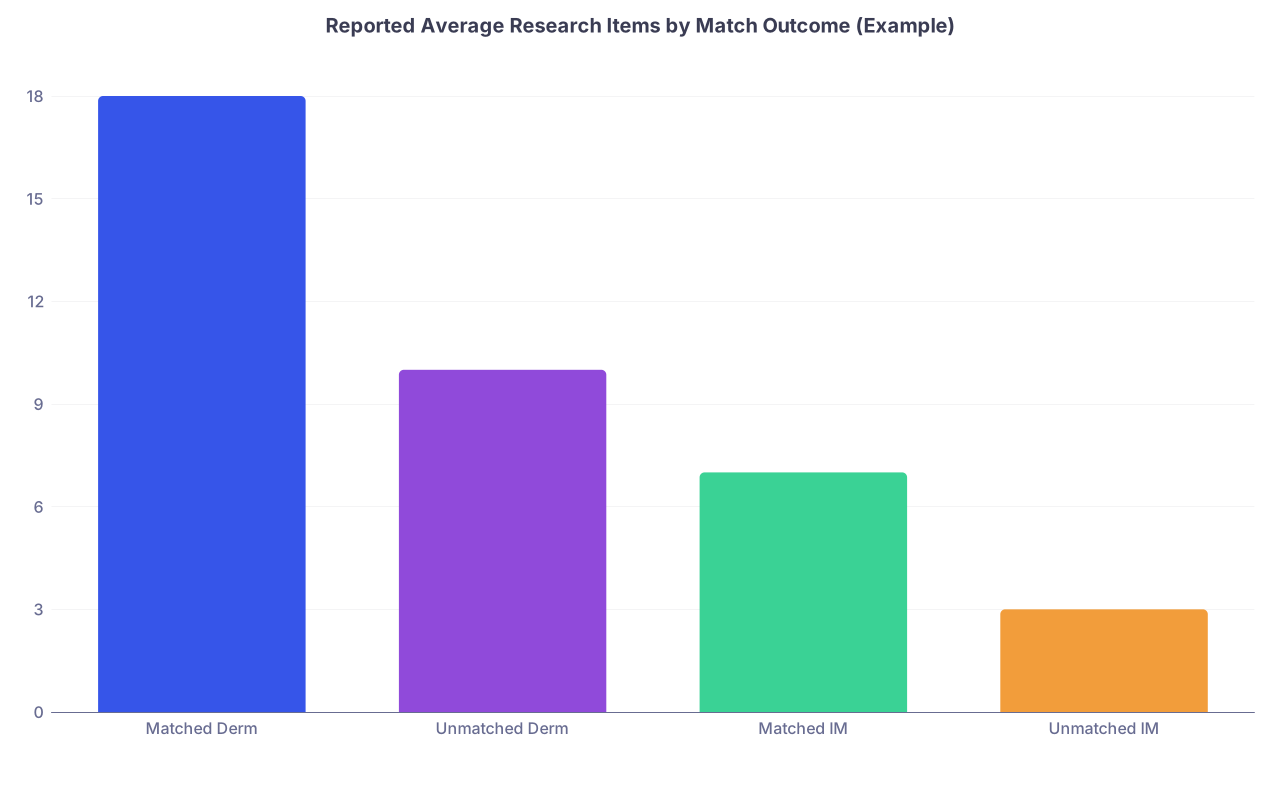
| Category | Value |
|---|---|
| Matched Derm | 18 |
| Unmatched Derm | 10 |
| Matched IM | 7 |
| Unmatched IM | 3 |
People stare at a bar chart like that and draw exactly the wrong conclusion: “I need more items.”
No. You need the right kind of research and the right story around it.
What Program Directors Actually Care About (And What They Ignore)
I’ve sat in rooms where people review ERAS applications. The conversation is not:
“Wow, this applicant has 24 items, automatic interview.”
It sounds more like:
- “Do they have any serious, sustained research?”
- “Is there a clear theme or did they just attach themselves to anything?”
- “Who wrote their letters—and do they actually know them?”
- “Do I trust this person to think, write, and finish things?”
Here’s the real hierarchy programs use, even when they do not admit it explicitly:

Evidence of deep engagement
One substantial, multi‑year project where you clearly owned part of the question, methods, or analysis beats eight scattered posters where you were author #10.First‑author or meaningful‑author work
That tells them you can actually write a paper, respond to reviewers, and see something through. Being author #14 on a retrospective chart review? Nobody is impressed.Consistency with your narrative
Applying to ortho and all your “research” is on medical education in psychiatry and a case report in peds GI? You look random. Or opportunistic. Both are red flags.Letters from research mentors who actually know you
A short, generic letter from a famous name is less powerful than a detailed letter from a mid‑tier PI who can describe how you think, write, handle setbacks, and work on a team.Basic academic honesty and credibility
Overstuffed sections with suspicious numbers, vague roles, or obvious CV‑padding get quietly downgraded. People in academics are professional skepticism machines. They notice.
What they do not care that much about:
- Whether you have 7 vs 14 vs 22 “items”
- How many local posters you squeezed out of the same dataset
- Case reports on random zebras with no broader relevance, repeated 10 times
More is not better. More is just more.
Where Quantity Becomes Actively Harmful
Beyond “not impressive,” chasing research volume can actually hurt your application. I’ve watched applicants do this to themselves.
Three common failure modes:
1. The Bloated, Unreadable ERAS
You list 30 “scholarly” outputs, half of which are:
- “Poster presented at institutional research day”
- “Oral presentation at local-interest conference”
- “Co-author on review accepted for submission” (yes, people actually write that)
On paper, you look busy. In reality, you look like you cannot prioritize. Reviewers glaze over and stop reading. That “wow factor” you were trying to engineer? Gone.
2. The Incoherent Narrative
You tell programs you are “deeply committed to academic neurosurgery,” but your ERAS shows:
- Three unrelated case reports in GI
- One QI poster in pediatrics
- A geriatrics education abstract
- A half‑finished neurosurgery project with “manuscript in preparation”
This does not read as “multidisciplinary.” It reads as “I will attach my name to anything that moves.” That’s not ambition. That’s desperation.
3. Red Flags in Interviews
You list 15 projects. On interview day, an attending casually asks: “Tell me about this poster on [X]. What was your specific role? What did you conclude from the data?”
If your answer is vague, generic, or obviously rehearsed, you just triggered an integrity alarm. I have seen interviewers write one line in their notes:
“Research inflated. Not genuine.”
That single impression can tank an entire file.
What the Data Suggests About “Enough” Research
No, there is not a magical cut‑off number. But there are clear patterns across specialties.
Let me simplify what the evidence and PD surveys consistently show:
| Specialty Type | Typical Competitive Profile |
|---|---|
| Ultra-competitive (Derm, PRS, ENT, Ortho) | 1–3 strong projects, 1–2 first‑author, possibly a research year if coming from low‑research school |
| Mid-competitive (Radiology, EM, Anesthesia, Neuro) | 1–2 substantial projects, at least one presented or submitted |
| Less research-focused (FM, Psych, Peds, IM-Community) | Any research is a plus, QI or education projects often sufficient |
Notice what is missing: “must have 20+ items.”
Program directors repeatedly say in surveys that:
- They value quality, depth, and relevance over raw counts
- They care whether you can explain your work thoughtfully
- For many community and mid-tier programs, a single honest, well‑described project is already above average
If you are applying to derm or plastics from a non‑research‑heavy school, you may need a dedicated research year or multiple serious projects to be competitive at the very top. Fine. That is still not “stack 40 case reports and hope.”
How to Build Research That Actually Helps You Match
If you want your research to move the needle—not just pad a line on ERAS—you need a different strategy.
1. Pick Fewer Projects and Actually Own Them
You want:
- One major project where you have a definable role: designing the survey, running the chart review, doing stats, building the database, drafting the manuscript
- Maybe one or two smaller, supporting projects
That’s it. More than 3–4 concurrent projects as a student is almost always code for: “I do background sections and copy‑editing for everyone.”
2. Prioritize Projects With a Clear Path to Completion
Good projects:
- Have a defined research question, clear outcomes, and a realistic sample size
- Have a PI who has actually published in the last 1–2 years
- Have infrastructure in place (IRB approved or in progress, established database, ongoing trial)
Bad projects:
- “We’re thinking about doing something on X”
- “We collected data 5 years ago, could be a paper someday”
- “You could help us start a registry” with no plan, no timeline
Your time is finite. Treat it that way.
3. Align Research With Your Target Specialty
Applying to EM? A project on sepsis care, trauma workflow, or ED crowding does more for you than a random derm case report. Applying to IM? QI-based readmission work or heart failure outcomes plays better than a single ENT case.
You are telling a story: “I care about X patient population / problem. Here is how I started contributing, even as a student.” That narrative is worth more than five unrelated case vignettes.
4. Make Sure You Can Explain the Methods
This is where weak applications fall apart.
You must be able to answer, without notes:
- What was the research question?
- What type of study was it (retrospective cohort, RCT, cross‑sectional, etc.)?
- What were your primary outcomes?
- How did you handle bias or confounders, if applicable?
- What were the main limitations?
If your only contribution was “helped with data entry,” you will not survive a detailed follow‑up. And yes, some interviewers absolutely test this.
The Hidden MVP: QI and Education Projects
Another myth: “If it isn’t a PubMed paper, it does not matter.”
Complete nonsense.
For a large chunk of programs—especially community and mid‑tier academic—what they really want to see is:
- Can you identify a clinical or workflow problem?
- Can you design and implement a practical intervention?
- Can you measure outcomes and adjust?
That is literally quality improvement (QI).
A well-executed QI project:
- “Reduced catheter‑associated infections by X% on our medicine wards over 6 months”
- “Cut ED triage delays for high-acuity patients”
- “Improved resident sign‑out quality and decreased errors”
…often impresses more than a fourth‑author basic science poster you barely understand.
Same with serious medical education projects:
- Developed and evaluated a new OSCE module
- Created and studied an ultrasound curriculum
- Implemented a new feedback tool and measured adoption
These tell programs you can improve systems. That is what residents actually do.

| Step | Description |
|---|---|
| Step 1 | Identify Clinical Problem |
| Step 2 | Define Measurable Outcome |
| Step 3 | Design Intervention or Study |
| Step 4 | Collect and Analyze Data |
| Step 5 | Implement Changes or Publish Results |
| Step 6 | Present Work and Reflect |
Notice where “count how many posters you have” shows up. Nowhere.
Time Tradeoffs: Research vs Step, Rotations, and Life
This is the part preclinical gunners do not like to hear. There is a real opportunity cost to chasing research volume.
A mediocre bump in your “items” count is not worth:
- A drop of 10+ points on your Step 2 CK
- Being average on your core clerkships because you were constantly distracted
- Destroying your bandwidth and burning out before interview season
Programs do not want a publication robot. They want someone who:
- Knows medicine
- Takes good care of patients
- Is teachable
- Can occasionally contribute to scholarship
If adding “just one more project” this month is going to tank your sleep and your shelf prep, skip it. Protecting your performance on rotations and exams has a stronger correlation with match outcomes than padding your poster count.
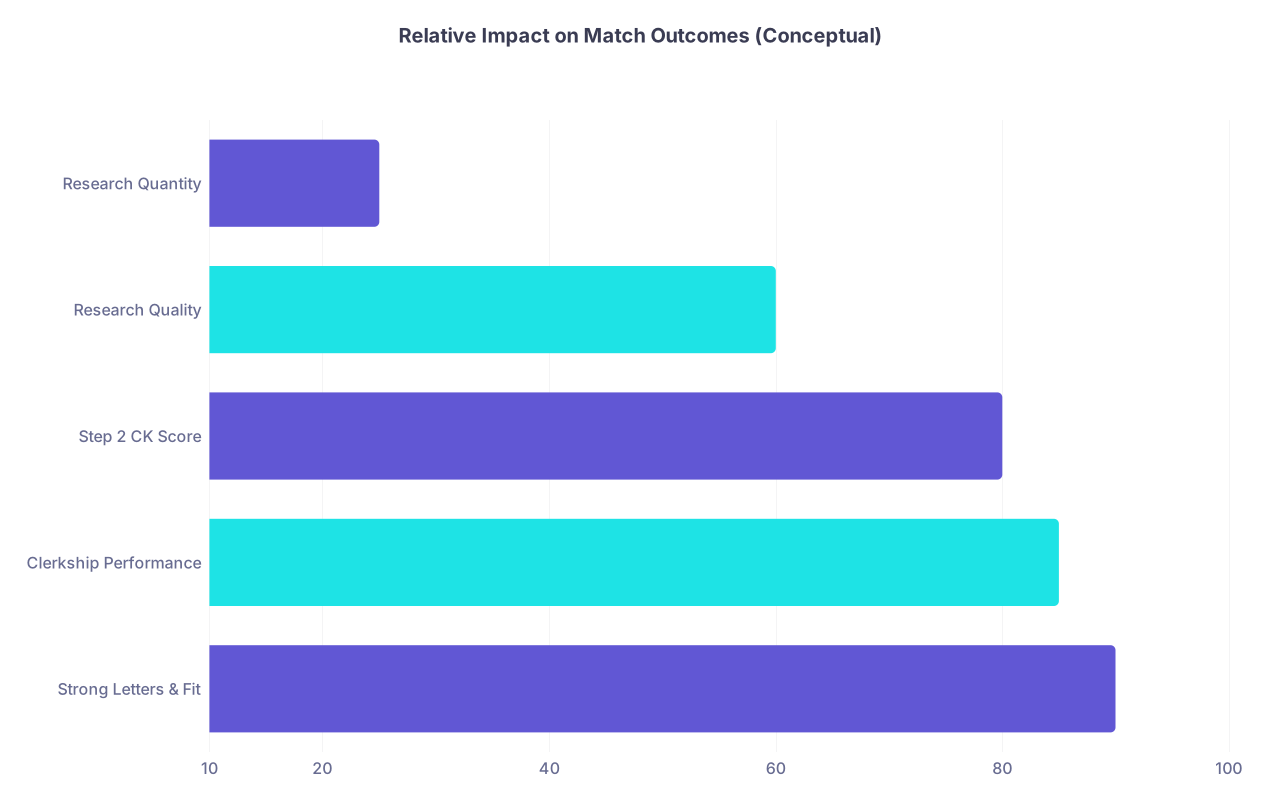
| Category | Value |
|---|---|
| Strong Letters & Fit | 90 |
| Clerkship Performance | 85 |
| Step 2 CK Score | 80 |
| Research Quality | 60 |
| Research Quantity | 25 |
No, these are not exact percentages. But that ranking is directionally accurate for most specialties.
How to Fix Your Application If You Already Over‑Padded
If you are reading this late and have already embraced the “more is more” gospel, you are not doomed. You just need to triage.
Prune ruthlessly on ERAS
You do not need to list every poster you stood in front of. Group related works. Focus on those with:- Clear outcomes
- Your meaningful role
- Relevance to your future specialty
Prepare to deeply discuss 2–3 projects
Decide now: which 2–3 things will you talk about in every interview?
Know them inside out. Methods, results, limitations, next steps.Stop adding low‑yield fluff
You are not going to impress anyone by jumping from 18 to 23 items. You are going to look like you still do not understand the game.

The Core Truth: Research Is Signal, Not Score
Here is the uncomfortable but liberating reality:
Programs do not care how many things you can cram into a spreadsheet. They care what your research says about you:
- Can you ask good questions?
- Can you follow through?
- Can you work in a team without disappearing or taking credit for everything?
- Do you understand the basics of evidence and methodology?
- Are you genuinely curious about your field?
Quantity does not answer any of those by itself. Quality, depth, and coherence do.
Years from now, you will not brag about how many posters you had on ERAS. You will remember the one or two projects where you actually learned something, changed something, or helped move your field an inch forward. Aim for those.