Community programs do not ignore research. They just value it differently than you were told on Reddit.
The premed-to-MS4 folklore goes like this: “Academic = research; Community = just be a hard worker and you’re fine.” I’ve heard that line, verbatim, from applicants on interview trails in internal medicine, EM, surgery, you name it. It’s clean. It’s simple. And it’s wrong in all the ways that actually matter for your match strategy.
Let me walk through what the data and program directors actually say, not what anonymous Discord servers repeat.
What the Surveys Actually Show (Not the Myths)
Let’s start with the closest thing we have to objective: NRMP Program Director Survey data. This is not perfect, but it’s a hell of a lot better than vibes.
In most specialties, program directors—academic and community—are asked to rate factors by importance and report how often they use them to decide whom to interview and rank.
Research output is never the top factor. But it’s also not “irrelevant,” especially as you move from FM/psych to IM/EM to neuro/surg/derm.
Here’s a rough, realistic sketch of how research lands across program types in more “middle-of-the-road” specialties like internal medicine, family medicine, and pediatrics. Numbers are approximate, but the pattern is real:
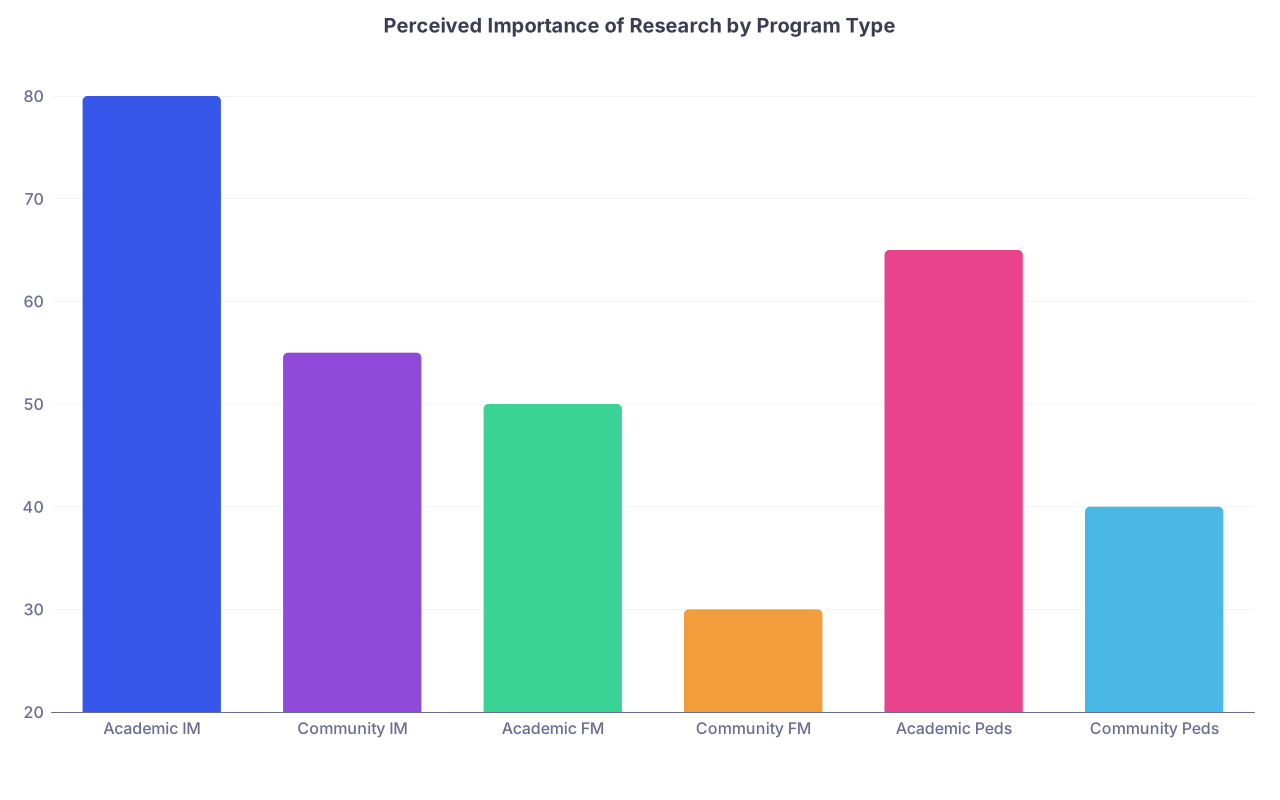
| Category | Value |
|---|---|
| Academic IM | 80 |
| Community IM | 55 |
| Academic FM | 50 |
| Community FM | 30 |
| Academic Peds | 65 |
| Community Peds | 40 |
Those percentages represent the share of programs rating “scholarly activity/research” as at least moderately important in interviews/ranking decisions.
Notice the pattern:
- Academic programs care more. No surprise.
- Community programs still care. Just less, and more variably.
The real myth is binary thinking. It’s not “research matters” vs “research doesn’t.” It’s “where, how much, and for whom.”
I’ve sat in on rank meetings where a community IM PD literally said:
“Research is not our main thing. But if I have two similar IMG files, step scores close, both green card holders, and one has a couple of PubMed-indexed papers in relevant topics? I’m moving that one up.”
That’s the honest hierarchy: not a deal-maker most of the time, but a tie-breaker, a context signal, and occasionally a rescue rope if something else in your app is weaker.
What Community PDs Actually Say When They Aren’t Performing for Brochures
If you read program websites, community programs often market themselves as “clinical workhorses, not research factories.” But web copy is branding, not policy.
Behind closed doors, here’s what I’ve repeatedly heard in community PD discussions (IM, FM, EM, psych, peds):
- “We’re not going to pick a weaker clinician just because they have a PhD.”
- “I like seeing some scholarly curiosity—it tells me they can handle QI and M&M projects.”
- “If they’ve never done a single project, nothing, ever, that’s a little concerning in 2026.”
Notice what’s missing: nobody says research is worthless. What they say is:
- It is not the primary selection filter.
- It is not more important than clinical performance, professionalism, and letters.
- It matters more for some applicants than others.
Let’s break that down by applicant type, because this is where people get burned by bad advice.
Who Actually Needs Research for Community Programs?
You cannot answer “does research matter?” in a vacuum. You answer it in context: who you are, what specialty, and what your other metrics look like.
1. US MD, solid step scores, mid-competitive specialty (IM, peds, FM, psych)
For you, at a typical community program:
- Research is almost never the gatekeeper for an interview.
- Strong clinical grades, decent Step 2, and normal professionalism will do the initial heavy lifting.
- Research—especially basic clinical projects, QI, or case reports—becomes a differentiator rather than a requirement.
Will a couple of posters or a small publication help? Yes. It makes you look engaged, shows effort beyond passively existing. But if you’re otherwise strong, not having them isn’t going to tank you at most community sites.
2. US MD going for competitive subspecialty-oriented paths (cards, GI, heme/onc) and wants a strong community IM program
Now the equation shifts.
Plenty of big community IM programs have strong fellowship pipelines. Their residents are matching cards, GI, pulm/crit. That culture bleeds downward into what they value in residents.
- These PDs know that a resident with some research exposure is more likely to build a fellowship-competitive CV.
- They don’t demand you show up with three first-author NEJM papers.
- But they do like to see evidence you’ll actually engage in scholarly activity once there.
Here, even in a “community” environment, your pre-residency research starts to matter more, because they’re selecting for trajectory, not just service coverage.
3. DO/IMG applicants to community programs
This is the group that gets sabotaged the most by the “community doesn’t care about research” myth.
When PDs talk informally, you hear things like:
- “For DOs/IMGs, research shows drive. It helps me justify taking a chance.”
- “If someone trained abroad but has U.S.-based research with faculty I know, that reassures me.”
Again, research is not magic. But for applicants with:
- Non-US schools
- Older graduation dates
- Borderline scores
…a few solid, verifiable research experiences can be the difference between “auto-skip” and “let’s at least look at this file.”
I’ve seen CVs from IMGs with no U.S. experiences except six months of research at a known academic center—those candidates got more serious consideration at community programs than IMGs with zero research and zero U.S. footprint. That’s not theory; that’s lived reality.
The Kind of Research Community Programs Actually Value
Another myth: community programs only care when you have “basic science R01-level” work. That’s just insecurity talking.
Most community PDs I’ve met do not care about the impact factor of the journal. They’re not parsing H-index. They care whether your scholarly work says anything useful about how you’ll function as a resident.
What lands best for them:
- Clinical research relevant to the specialty (retrospective chart reviews, outcomes projects, quality improvement tied to patient care).
- Case reports or case series that show you can spot and synthesize interesting clinical problems.
- QI projects with measurable impact (reduced readmissions, improved vaccination rates, sepsis bundle compliance).
What they roll their eyes at:
- Fake “research” padded on CVs (“research assistant” with no describable role, no outputs, no mentor reference).
- Grandiose yet vague descriptions: “Worked on multiple groundbreaking oncology trials” with zero specifics, no poster, no abstract, no citation.
- Obviously purchased or pay-to-play “observership-research hybrid” fluff from questionable entities.
If you want to know how PDs mentally weight these things, think of a simple table like this:
| Research Type | Typical PD Reaction |
|---|---|
| Specialty-relevant clinical/QI | Strong positive |
| Case reports with presentation | Mild to strong positive |
| Basic science, solid outputs | Mild positive, context needed |
| Vague “assistant” roles | Neutral to mildly negative |
| Obvious CV padding | Clearly negative |
No, they’re not literally keeping a table like this. But the pattern holds.
Data vs. Dogma: Why the Myth Persists
You might be wondering: if research does matter somewhat, why is everyone so convinced community programs do not care?
Because people oversimplify for coping and for storytelling.
I’ve seen residents tell juniors: “Our PD doesn’t care about research, just be a workhorse.” And then in the next breath complain that the PD ranked the IMG with multiple posters higher than the IMG with none, “even though they were basically the same.”
Here’s what’s really happening:
Research rarely rescues a disaster.
If your Step 2 is 205 for IM or you’ve failed courses/rotations, three posters will not magically erase that. So applicants with big red flags conclude “my research did nothing.” Wrong target.Selection is multi-factor.
Letters, scores, visa status, graduation year, interview performance, interpersonal fit—all weighed together. When you do not see all the other pieces, you over-interpret your own variable (research) as “ignored.”Residents’ memories are biased.
By PGY2, most people forget half their own CV details and why they were actually ranked where they were. They rewrite the story as “I matched here because I’m hardworking and nice” and delete the rest.Internet advice loves binaries.
“Research doesn’t matter for community” is a clean tweet.
“Research is a moderate, context-dependent positive signal that helps more for some applicant types than others” does not go viral.
Academic vs Community: The Real Gap
Now, I’m not pretending there’s no difference. Academic and community programs operate in different ecosystems.
Most academic PDs:
- Are faculty whose promotions depend (at least partly) on scholarship.
- Lead or participate in IRBs, clinical trials, QI collaboratives.
- Need residents who can feed the machine: data collection, abstracts, posters, departmental expectations.
So they will:
- Actively seek residents who already show research engagement.
- View a lack of any research as a mild negative, even in non-ultra-competitive fields.
- Sometimes explicitly filter with “publications/presentations preferred.”
Community PDs:
- Are mostly drowning in service demands and operational headaches.
- Care far more about reliability, work ethic, documentation, and basic resident competence.
- Don’t have the infrastructure to push every resident into projects.
So:
- They don’t want a research prima donna who balks at scut.
- But they do like residents who will at least help with QI, system improvement, maybe a poster at ACP or AAFP once in a while.
A simple way to think about it: academic programs select for research potential as a core trait. Community programs select primarily for clinical reliability, with research as a nice bonus or, for certain categories (IMGs, fellowship-minded applicants), a valuable tie-breaker.
Where Data and PD Opinions Actually Line Up
If you compare the NRMP survey data with how PDs talk, the story is pretty coherent:
- Research is almost never a top-3 factor for community programs across most specialties.
- It consistently shows up as “somewhat important” or “used” for at least a substantial minority of community programs, especially in IM, EM, peds.
- Programs that send graduates to fellowship more often care more about it, even if they’re technically “community.”
- For IMGs and DOs targeting community programs, PDs explicitly mention research as one of the ways they justify selecting outside their usual comfort zone.
You don’t need to worship research. But pretending it’s invisible is just self-handicapping.
How You Should Actually Think About Research for Community Programs
Strip away the noise. If you’re applying mostly or exclusively to community programs, here’s a sane framework.
Ask yourself three questions:
Do I have any meaningful scholarly activity at all?
- If the answer is “no,” and you’re an IMG/DO, or aiming for fellowship later, it’s worth doing at least one decent, real project or case report.
- If you’re a US MD with solid scores and strong clinical evaluations, a modest research footprint is enough.
Can I clearly explain my role and what I learned?
- PDs don’t care if you were “Research Coordinator II.” They care if you can say, “We looked at 300 COPD admissions, I did data abstraction, we found X, and it changed how we Y.”
Does my research support my narrative or contradict it?
- If you claim to love primary care but all your work is in interventional cardiology mouse models, that’s fine—but your story has to make sense.
- If you say you’re all about QI and systems, having zero involvement in any QI is… telling.
Research is not the star of the show at most community programs. But it is part of the set design. Ignore it completely and your stage looks pretty bare, especially if you’re not coming from a position of strength in other areas.
The Bottom Line
Three things to walk away with:
Community programs do not ignore research; they just do not treat it as the primary filter. It’s a secondary but real positive signal, especially for IMGs/DOs and fellowship-minded applicants.
The type and honesty of your research matter more than the prestige. Modest, clearly described clinical/QI work beats vague, inflated “assistant” roles every time.
If you’re banking on “community doesn’t care about research” as an excuse to do nothing scholarly, you’re gambling based on myth, not on what PDs and data actually show.