
The dominance of the Step score is breaking. Quietly, unevenly, and not in the way most applicants think—but it’s no longer the unquestioned king.
Everyone keeps repeating the old mantra: “Step score first, everything else later.” That was mostly true for a long time. It’s now lazy advice. The data from NRMP, program director surveys, and actual match outcomes tell a more complicated story: board performance still matters a lot, but research has moved from “nice bonus” to “functional requirement” in many competitive fields—and a real tiebreaker even in others.
If you’re still planning like it’s 2014, you’re playing the wrong game.
What Actually Changed: Step 1 Pass/Fail Didn’t Just “Shift to Step 2”
The standard myth: Step 1 went pass/fail, so programs just replaced it with Step 2 CK as the new hard cutoff.
Partially true. Also incomplete.
Here’s what the NRMP Program Director Surveys (2018–2022) and match data actually show:
- Programs still use score cutoffs—now mostly Step 2 CK.
- But fewer programs list a specific numerical cutoff in survey responses.
- The relative weight of “Scholarly activity” and “Research experience” has crept up, especially in competitive specialties.
- Holistic review is not a feel-good phrase. It’s mostly:
“We can’t blindly sort by Step 1 anymore, so we’re layering in more filters: Step 2, research, school prestige, letters, and concrete evidence of commitment.”
So no, Step scores didn’t just disappear. But the old single-axis ranking (score → interview → match) got replaced by a two- or three-axis model: score + research + fit/signal.
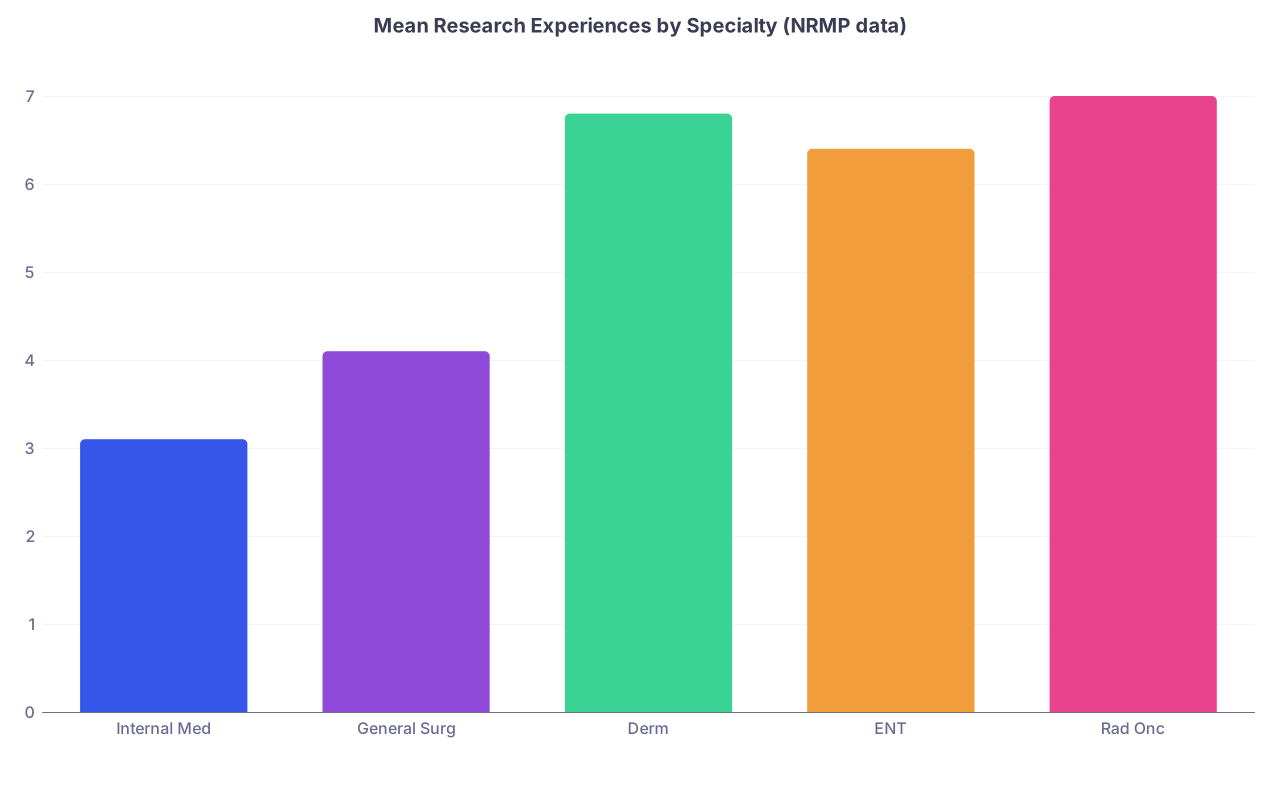
| Category | Value |
|---|---|
| Internal Med | 3.1 |
| General Surg | 4.1 |
| Derm | 6.8 |
| ENT | 6.4 |
| Rad Onc | 7 |
Look at that spread. If you’re pretending research is optional for derm, ENT, or rad onc, you’re kidding yourself.
Is Step Score Still King?
In raw filtering power? Yes—for now. In determining who gets ranked highly once you’re in the room? Much less so than people think.
Where Step Score Still Rules
There are three major functions of Step scores in residency selection:
- Screen out: “Do we even read this file?”
- Signal risk: “Is this person likely to struggle on boards / in training?”
- Fine-tune ranks: “Two similar applicants—who edges ahead on paper?”
Scores still dominate the first two.
For big, high-volume programs—think internal medicine at mid-tier academic centers getting 3,000+ applications—Step 2 CK is still the most efficient early filter. I’ve literally heard PDs say, “Anything under 230 we rarely read unless flagged by our own faculty.” Not universal, but common.
For procedure-heavy and board-pressure fields like anesthesia, radiology, surgery, ortho, Step scores are still strongly tied to perceived risk. Remediation, delayed graduation, board failures—these are expensive for programs. They’re not eager to roll the dice on a 215 if they’ve got a stack of 250s.
So no, you’re not in a fantasy world where research can “make up for” a 205 Step 2 in neurosurgery. It will not.
But here’s where the “Step is king” story breaks down.
Where Step Score Has Lost Its Throne
On the ceiling side, Step is way less decisive than applicants believe.
- A 270 does not make you a guaranteed match in derm or plastics anymore.
- Between, say, 245 and 260, Step is often a threshold, not a ranking weapon. Beyond “acceptable,” other factors take over.
- Once you’re in the “safe zone,” the marginal value of another 5–10 points is often lower than a strong first-author paper or a letter from a known name.
I’ve watched this play out in rank meetings:
- Candidate A: 257, minimal research, no real “story,” generic letters.
- Candidate B: 244, first-author in a reputable journal, clear trajectory in the specialty, glowing letter from a known attending.
Programs arguing hard for B over A is not rare anymore. It’s actually very common in research-heavy specialties.
Because here’s what PDs and faculty quietly care about:
- Who will help us publish and keep our division’s academic output up?
- Who is clearly committed to this field instead of sampling five others until M4?
- Who has demonstrated they finish what they start?
Step doesn’t answer those. Research does.
The Quiet Rise of Research as a Filter
People talk about “research is important,” but they often mean: “It looks nice if you have time.”
That’s outdated. The shift is more structural.
Evidence From NRMP Data
Look at the NRMP “Charting Outcomes in the Match” reports for the last few cycles. One pattern is striking: for matched applicants in competitive specialties, the average number of research experiences and abstracts/pubs/presentations has steadily increased.
| Specialty | Research Experiences | Abstracts/Pubs/Presentations |
|---|---|---|
| Internal Med | ~3 | ~5 |
| General Surgery | ~4 | ~7 |
| Dermatology | ~7 | ~19 |
| ENT | ~6 | ~15 |
| Plastic Surgery | ~7 | ~20 |
Are these exact numbers? No. Are they directionally accurate and frankly absurd compared to a decade ago? Yes.
For derm, ENT, plastics, rad onc, neurosurgery, ortho at top programs—this level of research is no longer an “edge.” It’s the baseline profile of the average matched applicant.
You aren’t competing against the “old” applicant profile. You’re competing against this new, research-heavy cohort.
How Programs Actually Use Research
Programs don’t just count lines on your CV. They use research in three crucial ways:
Evidence of specialty commitment
Longitudinal involvement in one field—multiple projects, poster, maybe a paper—shows you aren’t “derm-curious this month, maybe rad onc next month.” That matters more in the pass/fail Step era because Step 1 is no longer a discriminator.Productivity + follow-through
Everybody can say “interested in scholarly work.” Very few people actually get something over the finish line. A first-author or key middle-author on a real paper says: “This applicant can grind, revise, respond to reviewers, and not ghost when things get hard.”Letter leverage and institutional cachet
When an applicant has done meaningful work with a well-known faculty member, the letter that comes with it carries more weight than any Step score bump. A strong, specific letter from a national-reputation mentor is a trump card in many rank meetings.
So research is no longer just a “checkbox” in many programs. It’s a sorting tool in its own right.
Specialty-Specific Reality Check
Let’s stop hand-waving and get concrete.
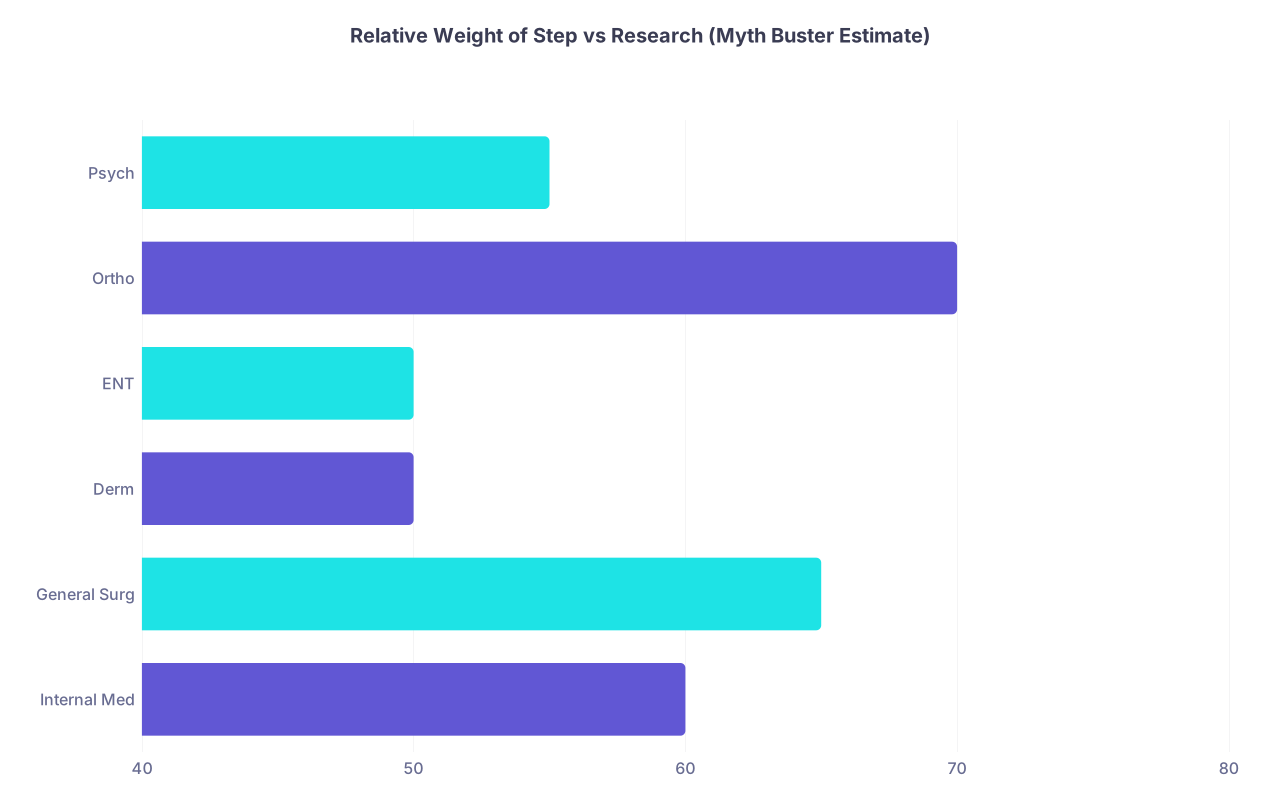
| Category | Value |
|---|---|
| Internal Med | 60 |
| General Surg | 65 |
| Derm | 50 |
| ENT | 50 |
| Ortho | 70 |
| Psych | 55 |
Think of these “values” as the approximate relative emphasis on exam performance (not precise percentages, but relative seriousness). The rest of each bar is filled by research, letters, fit, and other factors. Now:
Internal Medicine (Especially Academic IM)
For big-name IM programs (MGH, Hopkins, UCSF, UCLA):
- Step 2 CK: still important as a floor. Under ~230 and you’re in trouble unless you bring something extraordinary or are at their own med school.
- Research: strong upward trend. For people eyeing cards/onc/GI, having solid research in those fields during med school is borderline expected.
You can match IM community with mediocre research and average scores. But academic IM, physician-scientist tracks, and fast-tracks? Research sits almost equal with Step for competitive candidates.
General Surgery & Ortho
These are still very “Step-heavy” fields, but here’s the catch: the top programs now also expect serious research.
I’ve seen plenty of mid-230s with a year of strong surgical research get more serious consideration than 250s with nothing but shadowing and a single poster.
For ortho and integrated plastics, dedicated research years are increasingly common. Not because everyone “loves research,” but because everyone understands this is how you:
- Get into the specialty at all.
- Land at a top or academic program.
Dermatology, ENT, Neurosurgery, Rad Onc, Plastics
This is where the old “Step is king” narrative is simply wrong.
To be competitive at all, you generally need:
- Solid Step 2 CK (usually at or above national matched mean for that specialty—often well above 240).
- Plus heavy research output, often in that specific field.
- Plus strong specialty-specific letters.
In other words: Step is necessary, not sufficient. The king now rules alongside at least two co-monarchs: research and letters.
I’ve personally seen:
- 260+ Step applicants in derm fail to match with almost no derm research.
- Mid-240s with multiple derm pubs and a year of research land at top programs.
Old rule—“crush Step and you’re set”—does not hold reliably here anymore.
Psych, FM, Peds, and Less Competitive Fields
Here research can still be genuinely optional. But even here, the direction is shifting for top academic spots and for applicants with red flags.
- Great research sometimes rescues an applicant with an okay Step score if the rest of the application is very strong.
- For academic psych, child psych interest, addiction, etc., research is often a meaningful positive signal.
But if you’re aiming for “match somewhere solid,” not necessarily “top 5 program,” Step and letters carry more weight than research in these fields—for now.
The New Strategy: Stop Thinking Either/Or
The most common, and dumbest, false choice I hear:
“Should I focus on Step or research?”
Wrong question. The real questions are:
- Where are you in the risk spectrum for your target specialty?
- What does your application already signal strongly, and what is missing?
- How much time do you actually have before ERAS opens?
Here’s a rough, practical framework.
If You Haven’t Taken Step 2 CK Yet
Your priority stack is:
Do not bomb Step 2.
A poor Step 2 closes more doors than a lack of research. If your baseline practice scores are weak, fix that first. No amount of research compensates for an exam disaster in competitive fields.Once your Step prep is on a safe trajectory, layer in research.
Not “do everything at once.” But you can absolutely maintain 5–10 hours/week of research if you’re disciplined and your project is well-defined. Data cleaning, literature reviews, drafting methods—these can fit in.Pick research that actually fits your story and timing.
Joining a basic science lab 8 months before ERAS with no clear path to output? That’s performative, not strategic. You want projects with a realistic chance of abstract/presentation or at least a submitted manuscript before applications.
If Step 2 Is Done and You’re in the Safe Zone
“Safe” = around or above your specialty’s typical matched mean, with no major red flags.
Then research jumps sharply in value, especially if:
- You have minimal prior scholarly work.
- You’re targeting academic or competitive programs.
- You want to differentiate yourself from a sea of similar scores.
This is where a well-structured research year, or an intense 6–9 months of productivity with an engaged mentor, can change your entire application tier.
If Your Step 2 Is Mediocre for Your Target Field
This is the hardest reality.
- In some specialties (derm, neurosurgery, integrated plastics), a significantly below-average Step 2 basically forces you to rethink specialty or consider a research year plus a very strong back-up plan.
- In others (IM, peds, psych, FM), strong research can partially mitigate a non-stellar score, especially if you sell a coherent academic narrative and get excellent letters.
But let’s be clear: research is not a magic eraser. It’s an amplifier. It makes a good or decent application strong. It rarely makes a weak application safe in highly competitive fields.
What Applicants Keep Getting Wrong
I see the same three flawed mindsets repeat.
“If my Step is amazing, I don’t need research.”
False in competitive and academic-heavy specialties. You’ll look flat compared to your peers with similar scores plus double-digit abstracts.“If my Step is mediocre, I’ll just do a paper or two and be fine.”
One weak publication in an unrelated field will not undo a poor Step in ortho or derm. You either recalibrate your target specialty or commit to a serious, high-yield research plan—often including a full year.“Research is just a checkbox, any project works.”
Also wrong. Faculty see right through filler research. Busy-waiting on a chart review that never finishes or slapping your name on a massive group author list doesn’t show ownership or grit. Programs look for meaningful, sustained engagement and real ownership of a project piece.
The Bottom Line: Who’s Really in Charge Now?
Step isn’t dead. It’s just not the emperor it used to be.
The current reality:
- Step 2 CK is still the primary gatekeeper—especially on the low end. It keeps you out more than it gets you in.
- Research has become a co-equal pillar in many competitive and academic programs, especially once you clear the Step threshold.
- Within competitive specialties, no one axis is enough: Step, research, and letters form a three-legged stool. Lose one completely, and the stool tips.
If you remember nothing else, remember this:
- Step scores still control the floor. They rarely control the ceiling anymore.
- Research is no longer a “bonus line.” In many specialties, it’s a second filter and a major tiebreaker.
- Strategy beats effort. The right mix of solid Step, targeted research, and strong letters, tailored to your specialty, will beat blind Step worship or random CV-padding every time.