
This article is for educational purposes only. It is not financial advice, not legal advice, and not tax advice. Figures vary by individual circumstances, consult a qualified professional before acting.
The Problem: When Sepsis Alerts Become "More Antibiotics Than Evidence"
Sepsis kills fast. Antibiotic resistance kills slow. Both are real, and the tension between them is the entire reason this topic exists.
Hospitals adopted AI sepsis alerts with optimism, and why wouldn't they? Early detection saves lives. CMS bundles reward time-to-antibiotics. Vendors promise improved sensitivity. The pitch is seductive: catch sepsis earlier, treat faster, save more patients.
Here's where the optimism meets friction. In practice, AI sepsis alerts often trigger on nonspecific lab drift, post-op inflammation, or chronically abnormal vitals. The alert fires. The clinician, worried about liability and the sepsis bundle clock, orders vancomycin and piperacillin-tazobactam. Blood cultures? Sometimes. De-escalation plans? Rarely at hour zero. Six hours later, the patient is still afebrile with no growth, but the antibiotic continues because nobody wants to be the one who stopped therapy on someone who might be septic.
That's the mistake. Not the alert itself, but treating "more alerts" as automatically meaning "better outcomes." The data doesn't always cooperate.
What follows is what the evidence actually shows when you compare AI sepsis alert performance against downstream antibiotic overuse rates, and the red flags I want you to watch for before your hospital scales this technology.
What "the Data Says" Can Mean: Metrics, Study Types, and Hidden Confounders
The biggest mistake I see in hospital committee discussions? Conflating diagnostic accuracy with prescribing outcomes. They're not the same thing.
Sensitivity, specificity, and AUC measure whether the alert fires when sepsis is present. Antibiotic days of therapy (DOT), broad-spectrum initiation rates, and de-escalation follow-through measure what clinicians actually do with the alert. These are different endpoints, measured differently, in different study designs, with different confounders.
The metrics you need to track on both sides:
- Alert performance: sensitivity, specificity, positive predictive value (PPV), negative predictive value (NPV), false-positive rate per 100 patient-days
- Clinical process: time-to-antibiotics, blood culture timing, sepsis bundle adherence, lactate measurement
- Antibiotic overuse: DOT per 1000 patient-days, broad-spectrum initiation rates, duration beyond guideline targets, de-escalation within 48-72 hours
- Patient outcomes: mortality, ICU length of stay, C. difficile infection rates, confirmed infection rates
Confounders will eat your analysis alive if you ignore them. Alert thresholds, local antibiograms, baseline sepsis prevalence, order sets, clinician buy-in, and patient mix (ICU vs ward vs ED) all shift results dramatically. A 30% alert sensitivity improvement in a low-prevalence ward might look impressive on paper while doing nothing for outcomes, and driving substantial antibiotic overuse in patients who never had sepsis.
Red flags in published studies:
- Pre-post designs without strong controls
- Follow-up under 12 months
- Missing severity stratification (SOFA, qSOFA, baseline SOFA scores)
- No reporting of NPV or false-positive burden
- Outcomes limited to "antibiotics ordered within 1 hour" without downstream stewardship metrics
AI Sepsis Alerts: Where Performance Improves, and Where It Can Mislead
AI sepsis alerts can genuinely improve early recognition. I've seen implementations where time-to-antibiotics dropped by 30-90 minutes for true-positive cases. Guideline adherence improved. Documentation tightened. These are real wins.
But here's the trap: interpreting sensitivity gains as clinical benefit without checking absolute benefit sizes and harms.
An alert that catches 15 more true sepsis cases per 1,000 admissions is valuable. An alert that fires 200 additional times, and triggers empiric broad-spectrum therapy in 150 of those patients who never had sepsis, is a stewardship disaster disguised as innovation.
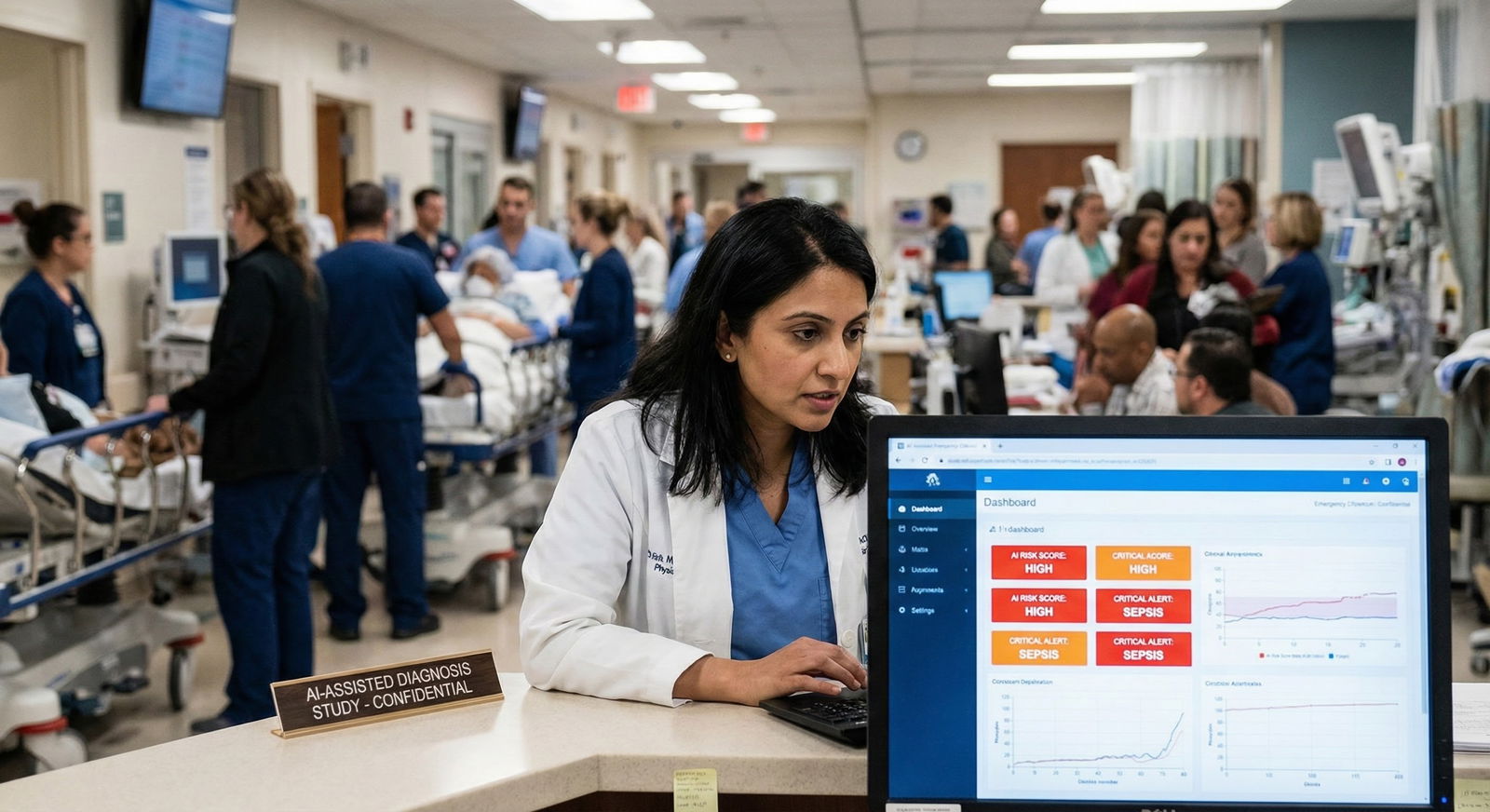
Where false positives inflate antibiotic exposure:
- Nonspecific lab changes (transient leukocytosis, mild lactate elevations)
- Chronic inflammatory states (ESRD, autoimmune disease, malignancy)
- Post-operative patients with expected inflammatory response
- Sterile systemic responses (pancreatitis, burns, trauma)
- Patients with abnormal baseline vitals (chronic atrial fibrillation, baseline tachypnea from CHF)
- Missing context: goals of care, hospice status, comfort-focused treatment plans
The warning signs I watch for:
- Antibiotic initiation rates climbing without corresponding improvement in confirmed infection rates or mortality
- Blood culture contamination rates rising (suggesting reflexive culture ordering at the same time as empiric therapy)
- Delayed cultures because the team jumped straight to "treat-first" without drawing cultures first
- Rising C. difficile rates in wards where the alert is most active
The most damning pattern? Antibiotic use goes up, microbiology yields don't improve, and mortality stays flat. That's not a sepsis program, that's a resistance-generation engine.
Antibiotic Overuse Rates: The Outcomes That Matter for "Don't Make This Mistake" Surveillance
Antibiotic overuse isn't a vague concept. It's measurable, and you should demand it be measured in any sepsis alert rollout.
Define it concretely:
- DOT per 1000 patient-days (total antibiotic exposure normalized)
- Broad-spectrum initiation rate (vancomycin, piperacillin-tazobactam, carbapenems, linezolid, daptomycin)
- Duration beyond guideline targets (>7 days for most uncomplicated infections)
- Antibiotics given to patients without subsequent infection confirmation (this is the critical one)
- De-escalation rate within 48-72 hours
Here's the mistake I want you to stop making: using only process measures like "antibiotics ordered within 1 hour" as a proxy for appropriate use. Timing alone can drive massive overuse. A patient who gets vancomycin and pip-tazo at minute 45 instead of minute 75 may have gotten exactly the same unnecessary therapy.
Downstream signals that matter:
- C. difficile infection rates
- Adverse drug events (AKI from vancomycin, rash, C. diff colitis)
- Escalation patterns (stepping up from ceftriaxone to carbapenem)
- Antimicrobial stewardship audit triggers
Risk adjustment isn't optional. You need to compare like with like, severity (SOFA/qSOFA), comorbidities, ICU vs ward, baseline sepsis prevalence, and case-mix index. Without it, you're comparing apples to submarines.
Illustrative example only. Check for harms whenever broad-spectrum use rises alongside faster antibiotic administration.
What Studies Typically Find When You Compare Alerts to Antibiotic Overuse
Here's the pattern I see most often in the literature, and it's the one that should make you cautious before scaling.
AI sepsis alerts improve early recognition in some cohorts. Time-to-antibiotics drops. But antibiotic overuse rises, unless stewardship guardrails are deployed from day one.
The studies that show the cleanest benefit share specific features:
- Controlled designs (not just pre-post)
- Longer follow-up (12+ months)
- Subgroup analyses (ICU vs ED, low vs high baseline prevalence)
- Stewardship coupling (built into the alert workflow)
- Severity stratification in outcomes
The studies that worry me, and there are more of these than hospitals want to admit, show:
- Improvements limited to documentation metrics (process compliance, not outcomes)
- Overuse gains concentrated in specific wards
- Inconsistent de-escalation follow-through
- No corresponding reduction in confirmed infection rates or mortality
Mistake to avoid: concluding causality from a single before-after study. These designs are vulnerable to Hawthorne effects, regression to the mean, and concurrent QI initiatives that confound the alert's true impact.
Program design changes outcomes dramatically. Alerts coupled with culture-ordering prompts, recommended empiric regimens aligned to local antibiograms, and mandatory clinician justification for broad-spectrum escalation produce different results than standalone alerts. This isn't optional, it's the difference between a sepsis program and a stewardship casualty.
Schematic illustration. Negative values indicate improvement (reduction in time-to-antibiotics or mortality); positive values indicate increase in antibiotic overuse. Real-world results vary by setting.
Guardrails That Prevent the Common Mistakes: How to Use AI Alerts Without Fueling Overuse
The operational mistake I see over and over: deploying alerts without monitoring. The vendor installs the software, the dashboard lights up, and everyone assumes the sepsis program is working because alerts are firing. Nobody checks what happens after.
That's malpractice from a quality standpoint. Here's what the workflow should actually look like.
Watch out: false positives cluster at the clinician review step. Slow down here.
Real-time dashboards you must have:
- Antibiotic starts per 100 patient-days (segregated by alert vs non-alert triggered)
- DOT trend
- Blood culture ordering rate relative to alert count
- De-escalation events within 48-72 hours
- C. difficile rates in units with high alert activity
Stewardship coupling recommendations:
- Automatic prompts for blood cultures before or simultaneously with antibiotic orders
- Empiric regimen constraints aligned to local antibiograms (not unrestricted broad-spectrum access)
- Automatic stop/review reminders at 48 and 72 hours
- Mandatory clinician justification for any escalation to broader therapy
Human-in-the-loop safeguards:
- Confirm clinical context before ordering antibiotics
- Check for false-positive drivers: chronic inflammation, post-op status, sterile systemic response
- Require severity cues (hypotension, lactate >2, organ dysfunction) to trigger broad-spectrum escalation
- Document goals-of-care conversations for patients near end-of-life
Policy-level escalation and de-escalation rules:
- When to broaden (hemodynamic instability, concern for resistant organisms)
- When to narrow (culture data, clinical improvement, low suspicion)
- When to hold (pending cultures, low pretest probability, hospice transition)
- Exception pathways for immunocompromised hosts (often need broader empiric coverage)
Implementation and Reporting Checklist: How to Tell If an AI Sepsis Program Is Safe
Before you scale, before you sign the contract, run through this checklist. If the vendor or your internal team can't answer "yes" to most of these, you don't have a sepsis program. You have an alert looking for a problem.
Patient-mix and severity reporting:
- Baseline sepsis prevalence documented
- Severity stratification (SOFA/qSOFA) in outcomes
- Case-mix index reported
- Clear inclusion/exclusion criteria for the alert cohort
Antibiotic overuse definitions:
- DOT measured before and after
- Broad-spectrum initiation rates tracked
- De-escalation events within 48-72 hours quantified
- Duration beyond guideline targets measured
Harms reporting:
- False-positive burden per 100 patient-days
- Adverse drug events tracked
- C. difficile rates monitored
- Antibiotic resistance trends in units with high alert activity
Red flags to watch for:
- No stratification by baseline infection likelihood
- Lack of culture/timing data
- Missing antibiotic de-escalation follow-through
- Unclear alert threshold tuning process
- No external validation
- Outcomes limited to documentation metrics
Audit cadence:
- Pre-deployment baseline (at least 6 months of data)
- Post-launch monitoring at 30, 90, 180, and 365 days
- Quarterly threshold recalibration
- Feedback loops to clinical teams

Reminder Conclusion: Better Alerts Aren't Automatically Better Antibiotic Stewardship
Track both effectiveness and overuse. Don't ignore false-positive burden. Don't equate faster antibiotics with appropriate antibiotics. Don't scale without monitoring.
AI sepsis alerts are tools, not outcomes. The goal isn't to fire more alerts. It's to save lives without generating the next resistance crisis. Implement stewardship guardrails. Require transparent reporting. Recalibrate alert logic to local practice, continually.
The mistake isn't using AI. The mistake is treating it like a black box that solves sepsis on its own.
Key Takeaways:
- Don't mistake alert performance metrics for stewardship outcomes, track absolute changes in antibiotic DOT and de-escalation, not just time-to-antibiotics.
- The most common failure mode is increased false positives without guardrails; pair AI alerts with culture prompting and 48-72 hour antibiotic review to prevent overuse.
- When reading studies, watch for red flags: inadequate severity adjustment, short follow-up, missing microbiology/culture timing, and lack of harms reporting.