Most applicants overlook program coordinators. That's a mistake.
If you're treating coordinators like faceless inbox managers while saving all your charm for program directors and residents, you're playing the match game badly. Coordinators are often the people who see everything first: your email, your tone, your timing, your professionalism, your weird follow-up at 11:47 p.m., your thank-you note, or the fact that you never sent one. And yes, that matters.
I've seen this happen more than once: two applicants look similar on paper, but one is known as pleasant, organized, and genuinely interested because they interacted well with the coordinator. The other is just another ERAS file. Guess who gets remembered?
This article is for educational purposes only. It is not financial advice, not legal advice, and not tax advice. Figures vary by individual circumstances, so consult a qualified professional before acting.
Why Program Coordinators Are Your Untapped Advantage
Program coordinators are not just schedulers. They're operational hubs. In many programs, they know the entire rhythm of the application season better than anyone else. They know when invites are likely to go out, which faculty are behind on file review, whether the program is expanding, what applicants usually do wrong, and which residents are actually happy versus just smiling on Zoom.
They're gatekeepers in the most practical sense:
- They manage interview logistics.
- They field applicant questions.
- They often notice who is professional and who is a headache.
- They may flag issues before faculty even look at your file.
- They help shape the applicant experience, which means their impressions carry weight.
A lot of applicants underestimate this because coordinators don't always hold flashy titles. That's naive. Influence in residency recruitment doesn't only come from whoever sits at the top of the org chart. It comes from whoever keeps the machine running. That's the coordinator.
In some programs, coordinators have direct access to the program director every single day. Not occasionally. Daily. If they say, "This applicant has been thoughtful, respectful, and clearly interested in our program," that comment lands differently than people realize. It won't rescue a weak application by itself. Let's not be ridiculous. But when you're one of many qualified candidates, small edges matter. This is one of them.
There's another reason this works: most people ignore coordinators entirely. They send polished letters of interest to faculty and gush to residents at open houses, yet fire off lazy, generic questions to the coordinator, or worse, none at all. That creates a huge opening for you.
For a deeper look at how coordinators communicate about candidates, read our guide on what really happens in residency backchannel networking chains.
Here's what coordinators often notice immediately:
- Whether you read the website before emailing.
- Whether you can communicate clearly.
- Whether you respect boundaries and timing.
- Whether your interest in the program sounds real or copied and pasted.
- Whether you're going to be easy to work with as a resident.
And that's the hidden part applicants miss. Programs aren't only selecting strong students. They're selecting future coworkers. Someone has to organize those residents for years. Coordinators know exactly what kind of applicant turns into a reliable resident and what kind turns into an exhausting mess.
Does contacting a coordinator guarantee interviews? Of course not. But it absolutely improves visibility when done well. Visibility matters. In a crowded cycle, being known for the right reasons is a competitive advantage.
Bottom line: if you ignore program coordinators, you're ignoring one of the few people in the match process who can quietly help you without any formal fanfare. That's a bad strategy.
How to Connect with Program Coordinators (Without Being Annoying)
The goal isn't to become memorable because you sent five emails. The goal is to become memorable because you were concise, respectful, and smart. Big difference.
Start by finding the right person. Usually that's easy:
- Program website under Residency, People, Staff, or Contact Us
- GME office page
- Residency social media pages
- If needed, a polite phone call to the office
Don't guess. Don't send your message into a generic black hole if you can avoid it. And don't email three different staff members with the same question. That looks sloppy fast.
Once you find the coordinator, send one good email. One. Not a saga.
A useful structure:
- Subject line: Question from [Your Name], [Program Name] Applicant
- Opening: Brief introduction
- Middle: Why you're interested in the program, specifically
- Close: One clear question and a thank-you
Example:
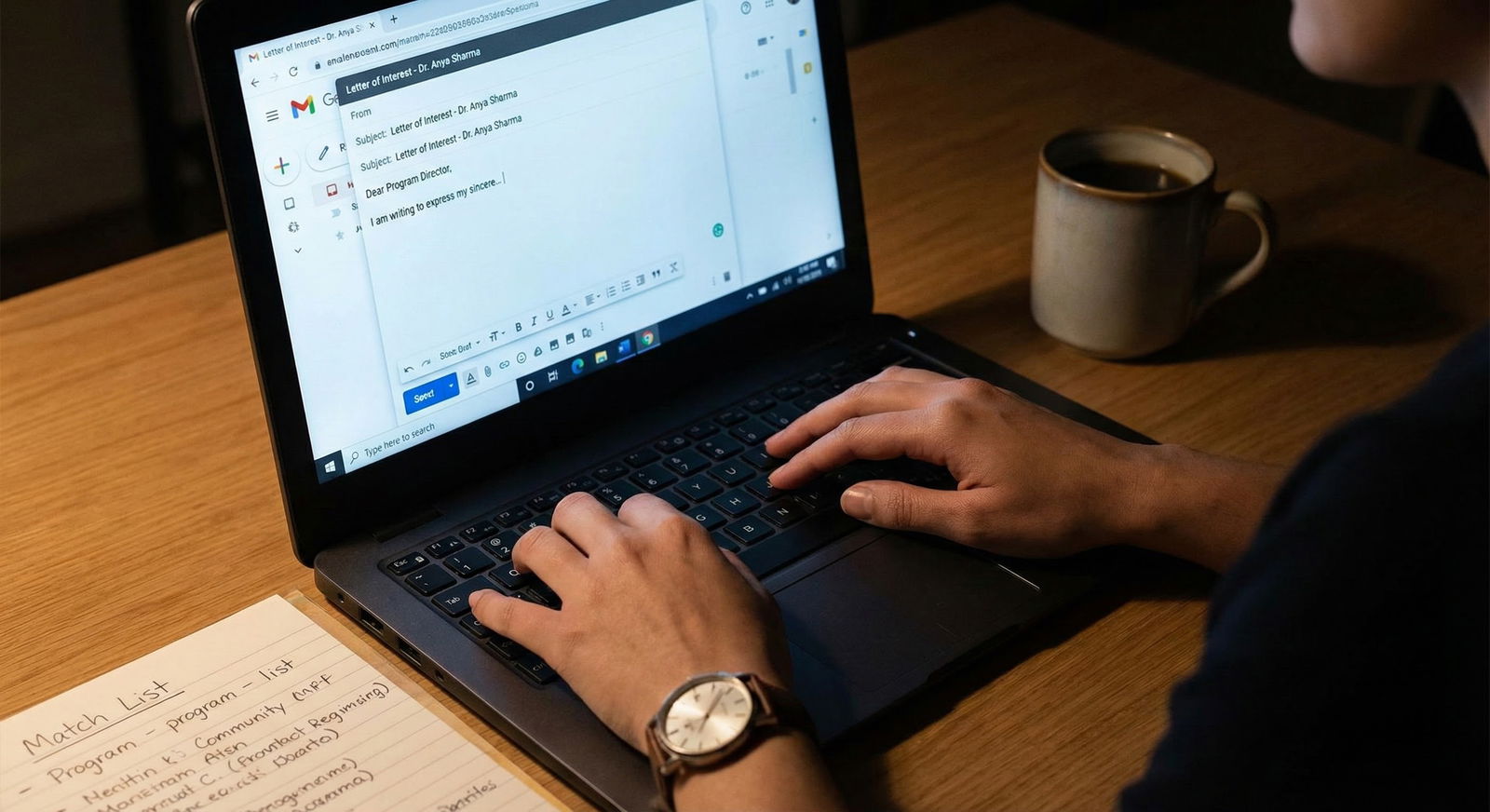
Subject: Question from Maya Patel, Riverside IM Applicant
Dear Ms. Johnson, My name is Maya Patel, a fourth-year medical student at State University, and I plan to apply to Riverside's Internal Medicine residency this cycle. I'm especially interested in your program's strong primary care training and the resident mentorship structure described on your website.
I wanted to ask whether your program plans to host any virtual open houses this season, and whether there are particular aspects of the application your team values most when reviewing candidates.
Thank you for your time and for helping applicants through the process.
Best, Maya Patel
That's it. Clean. Human. Useful.
What makes an email annoying?
- It's too long.
- It asks questions already answered online.
- It sounds entitled.
- It asks for reassurance: "Do I have a shot?"
- It pushes for special treatment.
- It includes multiple follow-ups in a short span.
- It feels mass-produced.
Here's the decision rule I tell applicants: if your message makes the coordinator do unnecessary work, rewrite it.
A few practical rules:
- Keep it under 3 short paragraphs.
- Ask one specific question.
- Wait 5-7 business days before any follow-up.
- Send only one follow-up if needed.
- Always thank them.
- Don't attach random documents.
And yes, tone matters. Coordinators read hundreds of emails. They can smell desperation, flattery, and template spam instantly. You don't need to sound impressive. You need to sound normal, prepared, and genuinely interested.
A follow-up, if needed, should be almost embarrassingly simple:
Dear Ms. Johnson, I wanted to briefly follow up on my message from last week in case it was missed. I remain very interested in the program and would appreciate any guidance when you have a moment. Thank you again for your time.
Done. No guilt-tripping. No "just circling back again." No three exclamation points. No drama.
The best outreach feels easy to answer. That's the secret.
What to Ask and What to Avoid in Email Conversations
Good questions do three things:
- Show you've done your homework
- Give the coordinator something reasonable to answer
- Help you learn something useful
Here are strong questions:
- What does the program value most in applicants?
- Are there upcoming virtual open houses or resident Q&A sessions?
- How does the program support resident wellness?
- Is there anything unique about your interview process this year?
- What advice would you give to someone applying this cycle?
- Are there specific program experiences applicants sometimes overlook?
Why do these work? Because they're respectful and relevant. They let the coordinator share information without putting them in a weird position.
What should you avoid? A lot, honestly.
Bad questions include:
- Do I have a good chance of matching there?
- Can you tell me where I am on your rank list?
- Why haven't I gotten an interview yet?
- What's the salary, vacation, or benefits package?
- Can you put in a good word for me?
- Did the program director read my application?
These are bad because they either:
- Put pressure on the coordinator,
- Ask for confidential information,
- Make you sound self-focused and unprepared, or
- Ask for details better addressed later in the process.
Let's be blunt: asking about your "chances" is one of the fastest ways to look insecure and clueless. Coordinators can't ethically predict your outcome, and forcing them into that corner is awkward for everyone. Same for salary and vacation early on. Those questions aren't evil, but timing matters. Before an interview, they often read as transactional. After you actually have meaningful engagement with a program, they're easier to discuss appropriately.
If you're applying from a smaller institution, you may benefit from advice on building your own network at a community program with few connections.
Tailoring matters too. Generic messages die in the inbox.
Bad:
I am very interested in your esteemed program and would love to learn more about what makes it unique.
That's fluff. Every applicant writes that. It says nothing.
Better:
I noticed your pediatrics program pairs interns with senior resident mentors from month one. Has that structure changed in recent cycles, and is it something applicants often comment on after interview day?
Now you sound like someone who actually looked.
Here's a simple filter before you hit send:
Ask yourself:
- Is this answer already on the website?
- Am I asking for information the coordinator can reasonably share?
- Does this question make me sound thoughtful or needy?
- Did I personalize this to the program?
- Would I be comfortable reading this email out loud to a mentor?
If the answer to that last one is no, don't send it.
Also, don't overdo the relationship. This is still professional communication, not networking theater. You are not trying to become best friends with the coordinator. You are trying to be known as the applicant who is courteous, easy to help, and serious about the program.
That reputation goes farther than people think.
Turning Coordinator Relationships into a Secret Advantage
This is where the payoff happens.
A strong coordinator relationship can help you in quiet ways:
- Your name becomes familiar.
- Your interest in the program feels real.
- You may get clearer guidance about timelines.
- You may hear about open houses, delays, or process updates sooner.
- Your professionalism may be mentioned internally.
And yes, coordinators can advocate for applicants. Not in some dramatic movie scene. Usually it's subtle. A quick comment to the program director. A mention during file discussions. A reminder that an applicant has shown consistent, thoughtful interest. That's often enough to move you from anonymous to recognized.
I've seen applicants get invited after being remembered positively. Not because a coordinator waved a magic wand, but because they helped make sure the file got a second look. That's real. It happens.
What about informal feedback? Sometimes coordinators will tell you useful things if you've built rapport:
- When interviews usually go out
- Whether the program is still reviewing files
- Whether a letter update is worth sending
- Whether there are upcoming events you should attend
That's gold. Not because it's secret gossip, but because it helps you act intelligently instead of guessing.
A word of caution: don't try to "use" coordinators. People can feel that instantly. If your politeness is fake, or you only appear when you want something, it shows. The best approach is simple:
- Be respectful from the first email.
- Be easy to work with.
- Show gratitude.
- Don't ask for favors you haven't earned.
- Keep your communication professional all the way through interview season.
And after the interview? Thank them. Absolutely.
A short thank-you note to the coordinator is one of the easiest wins in this whole process. They handled scheduling, logistics, reminders, tech support, last-minute chaos, and often applicant anxiety. A brief message stands out because so few people send one well.
If you build this relationship the right way, the coordinator becomes more than a contact. They become an ally. Quietly. Efficiently. The kind of ally that can make residency season smoother and your application more visible.
That's not manipulation. That's professional maturity.
Action steps
Do this now:
- Make a list of your top programs.
- Find each program coordinator's correct contact information.
- Read the website before you email. Actually read it.
- Send one short, personalized email with one smart question.
- Track responses and follow up once, politely, if needed.
- Thank coordinators after they help you, and after interviews.
If you want an edge in the match, stop chasing only the obvious power players. The smart move is often the quieter one. Program coordinators are one of the most underused advantages in residency applications.
Use that. Respectfully.