
78% of residents believe “who you know” plays a major or decisive role in getting into competitive specialties—yet the actual match data shows that board scores, research, and class rank consistently predict outcomes better than any single connection.
That gap between perception and reality is the problem.
You’ve probably heard some version of this in the call room or lecture hall:
“Cards is all connections.”
“You’ll never match ortho without an inside person.”
“PDs only rank their own students anyway.”
Comforting if you feel behind on metrics. Terrifying if you do not have a famous mentor. But mostly—oversimplified and wrong.
Let me be blunt: relationships matter in medicine. A lot. But not in the way most students think, and not enough to consistently rescue a weak application in the cold light of a rank meeting.
Let’s tear this apart properly.
What the Data Actually Shows About “Who You Know”
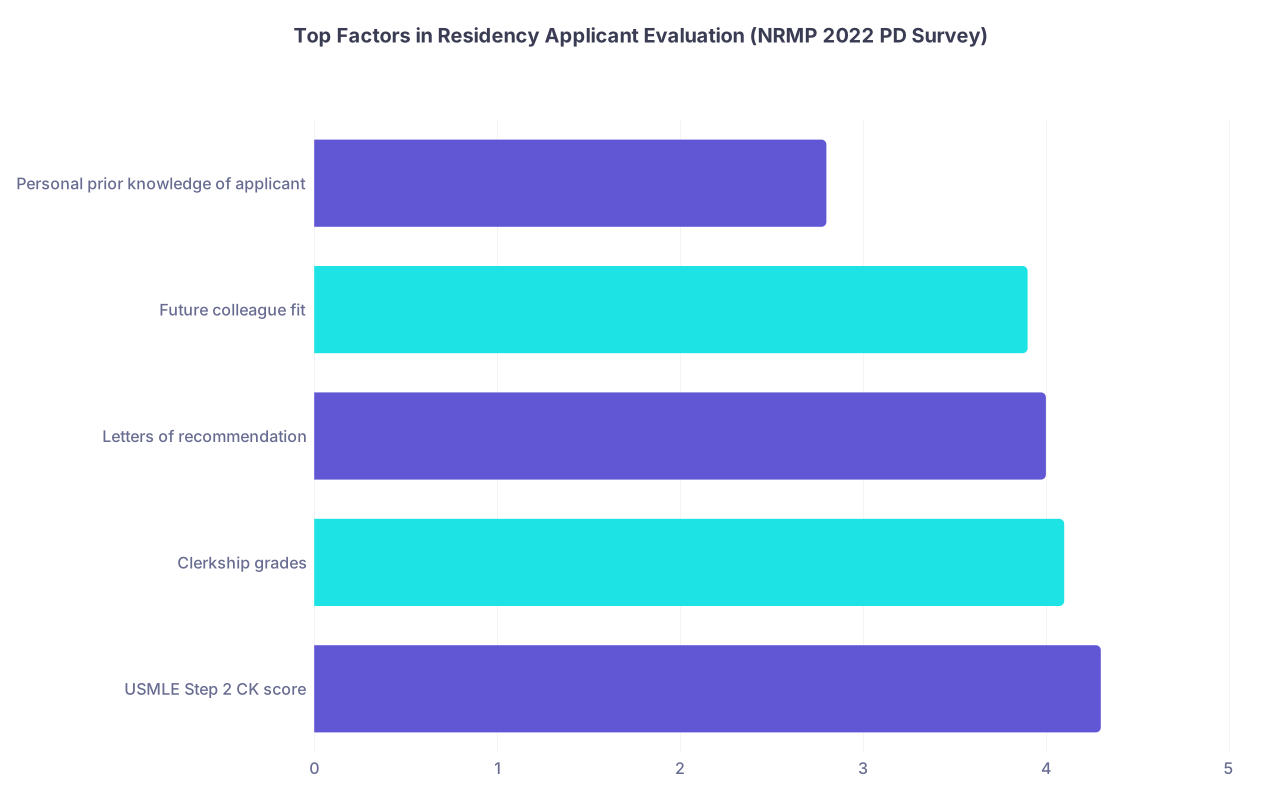
| Category | Value |
|---|---|
| USMLE Step 2 CK score | 4.3 |
| Clerkship grades | 4.1 |
| Letters of recommendation | 4 |
| Future colleague fit | 3.9 |
| Personal prior knowledge of applicant | 2.8 |
Start with something uncomfortable: program directors are not secretly ignoring the objective stuff.
NRMP’s Program Director Survey (2022) asked PDs to rate the importance of various factors (1–5 scale). Across most core specialties:
- Step 2 CK (and now-only board score) sits near the top.
- Clerkship grades and class rank / AOA matter a lot.
- Specialty-specific letters are heavily weighted.
- “Personal prior knowledge of the applicant” is mid-tier. Not trivial, not king.
Is this perfect? No. PDs say one thing and sometimes do another. But if “it’s all who you know” were literally true, you’d see that item at the very top, not floating in the middle of the pack.
To make this concrete, compare how certain “inputs” relate to match outcomes.
| Factor | Typical Effect on Match Odds* |
|---|---|
| Step 2 CK in top 25% for specialty | Strong positive |
| Multiple first-author publications | Moderate–strong positive |
| Honors in core clerkships | Strong positive |
| Home program in that specialty | Moderate positive |
| Away rotation at target program | Moderate positive |
| “Family friend” or weak connection | Small, inconsistent |
*Effect sizes based on trends from NRMP data, specialty organizations, and large institutional outcome reviews—not perfect causality, but patterns are obvious if you look.
Here’s the pattern I keep seeing when I review anonymized match lists with PDs and advisors:
- The “connected but weak” applicant occasionally squeaks through—but usually only when there’s something program-specific they provide (geography, niche interest, diversity of background, language skills).
- The “unconnected but objectively excellent” applicant almost always ends up somewhere solid, often at brand-name places they’ve never set foot in.
- The “average but very strategically networked” applicant often outperforms their raw stats—but they do it by showing value where people can see it, not by getting an uncle to make a call.
Networking amplifies your existing signal. It doesn’t create a signal out of nothing.
The Myth: Connections Trump Competence
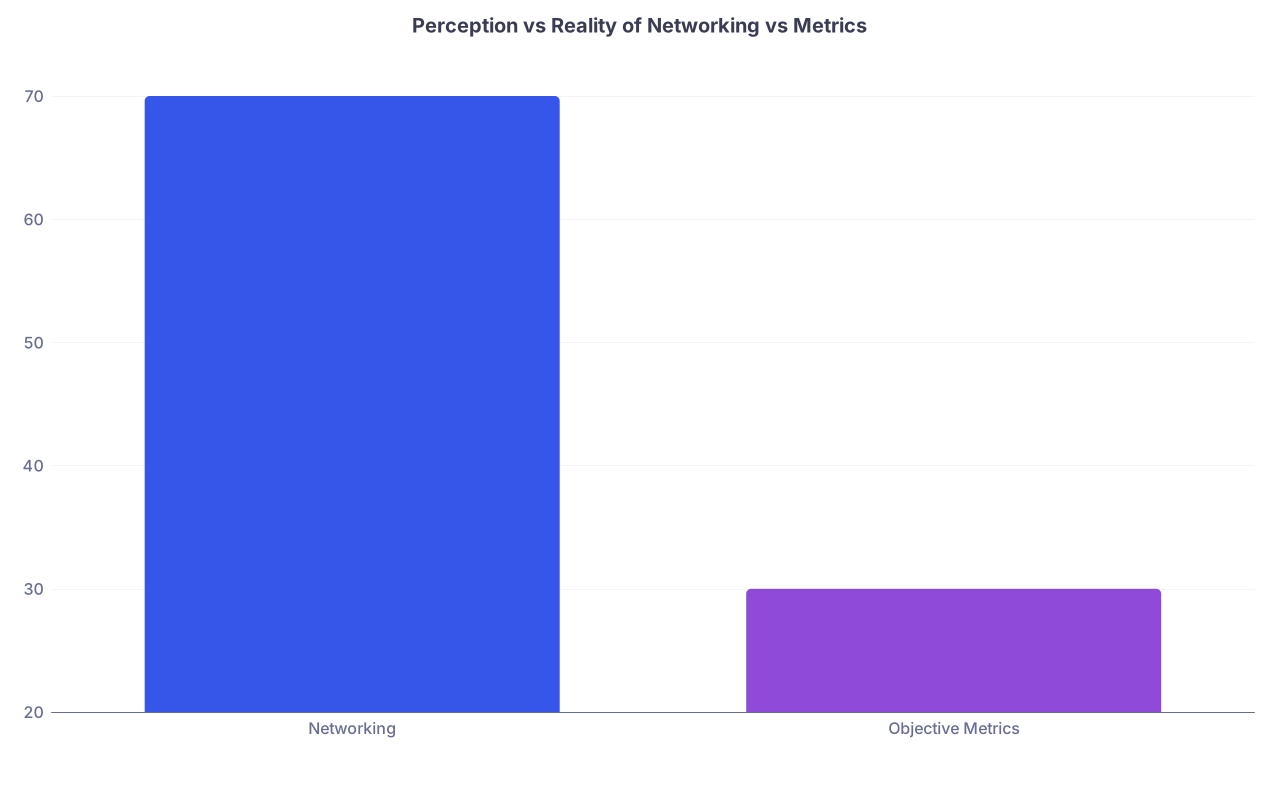
| Category | Value |
|---|---|
| Networking | 70 |
| Objective Metrics | 30 |
If you sit in a student lounge long enough, you’ll hear this storyline play on repeat:
- “She matched derm because her mom is a dermatologist.”
- “He got into that big-name IM program because he did research with the PD.”
- “They only take their own students for ortho; do not bother applying.”
It’s a rigged game narrative. Feels plausible because you only see the tip of the iceberg: the story that’s easy to tell.
What you do not see:
- The applicant whose “connected” parent quietly told them not to apply to dermatology because their numbers were too low.
- The student who worked with the PD and still got ranked in the middle of the list and matched elsewhere.
- The home student who didn’t get an interview at their own program because of professionalism concerns.
I’ve sat in meetings where someone says, “This is Dr. X’s student,” and everyone nods. Then pulls up the file. If the file is weak—shaky exams, lousy comments, meh letters—that “connection” just turns the tone from “no” to “polite no.”
Does favoritism ever happen? Absolutely. I’m not naïve.
But three hard truths:
Favoritism is usually constrained by the floor of competence.
Nobody is failing their board pass rates to protect someone’s cousin.There aren’t enough “favor” spots to explain most outcomes.
Programs rank dozens to hundreds. You might inflate rank by 10–20 spots; that doesn’t convert a bottom-quartile candidate into a guaranteed match.Many “connections” are actually earned relationships.
Students confuse nepotism with the very reasonable outcome of “this PD has watched this student crush work on service for 4 weeks.”
Which leads into what’s actually going on.
The Reality: Relationships Are Multipliers, Not Magic
The honest version isn’t “who you know.” It’s “who knows your work.”
Those are not the same thing.
A generic “knows someone” scenario:
- Your aunt knows a cardiologist at Big Fancy Hospital.
- You ask for a “good word.”
- The cardiologist sends a brief, lukewarm email: “This is my niece; she’s great.”
- Program coordinator adds exactly zero points to your file.
A “knows your work” scenario:
- You do an away rotation on Big Fancy Hospital’s cardiology service.
- You’re the first to the consults, you know your patients cold, you read overnight.
- The cardiology attending you worked with is on the selection committee.
- When your name comes up, they say, “I would work with this person tomorrow again if I could.”
That second one moves needles.
Programs are terrified of two things:
- Residents who will not carry the clinical load safely.
- Residents who will poison the culture.
Relationships—real ones—are evidence against those fears. That is why letters from known faculty, home rotations, and aways can matter a lot. Not because of pure “connection,” but because they’re data. Trusted data from a source the PD knows how to interpret.
If you insist on a slogan, use this one instead:
“It’s all about who has seen you do good work.”
Less catchy. Much more accurate.
Where Networking Actually Does Change Outcomes
This is where the “half true” part comes in. Smart, ethical networking absolutely moves the needle in places students underestimate.
1. Getting the “right eyes” on your file
Programs get swamped. A PD at a large IM program told me: “We could interview 900 people and still reject future stars.” They rely on crude filters—scores, geography, school name—to start.
What networking does here:
- A well-respected faculty member emails a PD saying, “This applicant is better than their Step score; please read their file.”
- A research PI picks up the phone for you with a program where they trained.
- A mentor steers you away from programs that won’t seriously consider your profile and toward ones that will.
This doesn’t guarantee you anything. It just gets you read. Massive difference between “auto-filtered out” and “read and consciously rejected.” The former you cannot fix. The latter you can learn from.
2. Converting paper strength into interview performance
You’ve met the person with phenomenal stats who interviews like a malfunctioning robot. You’ve also met the “medium stats” person who walks out of interviews with faculty saying, “I want them on my team.”
Networking—properly done—gives you reps and feedback:
- Mock interviews with faculty who actually grill you like a PD would.
- Real conversations where you learn how to talk about your work, not recite it.
- Informational meetings that expose you to the value system of a field.
That’s networking as skill-building, not door-opening. It still counts.
3. Creating opportunities long before “application season”
Most of the major differentiators are built 1–3 years before you hit Submit:
- Serious research with meaningful roles in study design, data analysis, or first authorship.
- Leadership positions that involve real responsibility, not just adding your name to a student group list.
- Niche interests (global health, medical education, informatics) that lead to talks, posters, or curricular work.
Those opportunities do not drop from the sky. They come from sending awkward emails, showing up to conferences, cornering someone after grand rounds to ask about their project. That’s networking. The unsexy kind.
Where “Who You Know” Is Overrated—or Flat-out Useless
Let’s point to some areas where people massively overestimate the power of connections.
1. Overcoming a bottom-tier academic record
You failed Step 1 twice, barely passed Step 2 on a third attempt, and have consistent below-average clerkship comments.
No amount of “who you know” will reliably place you into neurosurgery or dermatology. The informal sequence I’ve heard again and again in selection meetings:
- “Do we think this person can pass the boards?”
- “Do we trust them with overnight calls in PGY-2?”
- Only then, “Do I like them?” and “Do I know them?”
If your foundation is shaky, fix that first. Networking can help you find remediation resources, programs open to nontraditional trajectories, or alternative paths (prelim years, different specialties). But it is not a cheat code.
2. Forcing a bad specialty fit
I’ve seen applicants pushed by family into fields they clearly dislike because “we know people in ortho” or “the chair owes your uncle a favor.”
The result is predictable:
- Mediocre performance on rotations because they hate the work.
- Tepid letters full of coded warning phrases.
- Awkward interviews where faculty can tell the applicant is chasing prestige, not alignment.
Even strong connections hesitate to sponsor someone into a field where they will obviously be unhappy or unsafe. Because it will come back to them.
3. Post-Match reality
Connections might help you land a spot. They will not carry you through residency.
Once you’re in:
- Nurses will not care who your mentor is when you blow off pages.
- Attendings will not care who your parent is when your notes are half-baked.
- Your program director absolutely will not care who made the initial call when they’re deciding whether to remediate or non-renew a contract.
That’s the part people conveniently skip when they glorify “who you know.”
How to Build the Kind of Network That Actually Matters
Let’s fix the word. Networking in medicine that works looks a lot less like “schmoozing” and more like “genuinely collaborating with people you respect.”
Practical version, stripped of fluff:
Do excellent, reliable work wherever you are right now.
The best networking tool is still “I would work with this person again.” This travels.Ask for feedback early, not when you’re panicking.
“What would make me a strong applicant for cards from your perspective?” asked during MS2 is networking. And planning.Show up where your future colleagues actually gather.
Specialty conferences. Local society meetings. Institutional research days. You do not have to know anyone going in; you just need the nerve to introduce yourself and ask decent questions.Follow up like an adult.
Short, specific email. Reference the actual conversation. Ask one realistic next-step question. Do not ask for “sponsorship” on day one; ask for a paper to read, a project you can help with, or advice on a decision.Protect your reputation.
Medicine is a small town with better parking. People talk. Your name accumulates adjectives—“solid,” “flaky,” “sharp,” “entitled”—and those travel faster than any formal letter.
Do this consistently and yes, “who you know” starts to matter. Not because it bypasses merit. Because it documents your merit in human terms that PDFs cannot capture.
The Future: Will Networking Matter More or Less?
Some people think AI screening, holistic review, and pass/fail boards will kill the influence of connections. That’s naïve.
If anything, as objective metrics blur, trusted human vouching becomes more valuable, not less.
- Step 1 is pass/fail. More noise in the signal.
- Schools are moving to pass/fail clinical grades. Less stratification on paper.
- Application volumes keep inflating. PDs are drowning.
When everyone looks identical on the spreadsheet, what breaks ties?
- Narrative comments from people the PD knows.
- Phone calls that say, “I have worked with this person. They will not embarrass you.”
- Demonstrated commitment to a specialty over time—not one last-minute away rotation.
So no, networking is not going away. But the winners will be the ones who understand that the game is about earned trust, not social climbing.
FAQs
1. Can a strong connection ever fully override weak scores?
Very rarely, and usually only when “weak” means “borderline,” not “disastrous.” A respected mentor might persuade a program to look past an average Step score if the rest of your performance screams “excellent clinician.” But persistent, major red flags—failures, professionalism issues—are extremely hard to wash away with any single relationship.
2. Is it worth doing an away rotation at a dream program just for exposure?
Yes—if your baseline is competitive for that program and specialty. Aways are high-risk, high-reward networking: you’re asking to be judged up close. If you shine, that’s the strongest “who knows your work” signal you can generate. If you’re shaky, you’ve just handed them negative data with your name on it.
3. How do I network if I’m introverted or at a non-name school?
You do not need to be the loudest person at a reception. Start small: email faculty whose work you genuinely admire, volunteer for projects, attend smaller local meetings where conversations are less chaotic. Focus on building a few deep relationships rather than dozens of superficial ones. Quiet, thoughtful reliability impresses more than forced charisma.
4. Are “family connections” in medicine as powerful as people say?
They open doors for conversations, not for guaranteed positions. A parent or relative can introduce you, maybe get your file read more carefully. But they cannot single-handedly override a consensus that you’re not ready for a field or that another applicant is clearly stronger. In many academic settings, overt nepotism is actually a liability and people tread carefully.
5. If I feel behind on networking, what’s the single highest-yield move now?
Identify one or two people in your specialty of interest who actually know your work (or could, soon). Ask them for a brief, focused meeting about your trajectory. Show them you’ve done your homework, ask for honest feedback, and ask what concrete steps in the next 6–12 months would make you an easy “yes” for programs like theirs. Then do those things well and circle back.
Years from now, you won’t remember who promised to “put in a word” for you. You’ll remember the few people who truly saw your work—and the standard you held yourself to long before anyone was watching.