
What if the loudest person at the conference is not actually the one building the strongest network?
Let me go straight at the myth: medicine has a quiet bias toward extroverts. Every student hears some version of, “You’ve got to put yourself out there,” usually yelled by the guy who’s already “putting himself out there” in every teaching round and Q&A mic line.
The implication is clear: if you’re not naturally outgoing, you’re doomed to weak connections, fewer opportunities, and a slower career. That story sounds plausible.
It also happens to be wrong.
The Data: Networking ≠ Being the Loudest in the Room
First, separate two things people lazily conflate:
- Being extroverted
- Being effective at building and maintaining professional relationships
They’re not the same skill set. At all.
Personality research (Big Five traits: extraversion, conscientiousness, agreeableness, etc.) has looked at this in other fields pretty extensively. Healthcare-specific studies are fewer, but we’re not operating in a black box here.
Here’s what the broader data actually shows:
Extraversion predicts quantity of interactions more than quality of relationships. Extroverts talk to more people; that does not automatically translate to deeper trust, mentorship, or long-term sponsorship.
Conscientiousness and agreeableness are often stronger predictors of who gets strong recommendations, dependable collaborations, and leadership opportunities. In medicine, those two traits matter a lot more than who “works the room.”
Introverts are often better at:
- One-on-one conversations
- Listening
- Following up deliberately
And those three things—focused attention, recall, and consistent follow-up—are the backbone of networking in medicine. Not charm. Not crowd performance.
You don’t need to take my word for it. Look at how careers in healthcare actually move:
- Who gets the glowing letter that says, “I would trust this resident with my family”?
- Who gets asked quietly to join the grant, the QI project, the leadership committee?
It’s not the person who handed out the most business cards at the last conference. It’s the one who built trust over repeated, meaningful interactions.
Where the “Extroverts Win” Myth Comes From
This myth survives because people confuse visibility with networking.
Extroverts tend to be more visibly social:
- More likely to raise their hand during talks
- More likely to hang in large groups at conferences
- More likely to look “connected” because everyone recognizes them
But visibility is the flashy front end. Networking is what happens after the talk ends, after the name tag comes off.
In healthcare, the things that actually move your career are mostly quiet:
- A PD emails a colleague: “Do you know this person?”
- A senior physician calls someone on your behalf
- A researcher thinks of you when a multicenter project needs another site
- A nurse manager vouches for you to a new attending
None of that requires you to be loud. It requires you to be remembered for the right reasons and to have a few people who actually know you.
The irony? I’ve watched very extroverted residents who were “networking machines” stall out because everyone knew them, but not many trusted them. Lots of surface, not enough depth.
What Actually Works in Healthcare Networking (And Why Introverts Have an Edge)
Strip networking in medicine down to its functional parts. It’s basically:
- Being known
- Being trusted
- Being remembered at the right moment
Extraversion helps with the top of the funnel (being known). That’s it. The other two—trust and recall—are where introverts often outperform, if they stop trying to network like extroverts and lean into their strengths.
1. One-on-One > “Working the Room”
Most medical opportunities flow through small interactions, not big performances.
Which is more likely to lead to a meaningful connection?
- Option A: You rush around a poster session, introduce yourself to 20 people, say “We should stay in touch,” and then never follow up.
- Option B: You have two 15–20 minute conversations, ask focused questions, reference that person’s actual work, and then send a short, specific follow-up email.
Every PD, division chief, and researcher I know prefers B. It signals seriousness. It builds trust. And it’s exactly how introverts like to interact—deep, not wide.
2. Focused Curiosity Beats Charisma
Healthcare is full of people who love talking about their specialty, their research, their latest trial, their program’s unique process. You don’t need to be charismatic. You need to be curious and specific.
Notice the difference:
- Weak: “I’m interested in cardiology too.”
- Strong: “I read your JACC paper on post-MI follow-up. You mentioned adherence falling off after 3 months. Have you changed your clinic protocols to handle that?”
Guess which one makes an attending light up and remember you?
Introverts excel here because they naturally prepare. They’d rather know a lot about a few people they’ll meet than shotgun introductions across a room. That’s a strength, not a bug.
3. Follow-Up: The Quiet Superpower
Extroverts often dominate the first interaction. Introverts quietly win the second, third, and fourth.
In medicine, the “second touch” is where the relationship really forms:
- You email a resident after a rotation to thank them and ask a targeted question about programs.
- You send a brief note to a speaker whose talk you connected with, mentioning one specific point that stuck with you.
- You run into someone again at a conference and recall a detail from last year’s conversation.
That’s how you shift from “random student I met once” to “someone I recognize and respect.”
Let me spell out how absurdly low the bar is here: most people do no follow-up at all. None. If you send one thoughtful email and then one or two brief updates over a year, you’re already in the top 10–20% of “networkers” in medicine.
Introverts are usually good at this because:
- They notice details
- They remember the substance of conversations
- They’d rather write a careful email than improvise in a group
Use that.
Different Styles, Same Goal: Pick the Networking That Fits You
Let’s compare the stereotypical “extrovert playbook” with an introvert-friendly one that is just as effective—often more.
| Aspect | Extrovert Style | Introvert Style |
|---|---|---|
| Primary setting | Large groups, receptions | One-on-one, small groups |
| Contact volume | Many brief interactions | Few, deeper interactions |
| Strength | Visibility, first impressions | Listening, follow-up, depth |
| Typical mistake | Shallow, scattered connections | Over-avoiding new interactions |
| Best use case | Broad exposure, initial reach | Building trust, long-term advocates |
You do not need to “fix” being introverted. You need to stop trying to mimic an extrovert template that isn’t even optimal in healthcare.
Where Introverts Actually Get Hurt (And How to Fix It Without Faking Extroversion)
Let me be fair: there are ways being introverted can hurt you, but they’re not the ones people usually complain about. The damage comes from avoidance, not temperament.
Here’s where I’ve seen introverted students and residents shoot themselves in the foot:
Never initiating
- Waiting to be “discovered” on rotation
- Hoping attendings or residents will automatically remember them
Refusing low-stakes visibility
- Always standing in the back of the conference room
- Never asking a question, even when they genuinely have one
Overthinking outreach
- Drafting an email 7 times and then never sending it
- Deciding, “I don’t want to bother them,” while everyone else is actually bothering them and getting help
These are solvable without pretending to be someone else.
Concrete, Introvert-Compatible Fixes
Set a tiny, measurable rule:
- “On each rotation, I will intentionally talk one-on-one with two residents or attendings about their path.”
- Not 20. Not every day. Two. Over 4 weeks.
Use email as your main networking channel:
- Before a conference: email 2–3 people whose work you genuinely care about, and ask if you can say hello briefly after their talk.
- After a talk or rotation: one short thank-you email with a concrete callback to something specific they said or did.
Ask “safe questions” in public, deeper questions in private:
- Public (conference/Grand Rounds): “In your experience, how does this play out differently in community hospitals vs academic centers?”
- Private (one-on-one): “How did you decide you were ready to apply for that leadership role?”
You’re not forcing yourself to be a showman. You’re giving people openings to connect with you in a way that plays to your strengths.
The Hidden Advantage: Medicine Rewards Depth and Reliability
Here’s the part no one says out loud: healthcare is structurally biased toward people who are:
- Steady
- Predictable
- Detail-oriented
- Good listeners
Most introverts check those boxes more often than extroverts do.
Who do you want as:
- The co-author on your complicated manuscript?
- The person managing your shared panel of complex patients?
- The junior attending you recommend for a big committee?
You want someone who follows through, doesn’t spin out, listens to nuance, and doesn’t make it about themselves.
That’s not an “extrovert skill set.” That’s an “adult professional” skill set, and introverts are often closer to it by default. Networking in medicine is just the social version of the same thing: show up consistently, listen well, add value, and keep threads alive over time.
A Quiet Example: The “Invisible” Resident Who Won
I watched this play out with a resident in internal medicine who was classic introvert material: soft-spoken, rarely spoke in conference, hated big receptions.
If you judged by noise level, she looked “poorly networked.” But look closer:
- She always stayed a few minutes after sign-out to ask the attending a specific question about their career or a tricky case.
- She emailed a couple of former chiefs a couple of times a year with short updates and a genuine question.
- She read people’s actual papers before asking them about their work.
When fellowship season came around, she didn’t have 100 superficial contacts. She had maybe 8–10 people—attendings, former chiefs, a PD—who knew her well enough to pick up the phone. She matched into a competitive cardiology fellowship at a program that “never” took from her home residency.
Not because she “networked like a pro” at cocktail hours. Because she built quiet, durable relationships over years.
The Future of Networking in Medicine: Even Better for Introverts
If anything, medicine is moving toward a world that favors introvert-style networking.
A few trends:
- Virtual conferences, virtual away rotations, and remote meetings reward written communication, thoughtful questions, and direct follow-up. Not working the lobby bar.
- Collaborative research and multi-site QI projects happen over email, shared docs, and scheduled Zoom calls. Not random conference hallway bumps.
- Reputation is being built more on what you produce (papers, protocols, educational content, QI outcomes) and how you collaborate than how many hands you shake.
If you’re introverted, that should sound familiar. It’s exactly how you’d prefer to operate: deliberately, in smaller settings, with time to prepare.
Stop telling yourself you’re behind. The environment is shifting toward your strengths.
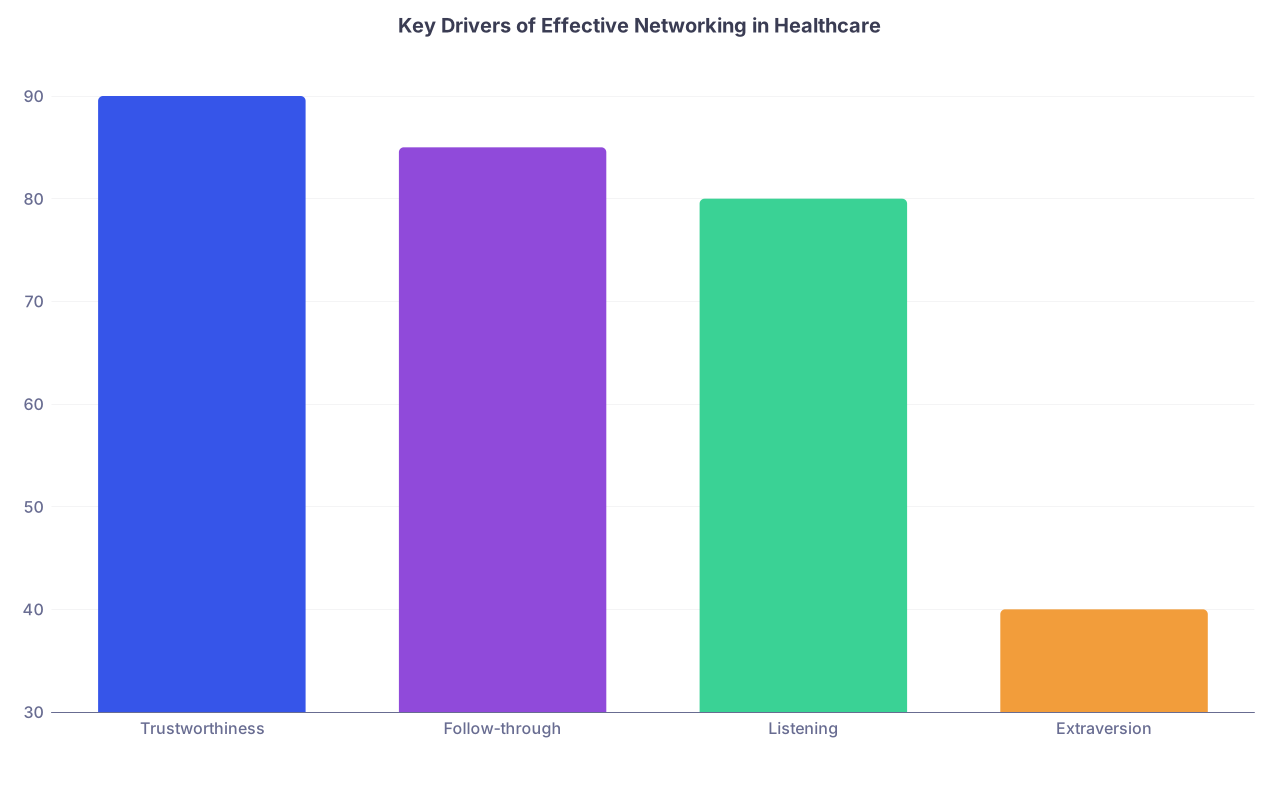
| Category | Value |
|---|---|
| Trustworthiness | 90 |
| Follow-through | 85 |
| Listening | 80 |
| Extraversion | 40 |

A Simple, Realistic Networking Blueprint for Introverts in Healthcare
Here’s a concrete approach that works, without forcing you to fake extroversion:
Identify 5–10 people per year you’d genuinely like to learn from.
- Attendings, residents, fellows, researchers, not all “famous” people.
Have a real conversation with each of them once.
- On rotation, after a talk, via a short Zoom call or coffee.
Follow up 2–3 times over the next 12–18 months.
- A thank-you. An update. A specific question. A “I saw your recent paper—congrats.”
That’s it. You don’t need 500 LinkedIn connections. You need 20–40 people over several years who know who you are, what you care about, and that you’re serious.
If you do that, I don’t care whether you’re a classic introvert, ambivert, or the quietest person in the room. You’ll be better networked than most of your peers who are still chasing volume and visibility.

| Step | Description |
|---|---|
| Step 1 | Identify 5 to 10 people |
| Step 2 | Have 1 real conversation |
| Step 3 | Send brief follow up |
| Step 4 | Share update or question later |
| Step 5 | Maintain light ongoing contact |
| Step 6 | Become trusted connection |
The Bottom Line
You don’t need to be extroverted to network well in healthcare. You need to:
- Stop conflating noise with value—networking is about trust, not volume.
- Lean into introvert strengths: focused curiosity, deep one-on-one conversations, and consistent follow-up.
- Build a small, strong web of real advocates over time instead of chasing endless shallow contacts.
If you do that, the “extroverts win at networking” myth stops being intimidating and starts looking like what it is: lazy thinking, not reality.