The fastest way to burn a bridge with an attending you’ve never met is with a sloppy, tone-deaf networking email.
You get one shot at a first impression. Most students waste it with the same annoying phrases that scream: “I don’t understand how busy you are” and “I think the world revolves around my CV.”
Let me walk you through the 10 phrases that instantly lower your chances of getting help, mentorship, research, or a reply at all.
Why Attendings Hate Most Networking Emails
Before the phrases, you need to understand the power dynamic you’re walking into.
Attendings are reading your email:
- Between notes and pages
- At 10:30 p.m. after a 12-hour day
- On their phone while walking to a case or a family meeting
They’re not sitting at a mahogany desk thoughtfully considering each message. They’re triaging.
Your email either:
- Feels respectful, specific, and easy to respond to
or - Feels entitled, vague, and like more work
The phrases below shove you straight into the second category.
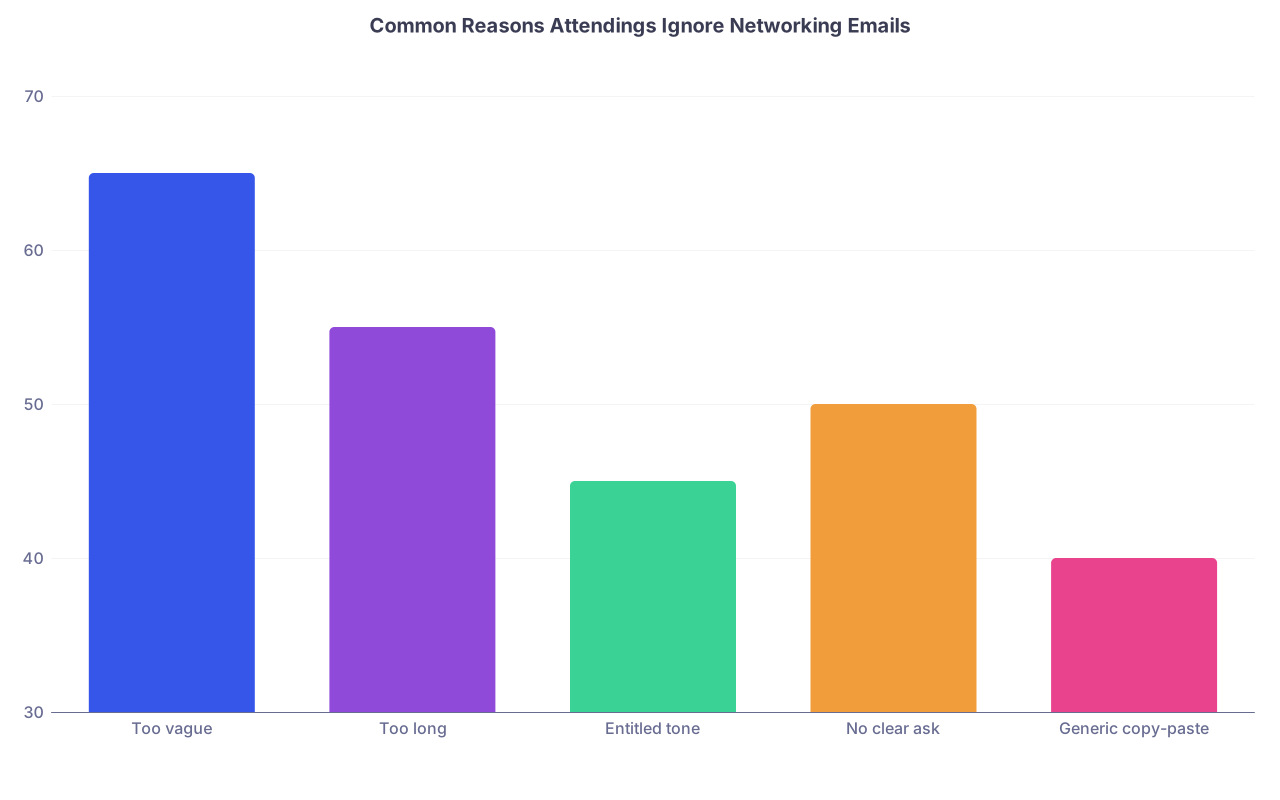
| Category | Value |
|---|---|
| Too vague | 65 |
| Too long | 55 |
| Entitled tone | 45 |
| No clear ask | 50 |
| Generic copy-paste | 40 |
Phrase #1: “I know you’re very busy, but…”
This one looks polite on the surface. It’s not. It’s manipulation dressed as courtesy.
What it really says:
- “I know this is an imposition, but I’m still going to make you feel guilty if you say no.”
- “I’m about to dump a long request on you and hope this sentence softens it.”
Most attendings hate this line because it’s become email wallpaper. They see it 20 times a week. I’ve heard people literally say, scrolling through their inbox, “If they say ‘I know you’re busy’ in the first line, I’m already out.”
Better move: Skip the fake acknowledgment and respect their time with structure and brevity.
Instead of:
I know you’re very busy, but I was wondering if you could…
Use:
I’ll keep this brief. I’m a [MS3 at X] interested in [Y]. I have a specific, small request:
You show respect by making the email short, clear, and easy to answer. Not by telling them you “know they’re busy.”
Phrase #2: “I would love to pick your brain about…”
This is a huge red flag.
“Pick your brain” sounds:
- Vague
- One-sided
- Like you want free consulting with no preparation on your end
I’ve seen attendings read that line and say, “So… they want me to do their thinking for them.”
You’re asking for attention, time, and expertise. You must show you’ve done some work already.
Instead of:
I’d love to pick your brain about cardiology as a career.
Try:
I’m deciding between cardiology and critical care. I’ve read about both paths and spoken with our residency director. I’d value 15 minutes of your perspective on how you chose cardiology and what you wish you’d known as a resident.
Specific. Prepared. Time-limited. That gets answers.
Phrase #3: “Can you be my mentor?”
Nothing scares off a potential mentor faster than treating mentorship like a one-click subscription.
This line fails because:
- It’s premature. You haven’t even met yet.
- It implies a large, open-ended time commitment.
- It’s like asking someone to move in on the first date.
I’ve heard attendings say, “They want a mentor, but they can’t define what they actually need. That’s not mentorship, that’s babysitting.”
Instead of asking for a big label, ask for a small, concrete step.
Bad:
I was wondering if you could be my mentor.
Better:
Would you be open to a brief meeting to see if I might be helpful on any ongoing projects and whether continued contact would make sense?
Or even simpler:
Would you be open to a 15-minute call in the next few weeks?
Start with one point of contact. Let the relationship grow organically. Mentorship is earned over time, not requested in paragraph three of a cold email.
Phrase #4: “I am extremely passionate about…”
Every student is “extremely passionate.” About research. About underserved populations. About cardiothoracic surgery. About “innovation and leadership.”
That phrase is so overused it’s meaningless.
What attendings actually think when they see it:
- “Show me, don’t tell me.”
- “Which essay template did you copy this from?”
Passion is proven with:
- What you’ve done
- What you’re willing to do
- How specifically you talk about your interests
Instead of:
I am extremely passionate about oncology and would love to work with you.
Try:
I’m interested in gynecologic oncology and recently completed a QI project on peri-op counseling for chemo patients. I read your recent paper on [X] and wondered if you have any ongoing projects where a student could help with data collection or chart review.
No “passion” word needed. Your actions and specificity do the job.
Phrase #5: “I was wondering if there are any research opportunities…”
This one can work, but most people use it wrong.
The mistake:
- It’s vague.
- It creates work for the attending to figure out where you might fit.
- It sounds like you’re sending it to 40 people at once.
I’ve watched faculty open that email and say, “Yeah, there are research opportunities. With students who already know how they can help, not with someone I have to design a role around.”
You must lower the activation energy for them to say yes.
Weak:
I was wondering if there are any research opportunities in your lab.
Stronger:
I’m looking for a small, well-defined project I can work on between now and August (about 4–5 hours/week). I’m comfortable with [Excel / REDCap / basic stats] and have previously helped with [chart review / literature search]. If you have a project at the data collection or manuscript preparation stage, I’d be glad to help with those tasks.
That shows you understand the process and your level. You’re not asking them to design a whole “research experience” for you.
Phrase #6: “I know this is last-minute, but…”
Translation: “I didn’t plan well, and now I’m making my poor planning your emergency.”
You see this most with:
- Letter of recommendation requests
- “Can I rotate with you next month?”
- “Can we meet tomorrow?”
I’ve seen attendings outright refuse letters when this line appears. Not because they’re cruel. Because it signals a pattern: this student will probably be last-minute on everything.
Worst version:
I know this is last-minute, but could you possibly write me a strong letter of recommendation by Friday?
You’re basically asking them to either:
- Lie (promise a strong letter they can’t thoughtfully write)
or - Feel guilty saying no
Don’t do this.
If you absolutely must make a late request (life happens: illness, schedule changes), drop the justification and own the constraint without emotional pressure.
Instead of:
I know this is last-minute, but…
Use:
I realize this is a tight timeline and completely understand if it’s not feasible.
Then be precise:
I need a letter by [date] for [specific program]. If that timeline doesn’t work for you, I completely understand and appreciate your consideration either way.
You remove the guilt trip. You give them a clean “out.” That’s how you preserve the relationship, even if they say no.
Phrase #7: “I just have a quick question…”
No, you don’t. Or you wouldn’t need three paragraphs to set it up.
This phrase irritates attendings because:
- It often precedes a complex, multi-part question.
- It trivializes the time you’re asking for.
- It feels like a bait-and-switch when the question is actually big.
They see “quick question” and brace themselves.
Instead of claiming it’s quick, make it actually quick:
- One clear question
- One sentence of context
- No long emotional preamble
Bad:
I just have a quick question about how to decide between specialties, work-life balance, fellowship choices, and also what you think of my CV…
Better:
I have one specific question about your path.
What factors most influenced your decision to choose cardiology over hospitalist medicine?
Or if the question truly needs more context:
I have a career question that’s too long for email. Would you be open to a 10–15 minute call in the next few weeks?
Do not label a thing “quick” that clearly isn’t.
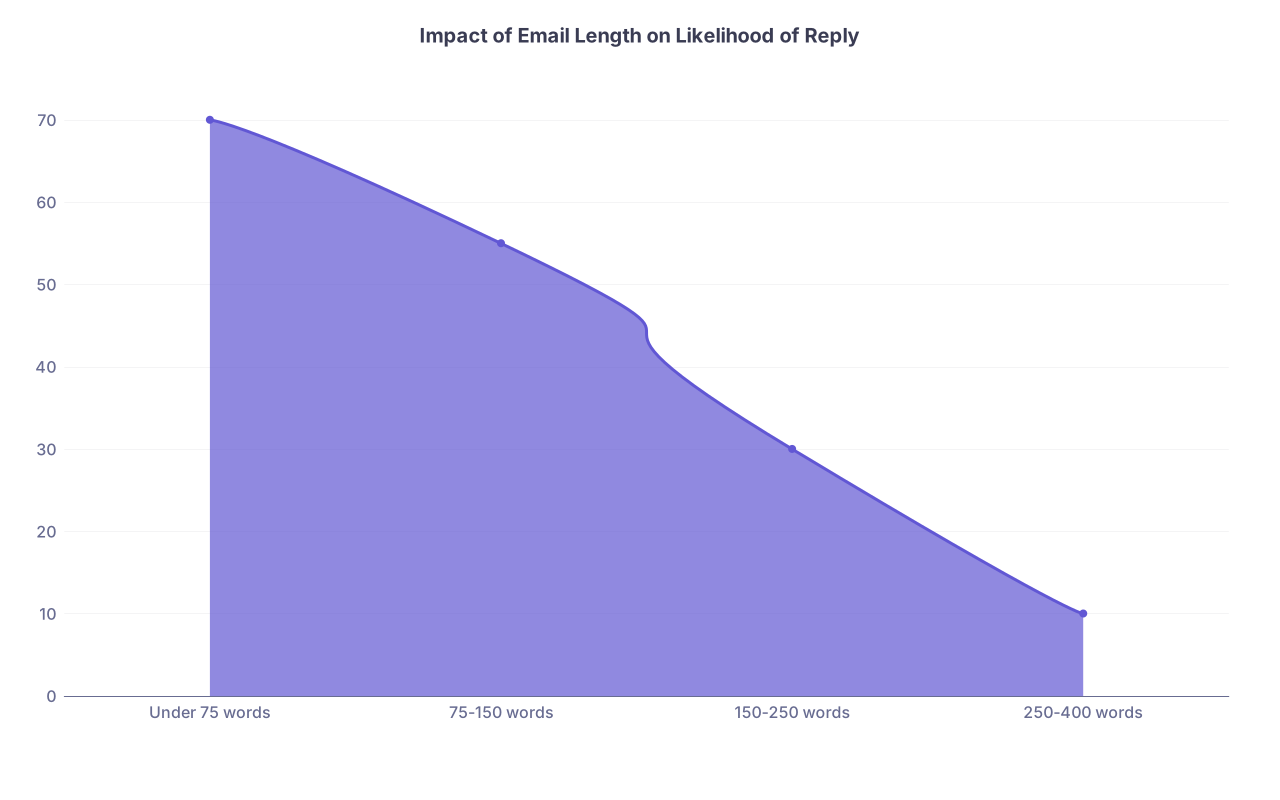
| Category | Value |
|---|---|
| Under 75 words | 70 |
| 75-150 words | 55 |
| 150-250 words | 30 |
| 250-400 words | 10 |
Phrase #8: “I really admire your work and was hoping you could help me with…”
This one is subtle, but attendings see through it instantly when it’s generic.
“I really admire your work” means nothing if:
- You don’t mention a specific paper, project, or talk.
- You clearly copy-pasted the same line to 15 faculty.
- You pivot immediately into a self-serving ask.
It reads as flattery used as currency.
A cardiologist once told me, “If they say they ‘admire my work’ but can’t even spell my subspecialty correctly, I’m done.”
Don’t compliment. Demonstrate you actually know what they do.
Instead of:
I really admire your work and was hoping you could help me with my career planning.
Try:
I attended your grand rounds on [topic] and was struck by your comments on [specific point]. I’m a [MS3] who’s interested in [related area], and I’d value your perspective on one focused question.
If you cannot name something concrete about their work, skip the admiration entirely. Generic praise is worse than none.
Phrase #9: “I would greatly appreciate any opportunities you might have…”
This is the networking email version of throwing a fishing net into the ocean and hoping something swims in.
Problems:
- It’s vague. “Any opportunities” means you haven’t thought about fit.
- It makes the attending do all the creative thinking.
- It sounds like you’re just trying to collect lines on your CV.
Typical unhelpful closing:
I would greatly appreciate any opportunities you might have for me to work with you.
Better: narrow the scope and name the type of opportunity.
More effective:
If you have a small project at the data collection, QI, or chart review stage where an extra pair of hands would be helpful, I’d be glad to contribute 3–4 hours per week through July.
Or:
If shadowing in clinic or in the OR is possible, I’d be grateful for even one half-day to observe how you approach [specific type of cases].
You’re not asking them to invent “any opportunity.” You’re proposing where you might realistically fit.

Phrase #10: “Sent from my iPhone” with no signature, no context
This isn’t about the literal phrase (everyone has that footer). It’s about the lazy, zero-context, two-line email that often comes with it.
Example I’ve seen:
Hi, I’m John, MS2. Want to do research with you.
Sent from my iPhone
No school. No last name. No detail. No ask. No professionalism.
When attendings are skimming on their phones, signatures matter. Context matters. Otherwise, your message becomes yet another anonymous blip they’ll never find again.
Do not hide behind “Sent from my iPhone” as an excuse for a low-effort message.
Even from your phone, you can send:
- A clear subject line
- A complete sentence or two
- A minimal but real signature
Better:
Subject: MS2 Interested in Helping With Your Heart Failure Projects
Dr Smith,
My name is John Lee, MS2 at [School]. I’m interested in heart failure research and wondered if you have any ongoing projects where a student could help with data collection or chart review for a few hours per week.
Best,
John Lee
MS2, [School] | [email] | [phone]Sent from my iPhone
Simple. Still professional.
How to Fix Your Networking Emails – A Quick Blueprint
You avoid these annoying phrases by building emails that are:
- Short
- Specific
- Low-pressure
- Easy to say yes or no to
Here’s a simple structure that works far better than 99% of what’s in attendings’ inboxes.

| Step | Description |
|---|---|
| Step 1 | Clear Subject |
| Step 2 | Brief Intro |
| Step 3 | Specific Connection |
| Step 4 | Concrete Ask |
| Step 5 | Time Boundary |
| Step 6 | Clean Exit and Signature |
Example template (adapt, don’t copy-paste blindly):
Subject: MS3 Interested in [Subspecialty] – Brief Question
Dr [Last Name],
My name is [Name], a [MS3] at [Institution] on my [rotation/service]. I’m interested in [specific field/topic].
I read your [paper/talk] on [very short description] and had one focused question about [X]. Would you be open to a brief 10–15 minute conversation in the next few weeks, if your schedule allows?
If that’s not feasible, I completely understand and appreciate your time.
Best,
[Full Name]
[Year, School]
[Contact info]
Notice what’s missing:
- No “I know you’re busy, but…”
- No “pick your brain”
- No “extremely passionate”
- No “any opportunities you might have”
You’re not performing politeness. You’re showing respect by being precise and realistic.
| Bad Phrase | Better Approach (Short Version) |
|---|---|
| I know you’re very busy, but… | I’ll keep this brief. |
| I’d love to pick your brain… | I have one specific question about… |
| Can you be my mentor? | Would you be open to a brief meeting? |
| I am extremely passionate about… | Mention concrete actions/experiences instead. |
| Any research opportunities? | Offer specific skills and time bounds. |
FAQ (Read This Before You Hit Send)
1. How long is too long for a networking email to an attending?
Anything over 200 words is pushing it for a first cold email. Most solid emails can be 75–150 words. If you’re telling your entire life story, you’re doing it wrong. Context should be minimal; the ask should be clear; the rest can be discussed later if they agree to talk.
2. How many times is it acceptable to follow up if they don’t respond?
Once. Maybe twice if you have a legitimate new reason (e.g., updated availability, a concrete project idea, or a changed timeline). Space your follow-up 7–10 days after the first email. If there’s still silence after a second attempt, stop. Do not become the person they associate with inbox harassment.
3. Is it okay to send the same email to multiple attendings?
You can reuse the structure, but not the content. A generic copy-paste that doesn’t mention anything specific about that attending’s work is obvious and forgettable. At minimum, tailor: reference their actual projects, your real intersection with their field, and a request that matches what they do.
4. What if I honestly don’t know exactly what I want from them yet?
Then your first “ask” should be small and exploratory. For example: “I’m early in my exploration of [field] and trying to understand what daily work looks like. Would you be open to a 10–15 minute conversation about your career path and what you enjoy about your work?” Do the homework first—read, ask residents, attend a talk—so you don’t show up empty-headed.
Three things to remember:
- Bad phrases are signals of bigger problems: vagueness, entitlement, laziness.
- Respect isn’t in the compliments; it’s in the clarity, brevity, and realistic ask.
- If your email makes their life easier, you’re already ahead of most of your competition.