
The wrong shadowing etiquette does not just make you “a little awkward.” It gets your name quietly blacklisted.
You think you are “just shadowing.” The physician knows they are deciding, in the back of their mind, whether they would ever write you a letter, recommend you to a colleague, or let you near their team again. Every interaction is a micro‑interview. People forget that and behave like tourists.
Let me walk you through the mistakes I see over and over. The ones attendings complain about behind closed doors. The ones that close doors that will never reopen.
Mistake #1: Treating Shadowing Like a Drop‑In, Not a Commitment
The fastest way to kill your reputation: acting like shadowing is casual.
I have seen all of these, repeatedly:
- Emailing an attending at 11 p.m.: “Sorry, something came up, I cannot make it tomorrow morning.”
- Showing up “about 10 minutes late” on your first day because of parking.
- Leaving early because “I have to study for an exam.”
From your side, those sound like reasonable explanations. From their side, it screams: unreliability, poor judgment, lack of professionalism. Remember: you are stepping into a clinical operation that does not pause for you.
Here is what you must not get wrong:
Cancellations
Canceling a shadowing day less than 24–48 hours ahead, without a genuine emergency, is a red flag. Do that more than once? You are done with that physician. And possibly with their entire network.Lateness
If you are “on time” in premed world (arrive at 8:00 when the day starts at 8:00), you are late in medicine. If your attending starts rounding at 7:00 and you walk in at 7:03 with coffee in your hand, people notice. They will not say anything that day. But your name is filed under “never recommend.”Leaving whenever you feel like it
Vanishing halfway through the clinic because “it was slow” or because you got tired. Shadowing is not a buffet. You do not leave because the most interesting cases are done. The day ends when the physician says it ends or when you have a pre‑agreed stop time.
If you have a true emergency? Fine. You send a concise, apologetic, professional message as early as possible. But do not build a pattern of flakiness. Medicine has a long memory for that.
Mistake #2: Acting Like a Fly on the Wall… Who Talks Too Much
You are there to observe, not to perform. Many students struggle with that balance. They either become a statue who never speaks, or they turn into an extra team member who comments on everything.
Both extremes can hurt you.
The toxic version looks like this:
- Asking long, theoretical questions during clinic: “So in heart failure, why do we actually prefer ACE inhibitors over ARBs in…”
- Jumping in with your own “differential diagnosis” in front of patients.
- Whispering to the nurse during a med reconciliation: “That seems like a lot of meds, right?”
- Laughing too loudly, checking your phone constantly, or swiveling around in the chair while the attending is charting.
Here is the rule: during patient care, your default state is quiet, attentive, and low‑profile. You are not the main character.
I once watched a premed interrupt a cardiologist mid‑history to ask the patient, “What made you decide to quit smoking?” Good motivational interviewing question. Terrible timing. After the visit, the attending looked at me and said, “Never again.”
You avoid this mistake by:
- Standing or sitting where you are clearly present but not in the way.
- Making eye contact and nodding attentively while the physician talks to the patient, but not inserting yourself.
- Saving 95% of your questions for between patients, or at lunch, or at the end of the day.
If you talk more than the attending during a clinic day, you have already made a mistake.
Mistake #3: Ignoring Patient Comfort and Consent
This one closes doors not just with one physician, but sometimes with an entire department.
Shadowing is not a right. It is a privilege granted only if the patient effectively consents to your presence. Many students treat rooms like they are automatically allowed in, because “I’m with Doctor X.”
Bad assumption.
I have seen students:
- Walk into exam rooms without knocking, directly behind the doctor.
- Stay in the room when a patient is crying or partially undressed, clearly uncomfortable.
- Stand so close they are almost hovering over the patient’s shoulder.
- Stare at exposed anatomy like they are watching a documentary.
If a patient complains about you even once, you may not be invited back. And rightly so.
You protect yourself by over‑respecting boundaries:
- Always wait just behind the physician at the door. If they pause or turn around, that usually means “not this one.”
- If introduced, give a brief, respectful greeting: full name, role (“college student observing today”), then step back.
- Watch the patient’s body language. Arms crossed, avoiding eye contact, glancing at you repeatedly? That is your cue to discreetly step out if appropriate.
If a physician says, “We’ll see this patient alone,” do not pout or look disappointed. Say, “Of course,” and step back. That one quiet, mature reaction can earn you a lot of trust.
Mistake #4: Turning Shadowing Into a Photoshoot or Social Media Content
Few things damage trust faster than pulling out your phone at the wrong time.
Too many students try to turn shadowing into Instagram content:
- Taking selfies in the hallway in a borrowed white coat.
- Snapping pictures of the name badge, the hospital logo, the OR board.
- Posting vague but obvious case descriptions: “Got to see a crazy trauma case today!!” with a time and location.
You may think you are anonymizing patients. You are probably wrong. And every hospital has at least one compliance officer who lives for this.
The unspoken rule: your phone stays away. No photos. No videos. No recordings. If you must check a message, you do it briefly, discreetly, and never in front of patients.
If you absolutely want one “I shadowed here” photo? Ask permission at the very end of the day, away from clinical areas, with no patient information or identifiers in sight. Many physicians will say yes. Some will say no. Accept either answer without pushing.
A single careless post can burn a bridge not only with that attending, but with their colleagues who hear about “that premed who posted inappropriately.”
Mistake #5: Dressing Like a Student, Not Like a Future Colleague
Shadowing etiquette includes what you put on your body. And yes, people absolutely judge you on it.
Common misfires:
- Sneakers that look like you are going to the gym.
- Tight or low‑cut tops, short skirts, loud patterns.
- Wrinkled shirts, unpolished shoes, hair all over the place.
- Wearing a white coat you bought online without being told to.
Here is the reality: you do not need to be fashionable. You need to be forgettably professional.
Think: neat, clean, boring.
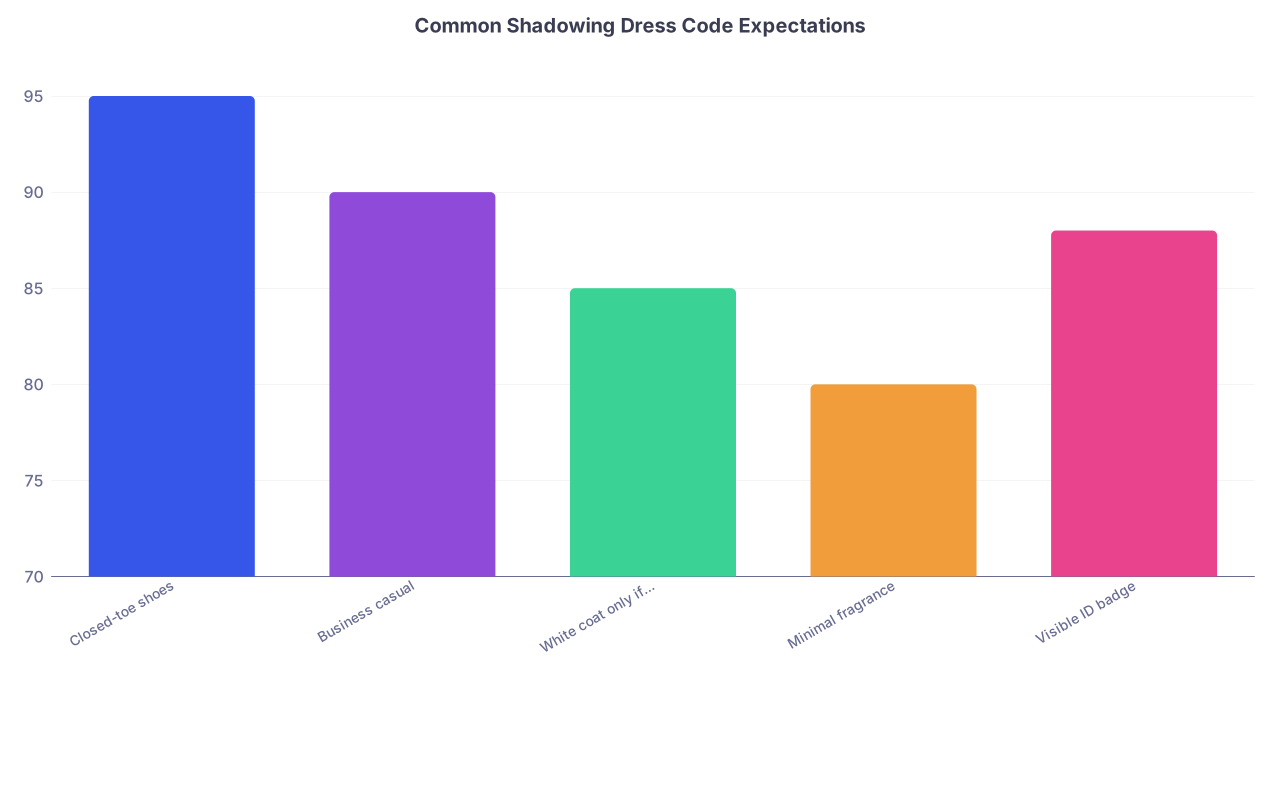
| Category | Value |
|---|---|
| Closed-toe shoes | 95 |
| Business casual | 90 |
| White coat only if instructed | 85 |
| Minimal fragrance | 80 |
| Visible ID badge | 88 |
Yes, different settings have different norms. Surgery vs pediatrics vs outpatient psych all look a bit different. But you will rarely go wrong with:
- Closed‑toe, clean shoes.
- Slacks or khakis, or a modest skirt.
- Button‑down shirt or conservative blouse.
- Hair pulled back if long. Minimal jewelry. No strong perfume.
The instant you look like more work to manage than you are worth, someone will quietly decide not to invite you back.
Mistake #6: Treating Staff Like Background Characters
This one is subtle but deadly.
Medical assistants, nurses, front desk staff, techs. Students often behave like these people are scenery instead of the backbone of the place.
I watched one student walk past the front desk three days in a row without even making eye contact or saying good morning. On day four, the receptionist told the attending, “Your student is kind of rude.” Shadowing opportunity ended a week later. The student never knew why.
Here is the harsh truth: attendings ask their staff what they think of you. Especially if they are considering writing you a letter.
If you ignore staff, talk down to them, or act impatient when they are busy, that feedback will travel.
Avoid this mistake by doing the basic things that somehow many people skip:
- Greet staff by name when you can. At least “Good morning” and “Thank you.”
- Never complain about waiting, schedules, or clinic chaos.
- If a nurse or MA tells you, “You cannot be in this room for this part,” you say, “Of course,” and step out. They know the protocols better than you.
The irony: sometimes it is the nurse, not the attending, who opens a door for you. “I know a doctor in cardiology who loves having students. Want me to introduce you?” You only get that if they actually like you.
Mistake #7: Being Vague, Demanding, or Clueless in Your Initial Ask
Bad shadowing etiquette starts before you ever step foot in the hospital. It starts with your first email.
Common disasters:
- Subject lines like: “Shadowing???” or “Need hours for med school.”
- Copy‑pasted emails with the wrong physician name in the salutation.
- Zero flexibility: “I need 40 hours this month, Monday and Wednesday afternoons only.”
- No context: not saying what level you are (high school, college, post‑bac) or what you actually want from the experience.
Busy physicians see these as spam. Or worse, entitlement.
Your first message needs to be clean, short, and respectful of their time and constraints. If you sound like hard work from the beginning, they will ignore you.
Once they say yes, do not immediately follow up asking for:
- A letter of recommendation.
- A clinical job.
- A specific number of documented “hours.”
You want to signal you care about learning first. Documentation and letters come later, if you have earned them.
Mistake #8: Treating Shadowing as a Transaction, Not a Relationship
Some of you are making this mistake every week: you are “collecting” physicians like Pokémon cards. Two days with an internist, one day with a surgeon, one morning in the ED. You do not really connect with anyone. You just chase numbers.
That strategy kills your chances at strong letters and real mentorship.
I have heard this exact sentence from attendings:
“I do not remember that student at all. They were here for a day or two and never followed up.”
Shadowing is networking. Networking in medicine is slow, quiet, and cumulative. It is built on:
- Showing up consistently over time.
- Asking thoughtful questions after you have observed a pattern, not after a single visit.
- Sending a short thank‑you email after your experience, maybe sharing one thing you learned.
You avoid the “transactional” trap by committing. Rather than 10 different physicians for 4 hours each, you are usually better off with 1–2 physicians for multiple weeks. That is where trust forms. Trust is what turns into letters, research opportunities, job offers, and informal sponsorship.

| Step | Description |
|---|---|
| Step 1 | Initial Email |
| Step 2 | First Shadow Day |
| Step 3 | Consistent Attendance |
| Step 4 | Attending Trust |
| Step 5 | Deeper Involvement |
| Step 6 | Strong Letter or Opportunity |
The mistake is thinking shadowing is about hours logged. It is not. It is about people who will vouch for you later.
Mistake #9: Overstepping Clinical Boundaries
Every attending has a horror story. The shadowing student who:
- Tried to “help” by adjusting an IV pump.
- Knocked on a patient’s abdomen without permission because they “wanted to feel what guarding was like.”
- Gave a patient “advice” based on something they learned in undergrad physiology.
This is where you can damage not only your own reputation but also patient safety. And yes, people remember those students’ names years later.
Here is the safe rule: You touch nothing and no one unless explicitly instructed, supervised, and it is clearly appropriate for your level. No exceptions.
If an attending says, “Do you want to listen to this murmur?” and hands you a stethoscope, fine. But you do not:
- Pick up instruments.
- Open the chart and start scrolling through sensitive notes.
- Log into systems using someone else’s credentials (huge no).
If you are unsure whether something is okay, assume it is not. That conservative instinct will serve you very well throughout training.
Mistake #10: Failing to Read the Room When Asking Questions
You are there to learn. You should ask questions. But you must avoid being that student who drains energy from an already overstuffed day.
Bad timing looks like:
- Launching into a 5‑minute monologue about your MCAT plan between patients when the attending is clearly behind.
- Asking them to “quickly look at” your personal statement between OR cases.
- Quizzing them on controversial topics in front of other staff: “What do you think about mid‑levels replacing doctors?”
You can see how that would be irritating.
You want a different pattern. The questions that get good responses tend to be:
- Short and specific.
- Asked during natural down time: walking between rooms, end of clinic, while waiting for a procedure.
- Focused on their thought process, not on testing your own knowledge.
For example: “I noticed you ordered a CT instead of an ultrasound for that patient. Can you share how you chose between them?” beats, “So I read that ultrasound is more sensitive in some cases, what do you think of this paper I found…”
If they say they cannot talk now or seem rushed, you back off. You can always send one concise follow‑up question by email, thanking them again for the opportunity, and ask if they have time to answer. Many will. Some will not. Accept both outcomes gracefully.
Mistake #11: Disappearing Without Closure
One of the most common, underappreciated etiquette failures is ghosting your attending once you are “done getting hours.”
Students finish a rotation of shadowing, vanish, and then show up 10 months later asking for a letter. It is not just tactless. It is ineffective.
You maintain the relationship by:
- Sending a brief thank‑you message within 24–48 hours of your last day. Mention a specific case or lesson that impacted you. Show you paid attention.
- If you plan to ask for a letter later, saying something like, “If things go well and I apply to medical school next year, may I reach out to you about a possible letter?” You are not demanding; you are planting a seed.
- Updating them later once or twice a year with big milestones: taking the MCAT, applying, getting in.
The mistake is thinking that because no one formally “ended” the shadowing relationship, you can just reappear whenever you need something. Physicians live in a world where disappearing residents, flaky consultants, and lost follow‑ups are huge problems. Do not act like another one.
Mistake #12: Forgetting That Everyone Is Watching, Not Just the Attending
One last trap: you behave perfectly when standing next to the attending, then let your guard down everywhere else.
You complain about how long rounds are to another student.
You roll your eyes in the hallway after a difficult patient.
You gossip about a case in the elevator.
And then you are surprised when the attending seems cooler the next day.
What you forget is that hospitals are small ecosystems. Word travels fast. And you never know who is behind you on that elevator or in that cafeteria line.
I have personally watched a premed loudly complain about “old people faking their pain” while still wearing a visitor badge. The nurse at the next table looked over, said nothing, and then brought it up to the attending later with a single sentence: “You should keep an eye on that one.”
You are being evaluated even when you think you are offstage. So act like someone whose name people would be comfortable repeating in a positive way.
Your Next Step
Pick one upcoming or ongoing shadowing experience you have (or want to have). Today, do three things:
- Draft a clean, professional email confirming the next date and time you will attend, including a brief thank‑you.
- Lay out the clothes you will wear, checking them against a conservative business‑casual standard.
- Write down, on a single sheet, two or three specific, respectful questions you might ask during true downtime—not during patient care.
Then look at that list of mistakes again and circle the one you are most at risk of making. Put that at the top of your page.
Bring that page with you the next time you shadow. Let it remind you: doors are either opening or closing around you, quietly, every minute you are there.