
The people who get quietly labeled “future chief,” “must recruit,” or “keep an eye on this one” almost never realize when it happens.
But their mentors do. And those mentors have already started signaling it to other leaders long before any formal title appears on paper.
Let me pull back the curtain on how that actually works in medicine. Because it is not a form, not a letter, not a checkbox. It’s a series of subtle, almost invisible signals that program directors, division chiefs, and chairs read fluently—and students and residents are usually completely blind to.
You want to be the rising star people whisper about? You need to understand the whisper network itself.
The Real Signaling Happens Off the Record
Here’s the part people outside leadership never see.
Most of the meaningful signaling about your trajectory happens:
- In five‑minute hallway conversations between attendings
- In quick texts between PDs: “This one is excellent—worth a close look”
- In committee meetings when someone says, “I know this resident. We should rank them highly.”
That last one is the real currency.
Nobody stands up and says, “I officially nominate this person as a rising star.” It’s more subtle and far more powerful. The language is coded, and the context matters even more than the actual words.
Here’s what you think matters: awards, evaluations, CV bullets.
Here’s what actually moves the needle: how leaders talk about you when you’re not there.
Let me walk you through the specific moves mentors use when they’ve decided you’re worth investing political capital in.
The Code Words Leaders Use (and What They Really Mean)
There’s a vocabulary that signals “this person is special” without ever saying it directly. When you hear these phrases used about others in meetings, pay attention. This is the language of promotion.
I’ve sat in more resident selection, fellowship, and hiring meetings than I can count. Here’s what seasoned leaders say when they’re quietly elevating someone.
“I would take them on my service any day.”
Translation: This is someone I trust clinically and professionally. Strong positive signal.“You can give them the hard cases.”
Translation: Above-average judgment and composure. Not just smart. Reliable under pressure.“They work at a faculty level already.”
Translation: We should be thinking about them for a future faculty role or leadership track.“Keep their name on your radar.”
Translation: I am predicting long‑term potential, not just this rotation’s performance.“I’d be comfortable sending my family member to them.”
Translation: Highest trust. That line gets attention in any room.“If we don’t recruit them, someone else will.”
Translation: Rising star. Make an offer, create a position, or at minimum do not lose them.
Those sentences are deliberate. Leaders know what they’re doing when they say that in front of a PD, chair, or section chief. It’s code for: I’m staking my reputation on this person.
If your mentor ever uses those phrases about you in public or in a group meeting, they’re not just being nice. They’re putting a flag in the ground.
How Mentors “Place” You in Front of Power
Signaling starts long before any formal letter gets written. It starts with where you are allowed to be.
When mentors think you’re a rising star, they start moving you—quietly—into higher‑leverage rooms and roles. I’ve watched this play out a hundred times.
1. Who You’re Seated With
At dinners, grand rounds, visiting professorship events—watch the seating chart. It is not random.
You’ll see a senior mentor do this move:
They walk in with you, scan the room, spot the division chief or visiting big name, and say, “Come sit with us.” Then to the leader: “This is one of our strongest residents. Working on X with us.”
That’s a signal. Two in one:
- They’re publicly tying their name to yours
- They’re giving the leader a script: “this is one of our best”
If this happens repeatedly—with different leaders—that’s not coincidence. That’s placement.
2. Who Gets Invited to Closed‑Door Meetings
Another hallmark: suddenly you’re getting invited to things where residents “normally” are not present.
Departmental QI task force. Curriculum redesign meeting. A strategic planning retreat with one token resident.
You’re that token.
What’s happening is simple: your mentor is giving other leaders extended exposure to you in a professional setting. Not as “the learner,” but as “a junior colleague whose opinion we actually want.”
Every time you speak up intelligently in those rooms, your mentor’s stock in you goes up—and they become more vocal about you elsewhere.
3. Which Projects You’re Handed
Rising stars do not get random scut projects. They get strategically chosen ones.
A savvy mentor will quietly steer key opportunities your way:
- The multi‑institutional study that will put you in front of big‑name collaborators
- The educational initiative that requires you to present to the residency or even the GME committee
- The grant idea where you’ll be the one giving the talk to visitors or at the local symposium
You think you just “got lucky” getting assigned to the interesting stuff. You didn’t. Someone advocated for you in the email thread you did not see.
The Backchannel: What PDs and Chairs Actually Ask
There’s a whole parallel communication channel applicants never see.
When you apply to fellowship, jobs, chief, or even competitive rotations, the formal letter is just the start. The real evaluation happens off‑paper.
Here’s how it plays out.
A PD gets your application. They see a familiar mentor name on the LOR. They don’t rely on the letter alone. They send a one‑line text or email:
“Hey, what’s the real story on [Your Name]? Worth pushing for?”
If your mentor believes you’re a rising star, their reply looks like this:
“Outstanding. Top 5% I’ve worked with. Great clinical sense, no drama, invests in the team. Happy to talk more.”
That “top 5%” line? That phrase gets attention. And leaders know not to use it lightly.
Or they’ll say, “If you have a spot, you should seriously consider them.” That is code for: I’m telling you they won’t be a headache, and they’ll elevate your program.
On the other hand, I’ve seen weak endorsements that look glowing on paper but are soft in the backchannel:
“Hard worker, no concerns.”
“Would do fine.”
“Yes, solid.”
Those are kiss‑of‑death phrases in competitive situations. They read neutral at best. Nobody burns political capital on “fine.”
The Micro‑Signals in Committees and Ranking Meetings
The sharpest mentors know that what they say in a room full of decision‑makers is worth more than any PDF.
Let me walk you into an actual selection meeting dynamic.
Fellowship ranking discussion. 60 applicants on the board. Everyone pretends to care about all 60. They don’t. Attention spans thin out quickly. The ones who get real discussion share one thing: someone in the room personally advocates for them.
Here’s how mentors signal “rising star” in that environment:
- They speak early, before the group momentum sets in
- They use specific, concrete examples, not generic praise
- They use their reputation capital explicitly: “I know you all trust my judgment on residents; this one is special.”
The language shifts from “seems strong on paper” to “I have worked with them directly and…” followed by a story that shows composure, judgment, leadership, or initiative.
I’ve literally heard:
“We’d be making a mistake if we let this one go somewhere else.”
When someone with institutional clout says that, the ranking moves. Quietly but decisively.
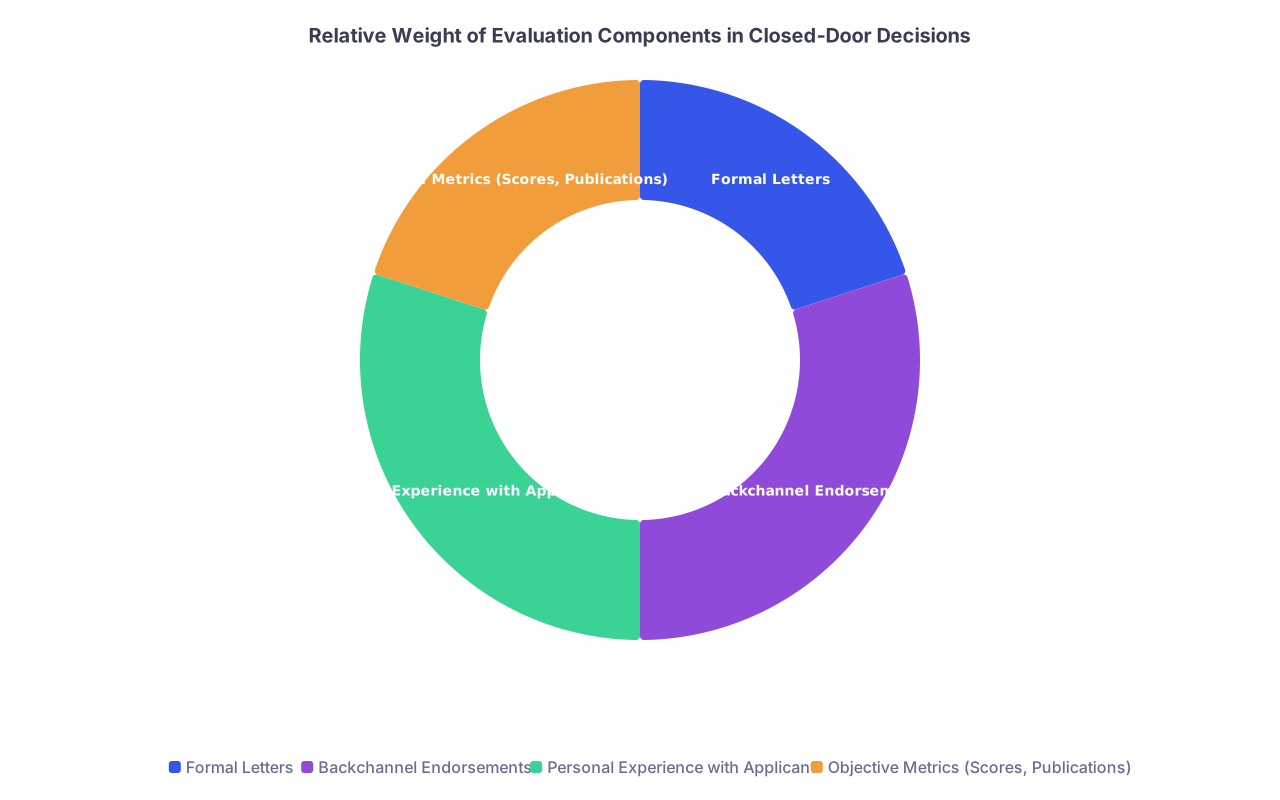
| Category | Value |
|---|---|
| Formal Letters | 20 |
| Backchannel Endorsements | 30 |
| Personal Experience with Applicant | 30 |
| Objective Metrics (Scores, Publications) | 20 |
That chart matches reality more than any official rubric. Backchannel + personal experience drives most of the final decision. Everything else is supporting documents.
How Mentors Talk About You in Public Spaces
Sometimes the signaling is open, almost casual—right in front of you, but you miss its meaning.
Picture this scenario. Noon conference. End of case presentation. Your attending stands up at the end and says:
“I want to highlight that Dr. X designed this whole approach and coordinated the team. Great work.”
Yes, it feels like a compliment. But listen to who they’re talking to, not just to you.
In that room:
- PD is in the back, half listening
- A couple of associate program directors
- Maybe a vice chair
Your mentor just publicly pulled you out of the crowd. That gives everyone else permission to see you differently.
Same thing on rounds when a senior says in front of students, other attendings, and nurses:
“If I’m ever sick, I hope Dr. X is on call.”
You hear flattery. Leaders hear endorsement.
The “Invite Them to Present” Move
Another classic signal: who gets chosen to present outside the basic requirements.
Not the mandatory M&M or simple resident talk. I mean:
- Departmental grand rounds as a trainee
- A slot at a regional or national meeting representing your program
- Presenting service‑level QI data to hospital leadership
Mentors know exactly what they’re doing here. They’re saying to other leaders:
“Watch this person. They can hold their own on stage, even as a trainee.”
And they’re taking a risk. If you bomb, it reflects on them. If you excel, everyone in that room mentally tags you as “one of the good ones.”

| Step | Description |
|---|---|
| Step 1 | Mentor Identifies Rising Star |
| Step 2 | Strategic Project Assignments |
| Step 3 | High Visibility Presentations |
| Step 4 | Closed Door Endorsements |
| Step 5 | Increased Leader Exposure |
| Step 6 | Program Decisions |
What Triggers Mentors to Start Signaling For You
Here’s the uncomfortable truth: mentors do not invest in everyone equally. Nor should they. Political capital is finite.
So what makes a mentor decide, “I’m going to start quietly pushing this person up the ladder”?
It’s not a single trait. It’s a pattern. The ones who get lifted tend to share a few characteristics:
- They deliver when given responsibility. No excuses. No drama.
- They make their mentor’s life easier, not harder.
- They’re low‑maintenance in the emotional sense. No constant chaos.
- They show judgment beyond their level: knowing when to call for help, how to communicate bad news, how to own mistakes.
- They treat staff well. Nurses, techs, admin. Leaders watch that very closely.
I’ve watched attending after attending say some version of:
“I can trust them with anything. I don’t worry when they’re on.”
That’s the switch‑flipping moment. Once a mentor truly feels safe trusting you, they start putting your name forward.
And one more unglamorous factor: they like working with you. People underestimate this, but they should not. Medicine is stressful. Leaders naturally lift up the people they’d actually want as colleagues at 2 a.m.
How You Can Make It Easier for Mentors to Signal For You
You cannot force someone to champion you. But you can make it very easy for a reasonable mentor to decide you’re worth the risk.
A few blunt truths most faculty will never tell you:
Respond like a colleague, not a student.
When someone senior emails you about a project, reply promptly, with clarity, and without weird deference or neediness. Short, direct, reliable.Own small tasks completely.
If you say “I’ll draft that IRB” or “I’ll email the coordinator,” it should happen. Without chasing. If they have to follow up repeatedly, you move from “rising star” to “extra work” fast.Show up prepared in public forums.
If they put you in front of people—journal club, conference, committee—take it seriously. Leaders remember who is crisp and who rambles.Signal that you understand systems, not just facts.
Rising stars talk about how pieces fit together: patient flow, team dynamics, QI impact. Not just “interesting cases” and “cool pathophys.”Protect their reputation.
Do not gossip, undermine, or behave unprofessionally on teams where people know you’re “their mentee.” That’s the fastest way for a mentor to pull back and stop advocating for you.

The Dark Side: When Mentors Don’t Signal For You
You should also understand the flip side, because it’s brutal and quiet.
Sometimes, a mentor will write you a “strong” letter, tell you “you’re great,” and then… do nothing when leadership asks for the real story.
Why? A few common reasons, whether fair or not:
- You’re inconsistent. Brilliant one month, flaky the next.
- You drain emotional bandwidth. Constantly in conflict, always in some interpersonal mess.
- You disrespect staff. Leaders hear about this faster than you think.
- You don’t take feedback well, and they’re tired of walking on eggshells.
What that looks like in reality:
A PD calls or emails: “We’re considering [Your Name]. Thoughts?”
Your “mentor” replies with:
“They’ll do fine with the right support.”
“Strong technically.”
Notice what’s missing: trust, judgment, would‑work‑with‑again.
That’s not sabotage. It’s just… absence of advocacy. In a competitive field, that’s enough to keep you off the “must recruit” list.
How You Know It’s Actually Happening
No one will send you a certificate that says “You are now officially a rising star.” If you’re waiting for that, you’ll wait forever.
The signs are more subtle but very real:
- You’re suddenly in meetings you did not ask to be in.
- Their emails introduce you to others with unusually strong phrasing: “One of our best,” “exceptional,” “someone I want you to know.”
- Opportunities come to you before they reach the mass email stage.
- People you’ve never worked with say, “I’ve heard great things about you.”
When that starts happening repeatedly from different directions, don’t brush it off as luck. That’s the mentor signal network doing its work.
Your job at that point is simple: keep making the people who spoke up for you look smart.
| Type | Example Phrase |
|---|---|
| Soft | Will do fine |
| Soft | Hard worker |
| Power | Top 5 percent I have worked with |
| Power | I would recruit them without hesitation |
| Power | I trust them with anything |
Those last three phrases? Those are the ones that change rank lists, create positions, and open doors.
FAQ: Quiet Signaling, Mentors, and Being Seen
1. How do I ask a mentor to advocate for me without sounding entitled?
Be direct and grounded. Something like: “I’m really interested in [fellowship/academic role/chief]. If, based on your experience working with me, you’d feel comfortable speaking up for me with [PD/leader], I’d be very grateful. If not, I completely understand and would value your honest feedback on what I should work on.” That gives them an out, shows maturity, and quietly asks for signal without demanding it.
2. What if I do not have a powerful mentor in my program?
Then your mission is to find the most connected person who actually knows your work and make them your ally. It might be the APD who runs scheduling, the QI director, or the research lead, not the chair. Leaders listen to people who consistently generate reliable trainees and successful projects, even if they’re not the biggest title in the room. Depth of relationship beats height of title.
3. Can a single bad rotation kill my chances of being seen as a rising star?
Not if the pattern over time is strong. Leaders know everyone has an off block, a toxic team, or a mismatch. What saves you is a mentor who can say, “Yes, that evaluation was rough, but I’ve seen them in multiple other settings and they are outstanding.” That statement reframes the outlier. But if multiple rotations echo the same concerns, no one will spend political capital arguing that it’s all a misunderstanding.
4. How early in training do these signals start?
Earlier than you think. By late MS3 or early intern year, certain people are already on the “keep an eye on them” list. The real advocacy generally ramps up around late PGY‑2 to PGY‑3, when decisions about fellowship, chief, and first jobs start to solidify. But the impressions that fuel that advocacy are often set much sooner, especially around professionalism, work ethic, and how you treat others.
5. What’s the single most underrated behavior that makes mentors want to signal for you?
Quiet reliability. The resident who does what they say they’ll do, never creates drama, owns mistakes without theatrics, and makes the team function better—that’s the one mentors feel safe betting on. They know that attaching their name to you will not backfire at 2 a.m. on some future crisis. Safety plus excellence—that’s the combination that turns a good trainee into someone leaders start whispering about as “the next one.”
With this lens, you’ll start to hear the quiet endorsements happening around you—and you’ll know how to behave so that, when your mentor is talking behind closed doors, they have every reason to say, “This is someone we cannot afford to lose.” The interview invitations, leadership roles, and offers come later. But that’s a story for another day.