
It’s 11:48 p.m. You’ve rewritten the same outreach email to that big-name cardiology researcher six times. Your cursor is hovering over “Send”. You’ve agonized over the CV attachment, the subject line, the closing.
What’s going to decide whether this gets you a project or gets quietly deleted?
The first three lines.
Let me be blunt: in academic medicine, the most important part of your “networking” isn’t the conference handshake or the LinkedIn request. It’s the cold email intro. That invisible 5 seconds where a PI decides:
- “I’ll reply tonight”
or - “Archive. Next.”
I’ve sat next to attendings while they skimmed 40+ student emails in one sitting. I’ve watched program directors search their inbox with “MS2 research” or “student project” and mass-select-delete anything that looks like work. You’re not competing against perfection. You’re competing against their fatigue.
So let’s talk about the hidden rules—the things they will never put on a mentorship slide deck—but that actually control whether your early research career gets oxygen.
What PIs See When Your Email Lands
First, you need to see your email from their side of the screen.
Here’s their life:
Clinic ended late. Two notes still open. Their kid’s school is calling. Their inbox says “Unread: 263”. They sort by “From: unknown”. That’s where you live.
What matters in that moment isn’t your GPA. It’s pattern recognition. They subconsciously sort student emails into three buckets:
- Work for me, benefit unclear
- Might help my lab but needs hand-holding
- This person will make my life easier and help my output
Your intro determines which bucket you fall into. Not your CV. Not your Step score. The first 4–5 lines.
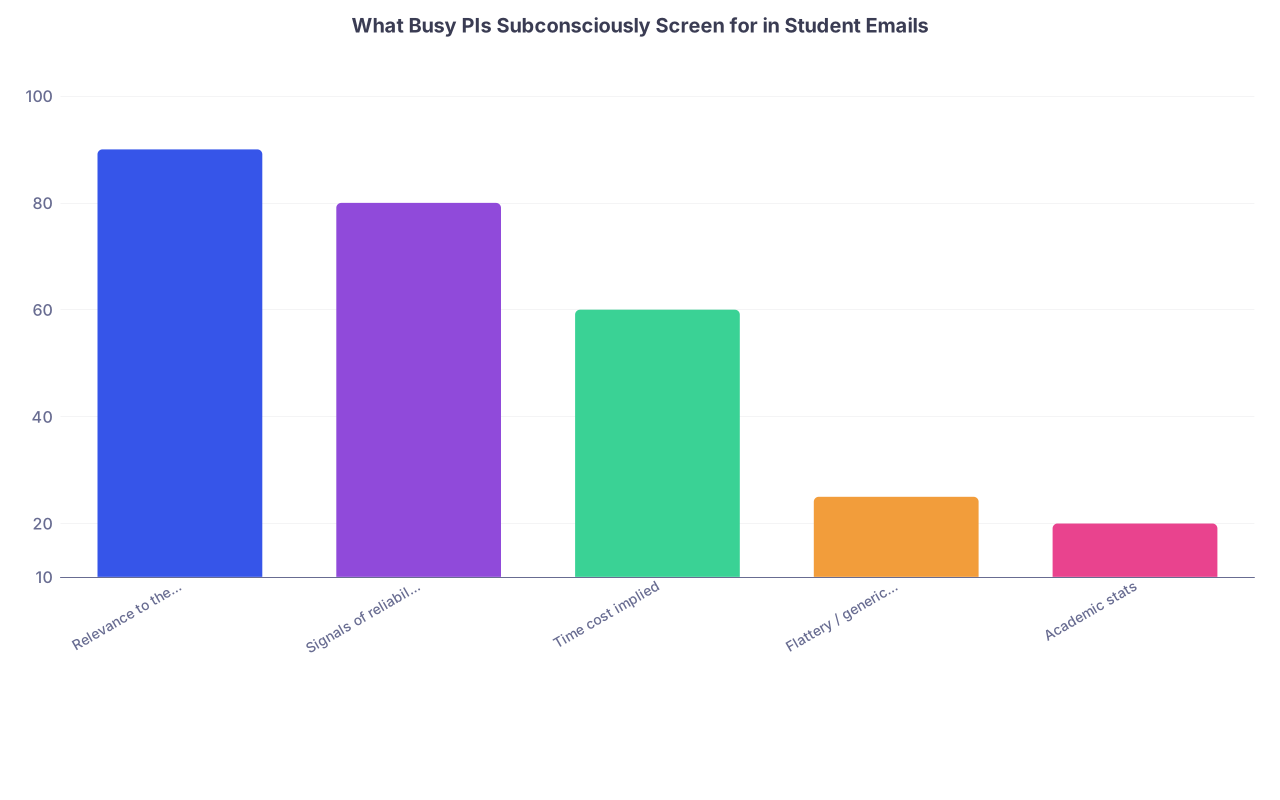
Here’s the unspoken priority stack they’re using, whether they admit it or not:
| Category | Value |
|---|---|
| Relevance to their work | 90 |
| Signals of reliability | 80 |
| Time cost implied | 60 |
| Flattery / generic enthusiasm | 25 |
| Academic stats | 20 |
They care if you’re aligned with what they’re already doing, whether you’ll be a drain or an asset, and whether responding will spiral into three meetings and nothing tangible.
Your intro is not a polite greeting. It’s a compressed argument:
“I am low-risk, high-yield, and already moving.”
The Subject Line: Where You Lose Half Your Chances
Let me ruin a few myths quickly.
If your subject line looks like any of these, you’ve already cut your reply rate in half:
- “Medical student interested in research opportunities”
- “Prospective research student inquiry”
- “Research?”
These read as: “This will take effort. And probably go nowhere.”
Strong subject lines do three things:
- Anchor you to a real identity or connection
- Signal specificity
- Hint that you’re already in motion, not asking them to build from scratch
Compare:
- Weak: “Second year student interested in oncology research”
- Strong: “MS2 with Python skills – interested in your JCO 2023 lymphoma outcomes work”
One screams “generic blast email.” The other tells them: you read their work, you have a concrete angle, and you’re not opening with “I’m very passionate about oncology” like every other stranger.
Here’s how subject lines actually play out in a PI’s head. I’ve heard them say this out loud.
| Subject Line Example | PI’s Instant Reaction |
|---|---|
| MS2 interested in research opportunities | Generic. Probably no. |
| Student seeking mentorship and guidance | Emotional labor request. Low priority. |
| Question re: your NEJM 2022 LVAD readmission paper | Ok, at least they read something. Maybe. |
| MS1 with R skills – potential help on your ICU sepsis dataset? | Specific, skills, my topic. Worth opening. |
| URiM MS3 interested in EM disparities (saw your ACEP talk) | Anchor + context + niche. Likely to get a response. |
Your subject line is your first filter. Don’t waste it on “Hi” and vibes.
The First Line That Kills You 80% of the Time
Now we get into the dirty secret: most intros are dead by line two.
You think you’re being polite when you write:
“Dear Dr. Smith,
My name is [X], and I am a second-year medical student at [School]. I am very passionate about internal medicine and am writing to inquire about potential research opportunities in your lab.”
This is the most common opening in academic medicine. Which means it’s white noise.
Here’s what an attending’s brain sees:
- Filler
- No unique signal
- No reason to answer now rather than later (which becomes never)
You’re wasting their most precious resource: attention.
The effective emails I’ve watched get near-instant replies all have a different structure. The intro is surgically focused on three things, in this order:
- Anchor – why you’re in their inbox specifically
- Alignment – exactly what of theirs you’ve read/seen/done
- Asset – what you bring to the table right now
The personal bio—where you go to school, your year—that can come after. You’re not introducing yourself to a stranger at a dinner party. You’re interrupting a drowning person with a pop-up.
Let me show you a before-and-after. I’ve watched versions of both get sent.
Weak intro:
Dear Dr. Patel,
My name is John Doe and I am a third-year medical student at Midstate University. I am interested in cardiology and research and was hoping to discuss possible opportunities with you in the future.
Stronger intro:
Dear Dr. Patel,
I read your 2023 Circulation paper on sex-based differences in post-MI outcomes and noticed your group has a large registry at City Hospital. I’m an MS3 at Midstate on your service next month and have prior experience cleaning large datasets in R; I’m hoping to contribute to your outcomes work while I’m on rotation.
Second version does several “hidden” things:
- Proves you know their actual work, not just their title
- Ties you to a time-bound, real-world connection (on their service soon)
- Offers a concrete asset (R skills) instead of “strong interest”
- Suggests low friction: they already have a registry; you might be a worker, not a dreamer
That’s the game. Real over generic. Concrete over “passionate.”
Three Hidden Email Archetypes That Actually Work
Let me walk you through three patterns that insiders use. I’ve seen these get traction again and again. Change the content, but keep the skeleton.
1. The “I Already Did Homework” Intro
This is for big-name people drowning in vague flattery.
Structure:
- Line 1–2: Specific reference to their work (paper, talk, project)
- Line 3: One focused question or angle related to that work
- Line 4–5: Your skills and ask
Example:
Dear Dr. Chen,
I watched your SCCM 2024 talk on machine learning for ICU mortality prediction and read your 2022 Critical Care Medicine paper using the MIMIC-IV database. I’m very interested in how your group handles external validation, especially in non-academic settings.
I’m an MS2 in the clinical informatics track at [School], comfortable with Python and SQL, and I’m looking for a way to help with data wrangling or model evaluation on your current ICU projects. Would you be open to a brief call to see if there’s a fit?
You’re not saying “teach me about AI.” You’re saying “I understand enough to be useful and I see a gap I can plug.”
2. The “Embedded on Your Turf” Intro
This works especially well when you’re going to be physically present on their rotation, service, or campus.
Structure:
- Line 1: Upcoming or current real-world overlap (rotation, elective, observership)
- Line 2–3: Tie-in to a specific line of their work
- Line 4–5: A very narrow, time-limited ask
Example:
Dear Dr. Alvarez,
I’ll be on your inpatient heme-onc service at County Hospital from March 4–29 and saw from your faculty page that you run the myeloma outcomes database. A resident mentioned you sometimes have small chart-review projects that fit into a 4-week block.
I’m an MS4 from [School] with prior experience abstracting data for GI oncology projects and would love to help with a focused myeloma chart review while I’m here. If you have anything suitable, I’m happy to adapt to your group’s existing templates and timelines.
Notice the psychology:
You’re not asking them to create a longitudinal project. You’re asking them to slot you into something they already do, in a defined window.
3. The “Skill Forward” Intro
This is underused but lethal when done right. Especially for data, coding, or stats.
Structure:
- Line 1: One-line credential or context
- Line 2–3: Clear statement of technical skills, tied to their domain
- Line 4–5: Offer framed around reducing their workload
Example:
Dear Dr. Singh,
I’m an MS1 at [School] with a prior master’s in biostatistics and two years of experience doing survival analysis in oncology datasets. I saw your ASCO abstract on immunotherapy in metastatic RCC and that you’re leading several institutional trials.
If you or your fellows have datasets that are stuck at the “needs cleaning/analysis” stage, I’d be glad to help with data management and basic time-to-event analyses under your team’s direction. If a quick Zoom to review what you have would be helpful, I can send a few time options.
Here, you’re not begging for a passion project. You’re offering to finish half-done work. That’s catnip for overextended labs.
What Quietly Signals “Do Not Touch”
There are intro phrases that are basically red flags. I’ve heard attendings say, “As soon as I see X, I know this is going nowhere.”
Common landmines:
- “I am looking for a mentor to guide me in my career” – That’s a long-term emotional and time investment. You haven’t earned it yet.
- “Any project you might have would be great” – Screams that you haven’t even read what they do. Non-specific.
- “I have limited availability due to my schedule but…” – Translation: high-friction, low-yield. Bad trade.
- “I’m not very experienced but eager to learn” – You just told them you’re a training project.
The quiet killers? Overemphasis on what you want rather than what they need.
Compare:
“I’m hoping to build my CV for a competitive residency and think your lab would be a great place to do that.”
versus:
“I know your group is very productive in surgical outcomes; if there are datasets or IRB-approved projects where you need help with data extraction or basic analysis, I’d be glad to support your current fellows and residents.”
Same desire on your side. Totally different framing. One asks them to serve your goals. The other offers to serve theirs.
The Timing and Follow-Up Game No One Teaches You
The intro doesn’t live in a vacuum. Timing and follow-up change how it’s perceived.
Here’s a timeline I’ve watched play out repeatedly, and how applicants misread it.

| Step | Description |
|---|---|
| Step 1 | Email Sent |
| Step 2 | Read same day |
| Step 3 | Unread for days |
| Step 4 | Flagged for later reply |
| Step 5 | Quick reply |
| Step 6 | Buried by new emails |
| Step 7 | Student polite follow up |
| Step 8 | Higher chance of reply |
The truth:
- Many PIs will skim and mentally respond “Yes, maybe later” but not actually type the reply
- Your email gets flagged or just mentally noted
- Then buried
A single well-written follow-up 7–10 days later, re-anchored with brevity, can rescue that.
Bad follow-up:
Hi Dr. X,
Just following up on my previous email. Looking forward to hearing from you.
Good follow-up:
Dear Dr. X,
I know you’re busy so a quick follow-up from my note last week about helping with your stroke registry work. Happy to send a 2–3 sentence summary of my prior REDCap/R experience if that’s helpful to see whether I’d be a fit for any ongoing projects.
Short. Anchored. Low-pressure.
Students are terrified of being “annoying.” The reality: most get ignored because they never follow up once. The rude line is the third email, not the second.
Where These Emails Actually Go: The Real Routing
Here’s the part no one explains: in many labs, the attending isn’t your real audience. Their fellows are.
What usually happens when your email lands:
- Attending gets your email
- Skims the first 5–6 lines
- If you pass the smell test, they forward you to a fellow or senior resident with a “Any projects for this person?” note
Which means your intro has to survive two audiences: the prestige-obsessed attending and the overworked fellow who doesn’t want dead weight.
The lines that signal “useful to fellows”:
- References to specific tools: R, Stata, Python, REDCap, Excel, NVivo
- Willingness to do “unsexy” work: chart review, data cleaning, follow-ups
- Flexibility about authorship as long as you can contribute meaningfully
The lines that make fellows roll their eyes:
- “I’m mainly interested in first-author projects.” (I’ve actually seen this.)
- “I’d like something that will be published by next year’s residency application cycle.”
- “I prefer to work remotely due to my schedule.”
Be honest about constraints, yes. But not in the intro. In the intro, prove you’re not entitled and you’re willing to earn trust.
Modern Twist: Email Intros + Conferences + Social Media
You’re in the “future of medicine” era whether you like it or not. Email networking doesn’t live by itself anymore. The more advanced students are stacking channels.
One hidden trick the savvy ones use: pre-email anchor.
They’ll do something like:
- Reply thoughtfully to a PI’s conference talk on X (e.g., tweet: “Loved your point about [specific detail] at #ATS2026”)
- Or comment something intelligent on their recent paper if they share it on social
- Or get introduced by a resident via text/Slack first: “Hey Dr. K, my med student wants to help with your disparities project, can they email you?”
Then the email intro starts with:
I’m the MS3 [Resident Name] mentioned who’s interested in contributing to your sepsis QI work…
or
I really appreciated your ATS talk last week on ventilator liberation; I was the student who asked about post-ICU clinics at the end.
Suddenly you’re not random. You’re anchored to a memory. Huge difference.
Example Email Intros That Work in Different Situations
Let me hand you a few more concrete skeletons. Change details, but keep the posture.
You’re a Preclinical Student With No Real Experience
Dear Dr. Morales,
I’m an MS1 at [School] very interested in your work on health equity in emergency medicine; I read your 2023 Annals paper on ED crowding and disparities in pain management. I don’t have formal research experience yet, but I’m comfortable with Excel and REDCap from QI work at my previous job, and I’m eager to support any part of your current projects that needs organized, consistent effort (chart review, data entry, follow-up calls).
If there’s a small piece of an ongoing project where an MS1 could be helpful, I’d be grateful for the chance to contribute under your team’s guidance.
You’ve removed the question “What would I even have this person do?” You answered it for them.
You’re Switching Fields and Need a Late Start
Dear Dr. Nguyen,
I’m an MS4 at [School] applying into neurology after initially planning for internal medicine, and I’m trying to build more focused exposure to stroke outcomes research. A resident on your team mentioned that you maintain a prospectively collected stroke database and sometimes have shorter, well-defined projects suitable for late-stage students.
I’ve previously completed two retrospective cardiology projects (one published, one submitted) and am comfortable with chart abstraction and basic stats in Stata. If there’s a discrete question within your stroke registry that could benefit from an extra pair of hands over the next 3–4 months, I’d value the opportunity to help.
Late start, but framed as: “I’ve done this before, I can plug in quickly.”
You’re Early but Have Technical Firepower
Dear Dr. Rossi,
I’m an MS2 in the MD/PhD track at [School] with a background in CS; I spent two years before medical school working with CNNs for image analysis in dermatology. I saw your Radiology paper on deep learning for pulmonary nodule detection and your lab’s interest in deploying these tools in real clinical workflows.
If your team has any imaging datasets that are stuck at the “we need someone to experiment with models and clean annotations” stage, I’d be glad to help under your fellows’ supervision. Happy to share a brief portfolio of my prior ML work if that would be useful.
You didn’t say “teach me AI.” You said “I’m ready to be your backend engine.”
How Often Do These Intros Actually Turn Into Projects?
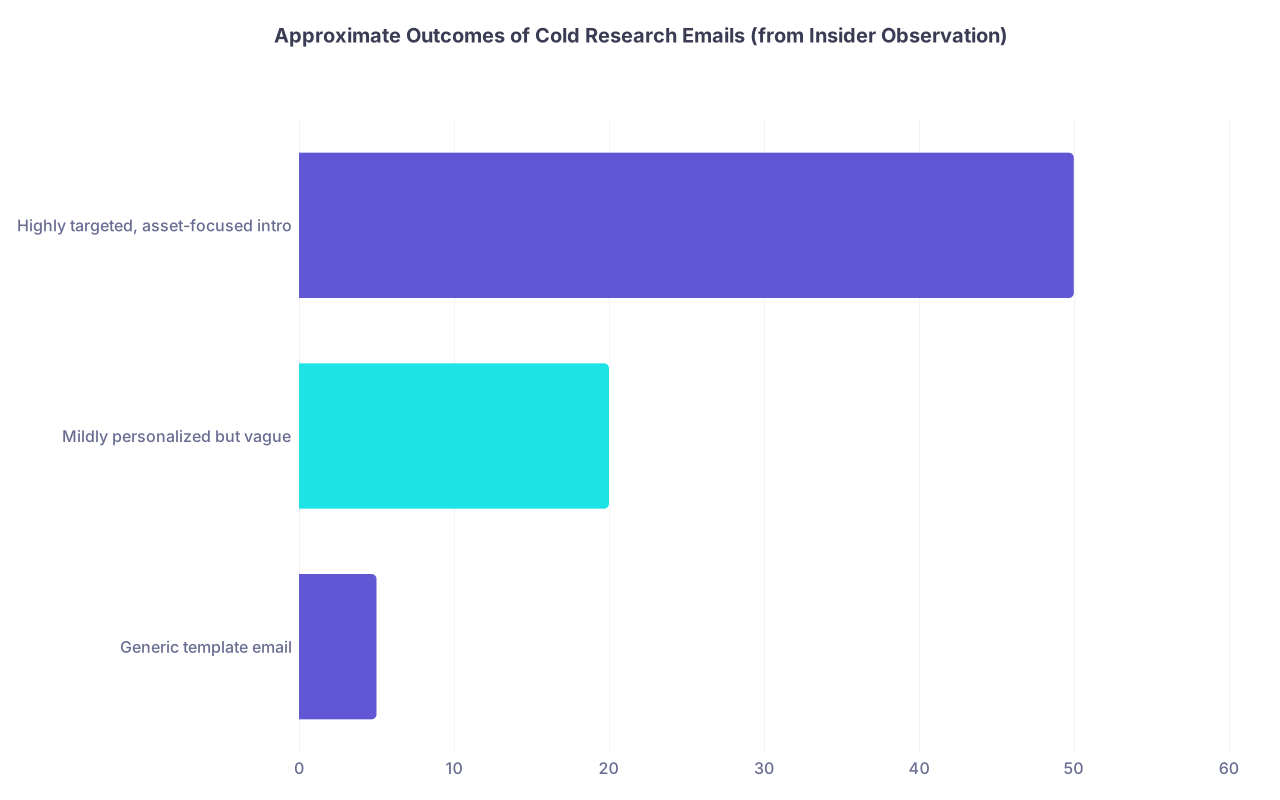
Everyone wants numbers. Here’s the unvarnished reality from what I’ve seen across multiple institutions.
| Category | Value |
|---|---|
| Generic template email | 5 |
| Mildly personalized but vague | 20 |
| Highly targeted, asset-focused intro | 50 |
- The “passionate about your field” templates: maybe 1 in 20 gets a reply, and half of those go nowhere.
- Mildly tuned intros (you mention a paper, still mainly focused on your passion): maybe 1 in 5–6 get some response.
- Carefully anchored, asset-forward intros: I’ve seen students consistently get around a 40–60% meaningful response rate when they send 8–10 of these thoughtfully to aligned faculty.
That’s the leverage here. It’s not sending 200 emails. It’s sending 8 killer ones.
FAQs
1. How long should the whole email be?
Under 250–300 words for the first contact. Less is better. If your intro plus context runs longer than a short phone screen would take to clarify, you’ve written too much. You’re aiming for: they can read your entire email on their phone between clinic rooms without scrolling more than once.
2. Should I attach my CV in the first email?
Yes, but don’t make it the star. One short line near the end is enough: “I’ve attached a brief CV in case it’s helpful for context.” PIs often forward your email + CV to a fellow. Some will never open the attachment until they’ve already decided you’re interesting based on those first five lines.
3. What if they say no or never reply—am I burning a bridge?
No. Silence or “no current projects” doesn’t blacklist you. People forget. If you rotate with them later and show up prepared and hardworking, they’ll treat you based on that, not your old email. The only way you actually burn a bridge with email is by being pushy, entitled, or sending a third or fourth follow-up after they’ve clearly ignored the first two.
Key takeaways:
Craft your intros like you respect their time: specific, anchored, and asset-focused.
Your first 3–5 lines are more important than your entire CV for getting that first “Yes, let’s talk.”
And the students who quietly win early research careers aren’t the ones sending the most emails. They’re the ones sending the smartest ones.