

What if the fact that no one is replying to your cold emails actually means you’re not cut out for this field?
That’s the voice in the back of your head, right? You send 10, 20, 40 emails to attendings, researchers, program directors, and your inbox is just… dead. And then the spiral starts:
“Everyone else seems to find mentors.”
“People say ‘just network’ like it’s easy.”
“Maybe I’m just not impressive enough to be worth answering.”
Let’s tear into that.
First: The Ugly Reality About Cold Emails in Medicine
Most people massively underestimate how bad the response rate is.
If you’re sending cold emails in medicine and getting a 10–20% response rate, you’re doing really well. A lot of people are in the 0–5% range and assume it’s a personal failure.
Here’s the thing no one bothers to say out loud:
- Attendings and PIs routinely get 30–100+ unsolicited emails a week
- Many are buried under notes, in-baskets, EPIC messages, random committee crap
- Some literally triage their inbox like: “Patient / admin / boss / known colleague / everyone else = unread forever”
Translation: a non-response often has nothing to do with you. It has to do with a cardiologist scrolling her inbox at 10:42 pm after a 14-hour day and thinking, “I’ll get to this later.” Then never does.
I’ve watched it happen in real time.
Student emails a big-name researcher three times. No answer. Months later, I’m in that researcher’s office. Their inbox has 2,546 unread messages. The student’s emails are sitting there. Unopened. The PI says, “Yeah, I probably missed some good people in there.”
So no, radio silence ≠ you’re trash.
But that doesn’t help much when you’re staring at your inbox at 1 am, does it?
You’re Probably Making at Least One of These Silent-Killer Mistakes
Silence doesn’t usually come from one big error. It’s death by a thousand small issues that all quietly push you into the “ignore” pile.
Let’s be brutally honest about a few of them.
1. Your subject line screams “generic student blast”
If your subject line is something like:
- “Research opportunity”
- “Medical student seeking mentorship”
- “Networking request”
There’s a good chance you blend into the inbox noise.
Compare these:
| Type | Subject Line Example |
|---|---|
| Generic | Research opportunity |
| Slightly better | MS2 interested in cardiology research |
| Strong | MS2 with stats skills – interested in your AFib registry |
| Even stronger | Read your JACC AFib paper – would love to help with data |
The more specific and anchored to them you are, the more you look like a real human and not a template.
2. Your email is about what you want, not what you offer
This one stings.
If your email is basically:
“I’d love to work with you because I want XYZ (research, letter, exposure)”
you sound like everyone else.
People in medicine are used to students wanting things from them. They are not used to students clearly offering value.
Compare this:
I’m very interested in cardiology and was wondering if you had any ongoing projects I could help with.
vs.
I’m an MS2 with basic R skills (dplyr, ggplot, basic regression), and I’d love to help with data cleaning or chart review on any of your ongoing projects, especially your recent work on AFib outcomes in older adults.
One sounds like work for them.
The other sounds like relief.
3. Your email is too long, too vague, or too “please like me”
You know those emails where you try to prove you’re worthy?
Three paragraphs of background. Every award. Every detail of your “passion.”
You think it shows you’re serious. They see a wall of text and think, “I don’t have time for this.”
You need short, skimmable, specific. Not a personal statement.
What “Good” Cold Outreach Actually Looks Like
Let me give you a concrete structure. Because the vague “keep it short and personalized” advice is useless when you’re already anxious.
Here’s a simple framework that actually gets responses more often.
Subject line
Specific + about them + hints at value.
- “MS3 with Python skills – interested in your sepsis project”
- “Read your NEJM delirium paper – data help?”
- “Student free evenings – can help with chart review for your stroke registry”
Opening sentence
Mention something real about them. Not fake flattery. Something you actually saw.
I’m a second-year at [Your School] and I came across your recent paper on [specific topic] in [journal/grand rounds talk/department conference].
Not: “Your work is so inspiring.” They’ve seen that line a thousand times.
One-line identity + skill
I’m an MS2 interested in [field], and I have experience with [1–2 skills: chart review, REDCap, R, Excel, literature reviews].
Even if your “experience” is from a class project. Say it.
Concrete offer
If you have any projects that could use help with [chart review / data entry / basic stats / lit review], I’d be happy to contribute, even with the less glamorous parts.
That phrase – “less glamorous parts” – is magic. It signals you’re not just chasing first-authorship.
Time + flexibility
I’m currently able to commit about 5–7 hours per week and can work evenings/weekends.
Suddenly you look like someone real, not an abstract “maybe later” student.
Easy next step
If you think there might be a fit, I’d love to set up a brief 15-minute Zoom or phone call at your convenience.
Make it sound light. Easy. Not “I want a long mentoring relationship please adopt me.”
Signoff with CV
I’ve attached a one-page CV for context, but happy to send more info if helpful.
1–2 short paragraphs total. That’s it.
How Many Cold Emails Is “Normal” Before You Panic?
You’re going to hate this answer.
If you’ve sent 5 cold emails and gotten nothing, that does not mean your networking is failing.
Honestly, I’d only start analyzing your strategy after at least 20–30 targeted emails with no response. And even then, it’s still often a numbers game.
Look at it this way:
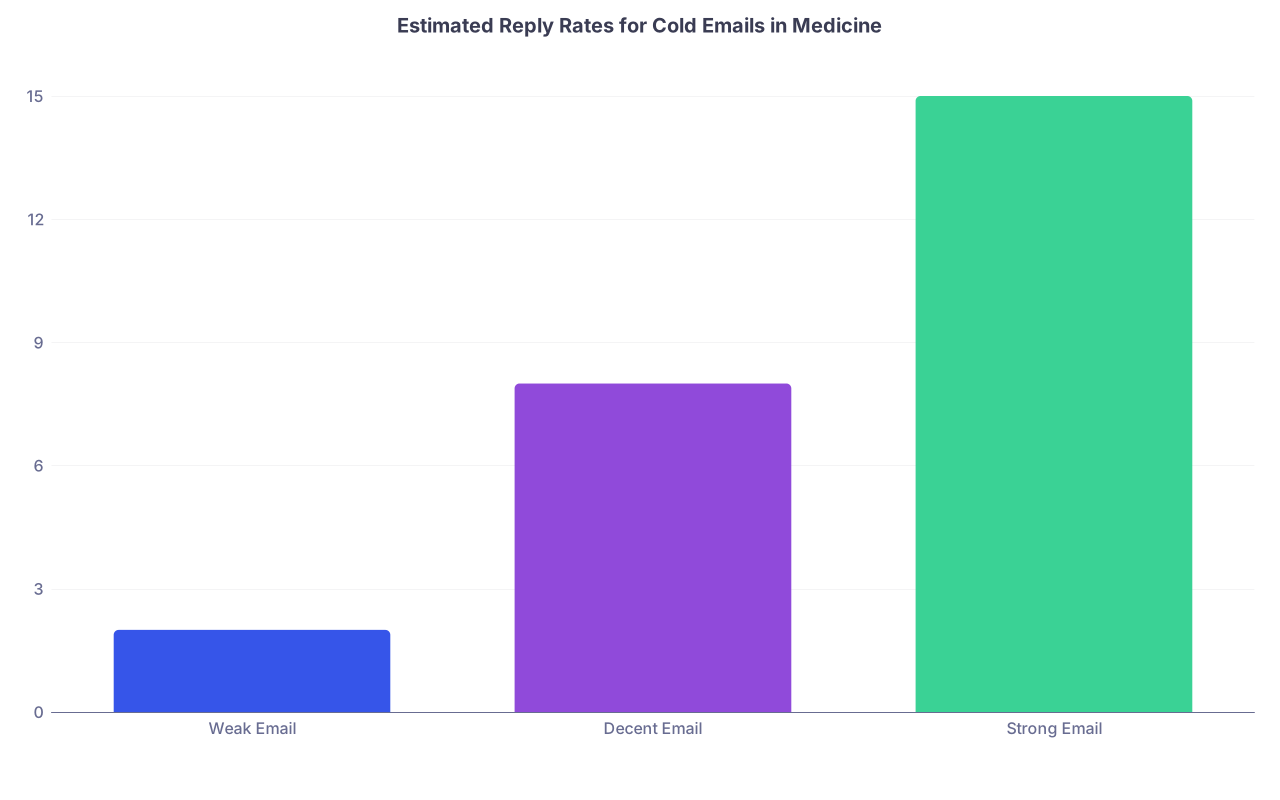
| Category | Value |
|---|---|
| Weak Email | 2 |
| Decent Email | 8 |
| Strong Email | 15 |
Even with a strong email, you might only get ~10–15% responding. That means:
- 10 emails → maybe 1 reply
- 20 emails → maybe 2–3 replies
- 40 emails → now you’re actually in the territory where things start to happen
The dangerous story you’re probably telling yourself is:
“The fact that 5 people didn’t answer proves I’m not good enough.”
No. It proves you’re sampling too small from a chaotic system.
You’re Also Probably Aiming Only at “Celebrities”
Another trap: you email all the big names.
The endowed chair. The national guideline author. The person with 200+ PubMed entries.
Guess who else is emailing them? Every ambitious student on earth.
Start thinking in tiers:
| Target Type | Who They Are | Response Odds |
|---|---|---|
| Tier 1 Big Names | Department chairs, national leaders | Low |
| Tier 2 Mid-Level | Associate professors, busy attendings | Medium |
| Tier 3 Early Career | New faculty, fellows, chief residents | Highest |
If your entire email list is full professors and department chairs, yeah, your response rate is going to be miserable.
Early-career faculty and fellows are where so many good opportunities actually are. They remember being ignored. They’re still building their CVs. They want help.
Follow-Up: Are You Being Annoying or Just Visible?
This part makes people really anxious. The “Should I follow up? Am I bothering them? Are they rolling their eyes at my name?”
Here’s my stance:
A single, polite follow-up about 7–10 days later is not annoying. It’s basic professional behavior.
Something like:
Dear Dr. X,
Just wanted to briefly follow up on my email from [date] in case it got buried in your inbox. No worries at all if now isn’t a good time – I’d still be grateful for any advice on who in [field] might be looking for a student to help with [data / chart review].
Best,
[Name]
If they ignore that too? Drop it. Move on. It’s not a referendum on your worth.
And no, they’re not sitting there thinking, “Wow, this student is so desperate and annoying.” They’re not thinking about you at all. That’s the painful truth, but also the freeing one.
Other Ways to “Network” That Aren’t Just Cold Emails
You might be over-relying on cold emails because they feel “safe.” You can obsess, rewrite, send, and then just wait. No live awkwardness. No real-time rejection.
But the people who keep ending up with mentors and projects? A lot of them:
- Start with warm introductions: a resident, another student, a dean’s office advisor
- Show up: conferences, grand rounds, interest group talks, QI committees
- Ask tiny, easy favors first: “Could I ask you 2–3 quick questions about your path into heme/onc?” rather than “Please give me a project”
You can even map out a small plan:

| Step | Description |
|---|---|
| Step 1 | Identify field |
| Step 2 | Ask classmates who is approachable |
| Step 3 | Email residents or fellows first |
| Step 4 | Attend their talks or rounds |
| Step 5 | Ask 10 min for advice |
| Step 6 | Then ask about projects |
Networking feels less like begging when it’s layered like this instead of jumping straight to “Give me research?”
Let’s Talk About the Dark Thought: “Maybe I’m Just Not Impressive Enough”
This is the quiet thing under everything else.
You’re not just worried your emails are bad. You’re worried you are the problem. Your CV. Your school. Your Step score. Your lack of publications.
Here’s the hard truth that’s actually a bit liberating:
Most people who respond to cold emails are not hunting for “perfect” students. They’re hunting for “reliable” students.
You don’t need:
- 10 publications
- A 270 Step score
- Ivy League on your email signature
You need:
- Clear communication
- Ability to follow directions
- Willingness to do boring tasks without disappearing
I have seen average-on-paper students thrive just because they answered emails promptly and turned in drafts when they said they would. I’ve also seen “superstars” get quietly blacklisted because they flaked after two weeks.
Non-responses to cold emails are not a reliable signal of your worth. They’re a signal of a broken, overloaded system that doesn’t have capacity for every student, even the great ones.
A Simple, Less-Miserable Plan for the Next 30 Days
Instead of spiraling, here’s a very doable reset:
- Rewrite your email using the tighter structure above.
- Build a list of 25–30 targets:
- 5–7 “big names” (fine, keep a few)
- 8–10 mid-career faculty
- 8–10 early-career faculty, fellows, chief residents
- Send 5–7 emails per week, not all at once.
- Follow up once, 7–10 days later, then drop it if no answer.
- In parallel, attend at least 2 events: grand rounds, interest group meetings, or department talks. Ask 1–2 people there, “Is there anyone in [field] who’s good to work with as a student?”
Then reassess.
If you’ve done all that and still have literally zero replies after a month? Then yes, we can start diagnosing more aggressively: maybe your email tone is off, your CV is confusing, or you’re at an institution where people are unusually non-responsive. But you need enough data points before you decide “I’m the problem.”
FAQ (Exactly 4 Questions)
1. How long should I wait before assuming someone won’t respond?
If it’s been 7–10 days with no reply, assume it’s either buried or a silent “no.” That’s when a single, polite follow-up makes sense. If you still hear nothing after that, let it go. Do not send a third or fourth email. Just move on to other people. The mental torture of waiting 3–4 weeks “just in case” isn’t worth it.
2. Is it okay to reuse the same cold email template for multiple people?
Partially. The basic structure can be the same, but at least 30–40% needs to be tailored: mention a specific paper of theirs, specific interest of yours that overlaps, and a concrete way you can help. If it reads like you could swap their name with someone else’s and nothing would change, it’s too generic. People can smell that a mile away.
3. Should I mention my low Step score or weaker GPA in my email?
No. Cold outreach is not the place to pre-defend yourself. You’re not applying for a fellowship with a formal selection committee. You’re asking a busy human if they could use an extra set of hands. Lead with skills and reliability, not stats. If it ever becomes relevant later, you can address it with context, but it doesn’t belong in the very first email.
4. What if I’m at a “no-name” med school or international and worried that’s why no one replies?
Does bias exist? Yes. Some people will quietly prioritize students from certain schools. But plenty of faculty don’t care, especially those drowning in projects and just wanting someone reliable. That’s why specificity and offering concrete help matter so much. “I can do REDCap, data cleaning, lit review” cuts through school name more than you think. Your school might affect your odds a little, but it’s rarely the main reason your inbox is empty.
Key points:
Most cold emails in medicine die in inbox purgatory, and it’s not a moral judgment on you. Tighten your email, aim more at early-career people, send enough messages to actually generate responses, and stop using a handful of silences as evidence that you’re failing as a future doctor.


