

The idea that you’ll be shut out of fellowships because your program has no “big names” is exaggerated—and also not completely made up.
Both things are true at once. And that’s what makes it so anxiety‑provoking.
Let me say it bluntly: coming from a no‑name or low‑prestige residency does not automatically kill your fellowship chances. But pretending pedigree doesn’t matter at all is also fantasy. The trick is understanding when it matters, how it matters, and what you can do so that “no big names” isn’t the thing that sinks you.
You’re not crazy for worrying about this. You’re just not getting the full picture yet.
Where Name Recognition Actually Matters (And Where It Doesn’t)
Programs with “big names” do have real advantages. People who deny that are either lying or insulated.
Here’s what a big-name program really gives you:
- Faculty who are on fellowship selection committees or text the people who are
- A recognizable program name that immediately lowers the reviewer’s anxiety: “We know what their residents are like”
- Built‑in pipelines: “We take one or two from there every year”
So yes, if someone is at MGH, UCSF, Penn, Hopkins, Michigan, etc., and wants a competitive fellowship (GI, cards, heme/onc from IM; ortho sports; derm complex med derm; ENT otology… you get the idea), the road is smoother. Not guaranteed. Just smoother.
But here’s the piece your anxious brain is skipping: fellowship programs are not only filled with people from elite residencies.
Walk through any major fellowship website—cards, GI, onc at big‑name places—and click the “Current Fellows” page. You will regularly see residents from:
- State university programs
- Mid‑tier community or hybrid programs
- International programs
- Places you’ve literally never heard of
Why? Because fellowship directors care about a few specific things more than brand name: performance, letters, fit, and evidence that you can actually do the work.
Pedigree is a shortcut when they know nothing else about you. It’s not the final word once they start reading closely.
How Much Does Your Program Name Really Move the Needle?
Think about it like this: the program name doesn’t decide if you’re in or out. It shifts how much benefit of the doubt you get.
At a “big name” residency, a committee might say:
- “Their research is okay, but they’re from [prestige place], so they’ve probably been well trained.”
- “Letter is strong and from someone we know. Let’s interview.”
At a lesser‑known residency with no celebrities on faculty, they might say:
- “We don’t know this program. Is this letter writer someone we’ve heard of?”
- “Stats are good. But can they handle the volume and complexity here?”
It’s not that one gets in and one is rejected. It’s that you have to prove more on paper if you don’t have the auto‑credibility.
And you can absolutely do that.
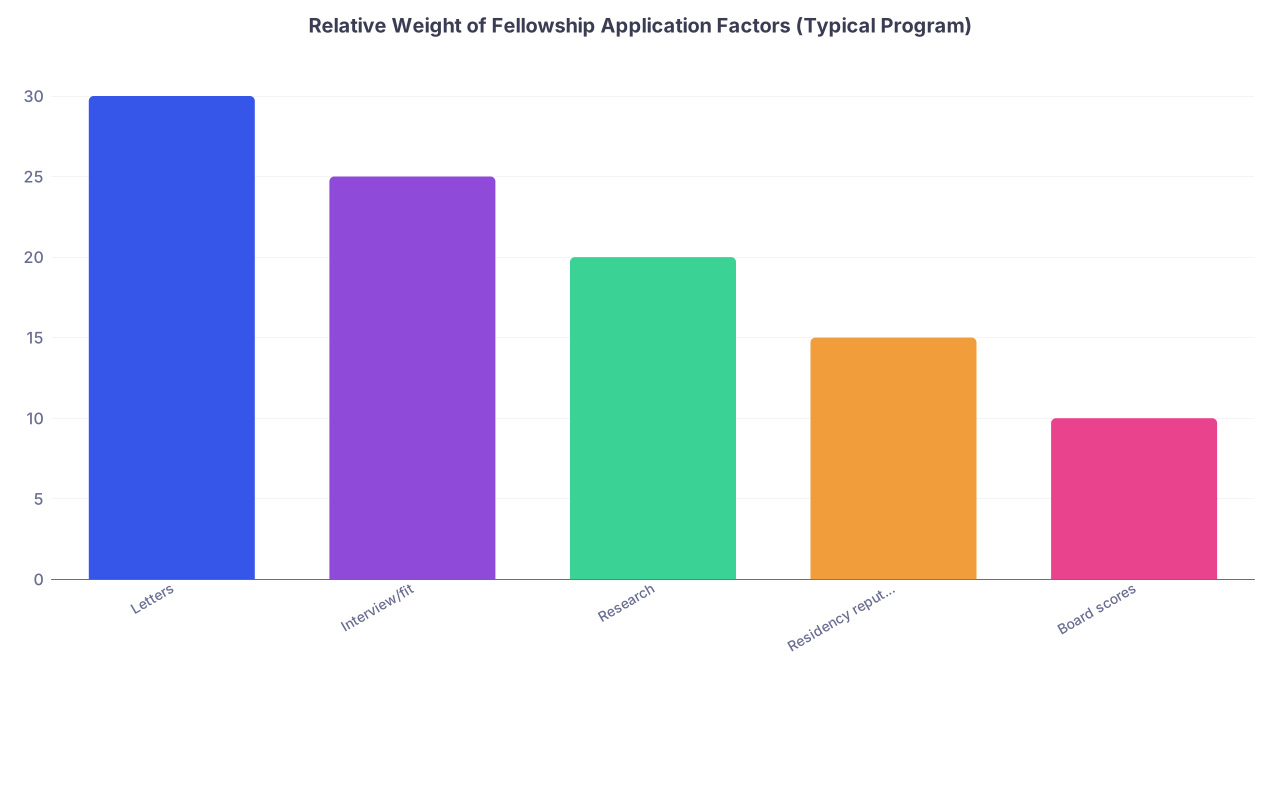
| Category | Value |
|---|---|
| Letters | 30 |
| Interview/fit | 25 |
| Research | 20 |
| Residency reputation | 15 |
| Board scores | 10 |
Are these exact percentages? No. But this is roughly how it feels from the other side of the table. Notice “Residency reputation” is not zero. But it’s also not everything.
The Ugly Truths You’re Afraid Are True (And What’s Actually True)
You’re probably running through worst‑case scripts in your head. Let’s go through them.
“If my program has no famous faculty, nobody will write me a ‘big’ letter. I’m done.”
Not quite.
What matters most in a letter:
- The strength and specificity: do they talk about concrete things you did?
- The credibility of the writer: are they at least known as an academic or regional figure? Do they have publications? Are they fellowship-trained?
- The consistency across letters: do they all paint the same story?
It’s true: a glowing letter from “Random Hospital Associate Program Director” may land softer than a similar one from “Internationally known PI at UCSF.” You’re not imagining that.
But what’s underrated is the impact of:
- A detailed, almost uncomfortably specific letter (“She stayed two hours late with the family after a devastating diagnosis; followed them up after discharge…”)
- A letter from someone mid‑tier but known in the subfield (regional cards person who gives ACC talks, say)
- A strong letter from a fellowship alum of the place you’re applying, even if they’re now at a smaller shop
You can compensate for “no celebrity names” by getting ridiculously strong, narrative letters from people who actually know you.
If the best they can honestly say is “hard‑working, pleasant, a team player,” then yes, you’re in trouble—and that’s not because of prestige. That’s because the letters don’t say you’re exceptional.
“Programs just filter by where you did residency and toss the rest.”
For some ultra‑competitive fellowships at top 5 or top 10 places? There is some soft bias like, “We know we usually do well with candidates from X/Y/Z.”
For most fellowships? No. They don’t have that luxury.
What they do have are dozens to hundreds of applications and limited time. So they use things like:
- Is this a known program or at least similar to prior fellows?
- Are there obvious red flags?
- Does the applicant show actual commitment to this field? (electives, research, letters)
Your job from a no‑name program is to make them say, very quickly: “We don’t know this residency, but this applicant looks strong and serious.”
That’s doable.
Your Program Has No Big Names. So You Manufacture Your Own Signal.
If the brand isn’t doing the work for you, you create your own credibility.
I’ve watched residents at very average community programs end up at top‑10 fellowships because they did a few specific things obsessively well.
1. Get Out of Your Bubble Early
You can’t sit there for three years, then in PGY‑3 suddenly panic and ask, “So how do I get a cards fellowship at a major center?” That’s too late.
You need to:
- Identify what you think you want by PGY‑1/early PGY‑2
- Tell people, explicitly: “I’m interested in [field]. I want to aim for a strong academic fellowship.”
Then you start reaching beyond your program.
That might mean:
- Elective rotations at nearby academic centers
- Research collaboration with faculty at another institution (yes, cold emails; yes, it’s awkward)
- Presenting posters at regional or national meetings where fellowship people actually roam the poster halls
Does it feel unfair that you have to hustle this hard while someone at a prestige program just exists and gets noticed? Yes. You’re allowed to be annoyed. Doesn’t change the strategy.
2. Use Conferences like Your Personal Networking Gym
Conferences are where “no big names” can quietly start to matter less.
You don’t go just to sit in lectures and collect CME. You go to:
- Present something—even a case report—so your badge says “Presenter”
- Stand by your poster and practice talking about your work like you care about it
- Walk up (heart racing) to that mid‑tier faculty who just gave a talk and say, “I’m a resident at [X], interested in [field]. Could I email you about how you got into [subspecialty]?”
You’re not job‑hunting publicly. You’re relationship‑building.
One of the strongest cards fellows I knew came from a truly obscure community IM program. What did he do? Two posters at ACC, one case report, and then shamelessly followed up with anyone who showed the slightest interest in his work. By applications, he had:
- A letter from his local cardiologist
- A letter from a regional academic cardiologist he collaborated with remotely
- A note in his personal statement referencing specific interactions and why he wanted training at X type of program
Nobody cared where his residency was as much after that. He’d built his own context.
Let’s Talk Actual Outcomes: Do People From No‑Name Programs Match?
Yes. All the time. You just don’t hear their stories, because they’re not on Twitter doing humble‑brag threads.
To ground this, imagine a typical mid‑tier IM resident applying to cardiology:
- Program: community‑based university affiliate, no national names
- Research: 1–2 posters, maybe a small retrospective study, mostly local
- Boards: solid but not insane (like 235‑245 Step 2 level)
- Letters: good to excellent, but from people you’ve never heard of
- Personality: shows up well in person, clearly loves the field
This person is absolutely matchable into a good cards fellowship. Maybe not always top‑3 name brands directly. But strong regional programs? Very realistic.
Compare that to someone from a big‑name IM program:
- Same boards
- Same or slightly more research
- Famous name on one letter
- Not great in person, vague interest, seems entitled
I’ve watched selection committees pick the first person many times. They’re trying to fill a program with people they want to work with daily, not build a museum of logos.
If you want to see this yourself, go look up current fellows at places like:
| Program | Example Resident Background |
|---|---|
| Big Tertiary Center A | Mid-tier state IM |
| Big Tertiary Center B | Community-university affiliate IM |
| Prestigious Academic Center C | International + US community IM |
| Solid Regional Program D | DO IM from community program |
| Solid Regional Program E | University IM, no big research |
This is real. It’s not all Harvard > Harvard > Harvard.
The Trap of Fatalistic Thinking: “If I’m Not At X, What’s the Point?”
This is where your brain becomes your biggest enemy.
You start from a true observation: “My program doesn’t have national figures in my field.”
Then you slide into: “Therefore, it’s almost impossible to get a good fellowship.”
Then you end at: “So none of this matters and I’m behind forever.”
And then, because you feel doomed, you stop doing the annoying, unglamorous stuff that would actually help you: sending emails, presenting posters, asking for feedback on drafts, tracking down mentors at other institutions.
The feeling of being shut out becomes a self‑fulfilling prophecy only if you let it paralyze you.
You don’t have the luxury of coasting on brand. So you have to be intentional. You don’t have to be perfect. But you do have to be visibly serious.
Concrete Ways to Offset “No Big Names” (Without Selling Your Soul)
Let’s pull this out of vague encouragement and into specific strategies that actually move the needle.
1. Make Yourself Unignorable on Paper
From a smaller program, your application needs to make a fellowship PD say, “Okay, this person looks legit” within 30 seconds.
That means:
- Clear, consistent story: everything points to your interest in that field
- Evidence of initiative: you didn’t just rotate; you did something with it
- Clean CV layout, no fluff, no padding with meaningless “interests”
Your personal statement shouldn’t read like “I am passionate about X because Y.” It should read like: “Here is what I have actually done over the last three years that proves I care about this and understand what I’m signing up for.”
2. Get At Least One Letter From Outside Your Home Program (If You Can)
This is where those away electives or conference relationships pay off.
A strong outside letter says:
- This person performs well even when people don’t know them already
- They’ve been seen in a different environment and still shine
- Someone outside their immediate program is willing to go to bat for them
It doesn’t need to be from a mega‑famous person. A credible mid‑career academic in your subspecialty, who writes a letter with specific examples, is gold.
3. Use Email the Way Other People Use “Big Names”
Cold email is cringey. Yes. Do it anyway.
Short, respectful, specific emails to people whose work you genuinely read:
- “I’m a resident at [X], interested in [field]. I read your paper on [Y] and have a question about [Z]. Would you have 15 minutes for a quick Zoom at your convenience?”
- “I’m trying to figure out how residents from smaller programs best position themselves for fellowship. I’d love your advice.”
You’re not emailing saying, “Please get me a fellowship spot.” You’re trying to:
- learn, and 2) exist on their radar as an actual human.
Do most of these emails go nowhere? Yes. You don’t need 50 hits. You need maybe 1–2 people who respond and are reasonably kind.
Where Program Name Matters A Lot (And What To Do If You Want Those Places)
If your dream is: “GI or cards at a top‑5 name, straight from residency,” then yeah—being from a non‑famous program is an uphill climb.
Not impossible. But tougher.
People who make that jump from small programs usually have:
- Strong research specifically in that field
- Multiple presentations at big national meetings
- At least one letter from a highly recognizable name
- Stellar evaluations and test scores
If you’re reading this and already a PGY‑2 or PGY‑3 at a modest program and you’re locked on “I must be at the ultra‑top place or I’ve failed,” you have two realistic paths:
- Swing hard anyway and accept some risk of not matching the first cycle
- Play a longer game: match a solid fellowship, then target a big‑name place for advanced/sub‑subspecialty training or a job afterward
People underestimate path #2. Fellowship isn’t the last stop. I’ve seen:
- Cards fellows at mid‑tier programs do a high‑profile EP or advanced imaging fellowship at top places
- Solid GI fellows from smaller places get IBD or advanced endoscopy fellowships at big centers
- Community heme/onc fellows go to major cancer centers for research fellowships
The hierarchy doesn’t lock permanently at age 27.
Your Real Question: “Is Where I Am Now A Life Sentence?”
No.
Will you always be competing with people who had more brand backing than you? Yes. Medicine is hierarchical and kind of obsessed with logos. That won’t change.
But your fate isn’t sealed because your residency brochure doesn’t have a Nobel laureate on it.
If you’re willing to:
- Start planning earlier than your peers
- Be more deliberate about meeting people at conferences
- Send awkward emails to strangers
- Take on unsexy work (chart reviews, case reports) to get your name on things
- Ask directly for strong, detailed letters and give your writers material to work with
You can absolutely match into a good fellowship. Maybe not always the fanciest. But good. Solid training. A real career.
And from there? Your reputation becomes about you, not the name at the top of your first residency contract.
Key Takeaways
- A program with no “big names” does not shut you out of fellowship, but it means you can’t rely on pedigree to open doors—you have to build your own signal.
- Strong, specific letters, visible commitment to the field (research, electives, conferences), and even one or two external connections often matter more than the logo on your white coat.
- The game isn’t over at residency match; if you’re intentional and a little relentless, you can still shape your fellowship and career path from where you are now.


