
It’s 7:58 a.m. You’ve sprinted from the stairwell into the auditorium, still slightly out of breath, half a cup of lukewarm coffee in your hand. Grand rounds is starting. Attending row is filling up. The department chair is talking to that PGY-3 who somehow “just happens” to be everywhere. Faculty are clustered in little circles that you’re not part of.
You sit in the back, open your laptop, pretend to care about the title slide, and tell yourself, “I’m here, that’s what matters.”
That’s the lie.
Being there is the bare minimum. The real game—the one that determines who gets mentored, who gets letters, who gets pulled into research and given the benefit of the doubt—that happens in the five minutes before and the ten minutes after. In the hallway. Near the coffee. Walking out of the room.
I’ve watched this from the podium, from the middle rows, and from the back. Residents who understand how to work grand rounds and journal club get opportunities that, on paper, they “don’t deserve.” And the ones who think showing up and taking notes is enough? They stay invisible.
Let me walk you through how this actually works.
What Grand Rounds and Journal Club Really Are
Officially, they’re educational. CME. Evidence-based updates. All that language admin loves to put on flyers.
Unofficially? They’re structured networking events with built-in hierarchy and plausible deniability. No one will ever call them that, but that’s how senior faculty use them.
The pattern is the same everywhere—big academic IM, surgical subspecialties, community hospitals trying to look academic. Same dynamic.
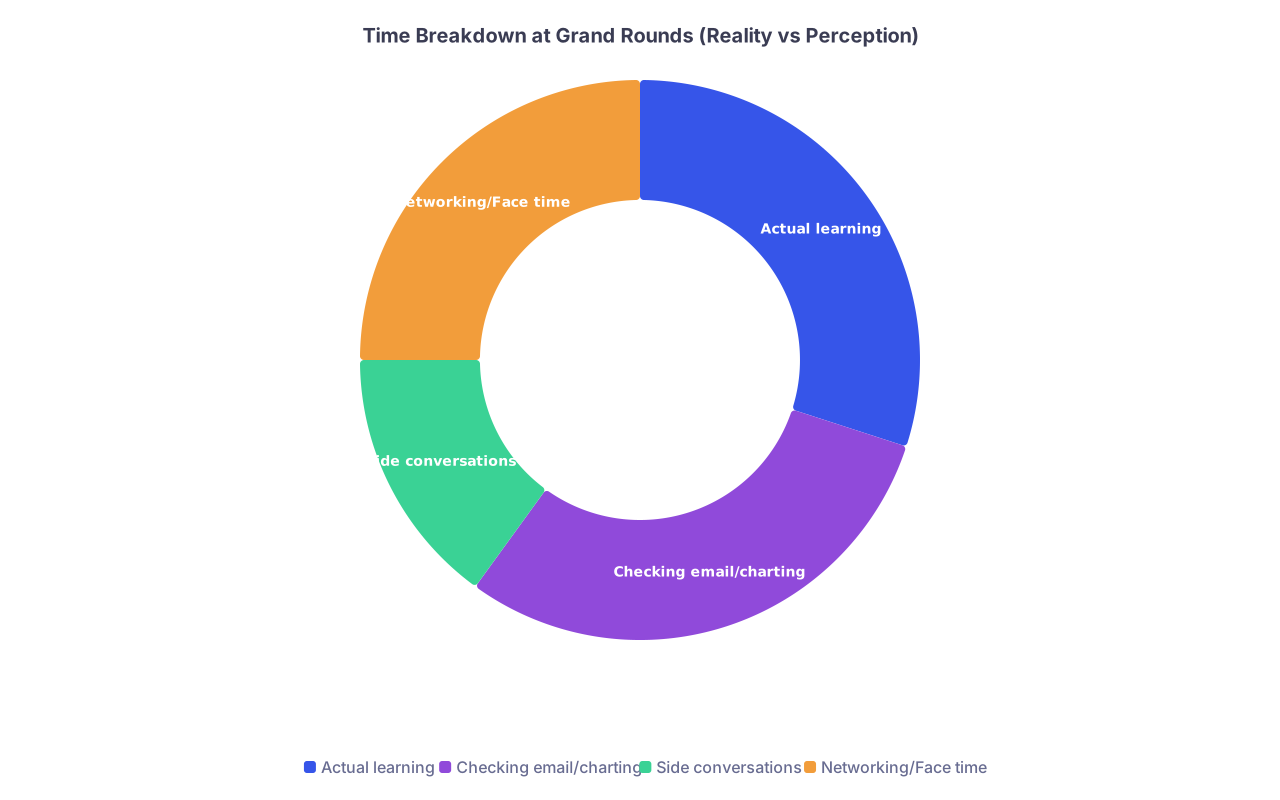
| Category | Value |
|---|---|
| Actual learning | 30 |
| Checking email/charting | 30 |
| Side conversations | 15 |
| Networking/Face time | 25 |
You think grand rounds is 90% content, 10% everything else. That’s how trainees see it. Faculty experience it differently. To them, this hour is:
- A chance to see who’s serious about the field
- A chance to spot which residents/med students are present, awake, engaged
- A low-risk way to meet people outside formal evaluations
- A social radar sweep of the department
Same with journal club. It’s not “just” about P values and hazard ratios. It’s where people see who can think on their feet, who’s read the paper, who can disagree without being obnoxious—and who might be worth investing in.
Once you understand that, you stop treating these things like lectures and start treating them like recurring professional auditions.
The Before-and-After Game: Where Networking Actually Happens
People focus way too much on what to say and not nearly enough on when to be there.
There are really three zones: pre, during, and post. Only two of them matter for schmoozing.
The five-minute rule
If you stroll in right at the start or sneak in five minutes late and vanish the second the last slide flashes “Thank you,” you’re signaling something very clear to the people who matter: “I’m here to check a box.”
You want to be in the room or hallway 5–10 minutes early and stay 5–10 minutes after. That’s the entire playing field.
The trick: you’re not “lingering aimlessly.” You’re circulating and landing in short, targeted interactions.
Where to physically position yourself
Nobody teaches you this, but it matters.
- The extremes of the back row: where disengaged people hide
- The absolute front row: where try-hards sit to be seen but not engage
- The edges of the middle: that’s your sweet spot
You want to be somewhere that lets you:
- Turn easily to talk to people behind/next to you
- Stand up and merge into a small group after without having to fight the aisle
- Be seen by faculty but not sitting directly under the podium like an overeager M1
At journal club, it’s simpler. Sit in the inner ring, not the outer periphery. If you’re on the couch along the wall behind everyone else, you’ve basically opted out.
How Faculty Actually Categorize You
Let me be blunt. Most attendings are not keeping a spreadsheet of residents and med students with scoring rubrics. But they do maintain mental buckets. Crude but powerful.
| Bucket | What They Notice | Typical Outcome |
|---|---|---|
| Engaged & normal | Shows up, asks 1–2 solid questions over a month, chats appropriately | Gets mentored, gets projects, gets strong letters |
| Eager but weird | Tries too hard, asks off-base questions, lingers awkwardly | Tolerated, seldom championed |
| Invisible | Sits in back, never speaks, leaves fast | Neutral evals, no extra effort on their behalf |
| Annoying | Dominates discussion, challenges to show off, name-drops | Quietly avoided, no one volunteers to help |
You want “engaged & normal.” That’s the bullseye.
The good news: that’s not hard. The bad news: people either overshoot and become The Eager One, or they stay silent and become furniture.
Schmoozing Without Looking Like You’re Schmoozing
This is where people blow it. They either “network” like they’re at a sales conference, or they stand there nursing coffee like a shy third-year at their first code.
Here’s what actually plays well with attendings.
Your pre-game: do 2 minutes of homework
If there’s a scheduled speaker, skim:
- The title
- Their institution
- One recent paper or area of interest
You’re not doing a lit review. Ninety seconds on PubMed and a quick scan of the flyer is enough to have one intelligent sentence ready.
“Dr. X, I saw you’ve done a lot of work on anticoagulation in cancer patients—I’m on heme right now and we were just struggling with a similar issue last week.”
That’s it. That’s the whole move. Shows intention, shows context, feels natural. No one does even this minimal prep, so you stand out.
Opening lines that don’t feel fake
The most effective lines are observational, specific, and short.
What doesn’t work: “Hi, I’m trying to get into cardiology, can you give me advice?” right off the bat. That’s needy.
Instead:
- “Dr. Patel, I’m on the wards team—you mentioned that case of severe AR last week at noon report, did they end up going to surgery?”
- “Dr. Chen, I’m one of the interns on CCU—we’ve been seeing so many patients with HFpEF, so I’m curious what you think about using [whatever the talk is about] in that population.”
You’re linking yourself to something they already recognize: a service, a previous case, their content.
The 60–90 second rule
Most residents stay too far away. The rest stay too long.
Perfect interaction length at grand rounds: 60–90 seconds. Two minutes max.
Enough to be remembered. Not enough for them to start glancing over your shoulder for escape.
Pattern it like this:
- Approach with something specific (“I liked the part where…” or “I’m on X service, we’ve been seeing…”).
- Make one sincere, specific comment or question.
- Add one tiny personal anchor (“I’m the PGY-2 who’s always on nights, hopefully on days next month”).
- Exit cleanly (“Don’t want to keep you, but thanks again, that was really helpful”).
That exit line matters. It tells them you understand time, boundaries, hierarchy. That’s a green flag.
Asking Questions in the Session: How Not to Embarrass Yourself
This is where careers get quietly torpedoed. I’ve seen it.
There are residents who think, “If I ask a question every single week, people will think I’m engaged.” No. People will think you’re trying to perform engagement.
Here’s what attendings judge when you ask a question:
- Did you listen to the talk or are you re-asking something they just answered?
- Is your question grounded in clinical reality or is it a flex about reading some obscure trial?
- Does it advance the group’s thinking or just your ego?
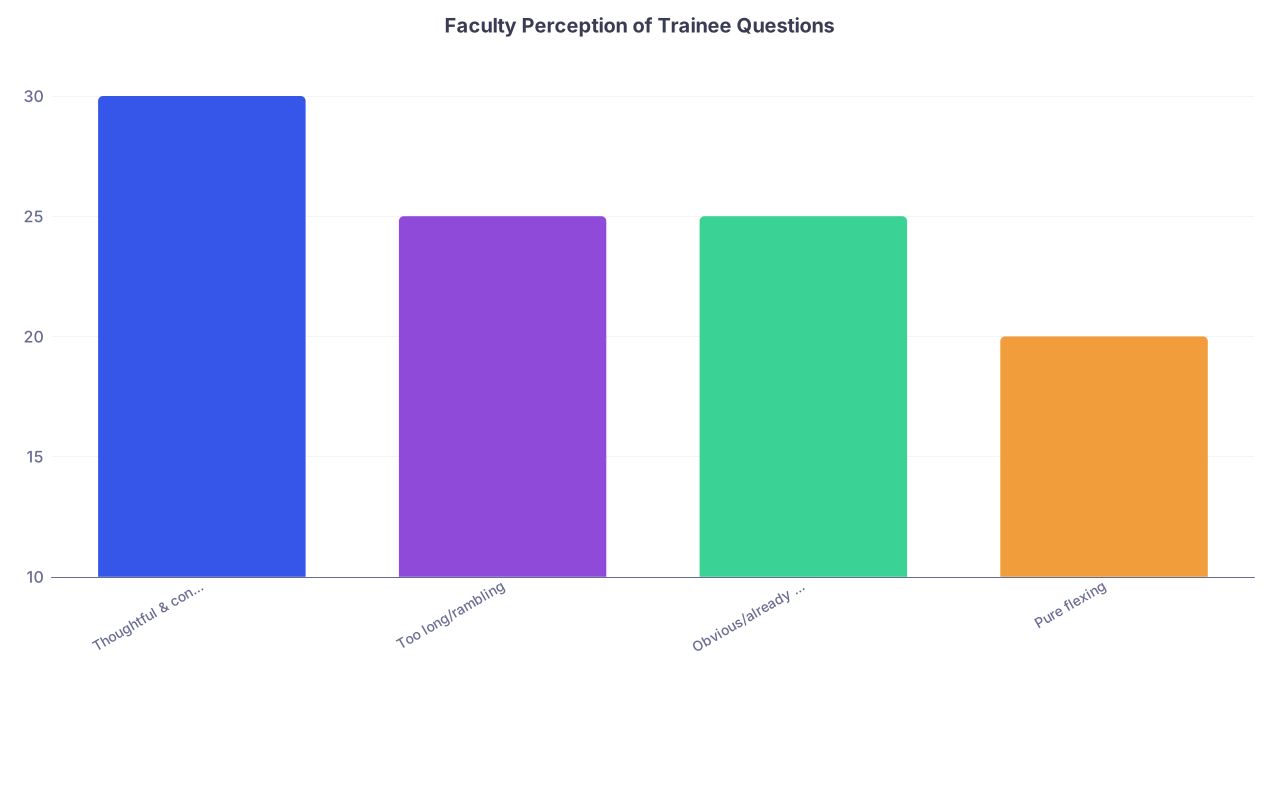
| Category | Value |
|---|---|
| Thoughtful & concise | 30 |
| Too long/rambling | 25 |
| Obvious/already covered | 25 |
| Pure flexing | 20 |
You want “thoughtful & concise.” The way to get there is boring but effective:
- Write your question down when it first occurs to you.
- Wait. See if they answer it later in the talk.
- If they haven’t, simplify it to one clear sentence with maybe one sentence of context.
Prototype:
“I’m a PGY-1 on the medicine service—right now our biggest struggle with X is Y. How do you approach that in your practice?”
You’ve anchored who you are and why the question matters. That’s it.
Don’t:
- Monologue.
- Cite six trials unless you actually know them cold.
- Start with, “So, in the New England Journal study from 2003…” unless that paper is literally central to the talk and you know they know it.
Journal club is slightly different: there, longer, more technical questions are expected—but the same rule applies. If you’re speaking, contribute. Don’t audition as the walking UpToDate extension.
Working Journal Club Like a Pro
Most residents treat journal club as a chore: free food, live torture. Faculty treat it as a diagnostic test.
They’re watching for three things:
- Can you read a paper beyond the abstract?
- Can you disagree respectfully without being a jerk?
- Can you build on someone’s comment instead of always shifting the spotlight to yourself?
This is where future chiefs and future academic hires often first register on the radar.
How to comment without overstepping
The mistake I see all the time: someone who’s never opened a methods textbook hears “hazard ratio” and decides this is the time to critique the Cox model assumptions. No.
When you speak, aim for one of these:
- Clarify clinical impact: “So for us on nights admitting HF patients, does this change who we’d start X on now vs at follow-up?”
- Connect to a patient: “Last week we had a patient very similar to the trial patients except they were older/more frail—would you still apply these results?”
- Pressure-test external validity: “It looks like 90% of their population was from a single center in Europe—do you think that affects how we apply this in our patients?”
These are mature comments. They show you understand the paper lives in the real world, not just in SPSS.
The small group post-game
Journal club usually ends with people lingering around half-eaten pizza and stacks of copies. This is prime time.
Walk up to the faculty who led it and say something very simple:
“I liked how you framed the limitations section—this is the first time I really understood why X might not apply to our patients on Y service.”
Short. Specific. Sincere. Then, if you have a follow-up (“I’m actually interested in outcomes research—is there someone at our institution who does more work in this space?”), this is where you ask.
That’s how side doors into projects open.
How to Be Remembered Without Being “That Guy”
There’s a quiet scoring system in academic departments. No one writes it down, but it’s there.
You do not need to be everywhere. You do need a consistent, recognizable presence.
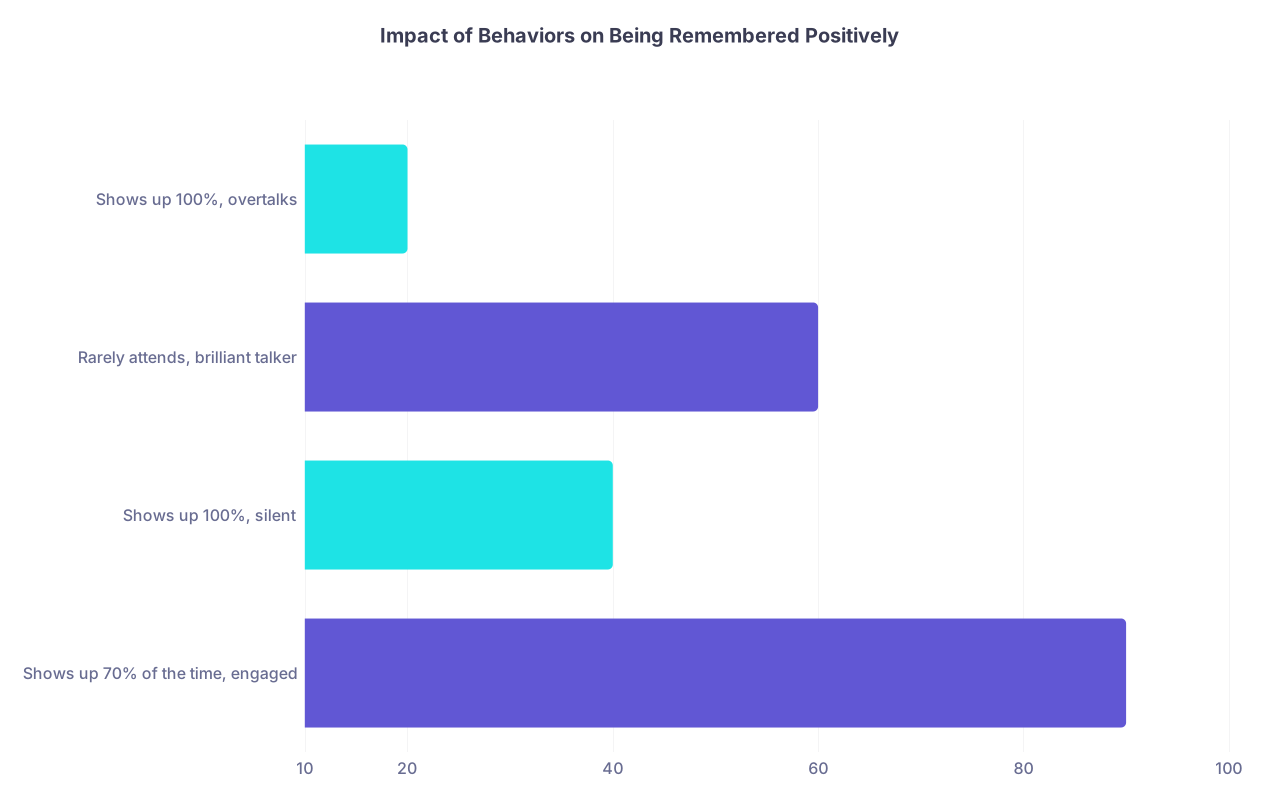
| Category | Value |
|---|---|
| Shows up 70% of the time, engaged | 90 |
| Shows up 100%, silent | 40 |
| Rarely attends, brilliant talker | 60 |
| Shows up 100%, overtalks | 20 |
The sweet spot is clear: show up regularly, participate selectively, and be normal.
Concrete habits that work:
- Know 3–5 attendings by name, and make sure they know yours. Use their names when you greet them.
- Once a month, ask a good question or make a meaningful comment in a large group setting. Not every week. Once a month.
- Twice a month, have a 60–90 second hallway / post-talk chat with a faculty member who is not on your current team.
This doesn’t sound dramatic, but over 6–12 months, you become “one of the engaged residents” in enough people’s minds that when something comes up—a new QI project, an abstract, a letter request—you’re in their available-to-help list mentally.
Just getting into that list is half the game.
Power Dynamics and Pitfalls: What Gets Talked About Later
There are things residents do at these events that become stories. Not in a good way.
I’ve heard all of these in faculty rooms after:
- The resident who kept interrupting the visiting professor to show off their own fellowship-level knowledge.
- The med student who cornered the chair after grand rounds and launched into a five-minute monologue about their CV.
- The fellow who used Q&A to aggressively “debate” the speaker like it was a trial defense.
Let me be direct: you are not scored only on content. You are scored on how you handle hierarchy, humility, and disagreement.
A few hard lines
Do not:
- Use Q&A to prove the speaker is wrong. If you truly think so, ask a softer version and then, maybe, approach after and have a real discussion.
- Ask questions that are really about you: “As someone applying to cardiology…” Everyone hears the subtext. It’s self-serving.
- Dominate. If you’ve spoken twice in one session and others haven’t spoken at all, that’s already too much.
Good faculty are allergic to attention hogs. The person you impressed with your deep question? There’s a decent chance three other attendings mentally crossed you off their list.
Turning Casual Contact Into Real Mentorship
Schmoozing is step one. Converting that thin thread into something substantial is step two. Most people never do it right.
You’re not trying to get a mentor out of every interaction. You’re trying to identify 1–2 people over a year who seem receptive, aligned with your interests, and decent to work with.
Here’s how the pipeline looks when it actually works:

| Step | Description |
|---|---|
| Step 1 | Brief chat after grand rounds |
| Step 2 | Second casual interaction a few weeks later |
| Step 3 | Short focused email |
| Step 4 | 15 min meeting or coffee |
| Step 5 | Small task or project |
| Step 6 | Ongoing mentorship |
Most residents skip from A to “Can you write me a letter?” Huge mistake.
Do it this way instead:
- You’ve had a short, positive interaction after a talk.
- A few weeks later, you see them again at journal club / another conference. You say: “Hi Dr. X, we talked after that anticoagulation talk—I’m the PGY-1 on nights who asked about cancer patients.” Short reconnection.
- After 1–2 of these, you send a focused email:
- Subject line: “PGY-2 interested in outcomes work on [X] – quick question”
- Body: four sentences: who you are, why you’re writing, what you’re asking for (15 min to ask about how to get involved in [their area]).
- Show up to that meeting on time, with one or two ideas or at least knowledge of their work. Be clear you’re ready to do grunt work.
That whole chain started with a 90-second schmooze at grand rounds. That’s how the system actually runs.
What Changes in the Future (and What Won’t)
We can talk about hybrid grand rounds, Zoom journal clubs, chat-based Q&A. Some places are already there.
Here’s the truth: even with digital formats, the human patterns don’t disappear. They mutate.
I’ve watched departments switch to Zoom and you know what faculty notice?
- Who keeps their camera on.
- Who asks real questions in chat vs copy-pasted lines from an UpToDate entry.
- Who sends a brief, thoughtful follow-up email to the speaker after a good talk.
The medium shifts, but people still remember the residents who engage like colleagues, not just learners.
So yes, the future might involve more virtual grand rounds, AI-summarized journal club articles, and recorded sessions. But the people who rise will still be the ones who:
- Show up
- Engage intelligently
- Make themselves known in small, human, low-friction ways
Schmoozing is just the old, slightly ugly word for what is, at its core, a very simple skill: making it easy for other humans to remember you positively and want to invest in you.
The Bottom Line
Keep this tight:
- Grand rounds and journal club are not just education—they’re recurring low-stakes auditions. Treat them that way.
- Aim for “engaged & normal”: short, specific interactions; occasional good questions; consistent, visible presence.
- Use those 60–90 second post-talk conversations as the starting point for real mentorship, not the end goal.