The way most people “network” at conferences is useless small talk and awkward badge-staring. You are going to do the opposite: run a simple, repeatable script before, during, and after the conference that actually creates relationships and opportunities.
This is not about “being outgoing.” It is about having a system. Scripts. Templates. Clear next steps.
Below is exactly what to say, when to say it, and how to say it in the medical world—where hierarchy, time pressure, and academic egos all complicate normal networking.
1. Core Principles Before You Touch a Script
If you skip this, your scripts will sound fake and you will default back to rambling.
The 4 rules of effective conference networking in medicine
You are not trying to impress everyone.
You are trying to build 5–10 real relationships. That is it. Anything more is noise.You must do 70% of the work before the conference.
Cold-walking into a ballroom hoping to “meet the right people” is amateur hour. You pre-identify targets, reach out early, and schedule contact points.Every interaction needs a “next tiny step.”
Not “let us stay in touch.” That is code for “goodbye forever.” You want something concrete:- “Can I email you one follow-up question?”
- “Could I send you a draft in 2 weeks for feedback?”
- “Is it alright if I reach out in the fall about away rotations?”
You control your introduction.
Medicine loves status markers: institution name, year, specialty. If you do not clearly and quickly position yourself, people will guess wrong or forget you. You want a 1–2 sentence “who I am and what I am working on” ready.
Write this down now:
- Name:
- Current role:
- Institution:
- Focus / interests (1–2 specific topics, not “I like everything”):
- One sentence about what you are looking for at this conference (mentorship, research collaborators, fellowship insight, etc.)
We will plug this into every script.
2. Before the Conference: The Pre-Game That Actually Matters
If you do this correctly, the conference itself becomes execution, not improvisation.
2.1 Build a short, ruthless target list
Open the conference website and identify:
- 3–5 people giving talks directly related to your interests
- 2–3 people from programs you care about (fellowship or residency)
- 1–2 people doing work you genuinely admire (landmark papers, big trials, policy work, etc.)
Put them in a table so you can track outreach and follow-up.
| Name | Role | Session | Priority | Status |
|---|---|---|---|---|
| Dr. A | Program Director | Fellows Panel | High | Emailed |
| Dr. B | PI, Big Trial | Keynote | High | No response |
| Dr. C | Assistant Prof | Poster Session 3 | Medium | Meeting set |
| Dr. D | Chief Resident | Residency Fair | Medium | To approach in person |
| Dr. E | Chair | Luncheon | Low | Observe only |
Your bandwidth: if you are early in training, 5–10 targets is realistic. More than that and your follow-up will fall apart.
2.2 Pre-conference email script (to faculty / leaders)
Subject line needs to be short and specific. No generic “Networking at [Conference]”.
Template:
Subject: Quick hello before [Conference Name] – [Your Name, Institution]
Dear Dr. [Last Name],
My name is [Name], and I am a [PGY-2 in Internal Medicine / MS3 / cardiology fellow] at [Institution]. I am particularly interested in [specific area – e.g., cardio-oncology, AI for imaging, sepsis quality improvement], and I saw that you will be [giving a talk / moderating a panel / presenting] on [session title] at [Conference].
I will be attending your session and wanted to briefly introduce myself ahead of time. I am currently working on [1 short line about your project, angle, or career direction].
If you are available for a 5–10 minute chat [before/after your session or during a break], I would be grateful for the chance to ask you one or two quick questions about [mentorship in this area / career paths / potential research directions]. I know your schedule will be busy, so I completely understand if that is not possible.
Either way, I am looking forward to your session.
Best regards,
[Full Name]
[Role, PGY/MS/Fellow] – [Institution]
[Optional: Cell number for text at conference]
Key points:
- You name the exact session so they know you are not spamming.
- You ask for 5–10 minutes — small ask, specific context.
- You give them a graceful out so they do not feel pressured.
If you get no reply: you still attend the session, and you still approach them using your “warm intro” script (see below).
2.3 Pre-conference email script (to peers / residents / fellows)
Peers respond better to casual and concrete than formal and vague.
Subject: Resident at [Institution] – will you be at [Conference]?
Hi [First Name],
I am [Name], a [PGY-1 in Pediatrics at X / MS4 interested in EM] at [Institution]. I saw your name on the [residency fair / panel / abstract] list for [Conference]. I am very interested in [their program / their project on X].
I will be there [Fri–Sun]. If you are around, would you be open to a quick coffee between sessions to hear your perspective on [your program / your fellowship / how you approached X project]?
No pressure at all — I know schedules get chaotic. If it works, great; if not, I will try to catch your [poster/talk].
Best,
[Name]
[Role, Institution]
You are not begging for life advice. You are asking for a specific 10–15 minute chat.
2.4 Prepare your 3 core scripts before you travel
Write and practice these out loud. Actually say them.
Hallway intro (10 seconds):
“Hi, I am [Name], a [role] at [institution], really interested in [specific area]. I have been following your work on [X / or came for your session on Y].”
Session follow-up question (15–30 seconds):
“I had a quick question about your point on [X]. For someone early in training who wants to get involved in that space, would you prioritize [A] or [B] as a starting point?”
Exit line with next step (10–20 seconds):
“I do not want to take more of your time now. Would it be alright if I emailed you one or two specific questions and a bit about what I am working on?”
These three cover 90% of interactions.
3. During the Conference: What to Say in Real Time
You have two jobs during the conference:
- Execute your prepared scripts.
- Create clean, low-friction follow-up paths.
3.1 First contact: approaching someone you emailed already
This is the easiest scenario. You “already know each other” by email.
Use this right after their talk / panel, when they are done answering mic questions and the crowd thins.
“Dr. [Last Name], hi, I am [Name] from [Institution]. I emailed you last week about your session on [topic]. Thank you for that talk — I especially appreciated your point about [specific idea].”
Stop. Let them respond. They will almost always say something like “Oh yes, nice to meet you” even if they barely remember. That is fine. You just moved from cold to warm.
Then:
“If you have 2 minutes, I would love your quick take on something.
For someone at my stage ([MS3 / PGY-1 etc.]) who wants to get involved in [their area], would you focus first on [option A] or [option B]?”
You are:
- Showing you prepared.
- Respecting time.
- Asking a simple, answerable question.
After they answer:
“That is very helpful, thank you. I will start with [their recommendation]. Would it be alright if I followed up by email once I have something more concrete to share?”
You now have permission to send a substantive follow-up (draft idea, proposal, updated CV, etc.).
3.2 Approaching someone you did not email
Classic hallway or coffee line approach.
Script:
“Hi Dr. [Last Name], my name is [Name]. I am a [role] at [Institution] and really interested in [their topic]. I came to your session on [exact session name or time]. The part about [specific detail] really caught my attention.”
Pause.
Then:
“I am early in my training and trying to understand how people actually get started in [clinical research / quality work / advocacy] in this space. If you were in my shoes now, what is one step you would take in the next 3 months?”
Faculty can answer that in 30–60 seconds. That is what you want.
Close with:
“Thank you, I will act on that. Would you be open to a brief email update once I have tried what you suggested? I would value any feedback if you have time.”
Again: you are not asking for a lifelong mentoring commitment on the spot. You are earning a right to follow up by executing one small step.
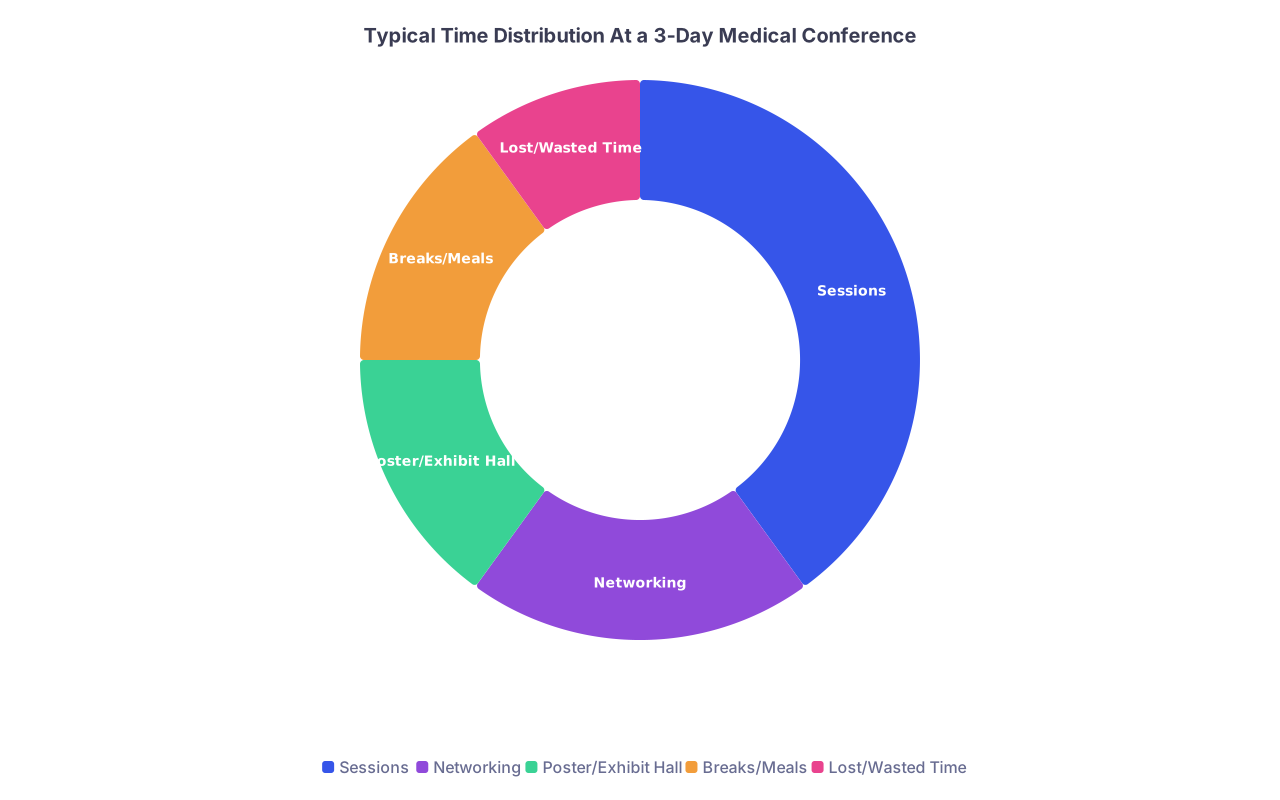
| Category | Value |
|---|---|
| Sessions | 40 |
| Networking | 20 |
| Poster/Exhibit Hall | 15 |
| Breaks/Meals | 15 |
| Lost/Wasted Time | 10 |
3.3 Small-group events and receptions
This is where people either hide by the cheese table or collect 30 business cards they never use. You are going to run a simple loop:
- Short approach
- Quick context
- Targeted question
- Exit + next step
Example with a group of fellows around a program director:
“Hi, I am [Name], [MS4 at X] interested in [specialty]. I do not want to interrupt, but I had a quick question for you and your fellows if that is alright?”
They nod.
“For someone who is a year or two away from applying, what is something you actually notice on applications or at interviews that is different from what people obsess about on online forums?”
You get program director plus insider fellow commentary. Gold.
Exit:
“This has been really helpful. I will not take more of your time, but could I email one of you if I have a follow-up once I have rotated more in [specialty]?”
Ask for one business card / email, not five. Then step out.
3.4 Poster sessions: how to not waste them
Poster halls are where many real relationships start. Most people walk through silently. Big mistake.
Approach script for a poster in your area:
“Hi, I am [Name], [role] at [institution]. I am also working on [similar domain, 1 short phrase]. I saw your title on [X] and wanted to hear the 30-second version — what did you find that surprised you?”
Poster presenters want to talk. You just gave them an easy starting line.
Then:
“I am curious — what would be the logical next step after this project, if you had infinite time or one more resident?”
You are fishing for:
- Unfinished work
- Follow-up ideas
- Potential ways to plug yourself in
If there is a possible fit, say:
“That is exactly the kind of thing I would like to be involved in more. If you and your team are open to collaborators at the [student/resident] level, I would be glad to send my CV and one or two specific ways I could help.”
Be specific later in email; for now, you just open the door.

| Step | Description |
|---|---|
| Step 1 | Build Target List |
| Step 2 | Send Pre Emails |
| Step 3 | Attend Key Sessions |
| Step 4 | Approach After Talks |
| Step 5 | Ask 1 Focused Question |
| Step 6 | Request Email Follow Up |
| Step 7 | Send Follow Up Within 72 Hours |
| Step 8 | Propose Small Next Step |
4. After the Conference: Turning Contacts into Commitments
Most value is lost here. People fly home, throw badges away, and go back to chaos. You are going to do the opposite: 7 days of disciplined follow-up.
4.1 The 72-hour follow-up rule
Within 72 hours of the conference ending, you send tailored emails to the 5–10 people who matter. Not 3 weeks later. Not “when things calm down.”
For faculty you spoke with:
Subject: Thank you – [Conference Name] follow up
Dear Dr. [Last Name],
It was a pleasure meeting you at [Conference] after your session on [topic]. Thank you again for taking a few minutes to discuss [their advice].
As you suggested, my next step will be to [their recommendation – e.g., identify 1–2 local mentors, start with a small QI project, join existing registry, etc.]. I have attached a brief 1-page summary of my current interests and background so you have a bit more context.
If you are open to it, once I have made progress on [specific step] over the next [timeframe – 4–6 weeks], I would appreciate the chance to send you a short update and possibly ask one or two more focused questions.
Thank you again for your time and for your work in this area.
Best regards,
[Name]
[Role, Institution]
[Contact]
You are reminding them:
- Who you are.
- What they said.
- What you are going to do.
- What the next touchpoint will be.
4.2 The “missed connection” follow-up
There will be people you wanted to meet but could not reach or only briefly interacted with.
Subject: Brief follow up from [Conference] – [Your Name, Institution]
Dear Dr. [Last Name],
I attended your session on [topic] at [Conference] and unfortunately could not catch you afterward due to the crowd. I especially appreciated your point on [specific idea], as I am working on [1-line about your project/angle].
I am a [role] at [Institution] with a growing interest in [their area]. If you are open to it, I would be grateful for the chance to send a short description of my current work and one or two targeted questions about possible next steps in this field.
I know you receive many requests, so no response needed if your schedule is already full.
Best regards,
[Name]
[Role, Institution]
Notice the pattern:
- You offer to send something rather than immediately asking for a Zoom.
- You give them permission to ignore you. Counterintuitively, that increases responses because it feels low-pressure.
4.3 What to send when they say “Sure, send it”
Now you need a tight 1-page “networking brief.” Not a 10-page CV dump.
Sections:
- Header – Name, role, institution, contact
- Current stage & goals (2–3 bullets)
- PGY-1 in IM, planning to apply for cardiology fellowship
- Interested in outcomes research in heart failure and quality improvement
- Relevant experience (3–5 bullets)
- Co-author on [trial name or topic], focusing on [part you did]
- Working on retrospective chart review about [X] with Dr. [Y]
- Coursework or training (e.g., clinical research certificate, basic stats)
- What you are looking for (2–3 bullets)
- Feedback on 1–2 potential project ideas
- Sense of what early-career steps matter in [field]
- Whether multi-center collaboration is realistic at my stage
Attach your actual full CV as a separate file. The brief gets read; the CV is reference.
Then your email:
Dear Dr. [Last Name],
Thank you again for being open to follow up after [Conference]. As promised, I have attached a 1-page summary of my current background and interests, along with my full CV for reference.
I would greatly value your thoughts on which of the following would be the most logical next step for someone at my stage:
- [Project idea A – 1 line]
- [Project idea B – 1 line]
- [Alternative – e.g., focusing on skills or joining existing project rather than starting new one]
A brief email response with your preference would be extremely helpful. If you think none of these are appropriate, I would appreciate any redirection.
Best regards,
[Name]
Again: you are making it easy to help you.
5. Scripts for Common Awkward Situations
You will hit friction. Here is how to handle the classic scenarios.
5.1 The “I am busy right now” brush-off
You: “Would you have 5 minutes now or later during the conference?”
Them: “Honestly this weekend is packed, sorry.”
Do not panic. Use this:
“No problem at all, I completely understand. Would it be alright if I sent you a brief email with one or two questions instead?”
Most will say yes. You just converted an in-person no into a remote maybe.
5.2 The senior person with a crowd around them
Do not hover for 15 minutes. That looks desperate.
Instead, wait for a small gap, step in with:
“Dr. [Last Name], I know you have many people waiting, so I will keep this to 10 seconds. My name is [Name], [role] at [Institution] interested in [their area]. I just wanted to thank you for your work on [X] — it has strongly influenced how I am thinking about [Y]. Would it be alright if I send a short email later with one specific question?”
You are not trying to have a full conversation. You are planting a flag and asking permission for follow-up.
5.3 You realize mid-conversation that this person is not relevant
Happens all the time. Someone is nice but clearly not aligned with your interests.
You do not need to force a connection.
Exit gracefully:
“This has been really helpful to hear about [their area]. I am going to check out the next session, but thank you for taking the time to chat.”
No promise of follow-up. No collecting a card you will never use. Your time is finite.
5.4 You forgot what someone does and feel dumb asking
Own it and reset the frame:
“I apologize — I have met so many people today that I am mixing up roles. Could you remind me of your position and main area of work?”
Everyone understands. Better to ask than fake it and say something off.
6. Turning One Conference into a Long-Term Network
If you execute everything above, you will leave the conference with:
- A list of 5–10 people you have actually spoken with
- Permission from some of them to follow up
- A handful of realistic next steps
Now you build a simple “networking maintenance” routine.
6.1 Track your relationships like you track patients
Create a very simple spreadsheet:
Columns:
- Name
- Role
- Institution
- Area (Cardiology outcomes, EM education, etc.)
- How we met (Conference 2026 – HF session)
- Last contact date
- Next planned touchpoint
- Notes (interests, advice they gave, any personal details – kids, hobbies, etc.)
Check this once a month. If someone hits 3–4 months with no contact and they matter, send a short update.
6.2 The 3-sentence update email
You do not need a reason as big as a new paper. Updates can be small.
Dear Dr. [Last Name],
A quick update since we last spoke at [Conference]: I have [completed step you discussed – e.g., submitted IRB, started data collection, joined X project]. Your earlier suggestion to [their advice] has been very helpful. Once [next milestone] is reached, I would welcome any feedback on [specific aspect, if appropriate].
Best regards,
[Name]
Consistent, brief updates turn a one-off conversation into a real mentoring relationship.
6.3 Bring it full circle at the next conference
If you see the same person on the next year’s program:
“Dr. [Last Name], I am [Name] from [Institution] — we met at last year’s [Conference] and you suggested I [their advice]. I wanted to thank you; we [result – e.g., completed the project, presented a poster, joined a registry] based on that conversation.”
Senior people remember the rare trainee who actually implements advice. That is how doors open to:
- Multi-center projects
- Strong letters
- Informal sponsorship during application seasons
FAQs
1. What if I am very introverted and hate “networking”?
Good. The most effective conference networking is not loud, constant socializing. It is a few intentional, structured conversations. Scripts actually help introverts, because you do not need to improvise. Focus on:
- 1–2 planned approaches per day (pre-identified targets)
- Having your 10-second intro and 1–2 questions written in advance
You can spend the rest of the time quietly in sessions, and you will still leave with more real connections than the extrovert who talks to everyone but follows up with no one.
2. How many people should I realistically try to meet at a conference?
If you are early in training, aim for:
- 3–5 faculty or senior people in your area
- 3–5 peers (residents/fellows/students) at places or in roles you care about
That is enough to change your trajectory if you follow up properly. Chasing 30 people guarantees shallow interactions and no real outcomes.
3. When is it appropriate to ask about research or letters of recommendation?
Not in the first 3 minutes. Your sequence should be:
- brief intro
- show you know their work
- ask for advice or perspective
- execute on the advice
- follow up with proof that you did what you said
Only then consider asking about:
- joining a project they mentioned
- brainstorming a specific idea you already outlined
Letters of recommendation normally follow real work together. Ask for opportunities first, not letters.
4. What if someone does not respond to my follow-up emails?
Assume it is bandwidth, not rejection. Many physicians live in inbox chaos. You can:
- Send one polite nudge 10–14 days later: “Just bumping this in case it was buried.”
- If no response after that, let it go and move your energy elsewhere.
Your job is to create multiple possible connections, not obsess over one silent inbox.
Key points to keep in your head:
- Conferences are not about collecting contacts; they are about creating 5–10 real relationships through precise, respectful scripts.
- The work is front-loaded: target list, pre-emails, and rehearsed intros/questions before you ever arrive.
- Every interaction must end with a specific, realistic next step — usually permission to send a short follow-up email, then proof that you actually executed their advice.