
You open your inbox after a long day on wards. Sitting there is an attending you really respect: “Happy to chat. Send me an email to set up a time.”
Your brain freezes.
What do you say? How formal? How long? How do you not sound awkward, needy, or like every other student who wants “advice about my career path”?
You are exactly who this toolkit is for.
This is not theory. These are plug‑and‑play templates and protocols I have seen work for:
- Med students trying to break into competitive specialties
- Residents looking for research or away rotations
- Fellows and junior attendings building national networks
I will walk you through:
- Core rules for networking emails that actually get answered
- Templates for first‑time outreach (cold emails)
- Templates for warm intros and “someone told me to reach out to you”
- Follow‑up templates (after talks, meetings, conferences, interviews)
- A simple cadence so you stay on someone’s radar without being annoying
You can literally copy, tweak, and send these.
1. Ground Rules: How to Write Networking Emails in Medicine That Get Replies
Let me be blunt: most networking emails in medicine are terrible. Way too long, vague, unfocused.
Here is the protocol that fixes that.
1.1 The 7-line rule
If your email takes more than 10 seconds to skim, you lose. Aim for:
- Short subject line with a clear hook
- 1–2 line context
- 1–2 line value / connection
- 1 line ask (specific, easy to answer)
- Simple sign‑off
If you find yourself writing your life story, stop. Attach a CV if needed; do not paste it into the email body.
1.2 Subject lines that work in medicine
Use something that orients quickly and shows relevance.
Good patterns:
- “MS3 at [School] interested in [Specialty] – brief question”
- “Resident at [Hospital] – [Topic] research / quick ask”
- “Follow‑up from your [Grand Rounds / Talk title] at [Institution]”
- “Intro from Dr [Name] – [Your Name], [Role]”
Avoid vague garbage like “Networking request” or “Opportunity?” That screams “time sink”.
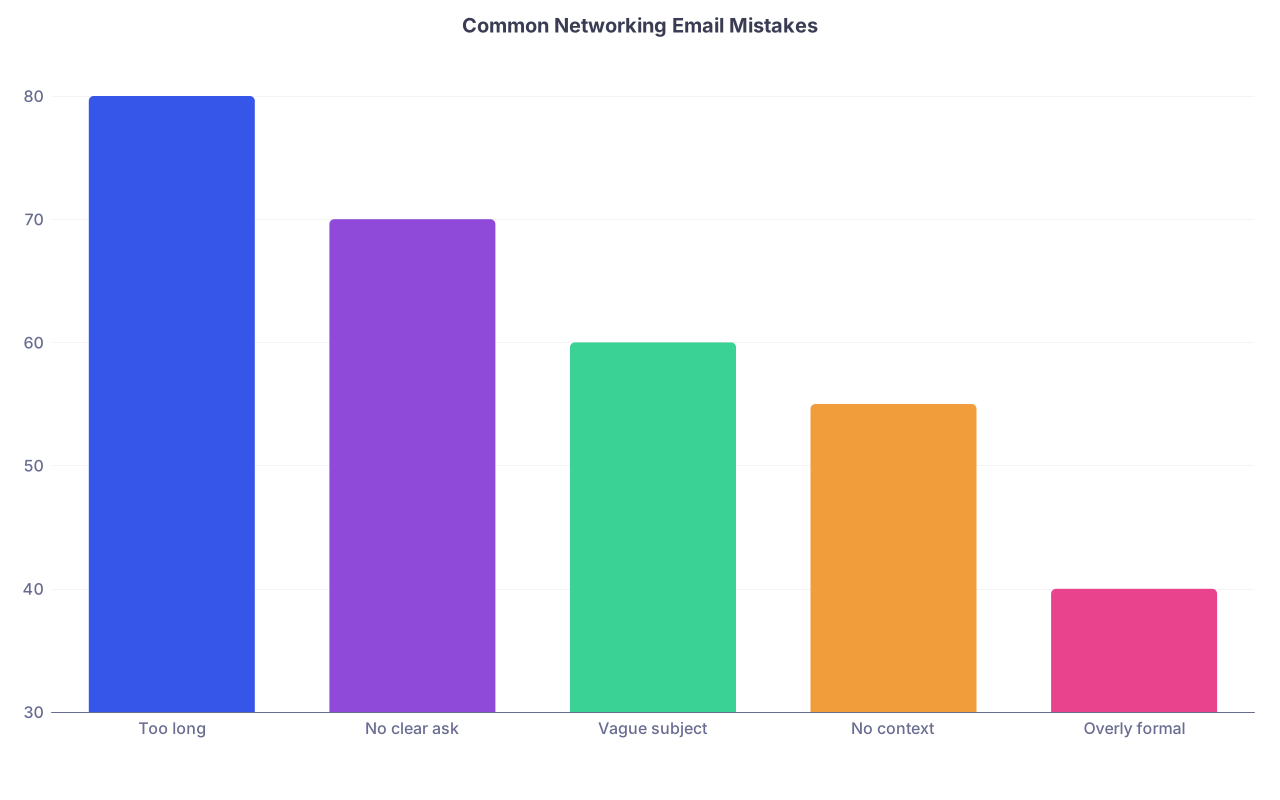
| Category | Value |
|---|---|
| Too long | 80 |
| No clear ask | 70 |
| Vague subject | 60 |
| No context | 55 |
| Overly formal | 40 |
1.3 What busy physicians silently judge you on
They look for:
- Can you respect their time? (brevity, clear ask, flexibility)
- Are you serious or just fishing? (specific interests, evidence of effort)
- Are you safe to connect with? (no boundary issues, no entitlement)
So your email must signal:
- You have done basic homework
- You are not asking for a job in the first message
- You are willing to do the legwork
1.4 One clear, low‑friction ask
Example of a bad ask:
“I would love to pick your brain about my career path and any opportunities you may know about.”
Translation: “Please commit 60 minutes, emotional labor, and potentially advocate for someone you do not know.”
Better:
“Would you be open to a 15–20 minute Zoom sometime over the next few weeks to ask 3–4 specific questions about early‑career paths in [field]?”
Or even lower friction:
“If you prefer, I can send 3–4 questions by email instead – whatever is easier for you.”
That last line doubles your reply rate. You gave them an escape hatch.
2. Cold Email Templates: First-Time Outreach That Does Not Feel Gross
Use these when you have no direct connection. You found them via PubMed, a talk, Twitter, program website, etc.
2.1 Basic cold email to a faculty in your field of interest
Use this when: You are exploring a specialty or research area and want a quick conversation.
Subject:
“MS2 at [School] interested in [Field] – brief question”
Body:
Dear Dr [Last Name],
My name is [Your Name], and I am a [MS2/MS3/resident PGY-1] at [Institution]. I am very interested in [field or niche, e.g., advanced heart failure and outcomes research], and I came across your work on [specific paper, project, or talk – 1 phrase max].
I am early in my training and trying to understand how people build a career that combines [X and Y – e.g., clinical care and outcomes research] in this space. Would you be open to a brief 15–20 minute conversation sometime in the next few weeks so I can ask a few targeted questions about how you approached this?
I am flexible and happy to work around your schedule. If it is easier, I can also send 3–4 questions over email instead.
Thank you for considering this, and for your work in [field] – it has been very helpful as I think about my next steps.
Best regards,
[Your Name]
[Year, School / PGY, Program]
[Phone – optional]
Where people screw this up:
- They do not name a specific interest – “I love cardiology” is useless
- They ask about jobs or research in the first sentence
- They write five paragraphs about their life story
Your job is not to impress. Your job is to be clear, respectful, and easy to say yes to.
2.2 Cold email when you also want to signal you are looking for research eventually
You do not ask directly for a project. You imply you are hungry and capable.
Subject:
“Resident at [Hospital] interested in [Topic] research – quick chat?”
Body:
Dear Dr [Last Name],
I am [Your Name], a [PGY-1/PGY-2] in [Specialty] at [Hospital]. I have developed a strong interest in [specific area, e.g., sepsis quality improvement and ICU outcomes], and your recent work on [short reference to paper/project] caught my attention.
I am trying to learn how early‑career physicians like me can get meaningfully involved in [clinical / outcomes / basic science] research in this area while balancing training. Would you be open to a short 15–20 minute call sometime in the next few weeks to discuss how you approached this early on, and what types of projects are realistic for residents?
If that is not feasible, I would appreciate any brief advice or resources you recommend for residents who want to build skills and contribute to work like yours.
Thank you for your time and for your work in [field].
Best,
[Your Name]
[PGY, Program]
Notice: you did not say “Please give me a paper.” They know exactly what you are hinting at. The ones who have room will offer something. The ones who do not will still often give you a useful pointer.
2.3 Cold email to someone you saw speak
These have higher hit rates. You already have a hook: their talk.
Subject:
“Follow‑up from your [Talk Title] at [Event] – [Your Name]”
Body:
Dear Dr [Last Name],
I am [Your Name], a [MS4/resident] at [Institution]. I attended your talk on [brief talk title] at [conference / grand rounds] yesterday and found your points about [1–2 specific details] extremely helpful.
I am very interested in [related field or niche], especially [short, specific interest]. I would be grateful for 15–20 minutes of your time sometime in the coming weeks to ask a few focused questions about how you approached [specific theme from talk – e.g., developing expertise in X, balancing research with clinical demands, etc.].
I know your schedule is very busy and would be glad to work around it. If it is easier, I can instead send a few questions by email.
Thank you again for an excellent talk and for considering this request.
Best regards,
[Your Name]
[Role, Institution]
If you asked a question during Q&A, mention that in line 2. It gives them a memory hook.
3. Warm Intros and “X Suggested I Reach Out”
If someone gives you permission to use their name, do not waste that social capital.
3.1 When someone explicitly offers to connect you
Let us say your attending says, “You should reach out to Dr Lee at Hopkins. You can mention my name.” Here is how you do it.
Subject:
“Introduction – [Your Name], student of Dr [Attending Last Name]”
Body:
Dear Dr Lee,
My name is [Your Name], and I am a [MS3/resident PGY-1] at [Institution]. I work with Dr [Attending Last Name], who kindly suggested I reach out to you regarding my interest in [specific field or niche].
Very briefly, I am interested in [1–2 lines describing your interest and current stage, e.g., applying into rheumatology with a focus on autoimmune lung disease]. Dr [Attending] thought your perspective on [specific topic – e.g., training pathways, research focus, academic vs private practice] would be especially valuable.
If you are open to it, I would be grateful for a brief 15–20 minute conversation at your convenience. I can send along a short CV beforehand so you have context, if that would be helpful.
Thank you for considering this, and for your time.
Best regards,
[Your Name]
[Role, Institution]
[Attach CV – optional, but usually helpful here]
Attach a one‑page CV. Not a 9‑page NIH monster.
3.2 When you only half‑know if you can use someone’s name
Maybe they said, “You can look up Dr Smith at UCSF, she is doing exactly what you want.” Not a direct “use my name,” but nearly.
I still like a soft reference.
Subject:
“MS4 at [School] interested in [Field] – referred by [Institution/Context]”
Body:
Dear Dr Smith,
I am [Your Name], an MS4 at [School]. I am very interested in [field] and in particular [sub‑interest]. Your work at UCSF on [short reference] keeps coming up as I learn more about this area.
A mentor of mine at [Your Institution] suggested that I look into your work and reach out for perspective on early training and career development in this area. If you are open to it, I would be grateful for a brief 15–20 minute conversation to ask a few focused questions.
I know you are busy and would be glad to work around your schedule, or send a small set of questions by email if that is easier.
Thank you for considering this.
Sincerely,
[Your Name]
[Year, School]
You do not have to name the mentor if you are unsure. “A mentor at my institution” is usually enough.
4. Follow-Up Templates: After Meetings, Talks, Conferences, and Interviews
This is where most people drop the ball. They have a good interaction, then vanish.
You fix that with a short, sharp follow‑up.
| Scenario | First Follow-Up | Second Touch | Ongoing Touches |
|---|---|---|---|
| Brief email advice | 1–2 weeks | 3 months | 1–2 times/year |
| Zoom / phone meeting | 24–48 hours | 2–3 months | 2–3 times/year |
| Conference hallway chat | 3–5 days | 2–3 months | 1–2 times/year |
| Research introduction call | 24–48 hours | As agreed | Project-based |
4.1 After a Zoom or phone call
Timeline: Email within 24–48 hours.
Subject:
“Thank you – [Your Name], [topic]”
Body:
Dear Dr [Last Name],
Thank you again for taking the time to speak with me yesterday about [topic]. I found your points about [1–2 specific insights] particularly helpful as I plan my next steps.
As we discussed, my next steps will be [1 short sentence: e.g., reaching out to Dr X about Y, reviewing Z resources, or exploring A type of project]. I appreciate your candid advice and your suggestions on how to approach this stage of training.
I will keep you updated on how things progress. I am very grateful for your time and generosity.
Best regards,
[Your Name]
Key phrase: “I will keep you updated on how things progress.” That line gives you permission to email them again in a few months with a short update. Use it.
4.2 After a conference interaction
You met someone at AHA, ASCO, RSNA, etc. You traded business cards or made awkward badge‑staring small talk. Now what?
Subject:
“Nice to meet you at [Conference] – [Your Name]”
Body:
Dear Dr [Last Name],
It was a pleasure meeting you briefly at [Conference] after your session on [topic] / near the [poster session / exhibitor area]. I appreciated your comments about [specific point you discussed].
As I mentioned, I am a [MS4/resident] at [Institution] interested in [field / niche]. I would value the chance to follow up with a brief 15–20 minute call in the next few weeks to ask a few more focused questions about [specific topic].
If that is feasible, I am flexible and happy to work around your schedule.
Best regards,
[Your Name]
[Role, Institution]
If they do not reply, you send one polite follow‑up 10–14 days later. Then you stop.
4.3 After an interview day (away rotation, residency, fellowship, job)
No, you do not need to email every interviewer a novel.
Pick 1–3 key people (PD, APD, someone you really clicked with) and send a short, specific note.
Subject:
“Thank you – [Program] [Position] interview”
Body:
Dear Dr [Last Name],
Thank you for the opportunity to interview for the [position – residency/fellowship/faculty role] at [Program] on [date]. I especially appreciated our discussion about [1–2 specific topics].
The visit reinforced my strong interest in [Program] given [1–2 concrete reasons – e.g., the patient population, approach to education, or specific tracks/resources]. I would be excited to contribute to and learn from your team.
Thank you again for your time and consideration.
Sincerely,
[Your Name]
Short. Gracious. Specific. Done.
5. Keeping the Relationship Alive: Simple Update Cadence
Networking in medicine is not “send one email, receive magic.” It is a drip campaign of being visible, reasonable, and useful over months to years.
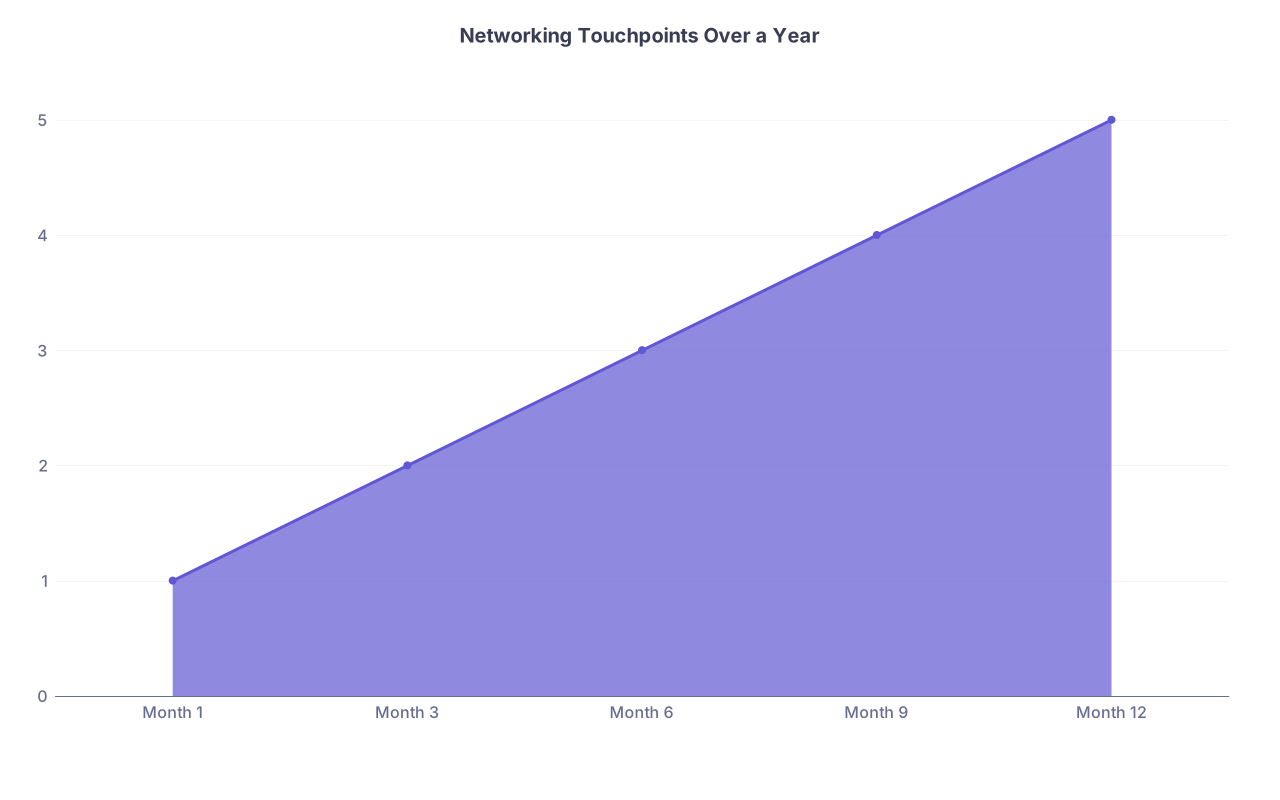
| Category | Value |
|---|---|
| Month 1 | 1 |
| Month 3 | 2 |
| Month 6 | 3 |
| Month 9 | 4 |
| Month 12 | 5 |
5.1 The 3–3–2 rule
For any mentor or senior contact you care about:
- 3 touchpoints in year 1
- 3 in year 2
- 2–3 per year afterward
Touchpoints can be:
- Quick update email
- Forwarding something relevant to their interests
- Seeing them at a meeting and saying hello
- Co‑authored project updates
5.2 Update email template (3–4 months later)
Subject:
“Quick update – [Your Name] from [Institution]”
Body:
Dear Dr [Last Name],
I hope you have been well. I wanted to briefly update you since we last spoke in [month] about [topic].
Since then, I have [1–3 bullet points max, e.g.]:
- Started a small QI project on [X] with [team/mentor]
- Submitted an abstract on [Y] to [conference]
- Confirmed that I will be applying into [specialty] this cycle
Your advice about [specific point] has been especially helpful; I have [very short example of how you used it].
No reply needed – I just wanted to thank you again for your guidance and let you know how things are progressing.
Best regards,
[Your Name]
Notice the line: “No reply needed.” This lowers friction and makes them more likely to actually read it.
5.3 When you have something relevant to share
Say you read a paper that directly builds on their work or aligns with a conversation you had. You can email:
Dear Dr [Last Name],
I came across this recent paper in [Journal] on [very short description] and immediately thought of our discussion about [specific topic] in [month].
Link: [URL]
I found [1 sentence about why you think it is interesting].
Hope you are well, and thank you again for your earlier guidance.
Best,
[Your Name]
This takes 3 minutes and puts you back in their mental “this person is paying attention and is serious” bucket.
6. Common Failure Modes (And How to Fix Them Fast)

You will probably recognize yourself in at least one of these.
6.1 You waited too long to reply
You had a great Zoom meeting. You meant to follow up. It is now 6 weeks later.
Do not overthink it. Own it briefly and move on.
Dear Dr [Last Name],
I wanted to thank you belatedly for taking the time to speak with me on [date] about [topic]. Our conversation has stayed with me, especially your comments about [specific point].
Since we spoke, I have [1–2 line update]. Your advice has been very helpful as I have been working through this.
Thank you again for your time and generosity.
Best regards,
[Your Name]
Do not give a monologue about being “so busy.” They are busier than you.
6.2 They never replied to your first email
Assume one of three things:
- They missed it
- They meant to reply and forgot
- They saw it and do not have capacity
You control only the first two. So you send one polite nudge.
Timing: 7–14 days after the first email.
Subject: (same as original, plus “re:”)
“Re: MS3 at [School] interested in [Field] – brief question”
Body:
Dear Dr [Last Name],
I wanted to briefly follow up on the note I sent on [date] (copied below) in case it was lost in your inbox. I would still be very grateful for a brief 15–20 minute conversation about [topic], if your schedule allows.
I completely understand if now is not a good time.
Best regards,
[Your Name]
Paste your prior email below. If they do not respond after this, stop. You move on.
6.3 You are asking for too much too soon
Typical rookie move: first email asks for mentorship, research, away rotation letter, and career advice in one shot.
Fix it by staging your asks:
- Email 1: Ask for 15–20 minutes of advice.
- Conversation 1: Show you are prepared and serious.
- Follow‑up email: Thank them, update on what you are doing.
- Later: If the vibe is good, ask about concrete opportunities.
Momentum matters more than volume.
7. Future-Proofing Your Networking: Digital and Remote Medicine
Networking in medicine is shifting. Remote talks, Twitter/X, virtual conferences, and online communities (specialty Slack groups, etc.) are now real entry points.

| Step | Description |
|---|---|
| Step 1 | See talk or paper |
| Step 2 | Find person online |
| Step 3 | Engage lightly - like/comment |
| Step 4 | Send concise email or DM |
| Step 5 | Short Zoom or call |
| Step 6 | Follow-up email |
| Step 7 | Periodic updates and value |
Here is how to not embarrass yourself.
7.1 Using social media without being weird
- Follow people whose work you genuinely respect
- Like or briefly comment on posts that speak to your interests
- After a few interactions, a short DM can be acceptable, but serious things still belong in email
DM template that does not feel creepy:
Hi Dr [Last Name], I am [Your Name], a [role] at [Institution]. I have really appreciated your posts about [topic], especially your recent thread on [specific].
I had a couple of questions about early‑career choices in this area – would you prefer I send a brief email to your institutional address, or is it OK to ask here?
Let them choose the channel. Many will say “email me” and you are back in familiar territory.
7.2 Remote talks and webinars
Treat a Zoom grand rounds or webinar like a conference talk.
- Ask a real question in the Q&A (short, specific, not self‑aggrandizing)
- Then send a follow‑up email referencing your question
Example opener:
I was the resident who asked about [X] during the Q&A of your talk for [Institution] last week…
Instant memory hook.
FAQ (4 Questions)
1. How many networking emails is “too many” to send in a month?
If you are early in the process (MS2–MS3, PGY-1), sending 5–10 targeted emails per month is reasonable, as long as they are personalized and not copy‑pasted spam. The ceiling is when your quality drops and you start sending generic, vague messages. I would rather see you send 3 excellent, specific emails than 20 bad ones.
2. Should I mention my Step scores, grades, or ranking in networking emails?
Usually no, unless the context is explicitly about residency competitiveness and someone has asked. Networking emails are about connection and alignment, not stats blasts. If you attach a CV, your metrics are there for them to view if they care. Leading with scores makes you sound insecure or transactional.
3. Is it rude to send a calendar link (Calendly, etc.) to an attending or senior physician?
If you are the one asking for their time, sending your calendar link can look tone‑deaf. It implies they should work around you. Better: propose a few windows (“I am free most weekdays after 4 pm Eastern”) and offer to adapt to their schedule. If they send you their calendar link, absolutely use it promptly.
4. How do I handle it if a senior person offers help but then never follows through (e.g., on an intro or project)?
Assume busyness, not malice. One gentle reminder after 1–2 weeks is fair: “Just checking in on whether you still recommend I reach out to Dr X about Y.” If they still do not act, let it go and move on. Do not nag. Build other connections. In medicine, some doors open slowly, some not at all. You do better by diversifying your network than by chasing one flaky person.
Key points to keep in your head:
- Short, specific, and respectful beats long, vague, and desperate every time.
- One clear, low‑friction ask + consistent follow‑up turns random emails into real mentors.
- Most people in medicine want to help serious trainees. Your job is to make it easy for them to say yes.