
The usual advice about “build your network in residency” is useless for anyone actually working 70–80 hours a week.
You do not need more vague encouragement. You need a tight, repeatable, 20–30 minute weekly networking system that runs even when you are post-call and half-conscious. That is what we are going to build.
Below is a structured weekly networking routine designed specifically for busy residents and fellows. Minimal time. Maximal return. No fluff.
The Core Strategy: Low-Effort, High-Consistency Touches
Let me set the rules first, because this is where most residents get it wrong.
Non‑negotiables:
- Your networking time block is 30 minutes, once per week. That is it.
- You will not “catch up when things calm down.” They will not.
- Every session must end with at least:
- 1 micro‑touch (DM / email / text), or
- 1 scheduled conversation, or
- 1 new contact added (with note).
Misconception: networking means conferences, big personalities, “working the room.”
Reality for you:
- 5‑minute hallway conversations
- 15‑minute Zooms between cases
- 2‑line emails that show you are thoughtful, not needy
We are going to turn that into a system.
The Weekly Networking Routine (Overview)
Here is the structure you are going to run every week:
| Day/Block | Time Needed | Focus |
|---|---|---|
| Sunday or Day Off | 30 min | Weekly networking session |
| 1–2 Weekdays | 2–5 min | Micro‑touches on rounds/breaks |
| Monthly (any day) | 30–45 min | One deeper conversation |
Your anchor is the 30‑minute weekly session. The rest are easy wins you layer on top.
I will walk through the 30‑minute block first, then show you how to plug it into your life, including realistic scripts and templates.
Step‑By‑Step: The 30‑Minute Weekly Session
Do this on the same day/time each week if you can. Sunday late afternoon, Friday night post‑call, or your golden day—whatever is least chaotic.
Minute 0–5: Quick Review of Your “People Map”
You need one place where your relationships live. If you are trying to hold everything in your head, you are losing 90% of your networking potential.
Use any of these:
- Simple Excel / Google Sheet
- Notion / Obsidian page
- Even the Notes app on your phone
Keep columns like:
- Name
- Role (attending, co‑resident, prior mentor, med school friend, industry contact)
- Institution
- Specialty / niche
- Last contact date
- Next contact date / idea
- Notes (how you met, what they care about, their current projects)
During minutes 0–5, you:
- Scan who you have not contacted in 2–3 months.
- Highlight 3 names:
- 1 near‑term ally (co‑resident, junior attending, or fellow)
- 1 senior person (program director, division chief, well‑known faculty, or external leader)
- 1 “horizontal” contact (friend in another specialty, another city, or industry adjacent)
These are your targets for the week.
Minute 5–15: Send 2–3 Micro‑Touches
Micro‑touches are short, low‑pressure messages that keep relationships alive without asking for anything big.
The formula is boring but it works:
Relevance to them + small value or thoughtful note + light ask (or no ask).
Examples you can literally copy:
1. To a senior faculty in your institution
Subject: Quick article that made me think of your work
Dr. Patel,
I remember you mentioning your interest in AI‑assisted imaging in clinic last month. This short piece in Radiology: AI reminded me of that conversation and how you framed the workflow challenges.
No response needed—just thought it aligned closely with what you described.
Best,
[Your Name], PGY‑2
Zero neediness. Signal: you listen, you remember, you see where their work is going.
2. To a co‑resident you respect but barely know
Hey [Name],
I keep hearing great things about the QI project you are doing on the medicine service. I would love to hear more about how you set it up—especially how you got buy‑in from leadership.
If you are open to it, maybe we could grab coffee near the cafeteria sometime next week between cases?
– [Your Name]
Direct, specific compliment, and a lightweight ask.
3. To a med school friend at another institution
Hey [Name],
How are things at [Institution]? We just started implementing [new protocol/EMR change/etc.] here and it has been chaos. Curious if you all are dealing with something similar.
Also, are you still thinking about [subspecialty/industry area]? I keep seeing interesting fellowships pop up.
– [Your Name]
You are building a horizontal network that will matter more than you think 10 years from now.
Goal for minutes 5–15: send 2–3 messages. Do not overthink them. If your drafts are longer than 6–7 lines, you are stalling.
Minute 15–25: Schedule 1 Short Conversation
This is where actual career‑shaping opportunities come from.
Aim for one 15–20 minute conversation per month. That is it. During your weekly session, you are either:
- Scheduling next month’s chat, or
- Preparing for one that is already set up.
Who to target for these 15–20 minute calls:
- Senior resident you respect in your desired specialty
- Fellow doing what you think you might want to do
- Faculty with a career path that looks interesting (clinician‑educator, physician‑scientist, hospitalist leader, etc.)
- Alumni from your med school at your current or target institution
- Non‑clinical contacts if you are exploring industry, policy, tech, or entrepreneurship
Here is a simple outreach template that works:
Subject: 15–20 min to learn about your path in [field]?
Dr. [Last Name],
I am a [PGY‑X / fellow in Y] at [Institution]. I have been especially interested in [their area: for example, point‑of‑care ultrasound education / perioperative outcomes research / early‑stage medtech].
Several people have pointed me to your work in this space, and your path as a [their role] is exactly the kind of trajectory I want to understand better.
If you are open to it, I would be grateful for 15–20 minutes by Zoom or phone at any point in the next few weeks to ask a few focused questions about how you approached training and early career decisions.
I know your time is limited, so no worries at all if it is not possible right now.
Best regards,
[Your Name], [PGY / Fellow]
[Program, Institution]
Notice:
- Respectful but specific.
- Clear, small ask.
- Built‑in graceful exit so they never feel trapped.
Your weekly task is:
- Identify 1 person to invite for next month.
- Send that email. Done.
Minute 25–30: Log and Set Reminders
You end every session by making your future life easier. Two steps:
Update your “People Map”:
- Add anyone new you contacted.
- Update “last contact date.”
- Add a 1‑line note about what you sent or discussed.
Set reminders:
- Calendar event for any scheduled call.
- 60‑second note to yourself: “Ask Dr. Chen about early faculty job search strategy” or “Ask Sarah about her industry internship.”
- Task/reminder for follow‑up 1–2 weeks after any call or significant interaction.
This step is where most residents fail. They have good conversations and then vanish for a year. That is not networking. That is random socializing.
Using Micro‑Moments During the Week (2–5 Minutes)
Now we stack free returns on top of your weekly anchor session. You already move through the hospital surrounded by people who can influence your future. You just are not using those interactions intentionally.
Here is how to convert ordinary moments into networking without being fake or annoying.
On Rounds or in the OR
Pick one attending per week you will make a small connection with beyond the case.
Examples:
Pre‑round quick question:
“Dr. Lopez, I heard you did your fellowship at MGH. If you had to do it again, would you still pick that program or somewhere else? I am just starting to think about next steps.”Post‑case comment:
“I really liked how you explained that complication to the family. That is the part of practice I feel least prepared for. Were there things you did in training that helped you get better at those conversations?”
This does not need to be some deep mentorship move. One question. Show them you are paying attention to more than just lab values.
Between Cases / In the Workroom
Use 2 minutes to:
Add someone to your People Map with a quick note:
“Met Dr. Khan (cardiology fellow). Mentioned they are doing a big registry project, want residents to help abstract data.”Send an ultra‑short follow‑up DM or email:
“Dr. Khan, great talking today about your registry project. If you are still looking for residents to help, I am interested in at least hearing more and seeing if I can reasonably commit.”
That is it. No essay. Just closing the loop.
Monthly Deep Dive: One Focused Conversation
One conversation per month, done well, is enough to change the trajectory of your career over 3–4 years of training.
Here is a simple structure for those 15–20 minute calls.
Before the Call (5–10 Minutes)
Do not show up cold. You are busy, they are busy. Respect both.
- Skim their PubMed or institutional profile.
- Write down 3–4 very specific questions.
- Decide your primary objective:
- Clarify if a field is right for you
- Understand how to be competitive for their path
- Get advice on next 1–2 concrete steps
Sample questions you can adapt:
- “When you were a PGY‑2, what did you actually do that ended up mattering for where you are now?”
- “If you were me and interested in [niche], what would you absolutely do in the next 6–12 months—and what would you ignore?”
- “Are there mistakes you commonly see residents make when they say they want to do what you do?”
- “Who else do you think I should talk to at some point?”
During the Call
Target structure:
Minute 0–2 – Framing
“Thank you again for taking the time. I am [PGY / fellow] in [program]. I am particularly interested in [their niche] and wanted to understand how you approached early decisions during training.”Minute 2–12 – Their story + your targeted questions
Let them talk. Then go through your 3–4 key questions. Stay on time.Minute 12–18 – Pull concrete advice
Ask directly:- “Given what I have told you about my situation, what would you prioritize in the next year?”
- “Are there particular conferences, people, or programs you think are especially high‑yield?”
Minute 18–20 – Exit cleanly
“This has been extremely helpful. I want to respect your time, so I will wrap up here. I really appreciate your openness—would it be alright if I reached out down the line with brief updates or a question as I make these decisions?”
You are not trying to “close” anything. You are building long‑term signal that you are serious, thoughtful, and respectful.
Designing Your Personal Networking “Tracks”
Not everyone wants the same outcome from networking. Your routine should be biased toward your actual goals.
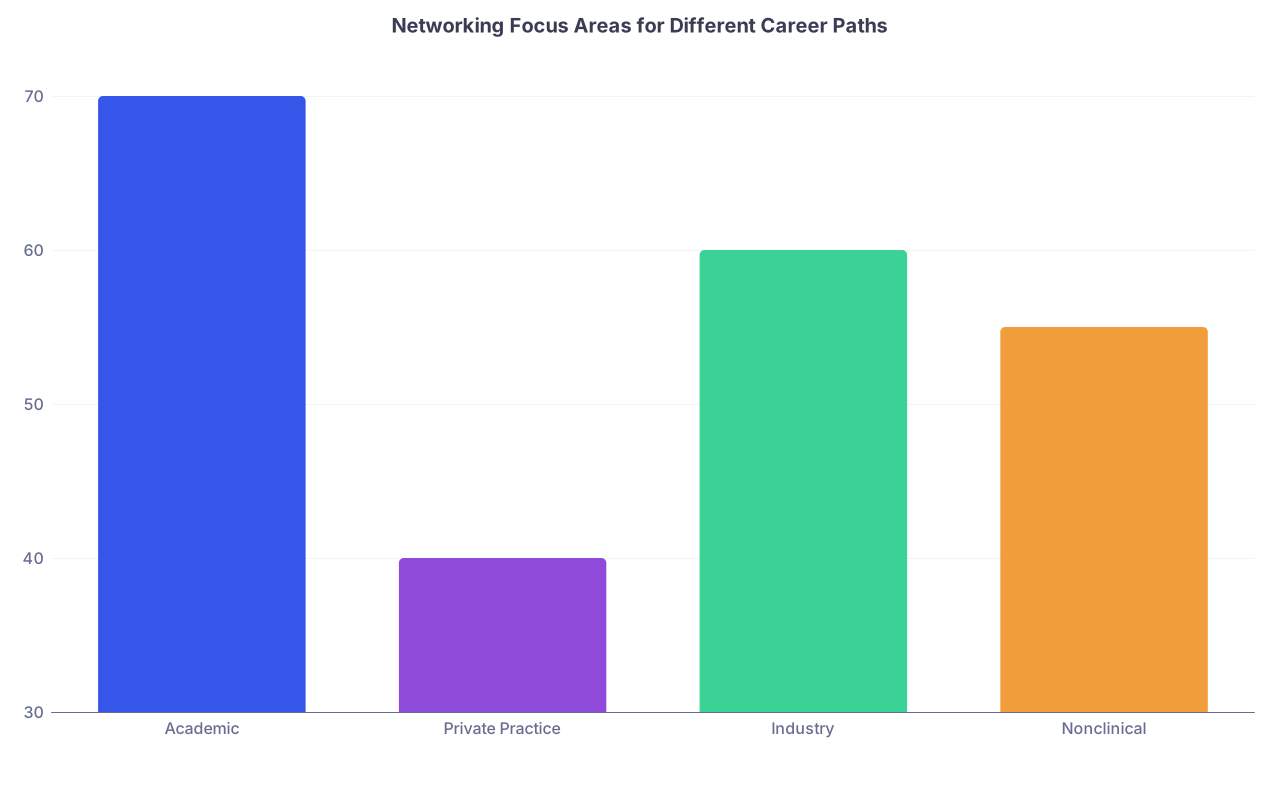
| Category | Value |
|---|---|
| Academic | 70 |
| Private Practice | 40 |
| Industry | 60 |
| Nonclinical | 55 |
Interpretation (not a perfect science, but a strong guide):
- Higher value → more strategic benefit from deliberate networking.
If You Want Academic Medicine
Your networking targets:
- Division chiefs and program leadership at your own institution
- Subspecialty leaders (fellowship program directors, national society heads)
- Residents/fellows who present and publish a lot in your field
Your weekly actions should lean toward:
- Sending brief feedback/thanks after grand rounds or journal clubs
- Asking to help with small parts of ongoing projects (chart review, data entry)
- Attending specialty‑specific virtual events and dropping 1–2 follow‑up emails
If You Want Community / Private Practice
Your networking targets:
- Graduates from your program now in private practice
- Local community physicians who take your hospital’s patients
- Practice managers / medical directors
Weekly routine tweaks:
Once a month, ask:
“Dr. [Name], I am curious how your day‑to‑day in community practice compares to what we see here. Would you be open to a 15–20 minute call about your transition out of training?”Pay attention to:
- Workload
- Compensation structures
- Realistic partnership timelines
- Red flags they warn you about in contracts
If You Are Eyeing Industry, Policy, or Tech
Targets:
- Alumni in pharma, medtech, digital health, consulting, health policy
- Physicians with hybrid roles (0.6 FTE clinical, 0.4 FTE industry)
- Non‑physician leaders who overlap with clinical care (product managers, data scientists)
Your weekly session should include:
- 1 micro‑touch to a non‑traditional contact every 1–2 weeks
- Reading one short piece per week (company blog, policy article) to avoid sounding clueless
- Explicit questions like:
- “What do you wish more residents understood about nonclinical roles before applying?”
Tools and Automation: Make the System Survive Q4 Nights
If your networking routine collapses every time you hit a brutal call month, it is the wrong design.
Here is how to harden it.
Simple Tools That Actually Help
Forget complex CRMs. Use what you will actually open at midnight between pages:
Google Sheet + Calendar
- One tab for people, one for conversation notes.
- Calendar reminders for follow‑ups and monthly calls.
Notion / Obsidian
- One “People” database.
- Tag by specialty, institution, and type (mentor, peer, potential collaborator).
Text Expanders / Email Templates
Save your common outreach templates so you can send a thoughtful email in 90 seconds instead of 10 minutes.
Making This Work In a 70–80 Hour Week
Let me be blunt. If this routine feels impossible, you have two issues:
- You are overestimating the time required.
- You have not assigned networking the same seriousness as notes, orders, or sign‑outs.
You do not need more hours. You need protected micro‑blocks.
Where the Time Actually Comes From
Common places my trainees have carved out their 30‑minute weekly block:
- 15 minutes of mindless scrolling before bed on Sunday + 15 minutes while laundry runs
- 30 minutes on post‑call afternoon once they wake up
- 30 minutes during a quieter golden day (yes, even with social life—you are investing in not being miserable in 5 years)
And the 2–5 minute micro‑touches:
- Waiting for the elevator
- While your co‑resident is consenting the next case
- In the cafeteria line
- After finishing a note but before carrying over to the next chart
If you literally time yourself once, you will see how many 2–5 minute gaps you waste. You are not lazy. You just have not aimed those gaps at your future yet.
Example: One Month of This Routine in Real Life
To make this concrete, here is what four weeks can look like for a PGY‑2 in internal medicine interested in cardiology.
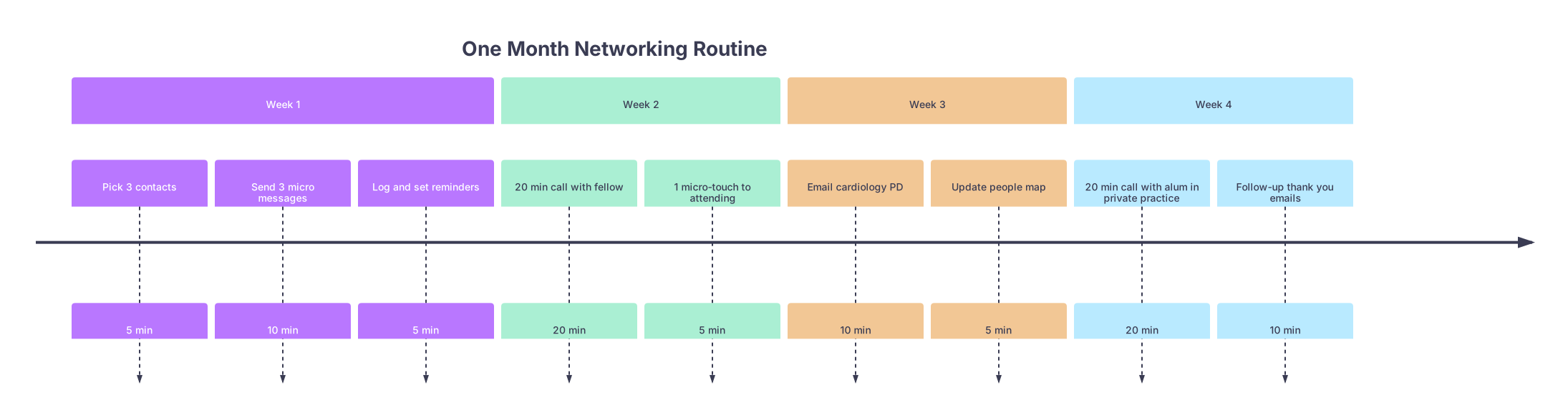
| Period | Event |
|---|---|
| Week 1 - Pick 3 contacts | 5 min |
| Week 1 - Send 3 micro messages | 10 min |
| Week 1 - Log and set reminders | 5 min |
| Week 2 - 20 min call with fellow | 20 min |
| Week 2 - 1 micro-touch to attending | 5 min |
| Week 3 - Email cardiology PD | 10 min |
| Week 3 - Update people map | 5 min |
| Week 4 - 20 min call with alum in private practice | 20 min |
| Week 4 - Follow-up thank you emails | 10 min |
Month 1 outcomes:
- 2 short but high‑leverage conversations (cards fellow, alum in community practice)
- 8–10 micro‑touches across attendings, co‑residents, and outside contacts
- Clearer picture of what actually matters to be competitive for cardiology
- 3–4 people who now know your name, your interests, and see you as serious
Run this for 12 months. The compounding is not subtle.
Common Mistakes That Kill Networking Momentum
You are going to be tempted by these. Avoid them on purpose.
Waiting until “you know what you want.”
People are much more useful for helping you figure that out than for rubber‑stamping a decision you already made.Only talking to people in your own program.
Comfort trap. You want cross‑institution, cross‑specialty, and cross‑sector ties.Using every conversation to ask for a letter or a position.
That screams desperation. Focus on information, advice, and understanding the landscape. Opportunities follow naturally.Writing long, dense emails.
Nobody has time. 4–7 lines, clearly structured, wins.Ghosting after someone helps you.
Thank‑you follow‑up and one update 1–3 months later. Low bar, huge impact.
How This Fits Into the Future of Medicine
Medicine is becoming more:
- Interdisciplinary
- Tech‑driven
- Politically and financially unstable
The people who navigate that well are not the smartest clinically. They are the ones with dense, diverse, active networks. The ones who know:
- Someone in informatics when their hospital adopts a broken EHR workflow.
- Someone in policy when reimbursement changes hit their group.
- Someone in industry when they want to split their time or exit.
You cannot build that after you need it. You build it now, in small, boring, 20–30 minute weekly increments.
Your Next Step (Do This Today)
Open your calendar and:
- Pick a recurring 30‑minute block in the next 7 days. Mark it “Networking – Non‑negotiable.”
- Create a one‑page People Map (Google Sheet, Notion, or Notes app). Add 5 names: 3 faculty, 1 co‑resident, 1 friend at another institution.
- During that first 30‑minute block, send two micro‑touch emails using the scripts above and schedule one 15–20 minute call for the next month.
Do not “plan to start this eventually.” Your network in 5 years depends on whether you carve out that first 30 minutes this week.