It is 4:45 pm on day two of a big academic conference. You are standing near the coffee table, badge half-twisted, lukewarm drink in hand. You have sat through keynotes, poster sessions, symposia. You have “met” at least 30 people.
And if you are honest, you will not remember more than two of them tomorrow.
Here is the harsh part: that is exactly how almost everyone else feels about you.
Conference networking in medicine is supposed to be this magic career accelerator. New mentors. Collaborations. Fellowships. Jobs. Yet most people walk away with a handful of business cards, a few LinkedIn connections, and zero people who would actually think of them when an opportunity appears.
You do not need more charisma. You need to stop making the same predictable, forgettable mistakes that almost everyone makes at medical conferences.
Let me walk you through the big ones I see over and over at events like ACC, ASCO, RSNA, AAMC, CHEST, and every specialty meeting in between.
Mistake #1: Treating Conferences Like Content, Not People
You know the person. Highlighting every talk in the program. Sprinting from ballroom B to breakout 7C. Taking notes on every slide. Then “networking” consists of maybe one question at the mic and a rushed, “Great talk, thanks” as they bolt to the next session.
That is how you turn a $1,500 trip into a PDF folder on your laptop.
The error: Prioritizing sessions over relationships.
Nobody will remember that you attended Dr. X’s talk on “Novel Biomarkers in HFpEF.” But Dr. X might remember a real conversation you had after the session.
At most conferences, the highest-yield career moments happen:
- In hallways right after sessions
- At poster boards
- In lines (coffee, lunch, registration)
- At smaller side events and receptions
Not in the dark lecture hall while you are passively listening in row 23.
How to avoid being forgettable here:
- Pick fewer sessions, attend them deeply, and budget time after each one to talk to at least one person.
- If a faculty member is truly important to your field, skip the next talk and stay to speak with them properly.
- Stop hiding in the audience. If your entire day is back-to-back talks, you are basically attending an online course in an expensive building.
The people who become memorable are the ones who treat the conference as a people event with content, not a content event with people.
Mistake #2: The Dead-Fish Introduction
“Hi, I’m Sarah. I’m a third-year at [insert generic med school]. Interested in cardiology.”
Then silence.
I hear this a dozen times a day at conferences. It is not wrong. It is just impossible to remember. After hearing 50 of those, everyone blends together.
The error: Generic, context-free self-introductions that give nothing to latch onto.
You need a short, specific hook that helps people mentally file you somewhere useful.
Contrast this:
“I’m Sarah, MS3 at UC Davis, really interested in cardio-oncology and imaging. I am presenting a poster tomorrow on anthracycline cardiotoxicity in breast cancer patients.”
Now I have several handles: school, level, sub-interest, and something you are doing here.
Focus on three elements:
- Who you are (role + place)
- What you are actually focused on (specific, not “I like research”)
- Why you are at this particular meeting (poster, looking for mentors, specific project area)
Do not make this mistake: memorizing a fake-sounding “elevator pitch.” You are not selling a startup; you are trying to be a real person with a clear focus. Natural, but intentional.
Something like:
“I’m Jae, a PGY-2 in IM at University of Washington. I am leaning toward pulmonary and really interested in ARDS phenotypes. I am here mostly to find people doing prospective clinical trials in that area and to steal ideas for our QI projects back home.”
That you will remember.
Mistake #3: Asking Vague, Useless Questions
Another common move: you finally get in front of someone important and say something like, “Do you have any advice for someone interested in your field?”
Translation: “Please give a generic speech you have given 200 times. I will forget most of it immediately.”
The error: Asking broad advice questions that produce predictable, forgettable answers.
You want questions that:
- Show you actually know something about the person’s work
- Invite a short, concrete answer
- Open the door for future interaction
Examples of bad questions:
- “How do I become competitive for your specialty?”
- “What should I focus on as a med student?”
- “How can I get involved in research?”
Examples of memorable questions:
- “I saw your JAMA paper on early palliative care integration in ICU – if you were redoing that study now, what would you change?”
- “I am at a community program without strong research infrastructure. If I can realistically do one project this year in sepsis outcomes, what kind tends to actually get noticed in our field?”
- “You have trained a lot of fellows. What is one habit or trait you notice in the ones who end up thriving vs just surviving?”
People remember the person who asked the one good question in a sea of generic ones. Do not waste that moment.
Mistake #4: Being a Conversation Taker, Not a Conversation Giver
You have probably felt this. Someone comes up to you and you can sense that the only thing they care about is what you can give them: a project, an email, a referral, a “mentorship.” Some do not even hide it.
The error: Treating interactions as one-way extractions.
This is how you become forgettable or, worse, slightly disliked.
You might think as a student or resident you have “nothing” to offer. That is wrong. You can offer:
- useful information (what your institution is doing, new tools you are using)
- enthusiasm and execution (volunteering for concrete tasks, actually following through)
- perspective (how something lands for trainees, patients, or frontline clinicians)
But you have to show that you are not just here to take.
Simple ways to avoid this:
- Ask about their current bottlenecks: “What’s something you wish you had more help with on your current projects?”
- Offer specific, realistic contributions: “I am very comfortable with REDCap and pulling from Epic SlicerDicer – if you ever need brute-force data help on smaller projects, I would love to contribute.”
- Share something of value: an article, a tool, a local initiative that is relevant to their work.
Memorable people leave others thinking, “That was energizing” or “That person might actually make my life easier.” Not “Here comes another person asking for a letter.”
Mistake #5: Hovering in Packs of People You Already Know
You flew across the country to spend three days…with your own institution again.
I see students and residents doing this constantly: moving as a cluster from session to session, standing in circles at receptions, talking mostly to their own friends. Comfortable. And completely useless.
The error: Using your home group as a social crutch that blocks new connections.
Staying attached to your group signals two things to others:
- You’re probably not looking to engage deeply (so they won’t bother interrupting).
- You might not be all that independent yet (not the impression you want to give).
You do not need to abandon your people. But you must:
- Intentionally break off for 30–60 minute chunks alone.
- Approach posters and small groups solo.
- Sit next to strangers at smaller sessions, not your co-residents every single time.
If this makes you uncomfortable, good. You remember the people who have the guts to walk up alone and start talking. Be that person.
Mistake #6: Generic, Mass-Fired Follow-up (Or None At All)
You collect 12 business cards and 25 new LinkedIn connections. Then either:
- You do nothing. Or
- You send the same “Great to meet you at [conference], I hope to stay in touch” message to everyone.
Both options are invisible.
The error: Failing to anchor people’s memory of you with a specific, personal follow-up.
Your job after the conference is to re-activate the memory you planted, and tie it to something concrete.
Within 3–5 days, you should:
- Send individualized messages that reference your actual conversation
- Attach or link something relevant (paper, resource, your poster, your CV if requested)
- Propose one small, clear next step when appropriate
Something like:
“Dr. Lopez, great to meet you after the ECMO session at SCCM. I am the IM resident from UAB who mentioned our small cohort of post-ECMO ARDS survivors. I read the Chest article you recommended on follow-up clinics – very helpful. If you are ever looking for a partner site to pilot remote follow-up protocols, I would be excited to explore whether our program could participate in a small feasibility project.”
That is specific. That is memorable.
Compare that to:
“Dear Dr. Lopez, it was a pleasure meeting you at SCCM. I enjoyed our conversation and hope we can stay in touch. Best regards…”
Delete that template.
To make this easier on yourself, jot a note on each card or in your phone immediately after meeting someone:
“Lopez – ECMO post-ARDS, follow-up clinics, wants remote model, suggested Chest article by X.”
Future-you will be very grateful.
Mistake #7: No Clear Goal, No Clear Pattern
Most people arrive at a conference with vague intentions:
“I want to network.”
“I want to meet people in cardiology.”
“I want to learn more about X.”
That vagueness guarantees scattered, forgettable interactions.
The error: Going in without a strategy for who and what you are trying to become known for.
You do not need a five-page networking plan. But you do need clarity on two questions:
- Who do I most want to become visible to? (roles and niches, not just “big names”)
- What do I want people to associate me with? (a topic, a problem, a skill, a niche)
If you are a med student thinking about academic EM, “emergency medicine” is too broad. “Prehospital care and EMS systems” is better. “Tele-triage in rural EMS” is even sharper.
Then your behavior at the conference should reflect that:
- Sessions you attend
- Posters you visit
- People you approach
- Questions you ask
- What you highlight in your introductions
When people hear your name later, you want them thinking, “Oh right, that is the person really into tele-EMS workflows.” Not “That student from…somewhere…who likes research.”
Mistake #8: Assuming Big Names Are the Only Names That Matter
Here is a quiet mistake that derails a lot of early-career networking: hunting only for “famous” people.
You hover at the edge of the crowd around the keynote speaker. You line up for the program director of the top-3 fellowship. You ignore the mid-career person with three fellows around them because their H-index is not 70.
The error: Chasing prestige instead of access and alignment.
You know who actually has time and incentive to remember you?
- Junior and mid-career faculty trying to build programs
- Fellows and senior residents who are actively publishing and presenting
- People running working groups, committees, registries, or QI collaboratives
- Investigators at your own level in other institutions who will be your long-term peers
Those are the people who will answer your emails, put you on early projects, and someday recommend you. The big keynote names often cannot even remember their own schedule, let alone your 90-second hallway chat.
At your next conference, force yourself to talk to:
- At least three people within 5–10 years of your level (in either direction).
- At least two people leading something structural: a registry, education committee, or multi-center trial network.
These are your realistic, high-yield relationship targets.
Mistake #9: Ignoring the “Invisible” Events
Plenary session? Packed. Poster session? Crowded. Official reception? Loud and chaotic.
Small committee meetings? Breakfast-roundtables? Early-morning interest groups?
Half-empty. And full of the people you actually want to meet.
The error: Only showing up to the big, advertised events and skipping the side rooms where real work starts.
Every conference has these:
- SIG (Special Interest Group) meetings
- Working group updates
- Training program director lunches
- Early-career networking breakfasts
- Journal or society committee meetings
The advantage is simple: fewer people, more structure, easier conversations, and you can follow up with, “I enjoyed hearing your thoughts in the ___ working group meeting.”
That is a concrete memory anchor.
Scan the agenda ahead of time and circle anything that sounds like:
- “Task force”
- “Working group”
- “Committee”
- “Interest group”
- “Early career” or “trainee” breakfast / town hall
If your only networking happens in giant ballrooms and receptions, you are making life harder than it needs to be.
Mistake #10: No System for Keeping People in Your Orbit
Even if you nail everything during the conference, you become forgettable again if you vanish for a year and reappear at the next meeting like a brand-new person.
The error: Treating contacts as one-off interactions instead of the start of a light-touch relationship.
You do not need to become best friends. But you do need a simple rhythm for staying very lightly on people’s radar.
This is where a basic tracking system helps. Nothing fancy.
| Field | Example Entry |
|---|---|
| Name | Dr. Maria Lopez |
| Role | Pulm/CC faculty, post-ECMO outcomes |
| Where Met | SCCM 2026 – ECMO session hallway |
| What We Discussed | Post-ECMO ARDS clinic models |
| Follow-up Date | 2026-02-20 |
| Next Touchpoint Idea | Send relevant ARDS paper / ask about pilot project |
Then every few months, you:
- Send a relevant paper or resource
- Congratulate them on a new publication or grant you saw
- Ask one targeted update question about something you discussed previously
The goal is not constant contact. It is just to prevent the “Who is this again?” reaction when your name hits their inbox in three years.
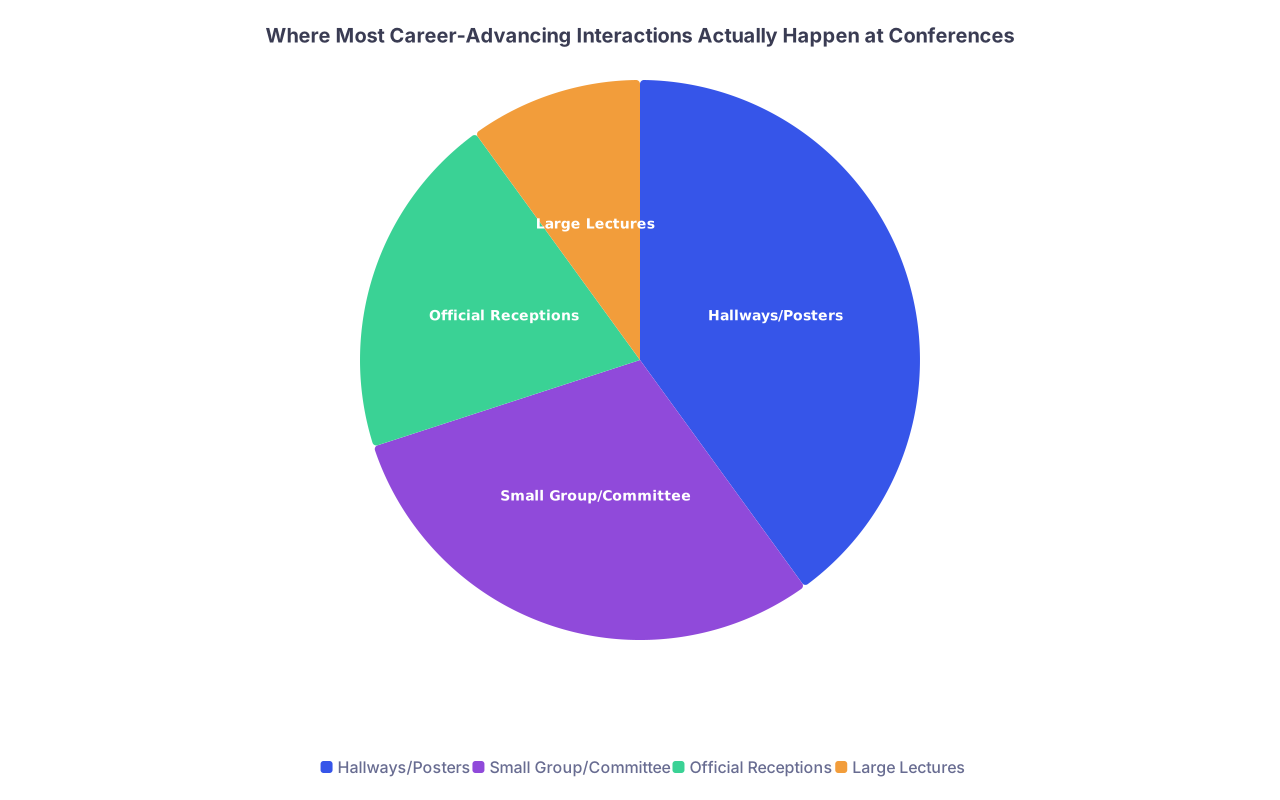
| Category | Value |
|---|---|
| Hallways/Posters | 40 |
| Small Group/Committee | 30 |
| Official Receptions | 20 |
| Large Lectures | 10 |
Mistake #11: Confusing Professionalism With Being Bland
Some people overcorrect. They are so worried about being “professional” that they sand off every interesting detail about themselves.
Monotone. Hyper-formal. No humor. No personality.
That is how you vanish into the noise.
The error: Thinking that memorable equals unprofessional.
There is a difference between sloppy and human. You are allowed to have:
- A specific non-clinical interest you mention once (“I actually came to this talk because we see a ton of this in our refugee clinic”)
- A bit of appropriate humor
- A strong, thoughtful opinion about your niche
At one oncology conference, a junior fellow introduced himself to me as “the guy trying to kill the dumb way we still do pre-chemo teaching in our clinic.” Slightly edgy. Memorable. I recalled him a year later when I saw his paper on patient education redesign.
You do not need to perform. You do need to be something other than “polite, quiet, and indistinguishable from everyone else in a navy suit.”

| Step | Description |
|---|---|
| Step 1 | Before Conference |
| Step 2 | Define 1-2 Focus Areas |
| Step 3 | Identify Target Sessions and Groups |
| Step 4 | Prepare 2-3 Specific Intros |
| Step 5 | During Conference |
| Step 6 | Attend Small Groups and Posters |
| Step 7 | Ask Specific Questions |
| Step 8 | Offer Concrete Help |
| Step 9 | Capture Quick Notes |
| Step 10 | After Conference |
| Step 11 | Send Personalized Follow Ups |
| Step 12 | Log Contacts in Tracker |
| Step 13 | Plan Light Touchpoints |
Mistake #12: Underestimating How Fast People Forget
Here is the brutal truth: most people barely slept, are jet-lagged, and have seen 200 faces in 72 hours. Memory is shot.
The error: Assuming a single interaction is enough to make you “known.”
You must act as if:
- They will forget your name within 24 hours.
- They will forget your face within 72 hours.
- They will forget your conversation within a week.
And design your behavior accordingly:
- Repeat your name and anchor it: “I am Samir Patel, the resident from UAB who is obsessed with ARDS phenotypes.”
- Tie yourself to something visible: “I am at poster B-142 tomorrow at 3 pm if you happen to walk through.”
- Use your follow-up email to reconstruct their memory: where you met, what you talked about, what they said that stuck with you.
Do not take it personally when someone looks at you at the next conference and clearly cannot place you. Help them. Give them the breadcrumb trail back.
FAQs
1. How many people should I realistically try to “network” with at a single conference?
Stop counting bodies. Five real conversations beat fifty shallow introductions. If you leave a 3–4 day conference with 5–10 people who could actually recognize your name, recall your interest area, and reply to an email, you did well. Anything beyond that is bonus.
2. Is it a mistake to ask directly for research or mentorship opportunities?
It is a mistake to ask for them too early and too vaguely. “Do you have any research I can help with?” usually goes nowhere. Instead, show that you understand their work, offer specific skills or time, and then ask about possibilities: “If you ever need someone to help with chart reviews or data cleaning for your [specific project], I would be very motivated to contribute.”
3. What should I do if I am naturally introverted or socially anxious at conferences?
The mistake is using introversion as a reason to avoid all higher-yield interactions. Play to your strengths. Aim for one-on-one or small group conversations, posters, and quiet hallway chats instead of giant receptions. Prepare 2–3 intros and a few go-to questions in advance so you are not improvising while nervous.
4. How do I follow up without feeling like I am bothering people?
You bother people when you send vague, needy, or frequent messages. You become memorable when you bring something specific and light: a paper, an update, a short question tied to a previous conversation. One thoughtful email within a week, then maybe one light touch every few months, is not “bothering.” It is how professional relationships are maintained.
5. Is it bad if I mostly network with peers instead of senior faculty?
No. The mistake is thinking peers are “less valuable.” Your peers become co-authors, co-fellows, co-faculty, study co-PIs, and hiring committee members. A balanced approach is ideal: a handful of senior or mid-career contacts, and a solid bench of people at or near your level. Ignore your peer network and you are throwing away long-term leverage.
Key points to keep in your head next time you walk into a conference center:
- Stop being generic. Specific intros, specific questions, specific follow-up.
- Prioritize people over content and depth over volume.
- Build a small, intentional system for follow-up so the few people who meet you once do not forget you forever.