
What do you think happens to that brilliant connection you made at a conference when your follow-up email is late, vague, or just a recycled template?
It does not “sort of help anyway.”
It dies. Quietly. And you rarely find out what you lost.
Networking in medicine is brutal in one specific way: people are busy, and they forget you very quickly unless you handle follow-up correctly. You do not get graded on good intentions. You get judged on what lands in someone’s inbox, on what you say when you bump into them again in the hospital corridor, and on whether you respect their time.
I have watched incredible medical students vanish from an attending’s radar because of one sloppy email. I have seen residents lose research, letters, and jobs simply because they mishandled the follow-up. No drama. Just silent opportunities that never materialize.
Let’s walk through the networking follow-up errors that quietly kill your future options in medicine—and how to stop making them.
Error #1: Waiting So Long You Might As Well Not Bother
The most common mistake? Delay. Not being rude. Not saying the wrong thing. Just… waiting.
You meet a division chief at a national conference. She says, “Email me next week, we’re starting a multi-site study.”
You email 3 weeks later with: “Sorry for the delay, things have been busy.”
You think: “At least I followed up.”
She thinks: “This person cannot manage basic timelines. Pass.”
The medical world runs on signals. Timing is one of the strongest.
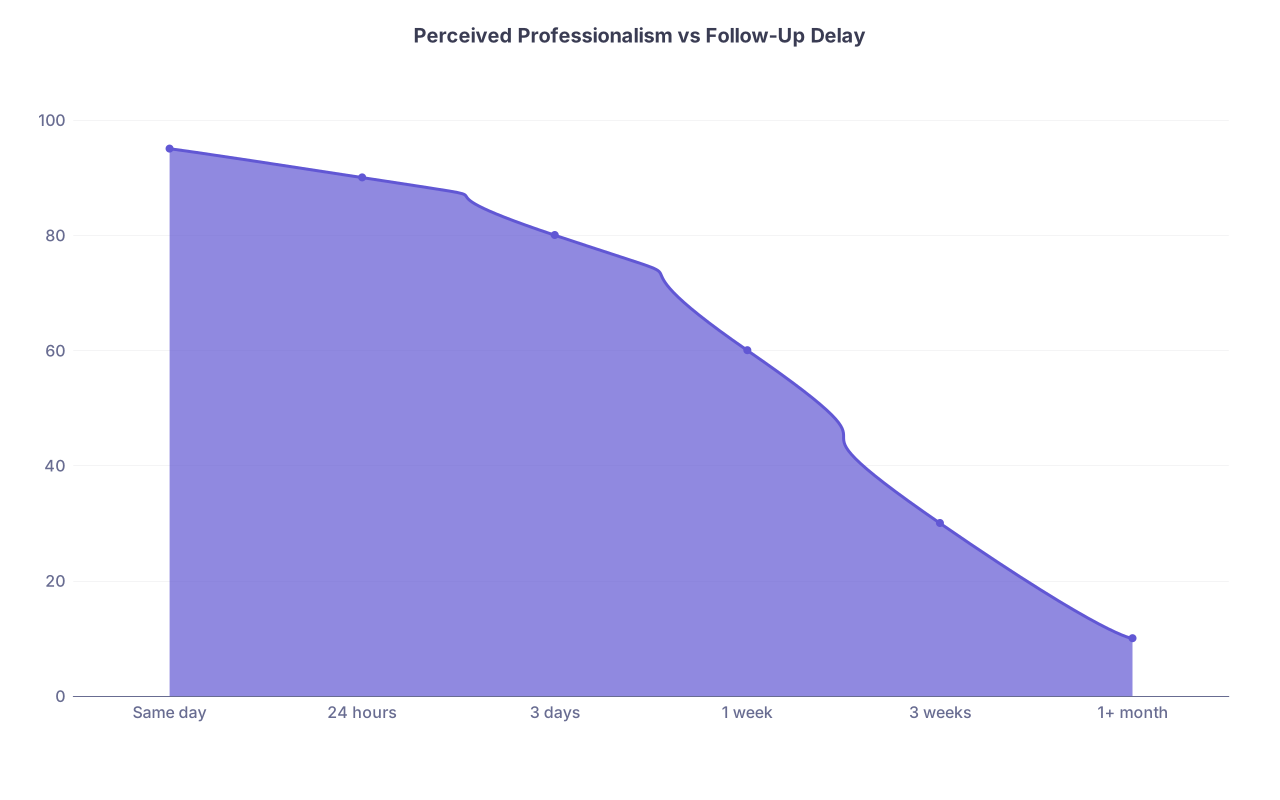
| Category | Value |
|---|---|
| Same day | 95 |
| 24 hours | 90 |
| 3 days | 80 |
| 1 week | 60 |
| 3 weeks | 30 |
| 1+ month | 10 |
Here is the pattern I see repeatedly:
- Same‑day or next‑day follow‑up: Seen as enthusiastic and competent.
- 3–7 days: Neutral to mildly disorganized.
2 weeks (without a clear reason): Viewed as uninterested or unreliable.
The quiet damage: you get mentally downgraded. People will not say it to your face. But they will not forward your name for that grant-funded project either.
How to avoid this mistake:
- Send a short thank‑you email within 24 hours of any meaningful interaction (conference talk, Zoom, shadowing, introduction).
- If you promised something (CV, manuscript, proposal), send at least a “received and working on this” acknowledgment within 24 hours, even if the full deliverable takes longer.
- If you actually did drop the ball and it has been weeks, do not pretend it did not happen. Own it concisely:
- “I apologize for the delay in following up; this fell off my radar, which is on me. If the opportunity is still open, I would still be very interested in contributing.”
Better to look human than flaky. Silence is what kills you.
Error #2: Sending the Generic, Forgettable “Thank You” Email
Medical networking is flooded with this masterpiece of uselessness:
Dear Dr. Smith,
Thank you for taking the time to speak with me. I really appreciated your insights.
Best,
[Name]
This email does almost nothing for you. No memory anchor. No specificity. No next step. Just more noise in an already ugly inbox.
I sat next to a program director once as she flipped through thank-you emails after a residency pre-interview dinner. She read three lines of the first, then said: “They all say the same thing; I just look at who actually follows through on what we talked about.”
She was not being cruel. She was being efficient. Your follow-up needs to give her a reason to remember you.
What you are doing wrong here:
- No reference to any specific conversation point
- No reminder of who you are in context (“MS3 from X school who asked you about Y”)
- No future-facing line (how this connection continues)
What to do instead:
Anchor the memory. Remind them who you are. Show that you listened.
For example:
Dear Dr. Smith,
Thank you again for speaking with me after your grand rounds on perioperative outcomes yesterday. I am the MS3 from UNC who asked about integrating frailty indices into pre-op risk discussions. Your comment about starting small with one high-yield metric really stuck with me.
I would be very interested in hearing more about your ongoing work with the quality improvement registry you mentioned, especially if there are any roles for a motivated student who can commit consistent time over the next 6–12 months.
Best regards,
[Name]
Specific. Anchored. Future-oriented.
Error #3: Following Up Only When You Need Something
This one kills long-term credibility.
You meet a surgical oncologist during a rotation. They help you get a poster. You vanish for a year. Then ERAS season hits and suddenly:
“Dear Dr. X, I hope you are doing well. I was wondering if you would be willing to write me a strong letter of recommendation…”
They remember you. Just not fondly.
Most faculty are not offended when you ask for help. They are offended when you only show up to ask for help. There is a difference.
The subtle damage here:
- You get classified as “transactional” rather than “collegial.”
- People will help once. They will not go out of their way for you again.
- When there are multiple students to support, you slide to the bottom of the list.
How to avoid this mistake:
You do not need to turn every contact into a monthly newsletter. That is annoying in the other direction. But you do need lightweight, ongoing touches.
What this looks like in medicine:
- Sending a quick update when a project you started with them is presented or published (“Wanted to share that our abstract got accepted to SCCM – thank you again for looping me in.”)
- Forwarding an article related to their work with a one-liner (“Saw this NEJM piece on perioperative risk; made me think of your talk about frailty scores.”)
- Dropping a short note once or twice a year: where you are now, what you are doing, how their advice played out.
You want them to think, “This person actually cares about the work and the relationship,” not “They remember me only when they need a letter.”
Error #4: Vague, Burdensome Asks That Require Too Much Work
Another classic networking sin: pushing the cognitive load onto the busy person you are trying to impress.
Examples I see constantly:
- “I’d love to work with you on research—do you have anything I can help with?”
- “Can we set up a time to chat about career advice?”
- “If you hear of any opportunities, please keep me in mind.”
These sound polite. They are not. They are lazy. They force the other person to:
- Figure out what you want
- Guess how serious you are
- Design a role for you out of thin air
So they do the easiest thing: nothing.
How to fix this: be specific and easy to help.
Give them a clear, constrained ask:
Instead of “any research,” say:
“I’m particularly interested in outcomes research in heart failure. If you have any ongoing database or chart review projects where an MS2 could help with data abstraction or figure creation, I would be grateful for the chance to contribute consistently over the next 6 months.”Instead of “career advice sometime,” say:
“Would you be open to a brief 15–20 minute conversation over Zoom in the next few weeks about early steps toward a career in academic cardiology? I would especially value your perspective on what to prioritize during MS3.”
Time-bounded. Topic-bounded. That tells them you have thought this through and you respect their schedule.
Error #5: Sloppy, Unprofessional Communication That Signals “Risk”
You can be brilliant, motivated, and kind—and lose someone’s interest in one careless email. I have watched attendings decide not to involve a student purely based on how they wrote.
The red flags:
- No subject line or something useless like “Hello”
- No context (“Following up from last week” – which week? Where did you meet?)
- Walls of text with no paragraph breaks
- Typos in the person’s name or title
- Sent from a weird personal email (dragonlord22@…) when you have a school email
In medicine, faculty are constantly filtering: “If I give this person work, will they create more problems for me?” Sloppy communication screams “more problems.”
Here is what a clean follow-up looks like structurally:
- Clear subject, including context
- Short reminder of where you met / spoke
- One or two clear sentences of purpose
- Specific ask (if any)
- Professional sign-off with your role and institution
Example:
Subject: Follow-up from ATS panel on pulmonary hypertension – MS3 from UAB
Dear Dr. Lee,
I enjoyed your comments during the ATS panel on managing advanced pulmonary hypertension this morning. I am the MS3 from UAB who asked about your approach to transitions of care.
I am developing an interest in pulmonary and critical care, particularly in longitudinal outcomes after ICU stays, and I wondered if you are currently involved in any projects in that area where a student could contribute. I can commit 5–8 hours a week over at least the next 6 months.
Thank you for your time and consideration.
Best regards,
[Name]
MS3, University of Alabama at Birmingham
Professional does not mean stiff. It means efficient and readable.
Error #6: Harassing Follow-Up vs. Professional Persistence
On the other side of the spectrum, there is the “Did you see this?” student. The one who emails, then emails again two days later, then messages on LinkedIn, then corners you after grand rounds.
I understand the anxiety behind it. You want certainty. You want an answer. But you are sending one very clear message: “I will be high-maintenance and difficult to manage.”
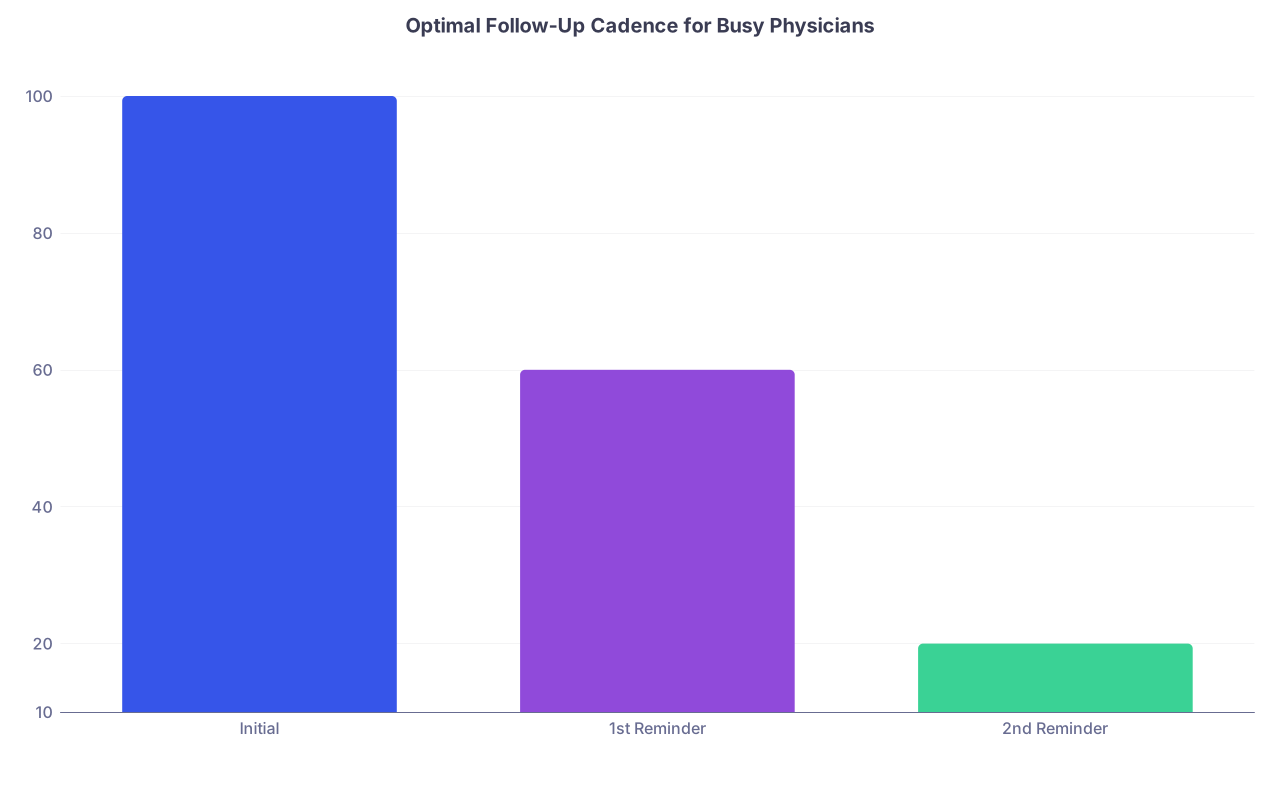
| Category | Value |
|---|---|
| Initial | 100 |
| 1st Reminder | 60 |
| 2nd Reminder | 20 |
A practical rule for medicine:
- Initial email
- One follow-up 7–10 days later if no response
- One final, very brief “closing the loop” message 2–3 weeks after that
Then you are done unless they reply later.
What to avoid:
- “Bumping this to the top of your inbox” every 2–3 days
- Multiple channels at once (text + email + social media) unless they specifically invited text communication
- Guilt-tripping language (“I was really hoping to hear back from you…”)
A better follow-up template:
First reminder (after 7–10 days):
Dear Dr. Patel,
I wanted to briefly follow up on my email from last week regarding potential involvement in your sepsis outcomes project. I know your schedule is extremely busy, so no rush at all, but I wanted to make sure my message did not get lost.
Best regards,
[Name]
Final message (2–3 weeks later):
Dear Dr. Patel,
I know your inbox is likely very full, so I will keep this brief. If you do not have capacity for additional student involvement in your projects right now, I completely understand and appreciate your time. If things change in the future, I would still be very interested, but I will not continue to email about this.
Best,
[Name]
This shows persistence without desperation. That balance is rare and respected.
Error #7: Failing to Track Your Contacts and Dropping Threads
People in medicine talk a lot about “networking” and almost never about the unglamorous part: tracking.
If you rely on your memory to keep track of:
- Who said “reach out next year”
- Who promised to introduce you to their collaborator at another institution
- Which attending told you to email in February about away rotations
—you will drop the ball. Not sometimes. Consistently.
Then what happens? You either:
- Never follow up at all (lost opportunity), or
- Follow up at the wrong time or with the wrong context (they do not remember you, or the window has closed)
Set up something simple. It does not need to be fancy.
| Column | Example Entry |
|---|---|
| Name | Dr. Karen Liu |
| Role | Pulm/CC Attending, Emory |
| Where We Met | ATS 2025 poster session |
| Topic Discussed | Post-ICU clinic outcomes research |
| Next Step | Email in August about joining data project |
| Follow-Up Date | 2025-08-10 |
You can do this in Excel, Notion, a Google Sheet, whatever. The tool is not the point. The system is.
Then, once a week, look at your list and ask:
- Who needs a short update?
- Whose promised deadline is coming up?
- Who did I say I would send something to?
This is the difference between “lucky connections” and an actual professional network.
Error #8: Not Preparing Before You Follow Up
Here is another quiet killer: you follow up, you get a positive reply, and then you are unprepared. You think the hard part was getting them to say “yes.” Wrong. The hard part is not wasting that “yes.”
Common unforced errors:
- You email a researcher about their work and have not actually read their latest paper
- You ask for a meeting and show up without questions or any idea what you want
- You say you are “very interested in their field” and then cannot name a single related topic
In medicine, your reputation spreads quickly. If you waste people’s time after they agree to help you, word travels. Future doors close that you never see.
Before you send a follow-up that might actually lead to a meeting or project, do the bare minimum (which is already more than many do):
- Read their most recent 1–2 publications (or at least skim intelligently)
- Look at their institutional profile and note specific interests
- Write down 3–5 concrete questions or areas you want guidance on
- Be ready to summarize your own experience and goals in 60 seconds
Think of it this way: the follow-up email is just the key. But you still have to walk through the door without tripping.
Error #9: Acting Entitled Because Someone Was Nice Once
This one is subtle but deadly. Some students interpret initial friendliness as an open debit card of time and opportunities.
Examples:
- Asking for multiple rounds of intensive feedback on personal statements from someone who barely knows you
- Expecting a letter of recommendation after one brief interaction
- Assuming they will introduce you to “famous Dr. X at your institution” without showing you can be trusted
I watched a fellow once say quietly after a student left her office, “I would have helped him, but he came in like it was my job to fix his application. It is not.”
You are not owed someone’s network, time, or reputation. When you forget that, your tone changes. People pick up on it almost instantly.
Safer mindset: treat every ask as a favor, not as a transaction. Show that you have done your homework and taken every step you can independently before involving them.
Instead of: “Can you tell me how to get into GI?”
Try: “I have been reading about different GI fellowship pathways and talking to a few residents. I am particularly curious about early research involvement during residency and how you approached that. Would you be willing to share how you structured that?”
Respect attracts help. Entitlement repels it.
Error #10: Not Playing the Long Game
The biggest networking follow-up mistake in medicine? Thinking this is about one attending, one project, one letter, one job.
It is not.
You are building a reputation that will follow you for decades. People move institutions. They sit on committees. They co-author with each other. They remember who:
- Responds when they say they will
- Shows up prepared
- Follows through without drama
- Does not disappear after they get something
A student who handled follow-up brilliantly as an MS2 is now a fellow. I have seen her name casually come up in conversations like: “She is solid. Very reliable. I would work with her again.” That reputation is worth more than any single CV line.
Networking in medicine is not a series of heroic one-off emails. It is a pattern of small, disciplined, respectful follow-ups over years.