
The belief that your medical professionalism lives only in the clinic is dangerously wrong.
In 2026, your social media presence is as visible to program directors, employers, credentialing committees, and patients as your CV. If you treat it like a private playground, you are handing people reasons not to trust you.
Let me walk you through the most common social media networking mistakes I keep seeing from medical students, residents, and early-career physicians—and how to stop sabotaging your professional image.
1. Treating “Professional Twitter/Instagram/LinkedIn” Like a Group Chat
The first major error: confusing “public” with “friends.”
You know the behavior:
- Posting subtweets about attendings or co-residents
- Complaining about specific rotations, programs, or services
- Venting about patients in vague but recognizable ways
- Joining pile-ons about controversial topics while listing “MS3 @ ___ Med” in your bio
You are not in a group chat. You are on a permanent, searchable, screenshot-able record.
A few specific traps:
“Protected” accounts are not actually safe
- Screenshots leak. People forward posts to PDs. I have seen this end in formal professionalism write-ups.
- Residents have lost leadership roles because something from a “locked” account made it to the wrong inbox.
“Views are my own” does nothing
That disclaimer in your bio? Worthless.- If you list your program and hospital, audiences will associate your comments with those institutions.
- PDs and employers absolutely judge you by what you say, regardless of that line.
Venting about your training environment in real time
- “Our ED is a disaster, no staff, unsafe ratios.”
- “Another day, another clueless attending making us stay 3 hours late.”
These read as professionalism problems to the people who might later write your letters or hire you.
How to avoid this mistake:
- Ask yourself: Would I be comfortable if this post was emailed to my PD, department chair, and hospital CEO with my name on it?
If the answer is anything less than “yes,” do not post it. - Create a real private space for venting: closed group chats with trusted friends, not public timelines.
- When in doubt, save it in your notes app, sleep on it, and see if you still think the world needs to hear it tomorrow.
2. Posting Anything That Even Looks Like a HIPAA Violation
You do not need to write a patient’s name to screw this up.
I have watched careers take serious hits from what the poster thought was a “harmless, de-identified story.” It was not.
Common ways people violate (or appear to violate) privacy:
- Posting about rare or newsworthy cases on the same day they occur
- Sharing age + diagnosis + city + specific circumstances
- “Funny” screenshots of patient messages or portal notes
- Photos in clinical areas where monitors, ID bands, or door signs are visible
- “Look at this crazy X-ray!” with unique findings and a timestamp in the background
Even if you technically scrub identifiers, it often does not matter. If a patient, family member, or journalist can reasonably identify the person, you have a problem. And your board, program, and hospital may not parse the legal nuance. They see “unprofessional and unsafe.”
You also look careless, which is a terrible look in medicine.
How to avoid this mistake:
- Do not post patient-related content on the same day as care. Wait weeks or months.
- Change non-clinically relevant details if you must tell a story (better: use composites).
- Never post from inside patient care areas—no badges, monitors, doors, or charts in frame.
- When in doubt, ask: Could this person recognize themselves or be recognized by others? If yes or maybe, delete.
3. Chasing Follower Counts Instead of Credibility
Another quiet career-killer: turning your professional identity into a clout project.
Common patterns:
- Posting oversimplified hot takes because they “perform well”
- Commenting on specialty decisions, salaries, or “lifestyle” in a way that’s entertaining but arrogant
- Jumping into every trending controversy, even far outside your expertise
- Selling yourself as a “medical expert” on topics where you have zero formal training
Here is what program directors and senior faculty see:
- Impulsivity
- Poor judgment
- Ego > humility
- A future colleague who might bring unwanted media attention to the department
I have heard variations of this in selection meetings:
“Good scores. Good letters. But the social media presence worries me. Too much drama. Not worth the risk.”
How to avoid this mistake:
- Decide your online “lane” and stay mostly within it: medical education, advocacy, health policy, specialty-specific content, etc.
- If you are still training, emphasize learning rather than “expertise.”
- Do not exaggerate credentials. If you are an MS2, you are not a “cardiology expert.”
- Be boringly accurate. Over time, serious people notice those who prioritize accuracy over virality.
4. Blurring the Line Between Personal and Professional in All the Wrong Ways
You are allowed to be human online. You are allowed to have a life.
The problem starts when that life becomes:
- High-volume partying content while you wear hospital IDs or branded gear
- Posts about heavy drinking / drug use that are easily linked to your real name
- Explicit content or sexualized posts on the same account where you discuss patients or post from the hospital
- Public drama about partners, coworkers, or friends that reads chaotic
Fair or not, medicine is conservative about perceived stability and judgment. A chief resident once told me, “I do not care if they party. I care if patients, nurses, and my boss can watch it in 4K on Instagram.”
How to avoid this mistake:
- Separate accounts:
- One clearly professional (name, credentials, institution).
- One private, locked, with no identifiable professional details.
- Turn off tagging or review tags manually before they appear publicly.
- Never mix hospital branding or white coats with content you would not show a mentor or PD.
If you are thinking, “They should not judge me for that,” I agree in theory. In reality, they do.
5. Being Sloppy With Conflicts of Interest and Sponsorships
The influencer economy has hit medicine. Companies offer:
- Free scrubs, stethoscopes, or gadgets
- Affiliate links and discount codes
- “Collabs” with wellness brands, supplements, or med-ed platforms
Here is where many trainees blow it:
- Promoting products without disclosing free items or payments
- Endorsing sketchy supplements or devices “as a doctor”
- Criticizing competitor institutions or services while quietly affiliated with a rival
- Giving medical “advice” tailored to a sponsored brand
This is a fast way to lose credibility with colleagues and signal to future employers that your judgment is for sale.
| Scenario | Why It Hurts You |
|---|---|
| Promoting free scrubs without disclosure | Signals dishonesty and lack of transparency |
| Advertising supplements as a med student | Overreaches your expertise; looks irresponsible |
| Trashing one EHR while consulting for another | Hidden bias; ethical red flag |
| Using “doctor recommended” for paid products | Undermines trust in your clinical judgment |
How to avoid this mistake:
- Disclose clearly: “I received this product for free” or “Sponsored.”
- Avoid endorsing anything health-related that conflicts with evidence-based practice.
- As a student or resident, be extra cautious. Many programs have strict policies about commercial relationships and name use.
- Remember that your license board may one day review those posts in a complaint file.
6. Arguing Like a Random Troll Instead of a Future Colleague
You can and should engage with difficult topics: racism in medicine, inequities, policy failures, specialty culture. Silence is not neutral.
The mistake is in how you show up:
- Personal attacks against named individuals or groups
- Dogpiles where you join in with insults just to belong
- Quote-tweeting colleagues to mock rather than engage
- Screenshots of private conversations shared publicly for points
Selection committees absolutely screen for this behavior. Nobody wants to deal with the resident who starts Twitter wars with attendings or specialty societies.
I have seen faculty withdraw mentoring offers based purely on how someone behaves during disagreements online.
How to avoid this mistake:
- Attack ideas, not people. “This policy is harmful because…” not “You’re a bad doctor.”
- Before posting, imagine reading those words aloud in a grand rounds room with your name on the slide.
- If something angers you, wait an hour. Then respond—if it still feels necessary—in measured language. Or not at all.
You do not need to “win” every argument. You do need to look like someone trustworthy in conflict.
7. Broadcasting Career Frustrations and Rejections in Real Time
Another quiet self-sabotage: oversharing your application process and disappointments.
Examples I have seen:
- “Just got my 10th rejection. This entire system is broken and biased.”
- “Program X treated us like garbage on interview day. Will definitely be ranking them last.”
- “I hate this specialty. Totally regretting my decision to apply here.”
You are allowed to feel all that. But when it is tied to your real name, people remember. And programs absolutely monitor what applicants say about them online.
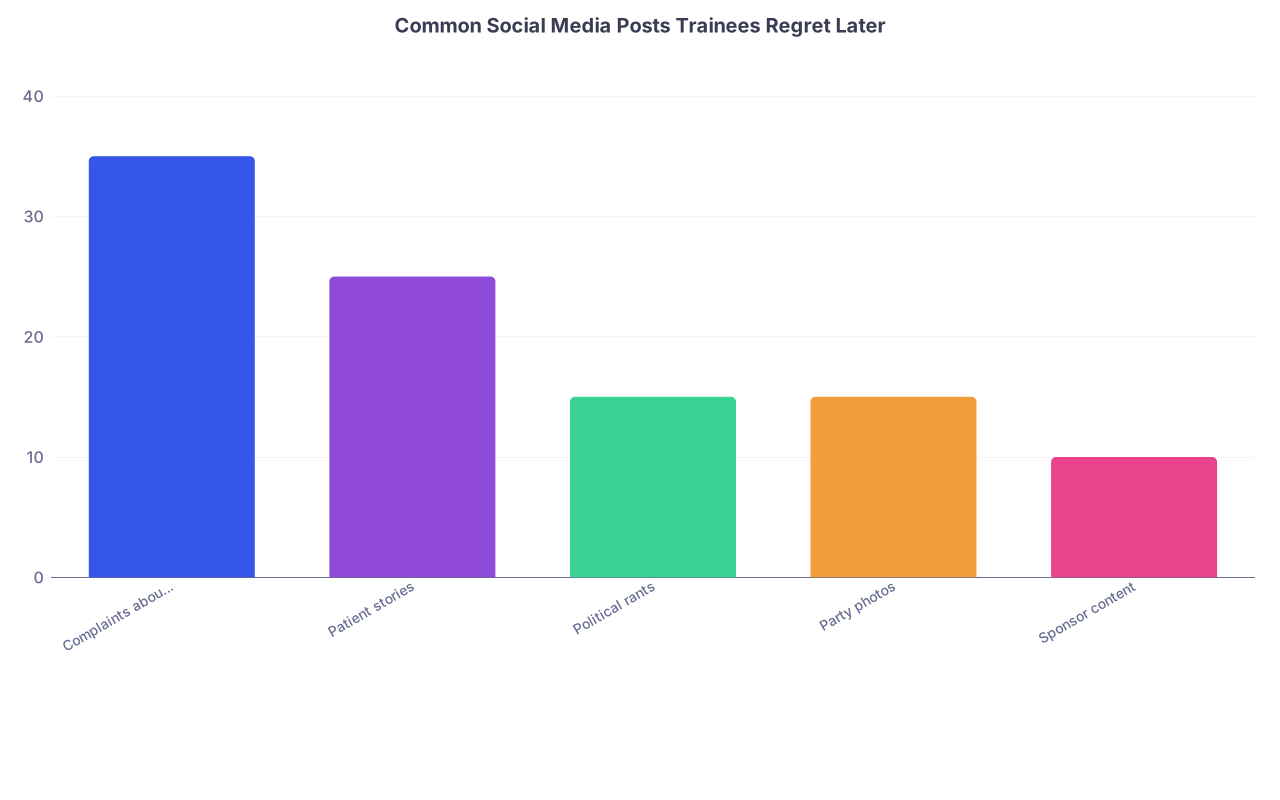
| Category | Value |
|---|---|
| Complaints about program | 35 |
| Patient stories | 25 |
| Political rants | 15 |
| Party photos | 15 |
| Sponsor content | 10 |
How to avoid this mistake:
- Keep real-time commentary about Match, fellowship, or job searches offline or anonymous.
- After the fact, if you want to share your story, do it thoughtfully: focus on lessons learned, not specific program bashing.
- Assume screenshots of your posts will circulate in group chats you will never see.
You can be honest without being reckless.
8. Confusing “Medical Advocacy” With Partisan Combat
Another minefield: politics.
Yes, medicine intersects with policy: reproductive rights, immigration, gun violence, public health, insurance, climate. These issues matter for patients.
The mistake is using your professional-branded account to:
- Hurl insults at entire voting blocs or parties
- Spread unverified claims or conspiracy-adjacent content
- Equate disagreeing with you politically to being a bad doctor
- Share content from fringe sources that crumble under scrutiny
What programs, employers, and boards see is not “passionate advocate.” They see “impulsive, polarizing, not careful with facts.”
How to avoid this mistake:
- Tie your advocacy explicitly to patient care and evidence: “Here is what I see in clinic; here is the data.”
- Fact-check everything, especially if it confirms your side strongly.
- Keep ad hominem attacks out of your feed. Strong positions do not require personal insults.
You can be unapologetically values-driven without turning your account into a partisan attack channel.
9. Networking Only Upward and Ignoring Real Relationships
This one is more subtle but professionally costly.
On social media, many trainees:
- Only reply to “big name” accounts
- Treat peers as audience, not colleagues
- Use networking as a one-way ask: “Can you read my PS? Can you introduce me?”
- Publicly flatter famous people in a way that reads as transparent ladder-climbing
Senior people notice this. So do your peers. It is not respected.
Real networking in medicine online looks different:
- Showing up consistently with thoughtful, useful contributions
- Supporting peers’ work—retweets, shares, thoughtful comments
- Having actual conversations in DMs that are not just asks
- Following up with gratitude when someone helps you, not disappearing

| Step | Description |
|---|---|
| Step 1 | Identify professional goals |
| Step 2 | Choose 1 to 2 platforms |
| Step 3 | Share useful content |
| Step 4 | Engage with peers |
| Step 5 | Engage with mentors |
| Step 6 | Move key connections to email or meetings |
| Step 7 | Maintain relationships over time |
Mistake to avoid: treating social media like a transactional vending machine where you deposit a like and expect a letter of recommendation.
Instead:
- Assume every person you engage with could one day be a coworker or supervisor.
- Invest in consistent, low-drama presence over performative “networking moments.”
10. Thinking Deletion = Erasure
The final, fatal myth: “If it ever becomes a problem, I will just delete it.”
No. You will not. At least not effectively.
Screenshots exist. Archive sites exist. People save receipts when drama happens.
I have personally watched someone delete an entire account after a bad thread, only to have every screenshot reposted by others. By then, faculty in their specialty had all seen it.
Operate with this rule:
If you would be horrified to see it on a slide during your promotion review or credentialing hearing, do not post it.
That sounds extreme. It is also realistic.
FAQ (Exactly 4 Questions)
1. Should I just avoid social media completely during training?
No, and that is another mistake. A thoughtful, low-drama presence can actually strengthen your professional image. You can:
- Follow specialty leaders and societies
- Share evidence-based resources
- Highlight your research or projects
- Connect with peers across institutions
The key is discipline. Post less than you think, and think more than you post.
2. Can I ever share patient stories for education or advocacy?
Yes, but extremely carefully. Options that minimize risk:
- Use composite cases (blend details from multiple patients)
- Change all nonessential details: age ranges, timing, location
- Avoid anything newsworthy or rare enough to be identifiable
If there is any chance the patient or family would recognize themselves and feel exposed, you are already in the danger zone.
3. How do programs or employers actually find my accounts?
They search your full name, common usernames, email handles, and cross-reference followers. Peers sometimes send screenshots. Faculty occasionally recognize your photo or voice. Do not assume that because you did not list the handle on ERAS, nobody will connect it to you.
4. Is it really that serious if I am “just” a med student or PGY-1?
Yes. Your digital footprint is cumulative. A bad pattern now becomes a narrative later: “They have had judgment issues for years.” Committees rarely see a single post; they see a trail. Start behaving like the future attending you aim to become, not the anonymous college student you used to be.
Key points to leave with you:
- Your social media is part of your professional record, whether you like it or not.
- Anything that smells like privacy violation, impulsive drama, or poor judgment will follow you longer than you expect.
- Use these platforms to build a reputation for integrity, thoughtfulness, and restraint—not as a place to prove you are edgy, clever, or always right.