
The way you network on interview day can quietly kill your ranking. Or vault you into the top 5. And most applicants have no idea what we’re actually watching.
I’ve sat in post‑interview meetings where two applicants with nearly identical scores and letters were separated on the rank list purely because of how they moved through the room. Not what they said in the 20-minute faculty interview. How they handled the unstructured parts: pre‑interview dinner, hallway chatter, conference room small talk, the awkward coffee line.
Let me walk you through what program directors, faculty, and residents are really noticing when you “network” on interview day — and how those tiny behaviors turn into actual rank list moves.
The First 15 Minutes: You’re Being Sorted
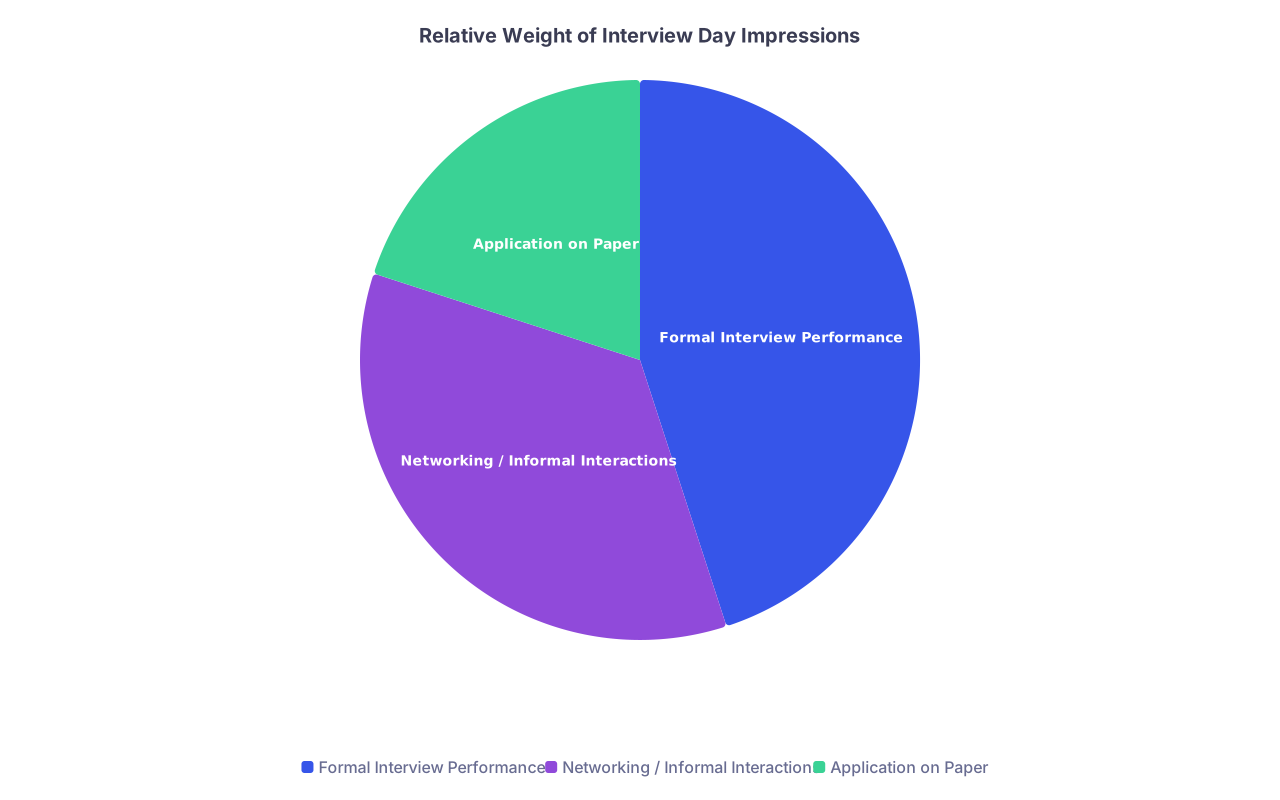
| Category | Value |
|---|---|
| Formal Interview Performance | 45 |
| Networking / Informal Interactions | 35 |
| Application on Paper | 20 |
The brutal truth: by the time you set foot in the building, your application has already done 80–90% of the filtering. Interview day is about deciding if they can tolerate working with you at 3:00 a.m. for the next 3–7 years.
Program directors and chiefs are doing a rapid triage in the first 15 minutes. They won’t say this on the tour, but the internal categories are basically:
- “Top of list unless they implode”
- “Solid, could work here”
- “Only if we need to fill spots”
- “No chance, do not rank”
Your behavior during informal networking is what moves you between those buckets.
Here’s what they’re noticing before you ever sit in a formal interview:
Who you gravitate toward.
If you instantly swarm the PD, chair, or “most important” person and ignore the residents and coordinators, that’s noted. The phrase I’ve heard more than once in the debrief: “Already politicking. Will be exhausting on service.”Whether you talk to people or just positions.
The resident who asks the coordinator how long their commute is? That gets you marked as a human being. The applicant who never learns anyone’s name unless they have “MD” on their badge? That’s a problem.How you enter a group.
Do you slide into a circle, make eye contact, say a simple “Hey, I’m Alex from Penn — mind if I join you?” Or do you physically wedge yourself between two people mid-conversation to get closer to a senior faculty member? The second one gets discussed later. I promise you.
Networking on interview day is not “schmoozing.” It’s an extended simulation of how you’ll function in a team when nobody is directly grading you.
The Residents Are Not Just “Being Nice” — They’re Scouting
Let me be explicit: at almost every program, residents have real influence on the rank list. Not symbolic. Real.
Some programs I’ve worked with literally start the rank discussion with the resident impressions spreadsheet. Others give residents an anonymous vote on “would you want to work with this person” that the PD takes very seriously.
So when you’re “networking” with residents over lunch or on the tour, here’s what they’re clocking.
1. How you treat them compared to attendings
The contrast is what kills people.
If you’re polished and deferential with faculty, then visibly disengaged with residents — looking over their shoulder, checking your phone, scanning for someone “more important” — they notice. And they tell us.
The exact phrases I’ve written down during debriefs:
- “Two-faced. Very different with PD than with us.”
- “Performative nice, not real.”
- “Already buttering up leadership, will throw juniors under the bus.”
One specific example: At a large IM program, an applicant spent five minutes at lunch charming the chair — asking thoughtful questions about research funding, nodding, laughing. Chair walks away. Applicant immediately turns to the interns at the table and says, “So, are you actually happy here? You can tell me the real story now that the boss is gone, right?”
Residents reported it almost word for word. That applicant slid 20+ spots down the rank list.
2. Whether you actually listen
Residents are not impressed by canned “What do you like most about this program?” questions asked for the fifth time that day. They’re listening for whether you respond to what they actually say.
If a senior resident says, “Our call schedule is front‑loaded but gets easier third year,” and your follow-up is “So, what is your call schedule like?” they realize you’re just working through your mental checklist.
When you’re networking with residents, they notice if you:
- Ask pointed, specific questions based on their answers
- Remember small details (e.g., “You mentioned you have kids — how do you manage childcare with call?”)
- Loop in quieter residents at the edge of the table
The applicant who pulled a shy PGY‑2 into the conversation — “You’re on nights, right? What’s that been like for you?” — got a universal “yes, absolutely work with” vote from our residents that year. Her Step score was not the highest. Her file was “fine.” She matched because people wanted to be on call with her.
3. Your subtle competitiveness
Residents can smell insecurity and competitiveness a mile away.
The networking behaviors that trigger red flags:
- Sliding your own scores, publications, or prior match results into conversation unprompted
- Gently undermining your classmates from the same med school (“Yeah, Brian and I both applied here — he’s more into procedures, I’m more research-oriented”)
- Fishing for how you compare to other applicants that day (“So… do you get a sense of how competitive this group is?”)
Residents go back to the PD and say, “High maintenance. Will need constant reassurance. May not share opportunities.” That doesn’t mean you’ll be unranked, but it can easily be the tiebreaker that pushes someone else above you.
What Program Directors Watch When You “Work the Room”
Program directors and faculty aren’t just listening to your words. They’re watching patterns across the entire day.
Your social stamina and consistency
Everyone can be “on” for 20 minutes in a closed-door interview. Networking shows us what happens in hour three, after your third hospital corridor tour and your fifth “So where are you from originally?”
We’re looking for consistency:
- Do you treat the last resident you meet with the same basic courtesy as the first?
- Are you still engaged by the afternoon, or are you mentally checked out and scrolling through your phone?
- Do you have the same personality with different people, or are you markedly different with leadership vs staff?
I remember one PD who turned to me after the pre‑interview dinner and said: “He’s great when he thinks someone important is listening. But when he thinks nobody important is around, he shuts off. I’m not rolling the dice on him at 2 a.m. in the ICU.”
That applicant’s formal interview went well. His letters were fantastic. He still ended up middle of the list because of that one observation.
How you handle awkwardness
Interview day is structured awkwardness. The people who rise are the ones who can tolerate it without making others uncomfortable.
We notice:
- The silence fillers. Do you rescue awkward pauses with simple, inclusive questions, or do you bury your face in your phone?
- Self-awareness. If you accidentally talk over someone, do you catch yourself and say “Sorry, go ahead”? Or plow through like you didn’t notice?
- Grace under small social stress. Coffee spills. Someone mispronounces your name. A resident starts venting more than they should. You’re being evaluated on how you keep the room comfortable.
One applicant at a West Coast program spilled coffee on her own folder as she sat down. She laughed, said, “Well, now you know what my intern year will look like,” grabbed some napkins, and kept going. PD literally wrote: “Graceful. Adaptable.” Small thing, big impression.
Whether you create or reduce friction
This is the hidden metric: Are you a friction multiplier or a friction reducer?
Networking is just the PD’s way of seeing whether you smooth group dynamics or subtly increase tension.
Friction creators:
- Dominate conversations and don’t notice others trying to speak
- Answer questions that weren’t directed at them because they “know the answer”
- Subtly compete with other applicants in front of residents (“Oh, my school does way more of that…”)
Friction reducers:
- Notice the quiet applicant in the corner and bring them in
- Use names after hearing them once or twice
- Share the spotlight when residents ask multi-person questions (“I had X experience, but I know Sam here did a sub‑I in that, too”)
I’ve seen PDs bump an applicant up ten spots because every single resident independently commented, “They just made the whole group feel more at ease.”
The People You Think Don’t Matter Actually Matter
Here’s the part applicants consistently underestimate: the “non-physicians” you interact with are often the loudest voices in the PD’s ear later.
The coordinator is watching everything
Your email tone with the coordinator before interview day. How you handle schedule changes. Whether you say thank you when they hand you a packet. Whether you make eye contact and use their name.
I’ve been in ranking meetings where the PD literally opened with: “Any red flags from [coordinator’s name]?” If the answer was yes, that applicant was effectively done.
Common mistakes that get mentioned:
- Arguing with them about interview times
- Being short or dismissive in person
- Ignoring them completely while falling over yourself to impress faculty
I know one applicant who was dropped off the rank list entirely because he snapped at the coordinator about parking validation, not knowing she was in the PD’s office almost daily.
Front desk, nurses, and support staff
Does every single staff interaction get reported? No. But extremes do.
The nurse who runs your tour and mentions that you didn’t hold the elevator for the group — that’s the kind of strangely specific thing that sticks. The security guard you brushed past without acknowledging while shaking hands with the PD behind them? It gets noticed.
There’s a quiet mental checklist: Would I trust this person to speak respectfully to my nursing staff? To my front desk? To the midnight radiology tech?
If you fail that test during networking, you will not hear about it. You’ll just slide.
Strategic Networking That Actually Helps You (Not Cringes You)
Let me be clear: you should network on interview day. Just not the way some of you think.
Here’s what program directors actually like seeing.
Genuine curiosity, not performance
We’re drawn to applicants who seem truly interested in this place, these people, this culture — not just “matching somewhere competitive.”
That looks like:
- Asking residents, “What type of applicant tends to thrive here? Who struggles?”
- Asking PDs, “What are you most proud of changing in this program in the last 3–5 years?”
- Following up when someone mentions a specific initiative or conference rather than jumping to the next generic question on your list
The person who clearly copy-pastes the same five questions at every program is easy to spot. And forget.
Targeted follow-up — used sparingly
Polite, specific follow-up can help you, but only when it’s done like a grown adult, not a desperate applicant.
Emailing the PD or a faculty member after a meaningful conversation that day — referencing something specific you talked about — that can move the needle a bit, especially in smaller programs.
What doesn’t help:
- Mass “Thank you for interviewing me” emails that read like a template
- Overly personal or boundary-crossing notes after one brief encounter
- Multiple emails fishing for feedback or reassurance
A PGY‑1 at one program I know jumped several rank spots because three different faculty independently mentioned, “That was the person who followed up about the curriculum project we talked about — I think they’ll actually get involved.”
Contrast that with the applicant who sent five separate “update” emails about new abstracts to the PD. People started avoiding their name in the inbox.
The Networking Behaviors That Quietly Tank You
No one will tell you these in real time. You’ll just not match at your “reach” programs and wonder why.
Here are the patterns that reliably hurt applicants:
Over‑networking with the PD
Yes, you should introduce yourself. Yes, you should engage in a normal conversation if the opportunity presents itself. But hovering is death.
When a PD is chatting casually with residents, and you insert yourself every single time, it reads as insecurity and lack of social radar. If you create a “barnacle” impression — always attached — that’s talked about later.
I’ve heard this line: “If he’s this needy on interview day, what’s he going to be like as an intern?”
Undermining other applicants
You think you’re being subtle. You’re not.
Sneaky comments like:
- “Oh, wow, you only applied to 15 programs? That’s… brave.”
- “You haven’t done any away rotations? Interesting.”
Residents watch this like hawks. Remember: by the time you’re networking with them, they’ve already worked with multiple classes of residents. They know exactly what this behavior predicts at 2 a.m. in the ED when things go wrong and someone’s looking to assign blame.
Being “on” the whole time
This one surprises people. If you’re relentlessly “switched on” — forced jokes, constant self-promotion, over‑the‑top enthusiasm — it reads as inauthentic and exhausting.
You’re allowed to be quiet for a few minutes. You’re allowed to listen more than you talk. You’re allowed to say, “Honestly, I’m a bit overwhelmed, but in a good way.”
We’re not hiring cruise directors. We’re hiring colleagues.
How Networking Actually Translates to the Rank List
Let’s get very explicit.
Most programs now blend objective and subjective scores in some version of a composite ranking before the final meeting.
| Domain | Source on Interview Day | Typical Weight Impact |
|---|---|---|
| Interpersonal/Team Fit | Resident & staff impressions | ±1–2 tiers |
| Professionalism | Coordinator & faculty | Can move to “Do Not Rank” |
| Genuine Interest in Program | Questions, follow-up | ±0.5–1 tier |
| Red Flags (Ego, Disrespect) | Anyone, especially residents | Trigger PD veto |
Then the real discussions start. This is where networking comes back up in very specific language:
- “She was the one who really clicked with the night float residents.”
- “I’d be happy to share a call room with him.”
- “Honestly, I got weird vibes — very transactional with residents, totally different with PD.”
Applicants with similar paper stats get sorted by those comments.
I’ve seen cases where:
- A slightly weaker candidate on paper jumped ahead of five “stronger” ones because every resident who met them put them in their top 3.
- An objectively outstanding candidate (research, scores, letters) was moved down to the mid‑list because of repeated comments about arrogance during dinner.
- One rude interaction with the coordinator led to a quiet “I don’t care what his Step score is, I’m not dealing with that for four years” from the PD.
Networking doesn’t overwrite your application. But it absolutely edits your final chapter.
A Simple Mental Model to Use on Interview Day
Here’s the framework I give my own mentees.
On interview day, assume:
- Every person with a name badge has a microphone to the PD
- Every room is a test of who you are at 3 a.m., not who you can pretend to be for 20 minutes
- Every interaction nudges you slightly up or down a tier — not huge swings, but enough to matter
Before you speak or “network,” ask:
“Does this make life easier or harder for the people around me?”
If the answer is “harder,” save it for your journal.