
Over-networking is one of the fastest ways to ruin your reputation in medicine.
Not a slow burn. Not “oh, people will understand I’m just enthusiastic.” If you cross the line, you become that student — the one faculty quietly warn each other about, the one residents roll their eyes over in the workroom.
Let me be blunt: networking is necessary in medicine. Over-networking is nuclear. The problem isn’t that you talk to people. The problem is how quickly people in this field notice — and punish — neediness, insincerity, and opportunism.
You’re here because you don’t want to be that person. Good. Let’s keep it that way.
The Hidden Cost of Being “Everywhere”
You’ve seen this person.
Rotations, conferences, grand rounds, department socials — they pop up at all of them. Always with an agenda. Always with an ask.
On the surface, it looks like hustle. Underneath, people are quietly backing away.
Here’s what over-networking actually costs you:
- Trust – People assume your interest is transactional, not genuine.
- Access – Ironically, the more you push, the fewer doors open.
- Opportunities – Mentors route real chances to the students who don’t chase them like oxygen.
- Reputation – Your name starts to come with a warning label.
The worst part? Most over-networkers don’t realize it’s happening. They think, “I’m just being proactive” while their name is getting torched in conversations they’ll never hear.
Clear Red Flags: Signs You’re Becoming “That Student”
If you read this section and feel uncomfortably seen, that’s not an attack. That’s your early warning system doing its job.
1. You Collect Contacts Like Pokémon
If your “networking” looks like hoarding names instead of building relationships, you’re on thin ice.
Common behaviors:
- You send LinkedIn/Email requests to every speaker after a single grand rounds.
- You ask for “a quick call to hear about your path” from people you’ve never actually interacted with in person.
- You keep a tally of “attendings I know” like it’s a score.
The mistake: You treat people as career points, not humans. Physicians have stunningly good radar for this. They live in a world where everyone wants something from them.
Fix it:
Only reach out when:
- You have a specific, non-Googleable question, and
- You’ve already engaged with their work in a meaningful way (read a paper, heard them speak, worked with them clinically).
If you can’t describe what you genuinely admire or are curious about in one sentence, don’t reach out yet.
2. You Ask for Letters From People Who Barely Know You
This is one of the ugliest forms of over-networking.
Scenario I’ve actually seen:
Student shadows an attending for one afternoon. Two weeks later: “Dr. Smith, I loved working with you. Would you feel comfortable writing me a strong letter of recommendation?”
That phrase “strong letter” in an email from someone you barely know? Massive red flag.
Why it backfires:
- Faculty talk. “So-and-so asked me for a letter after one clinic day” spreads.
- You signal that you don’t understand what meaningful mentorship or evaluation looks like.
- You corner people into either lying (writing a generic letter) or refusing (awkward).
Don’t make this mistake:
- No letters from someone who:
- Hasn’t directly supervised your work for a meaningful period (usually at least a full rotation, project, or sustained clinic time).
- Can’t describe specific examples of your performance.
If you’re unsure, ask this instead:
“Would you feel you know my work well enough to write a strong letter for X?”
And be ready to gracefully accept “I don’t think I know you well enough yet.” That answer is a gift, not a rejection.
3. Your Name Shows Up in Too Many Inboxes
Over-networkers underestimate how small each specialty really is.
Patterns I’ve seen:
- Same student emailing every subspecialist in a department.
- Multiple PIs in one research group getting almost identical “I’d love to be involved in your work” messages from the same person.
- Mass cold-emails to faculty at a conference, all with copy-paste intros.
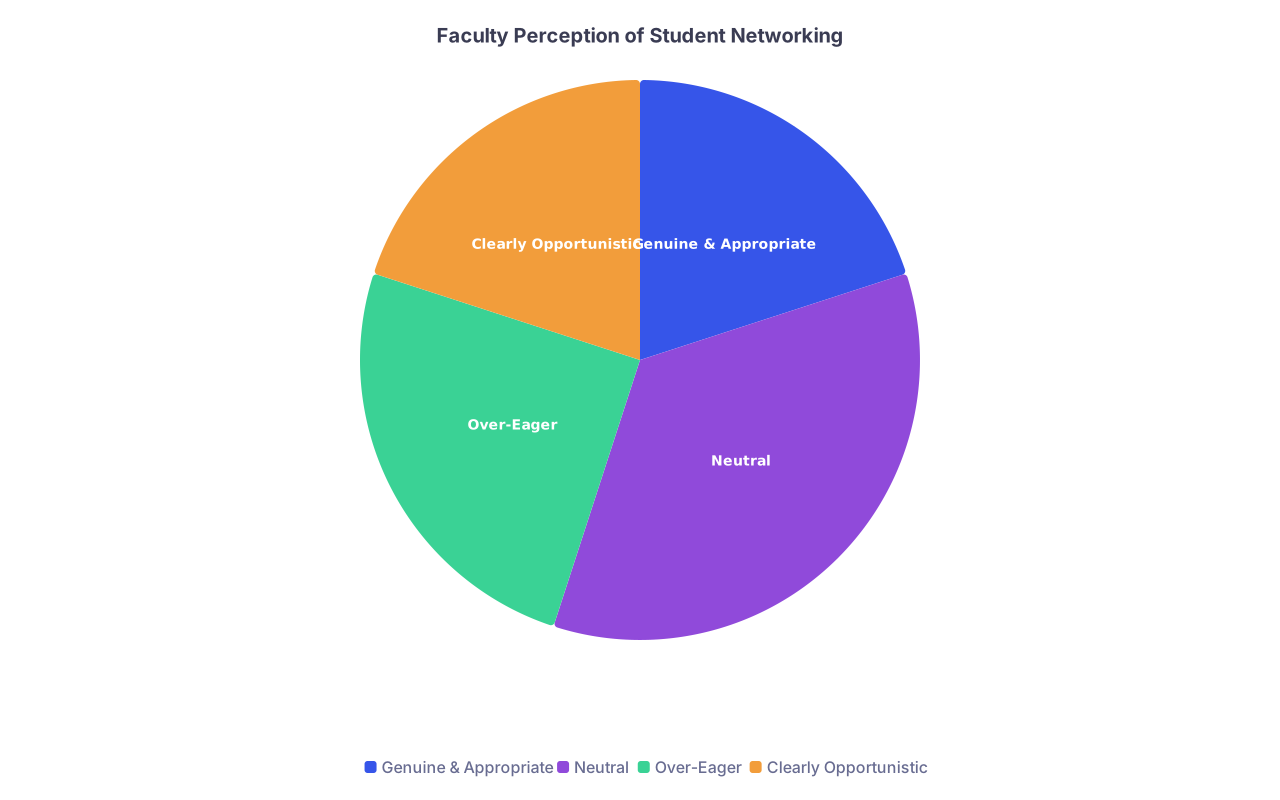
| Category | Value |
|---|---|
| Genuine & Appropriate | 20 |
| Neutral | 35 |
| Over-Eager | 25 |
| Clearly Opportunistic | 20 |
The big mistake: You’re treating a tight-knit department like a random LinkedIn search. Faculty compare notes. Residents gossip. Your messages are not living in isolated silos.
What they say in the workroom:
- “Did you get that same email from him?”
- “She emailed me last month saying I was her dream mentor. Funny, she said the same to Dr. X.”
- “Feels thirsty. Hard pass.”
Fix it:
- Do your homework. Pick 1–2 people per niche to contact, not all of them.
- Space out your outreach. Faculty in the same division should not be hearing your name for the first time in the same week from 3 different inboxes.
- Customize for real — specifics from their work, not just “I’m really interested in cardiology and your research seems fascinating.”
4. You “Network” Up and Ignore Everyone Sideways
Classic over-networker move: you’re laser-focused on impressing attendings and name-brand faculty while treating residents, fellows, and peers like background scenery.
That’s a mistake for three reasons:
- Residents often decide whether you get strong comments on evaluations.
- Fellows are closer to where you’re headed and can actually give you the playbook.
- Peers become your future colleagues, co-authors, and references.
People notice when you:
- Suddenly become warm and attentive when an attending walks into the room.
- Barely acknowledge the intern but turn on the charm for the PD.
- Only show up to events if “important people” are listed as speakers.
It screams: I only care about people who can advance me. That reputation is hard to shake.
Do this instead:
- Treat residents and peers as primary networking targets — because they are.
- Ask residents, “Whose mentorship has actually been helpful here?” before cold-emailing faculty.
- Be the student who’s reliably decent to everyone, not selectively nice based on title.
5. Every Conversation Feels Like a Pitch
If people walk away from talking to you and feel sold to, not spoken with, you’re in trouble.
Red flags:
- You steer every small talk moment into your resume: “Actually, that reminds me of my research in…”
- You keep mentioning your Step score, leadership roles, or publications in casual conversation.
- You drop names — “When I worked with Dr. Big Name…” — constantly.
I’ve watched this happen at pre-interview dinners, at rounds, in the OR lounge. It’s off-putting. And it makes you forgettable, because there’s nothing authentic to latch onto.
Pull back:
- Let people ask about your achievements; don’t cram them in.
- When they say “Tell me about yourself,” don’t recite your ERAS. Talk like a person.
- Practice one sentence about a highlight you’re proud of, then stop. Don’t turn it into a 5-minute monologue unless they push for more.
6. You Follow Up Too Much, Too Soon, With Too Many Asks
Follow-up is good. Harassment is not.
Here’s the pattern that gets you silently blacklisted:
- You email someone asking to meet.
- They say yes, you talk once.
- Within days, you:
- Ask for a project.
- Ask for a letter “in the future.”
- Ask to be introduced to someone else.
- Ask for advice on specialty choice, CV review, and program list.
Then, if they don’t respond quickly:
- You follow up every few days.
- You message on multiple platforms (email + LinkedIn + asking a resident to “remind them”).
You’ve turned one contact into a pressure campaign.
- One follow-up after 7–10 days if there’s been no response.
- If nothing after the second email? Drop it. They’re politely telling you no.
- Don’t stack asks. One concrete ask per interaction:
- “Could I help with any current projects?”
- Or “Do you have 15 minutes for advice on X?”
- Not every life problem you have this month.
7. You Show Up Physically But Contribute Nothing
Another subtle form of over-networking: being present at everything but useful at nothing.
You:
- Go to all the lab meetings… but don’t read the papers.
- Attend every optional teaching session… but never prepare cases.
- Show up on rounds early… but don’t look up your patients.
It becomes clear you’re there to be seen, not to do anything.
Faculty notice when:
- You hover around sign-out without offering to help.
- You attend conferences just long enough to shake hands, then disappear before the actual content.
- You come to research group meetings just to remind people you exist.
Correction:
Pick fewer things and actually commit.
| Behavior Type | Healthy Version | Over-Networked Version |
|---|---|---|
| Conferences | 1–2/year with real engagement | Every event possible, shallow presence |
| Research meetings | Ongoing project, active participation | Attending many groups, contributing little |
| Email outreach | Targeted, personalized, spaced out | Mass, generic, frequent |
| Mentors | 1–3 strong relationships | 8–10 “mentors” with no real depth |
Depth beats volume. Always.
8. You Brand Yourself Before You’ve Done the Work
Medical students love prematurely declaring an identity:
- “I’m a future neurosurgeon.”
- “I’m really passionate about cardiology outcomes research.”
- “My thing is global surgery.”
Sometimes that’s true. Often it’s branding without substance.
The problem isn’t having interests. The problem is marketing yourself hard as something your record doesn’t support yet. Faculty see the mismatch immediately.
What it looks like:
- Your email signature lists five roles, two of which are basically aspirational.
- Your personal website talks like you’re an expert in a field you’ve barely touched.
- You introduce yourself as “a big AI-in-medicine person” with no concrete involvement beyond a single course.
People in that field will test you with simple questions. If you crumble, they mentally file you under “inflated self-presentation.”
Better approach: Use language that shows interest, not false accomplishment:
- “I’m exploring neurosurgery and really enjoying it so far.”
- “I’m starting to get involved in cardiology outcomes research.”
- “I’m interested in global surgery and looking for ways to build real experience.”
Ambition is respected. Pretending you’re already there is not.
The Emotional Traps Driving Over-Networking
You’re not doing this because you’re evil. You’re doing it because you’re scared.
Here’s what usually sits under the behavior:
- Fear of being left behind – “Everyone else has a mentor/research/connection. I’m late. I have to catch up.”
- Comparing yourself to social media – Seeing classmates’ posts about conferences, papers, “amazing mentors” and thinking networking volume equals success.
- Panic about competitive specialties – So you overcorrect by trying to be on every radar at once.
- Confusing visibility with value – You think being seen is the same as being respected.
The ugly truth: over-networking is anxiety in disguise. People can smell it.
Instead of chasing more people, fix the underlying problem:
- Build skill.
- Show up prepared.
- Be reliable.
- Do good work where you already are.
Mentors are drawn to competence and consistency, not hyperactivity.
What Healthy Networking Actually Looks Like
Let’s be concrete. Healthy networking isn’t mysterious. It’s just quieter and more sustainable than the frantic version Instagram sells you.

| Step | Description |
|---|---|
| Step 1 | Show up and do good work |
| Step 2 | Identify 1-2 people you genuinely respect |
| Step 3 | Ask a focused, specific question |
| Step 4 | Follow through on any advice or opportunity |
| Step 5 | Update them once with results |
| Step 6 | Let the relationship grow naturally |
Healthy networking patterns:
- You have a small number of real mentors who actually know you, not a huge list of “connections.”
- You reach out with purpose: “I read your paper on X and had a question about Y.”
- You follow through. If someone gives you an article, you actually read it and send one short thought.
- You respect silence. If they don’t reply, you don’t chase them around the institution.
What faculty quietly love:
- Students who are low-maintenance, high-reliability.
- Students who make their lives easier, not more cluttered.
- Students who aren’t constantly selling themselves but whose work speaks loud enough that others ask about them.
A Simple Self-Check: Are You Over-Networking?
Ask yourself these questions. Answer honestly. No one’s grading you but your future career.
How many mentors do you claim?
More than 3–4 “primary” mentors? You probably have a list, not relationships.How often are you emailing faculty you don’t work with?
Weekly? Too much. Monthly and targeted? Probably fine.If every email you’ve sent in the last month were printed and shown to your PD, would you be proud — or deeply uncomfortable?
If the second, you already know the answer.Do you feel calm or anxious when you think about networking?
If it feels like a desperate race, you’re heading toward overkill.
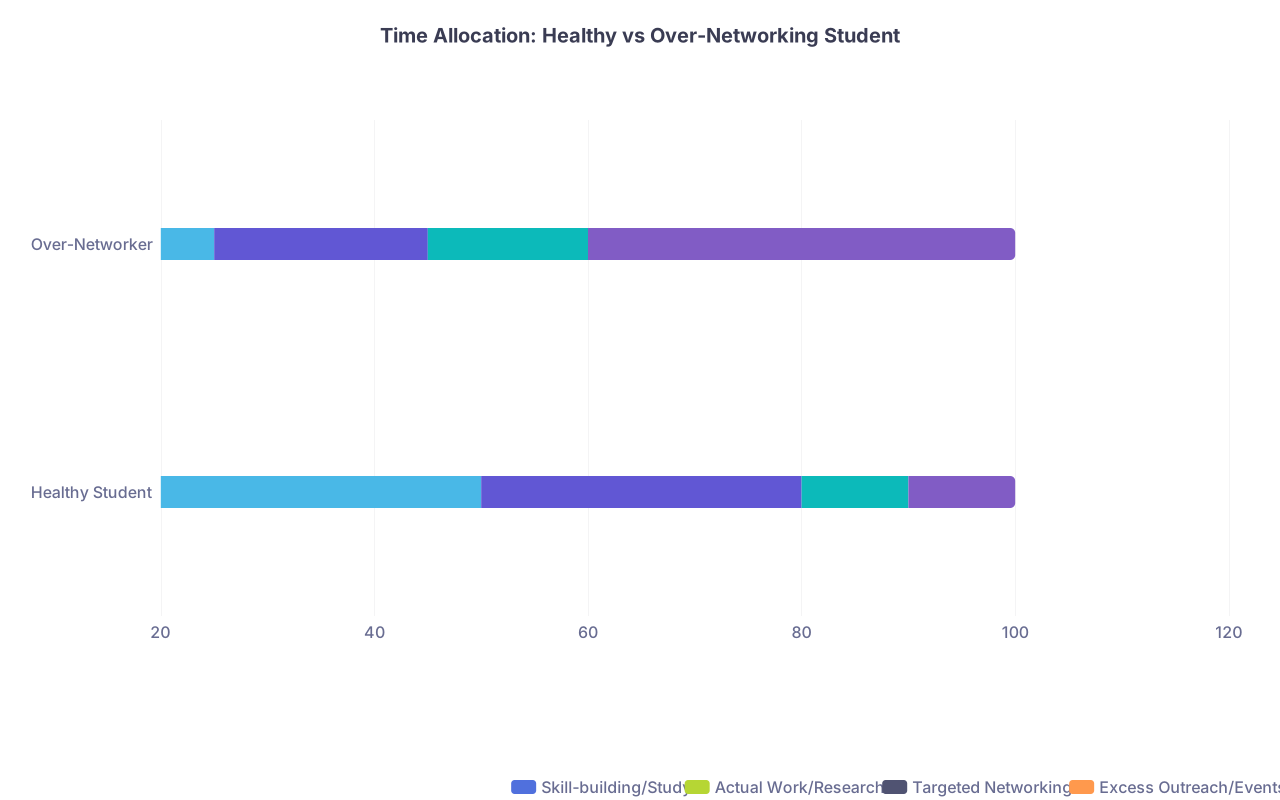
| Category | Skill-building/Study | Actual Work/Research | Targeted Networking | Excess Outreach/Events |
|---|---|---|---|---|
| Healthy Student | 50 | 30 | 10 | 10 |
| Over-Networker | 25 | 20 | 15 | 40 |
If your schedule looks like the right bar more than the left, scale back.
How to Course-Correct If You’ve Already Crossed the Line
Good news: most of the time, you can recover. But you need to stop digging.
Hit pause for 4–6 weeks
- No new cold emails to faculty.
- No asking for new letters or opportunities.
- Stay in your existing lanes (current projects, current teams).
Over-deliver where you already are
- Be the student who turns things in early.
- Read on your patients and present better.
- Make your current mentors glad they know you.
Quietly repair soft damage
- If you pushed someone too early for a letter or project, back off gracefully:
“I realized I may have rushed that ask. I’d love to keep learning from you and let things develop more naturally.”
- Then actually stop asking for more for a while.
- If you pushed someone too early for a letter or project, back off gracefully:
Refocus on skills, not access
- Pick one area: clinical performance, research methods, writing, presentations.
- Spend more time getting good and less time trying to be seen as good.
Set simple rules for yourself
- No more than 1–2 new outreach emails per month.
- No emails after 10 PM that are clearly panic-driven.
- Before any ask, answer: “Do I bring enough value and context to justify this yet?”
You’re not trying to disappear. You’re trying to become the student whose work speaks quietly but clearly enough that people lean in.
FAQ (Read These Before You Send Another Email)
1. How do I know if it’s “too early” to ask someone to be a mentor?
If you can’t answer these two questions clearly, it’s too early:
- What specifically do I hope to learn or gain from this person (not just “mentorship”)?
- What have I already shown them about my work ethic, reliability, or interests?
If all you’ve done is attend one session or say hi after a talk, they’re not your mentor. They’re a contact at best. Work with them first, then label things later.
2. Is it bad to cold-email faculty I’ve never met?
No — done correctly, it’s fine. The mistake is volume and vagueness. One targeted, thoughtful email to someone whose work you truly understand is normal. Ten generic emails to everyone filtered by “cardiology” on the website is spam. Aim for:
- Specific subject line (e.g., “MS2 interested in your AFib outcomes work”).
- One short paragraph about what you read of theirs.
- One clear, modest ask (e.g., “Is there a way I could get involved in X-type work in your group?”).
Then accept silence as an answer after one follow-up.
3. How many mentors should I actually have as a med student?
You don’t need a “board of advisors.” You need:
- 1–2 people in your potential specialty (or area of interest).
- 1 general career advisor (could be an APD, student affairs dean, or trusted faculty). That’s it. Everyone else is a connection, collaborator, or supervisor. Don’t inflate every interaction into mentorship. It looks needy and naive.
4. What if I’m at a disadvantage (no connections, non-traditional, IMG) — shouldn’t I network harder?
You should network smarter, not louder. You’re right that you may need to be more proactive. But the same rules apply:
- Overexposure without substance makes you forgettable or annoying.
- A few strong champions beat dozens of weak “contacts.”
- People who feel you’re over-pursuing them are less likely to go out on a limb for you.
Your best strategy if you’re starting from behind:
- Do excellent work wherever someone actually gives you a chance.
- Stay in touch with those few people with brief, meaningful updates.
- Add new relationships slowly, anchored in real collaboration, not just conversation.
Open your sent email folder from the last 60 days. Pick 10 messages to faculty or residents. For each one, ask: Did this build a real relationship or just try to get me something? If over half fall into the second category, it’s time to stop broadcasting and start actually building.